SF6-free switchgear is no longer a niche product line, but the label is used loosely. Vacuum interrupters, clean-air insulation, solid-dielectric encapsulation and fluoronitrile gas mixtures are all marketed as alternatives, and only three of those four are actually free of fluorinated greenhouse gases. If you are specifying equipment against an F-Gas phase-out date, that distinction decides whether your purchase is compliant.
This guide sets out what each SF6-free technology actually is, where it performs well, where it still loses to the conventional high voltage SF6 circuit breaker on footprint and cost, and how to choose between them at 12 kV, 24 kV, 52 kV and above. The practical target is simple: reduce or eliminate fluorinated gas where the technology genuinely supports it, and specify the lowest-inventory conventional design where it does not.
What “SF6-Free” Actually Means
Regulators use a gas-based test, not a marketing one. Under the EU F-Gas framework, the restriction applies to switchgear using fluorinated greenhouse gases with a global warming potential of 1 or more. That threshold excludes every fluorinated gas in commercial use, including the fluoronitrile mixtures with GWP in the 300 to 700 range that were introduced as “low GWP” substitutes. A product is only phase-out proof if its insulation medium contains no fluorine at all.
That leaves three genuinely compliant families in mainstream use, plus one adjacent technology that is compliant but not a like-for-like replacement:
Vacuum interruption with air or solid insulation. The interrupter is a vacuum bottle; the external insulation is air, dry air, epoxy or solid shielding.
Clean air or dry air insulation. Compressed synthetic air at a few bar replaces SF6 as the dielectric, usually combined with vacuum interruption.
Fluoronitrile mixtures (g3-type). Lower GWP than SF6 by a factor of roughly 30 to 70, but still fluorinated and therefore still caught by a GWP-of-1 threshold.
The engineering consequence of removing SF6 is almost always volume. SF6 provides roughly three times the dielectric strength of air at the same pressure, so an air-insulated design needs either higher pressure, greater clearance or both. Every SF6-free technology is, at bottom, a different answer to the question of where to put that extra distance.
Vacuum Interruption: The Mature Path
Vacuum has been the default interruption medium below 40.5 kV for decades, and for good reason. A vacuum interrupter draws a very short arc that extinguishes at current zero with minimal energy release, contacts are sealed for life, and there is no gas to monitor, top up or recover. The technology is well characterised by IEC 62271-100, mechanical life is long, and the cost per bay is competitive.
The limitation is dielectric, not interruption. A vacuum gap recovers strength extremely fast, but the open contact gap cannot hold off very high voltage across a long distance, and the external insulation still has to be provided by air, gas or solid material. That is why vacuum breakers dominate at 12 kV and 24 kV, remain common at 36 kV and 40.5 kV, and become unusual above 72.5 kV outside of specialised enclosed designs.
For a direct technology comparison at medium voltage, our earlier analysis of SF6 versus vacuum circuit breakers covers the duty-cycle and cost trade-offs in more detail. The short version: below 40.5 kV, vacuum is usually the better engineering answer regardless of regulation, and the phase-out has simply removed the inertia that kept SF6 in some specifications.
Clean Air and Dry Air Insulation
Clean air switchgear replaces SF6 with compressed synthetic air, typically at 2 to 7 bar depending on voltage, and pairs it with vacuum interruption. The gas is not a greenhouse gas, requires no F-Gas certification, needs no recovery at end of life, and can be vented to atmosphere during maintenance. For asset owners with reporting obligations, those four properties eliminate an entire compliance workload.
The penalty is physical. Air at 5 bar has perhaps a fifth of the dielectric strength of SF6 at the same pressure, so compartments grow, tanks get thicker, and the switchgear footprint increases — often by 20 to 40% for the same ratings in a GIS-style enclosure. Pressure vessels also introduce their own inspection regime. Below 24 kV in compact secondary distribution, the footprint penalty is manageable and clean air is now a mainstream choice. At 52 kV it is feasible in enclosed designs. Above 126 kV, clean-air switchgear exists as prototype or limited-series equipment rather than a standard catalogue product.
Dry air has a further practical advantage in cold climates: the liquefaction temperature is far lower than SF6, so there is no need for heater blankets or density derating at −40 °C. Projects in northern China, Central Asia and Canada increasingly cite this as a deciding factor.
Fluoronitrile Mixtures: Lower GWP, Still Fluorinated
The g3-type mixtures — fluoronitrile combined with a buffer gas such as CO2 or dry air — were designed as a transitional answer. They carry roughly 30 to 70 times less warming potential than SF6, work at similar pressures, and can be used in equipment whose dimensions are close to the SF6 original. For a utility replacing an ageing GIS in a constrained building, that is a real advantage.
They are not, however, a solution to a phase-out. Their GWP remains in the hundreds, which fails a GWP-of-1 test, and they are still fluorinated gases subject to certification, leak checking, recovery and reporting. Several suppliers market these products as “SF6-free” or “eco-efficient”, which is misleading in a procurement context. Ask for the composition and the GWP figure in writing, and check it against the regulation you are actually being measured on. The wider compliance picture is set out in our guide to SF6 emissions and F-Gas regulation.
Comparing the Technologies Side by Side
The table below summarises the four families on the criteria that actually drive a specification decision. Cost indices are relative to an SF6 unit of the same rating and should be read as order-of-magnitude rather than quotation figures.
Technology
Interruption
Insulation
GWP
Practical voltage range
Footprint vs SF6
Cost index
Vacuum + air / solid
Vacuum bottle
Air, epoxy, solid shield
0
12 – 40.5 kV, some 72.5 kV
1.0 – 1.3×
0.8 – 1.0
Vacuum + clean air
Vacuum bottle
Compressed synthetic air
0
12 – 52 kV, limited 126 kV
1.2 – 1.4×
1.1 – 1.4
Solid dielectric
Vacuum bottle
Cast epoxy / silicone
0
12 – 24 kV (RMU, compact)
0.7 – 0.9×
0.9 – 1.1
Fluoronitrile mixture
Self-blast gas
Fluoronitrile + buffer gas
300 – 700
12 – 145 kV
0.95 – 1.1×
1.2 – 1.6
SF6 (reference)
Self-blast / puffer gas
SF6
23,500
12 – 800 kV
1.0×
1.0
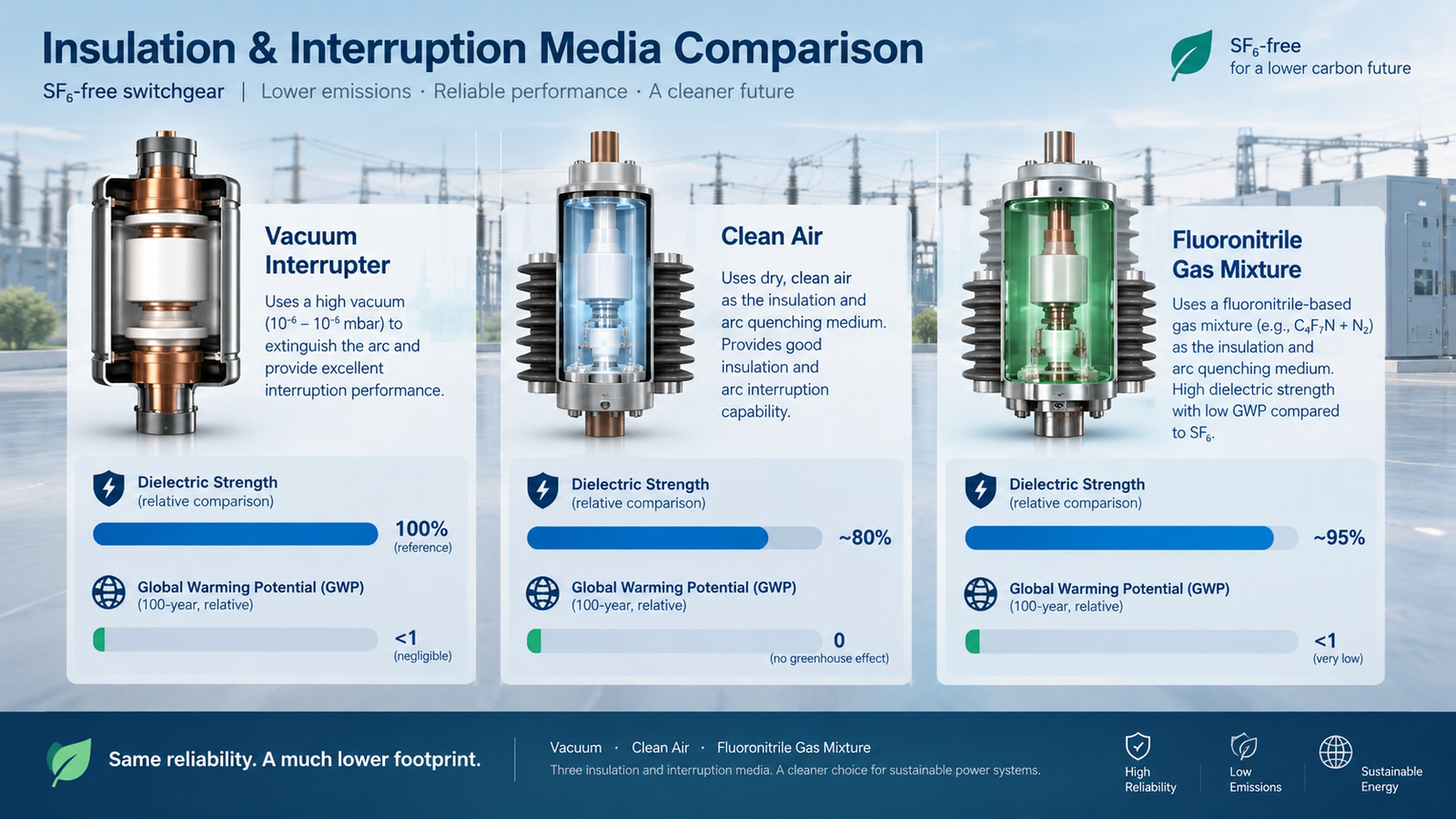
Vacuum, clean air and fluoronitrile media compared on GWP and dielectric strength.
What Works at Each Voltage Class
Voltage class, not marketing preference, should drive the decision. The table below maps the realistic options at each level.
Voltage class
Realistic SF6-free option
Verdict
12 kV
Vacuum + air, solid-dielectric RMU, clean air
Fully displaced. No technical reason to specify SF6 in new equipment.
24 kV
Vacuum + air, clean air, solid-dielectric
Displaced for new installations. Retrofit into existing SF6 panels is the main exception.
36 – 40.5 kV
Vacuum + air (indoor), clean air (enclosed)
Viable and increasingly common. Footprint penalty of 20 to 30% is the main objection.
52 – 72.5 kV
Vacuum + clean air in enclosed switchgear
Technically proven but heavier and costlier. Outdoor live-tank SF6 remains more economic.
126 kV
Limited clean-air or vacuum hybrid designs
Not yet a general-purpose substitute for outdoor transmission breakers.
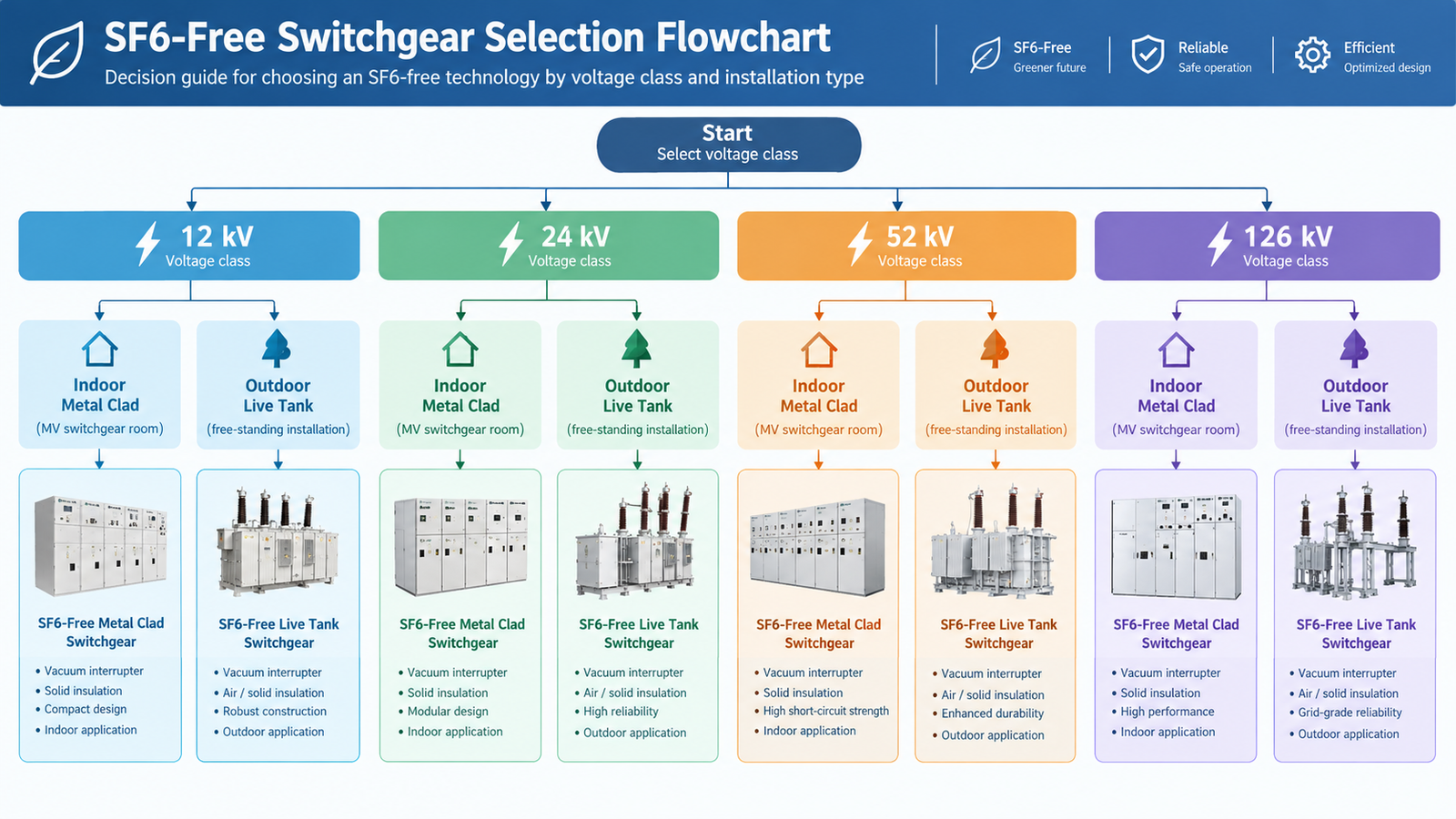
Selecting an SF6-free technology by voltage class and installation type.
The 52 kV to 145 kV Gap, and What to Do About It
This is where procurement decisions get difficult. A distribution utility in Europe can specify SF6-free equipment across its entire medium-voltage network today. A transmission utility buying 126 kV outdoor breakers for a substation in Southeast Asia cannot, and will not be able to for several years. Between 52 kV and 145 kV, the honest position is that SF6-free options exist but are heavier, larger and more expensive for equivalent ratings, and their availability depends on the specific enclosure type. The full ladder from 12 kV to 800 kV is mapped in our guide to SF6 circuit breaker voltage classes.
Three practical strategies work in that band.
Minimise the number of gas-filled units. Specify the highest current rating each bay can justify so that fewer bays carry the same power. A 3150 A continuous rating at 126 kV, for example, can serve duties that would otherwise need two lower-rated circuits, which halves both the capital cost and the gas inventory. A unit such as the LW36-126 for 52 Hz power distribution is representative of that mainstream specification, and the 52 Hz variant matters for networks that do not run at exactly 50 Hz.
Specify tight gas containment. Where SF6 is unavoidable, leak rate becomes the compliance lever. Sealed-for-life designs with a documented annual loss below 0.1% reduce the emissions profile of an SF6 installation by an order of magnitude compared with older equipment, and that is often enough to satisfy a lender’s environmental review. Designs built around a defined filling pressure, such as a 0.5 MPa rated gas pressure, are engineered to hold that pressure across the service interval rather than requiring periodic top-up.
Plan the replacement cycle, not the purchase. A 126 kV breaker bought in 2026 will still be in service in 2056. The specification should therefore require documentation that supports future reporting, and a supplier that can still supply spares and gas recovery services in twenty years. Where a project includes both medium and high voltage, splitting the strategy is entirely rational: SF6-free at 24 kV, low-leak SF6 at 126 kV, and a written roadmap for what happens to the high-voltage fleet at mid-life.
Retrofit or Replace?
Existing SF6 switchgear does not have to be replaced to be compliant. The phase-out targets new equipment placed on the market, so the installed base can continue in service, be maintained and be refilled. The decision to replace should be driven by condition and economics, not by the calendar alone.
Replacement usually wins when the existing unit is at end of mechanical life, when spares are unavailable, when leak rate has drifted above 1% per year, or when the switchboard is being rebuilt anyway for protection upgrades. Retrofit of just the interrupter or the gas compartment rarely makes sense economically because the busbar, earthing and interlocking arrangements usually need to change as well. In compact indoor substations, the footprint difference between an SF6 panel and a clean-air panel is the single largest hidden cost of replacement, and it should be assessed before the technology choice is fixed.
Procurement Checklist for SF6-Free Switchgear
Confirm the insulation medium contains no fluorine, and get the composition in writing.
Record the GWP of every gas in the equipment, including any buffer gas mixture.
Check the target market’s phase-out date against the voltage class, not against the product name.
Compare footprint and civil works cost, not just equipment price.
Confirm the pressure vessel inspection regime if compressed air is used.
Ask for the liquefaction and operating temperature range if the site is cold.
Verify that end-of-life venting is permitted without recovery, which is the main maintenance saving.
Require a written statement of type-test standards and certification for the SF6-free design.
Conclusion
SF6-free switchgear is a settled answer at distribution voltages and an emerging one above 52 kV. The decision framework is not complicated: below 40.5 kV, specify vacuum with air, clean air or solid insulation and treat SF6 as obsolete for new equipment; between 52 kV and 145 kV, compare clean-air enclosures against low-leak SF6 on total cost and footprint, and expect SF6 to win outdoors; above 252 kV, plan for SF6 containment and recovery rather than substitution. The one thing to avoid is accepting a fluoronitrile product described as SF6-free without checking its GWP against the regulation you are measured on.
If you are comparing SF6-free options against conventional high-voltage equipment for a specific project, send us the voltage class, breaking capacity and site conditions. Our engineering team can put the two configurations side by side, including gas inventory, footprint and documentation for environmental review. Start from the high voltage SF6 circuit breaker range for the conventional baseline, or ask us directly about the SF6-free alternatives available at your voltage.
FAQ
Is clean air switchgear truly SF6-free?
Yes, when the insulation medium is synthetic air or dry air and the interrupter is a vacuum bottle. There is no fluorinated gas in the equipment, so no F-Gas certification, leak checking or recovery obligation applies.
Is g3 or fluoronitrile switchgear SF6-free?
No. It contains no SF6, but it does contain a fluorinated gas with a GWP typically between 300 and 700. That fails a GWP-of-1 phase-out threshold and remains subject to F-Gas handling and reporting rules.
At what voltage does SF6-free switchgear stop being practical?
Around 72.5 kV outdoors. Clean-air and vacuum hybrid designs exist at 126 kV in enclosed configurations, but for outdoor transmission breakers at 126 kV and above, SF6 remains the practical choice for general duty.
Can I replace SF6 in existing switchgear with clean air?
Generally no. Clean-air designs operate at different pressures and require larger clearances, so the compartment, busbar and insulation geometry all change. Replacement is normally a new switchboard rather than a gas swap.
Does SF6-free switchgear cost more?
At 12 kV and 24 kV, vacuum and solid-dielectric designs are typically at or below SF6 cost. At 52 kV and above, clean-air designs carry a premium of roughly 10 to 40%, partly offset by lower lifetime compliance and gas-handling costs.
Do I still need F-Gas certification for SF6-free equipment?
No, provided no fluorinated gas is present anywhere in the equipment. Personnel certification, leak checks and recovery obligations attach to the gas, so a fluorine-free design removes them entirely.
Why a breaker rated 40 kA may still restrike on 50 A: the four capacitive duties, preferred current values by voltage class, C1 vs C2 tests and what to check.