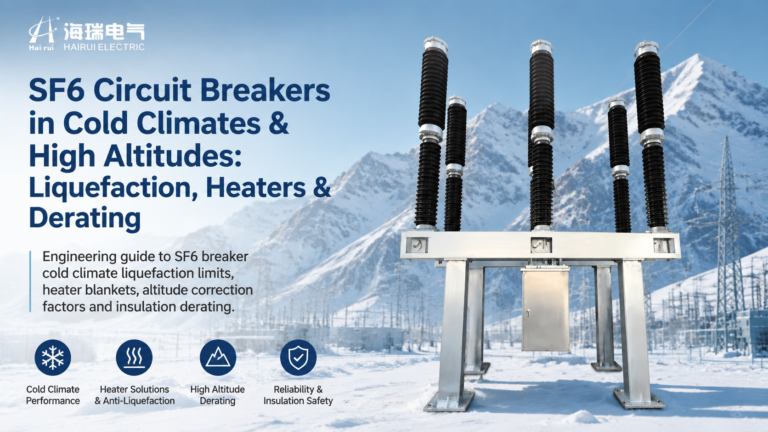
An SF6 greenhouse gas inventory is now a line item in procurement, not a footnote in an environmental report. A single 126 kV live-tank breaker typically holds 8 to 12 kg of sulfur hexafluoride, and at a global warming potential of 23,500 that is roughly 235 tonnes of CO2 equivalent sealed inside one porcelain column — about the annual emissions of fifty passenger cars. Multiply that across a substation bay count and the gas becomes the largest single component of a utility’s operational carbon footprint.
That arithmetic is why regulators moved first on switchgear. This guide explains what the numbers mean, how the European F-Gas phase-out actually applies to SF6 circuit breakers at each voltage class, which leak-rate and reporting obligations now land on the buyer rather than the manufacturer, and the specific questions to put to a supplier before you sign.
Why SF6 Is the Benchmark Problem Gas
SF6 is not a by-product or an impurity. It is a deliberately chosen dielectric and arc-quenching medium, and it is exceptionally good at that job: dielectric strength roughly three times that of air at the same pressure, fast thermal recovery after arc extinction, and chemical stability that lets a sealed unit run for decades without gas treatment.
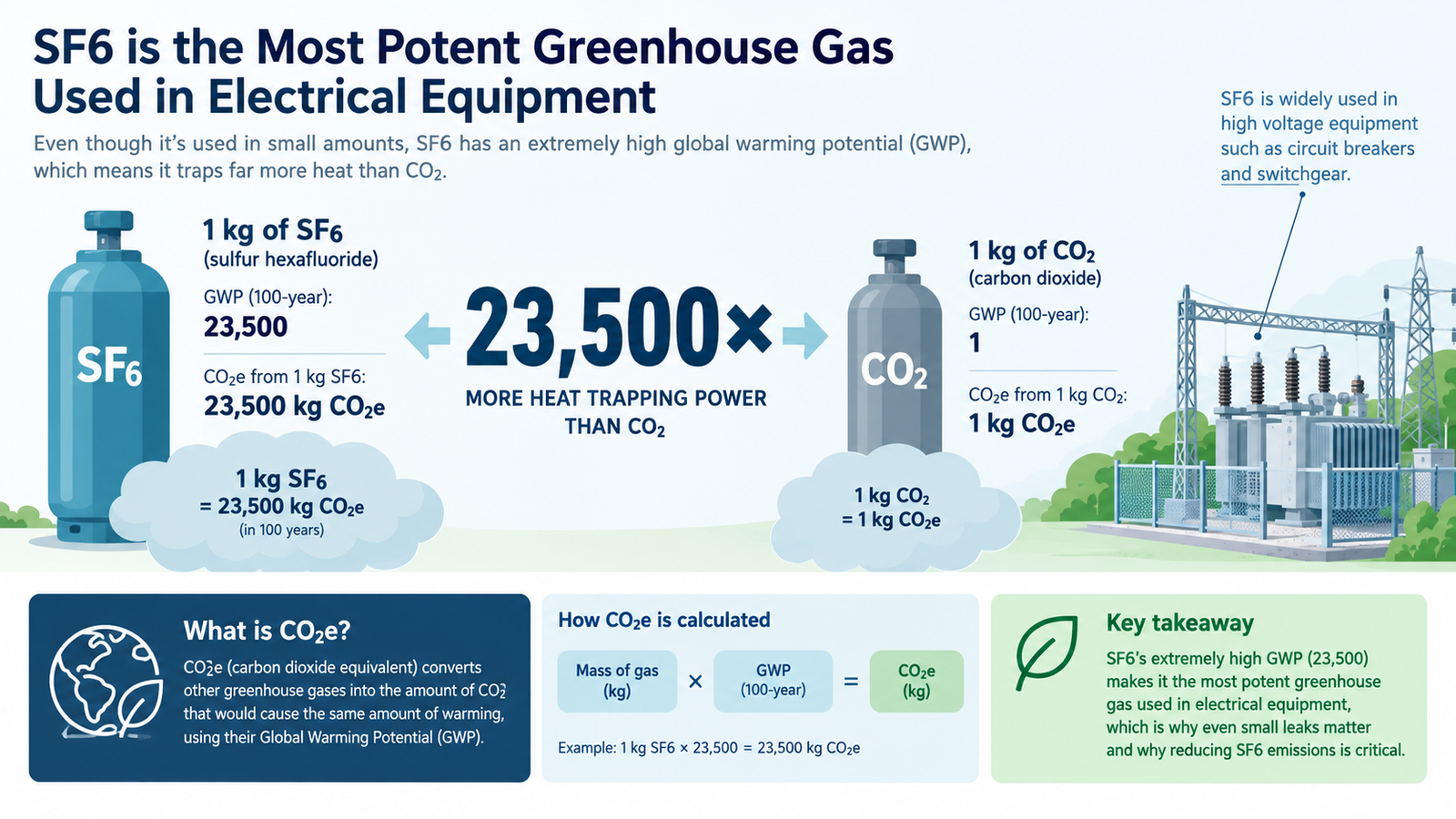
The same stability is the environmental problem. SF6 molecules absorb infrared radiation in a band where the atmosphere is otherwise transparent, and they persist. The IPCC assesses a 100-year global warming potential of 23,500 in AR5 and approximately 25,200 in AR6, with an atmospheric lifetime measured in thousands of years. One kilogram released is therefore not a small leak in carbon terms; it is the equivalent of burning about 10,000 litres of diesel.
The conversion is simple and worth memorising, because every reporting obligation is expressed in the same unit:
CO2 equivalent (t) = SF6 mass (kg) × GWP ÷ 1,000
The table below applies that formula to typical gas inventories across the voltage classes you are likely to specify. Mass figures are indicative ranges for outdoor live-tank and dead-tank designs; always use the nameplate filling mass for reporting.
Voltage class
Typical SF6 filling mass
CO2e at GWP 23,500
Equivalent cars for one year
40.5 kV
1.5 – 3 kg
35 – 70 t
8 – 15
72.5 kV
4 – 7 kg
94 – 165 t
20 – 36
126 kV
8 – 12 kg
188 – 282 t
41 – 61
252 kV
20 – 35 kg
470 – 823 t
102 – 179
One kilogram of SF6 carries the same 100-year warming effect as 23.5 tonnes of CO2.
The practical lesson is that emissions scale with voltage, not with unit count. A 40.5 kV distribution fleet of forty breakers holds less gas than four 252 kV transmission breakers. Any credible decarbonisation plan therefore has to look at where the high-voltage inventory sits, not only at how many devices were purchased.
The Regulatory Map in 2026
There is no single global SF6 rule. What exists is a European regime that is now the de facto design standard for anyone selling into the EU, a set of national regimes elsewhere, and voluntary programmes in markets that have not legislated. The table below summarises the position that matters for procurement decisions.
Region
Instrument
What it does
Buyer impact
European Union
Regulation (EU) 2024/573 (F-Gas), in force since March 2024
Bans placing new fluorinated-gas switchgear on the market above defined voltage thresholds, with a staggered calendar; requires certification, leak checks, recovery and annual reporting
New projects face hard dates by voltage class; documentation and end-of-life gas recovery become contractual
United Kingdom
Retained EU F-Gas Regulation, separately amended
Same certification, leak-check and recovery duties; phase-out trajectory broadly aligned but on its own timetable
Treat as a separate compliance file; do not assume EU certificates transfer
United States
No federal SF6 phase-out; EPA SF6 Emission Reduction Partnership is voluntary; state rules apply
Emissions reporting and corporate disclosure drive behaviour rather than a product ban
Specify low leak rate for ESG reasons; expect utility-specific gas accounting
China, India, Southeast Asia, Middle East
No SF6 phase-out for HV switchgear; national carbon reporting frameworks developing
Multilateral-funded projects increasingly require greenhouse gas accounting and gas recovery plans
Compliance is project-driven, not statutory; lender requirements often set the bar
What the EU Phase-Out Actually Covers
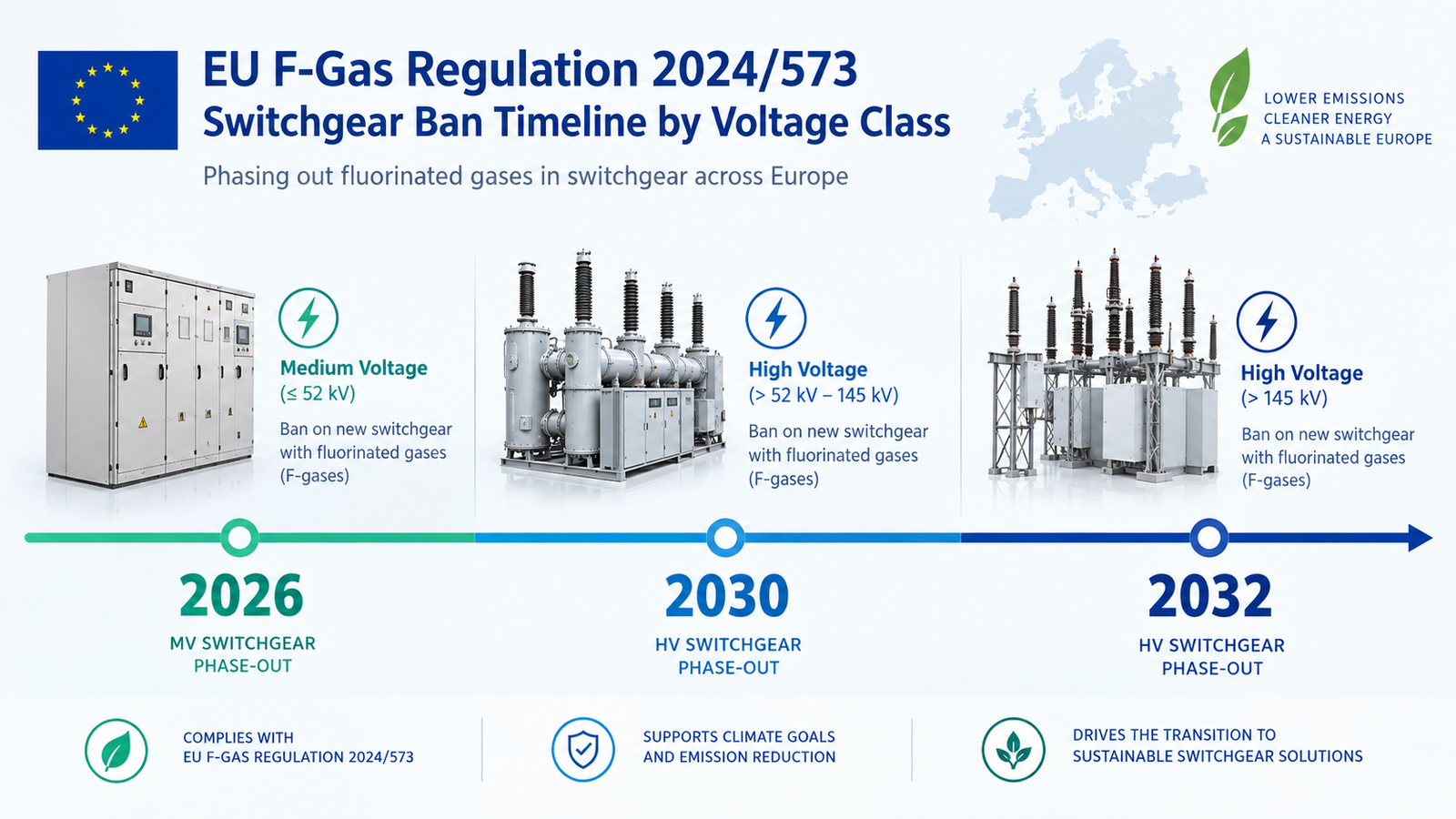
The EU rule is the one that shapes product roadmaps globally, so it is worth reading precisely. The ban is on placing on the market new switchgear that uses fluorinated greenhouse gases with a GWP of 1 or more — which in practice captures SF6 and the fluoronitrile mixtures that were originally marketed as drop-in replacements. The thresholds step down by voltage class:
From 1 January 2026: medium-voltage switchgear for primary and secondary distribution up to and including 24 kV.
From 1 January 2030: medium-voltage switchgear for primary and secondary distribution above 24 kV and up to and including 52 kV.
From 1 January 2032: high-voltage switchgear above 52 kV.
EU F-Gas phase-out dates by voltage class under Regulation (EU) 2024/573.
Three nuances matter more than the dates themselves.
It applies to new equipment, not the installed base. Breakers already in service are not required to be replaced. Maintenance, repair and refilling of existing equipment with reclaimed or virgin SF6 remain permitted within the regulation’s service framework, although the direction of travel is clearly toward reclaimed gas and tighter servicing controls. A twenty-year-old 126 kV breaker can legally keep running; a new one sold into the EU after 2032 cannot contain SF6.
Exemptions exist but are narrow. The regulation allows derogations where no technically acceptable alternative is available, subject to documented justification and, in some cases, Commission approval. These are project-specific arguments, not a general escape route, and they carry administrative burden that most utilities would rather avoid.
GWP of 1 is a very low bar. It excludes essentially every fluorinated gas, including the G3-type mixtures with GWP in the 300 to 700 range. Products marketed as “low GWP” are not compliant with the phase-out; only fluorine-free insulation is. That distinction is frequently blurred in supplier literature and worth pinning down in writing.
Leak Rate Is the Number That Moves Your Carbon Report
Filling mass sets the potential liability. Leak rate sets the actual annual emissions, and it is the parameter you can specify, test and enforce. IEC 62271-1 separates sealed pressure systems — designed so that no gas replenishment is expected over the design life, typically 30 years — from closed pressure systems that require periodic top-ups. Modern sealed-for-life designs are commonly specified below 0.1% per year by mass; older installed fleets average closer to 0.5 to 1% per year, and a neglected joint or seal can push a single unit far higher.
The table below shows why the difference is not academic. It models a 126 kV breaker with a 10 kg filling mass at four leak rates.
Annual leak rate
SF6 lost per year
CO2e per year
CO2e over 30 years
0.1% (sealed-for-life)
0.01 kg
0.24 t
7 t
0.5%
0.05 kg
1.18 t
35 t
1.0%
0.10 kg
2.35 t
71 t
3.0% (fault condition)
0.30 kg
7.05 t
212 t
A single leaking seal at 3% per year emits as much as thirty sealed units combined. This is why routine SF6 circuit breaker maintenance and density-monitor alarm response are now compliance activities rather than housekeeping. Gas-tightness verification is a type-test item and a routine-test item, and the design basis behind it — a defined filling pressure with a guaranteed annual loss — is visible on the product specification. Units engineered around a stable 0.5 MPa rated gas pressure, for example, are built to hold that pressure without top-up across the service interval, which is exactly what a reporting obligation rewards.
Reporting and Record Keeping: What Buyers Now Inherit
Under the EU framework, obligations attach to the undertaking that operates the equipment, not only to the manufacturer. In practice that means keeping a register of every unit with its filling mass, its GWP, its leak-check history and its end-of-life recovery record. Annual reporting is expressed in tonnes of CO2 equivalent, so a utility with a few hundred breakers crosses reporting thresholds without difficulty.
Three operational consequences follow. First, personnel handling SF6 need documented certification, including for recovery and reclamation. Second, leak checks are frequency-based and tighten with charge size, so a large 252 kV inventory triggers more inspection work than the same CO2e spread across small units. Third, decommissioning is no longer a scrap decision: gas must be recovered, and reclaimed gas must meet the purity limits of IEC 60480 before it can be reused. That standard, together with the moisture and decomposition limits in IEC 60376 for new gas, is what makes reclaimed SF6 tradeable rather than waste — the subject of a separate guide on SF6 gas purity, moisture and decomposition limits.
If your organisation recovers, stores or transfers gas on site, the handling procedure itself becomes auditable. Recovery carts, cylinder labelling, evacuation limits and moisture control all feed the same record. Our walkthrough of SF6 gas handling on site covers the sequence and the safety envelope in detail.
What This Means for Buyers: Six Questions for Suppliers
Compliance risk concentrates at the specification stage, where vague language becomes expensive later. Put these six questions to any supplier in writing and require documentary answers.
What is the guaranteed maximum annual leak rate, and how is it verified? Ask for the type-test report reference and the routine gas-tightness test method, not a marketing figure.
Is the pressure system sealed or closed over the design life? A sealed system with no planned top-up is a different maintenance and reporting profile from a closed system.
What is the nameplate filling mass per pole and per breaker? You cannot compute CO2e without it, and it is often absent from quotation documents.
Which standard governs the gas quality at delivery? New gas should meet IEC 60376; reclaimed gas should meet IEC 60480, with a test certificate supplied.
Is there a recovery and take-back commitment at end of life? Ask who supplies the recovery equipment and whether the gas is reclaimed to reusable specification.
What is the fluorine-free roadmap for this voltage class? A supplier with no answer is telling you something about its product development.
Where SF6 Still Wins, and Why the Ban Is Not a Ban on HV
The phase-out is often reported as the end of SF6. For distribution voltages, that reading is close to correct: vacuum interruption with solid or air insulation has displaced SF6 in 12 kV and 24 kV metal-clad switchgear on cost, footprint and maintenance grounds, and the 2026 date simply formalises a transition that was already underway. Our comparison of SF6 versus vacuum circuit breakers sets out where each technology actually earns its place.
Above 52 kV the picture is different. Vacuum interrupters exist at 72.5 kV and 126 kV, but the dielectric requirement for the external insulation and the interrupter gap pushes designs toward larger envelopes, more series gaps and higher cost. Clean-air and vacuum hybrid designs are commercially credible at 72.5 kV in enclosed switchgear; at 126 kV outdoor live-tank and at 252 kV they remain heavier, larger and more expensive than SF6 for equivalent ratings. That is precisely why the EU calendar gives high voltage until 2032 rather than 2026.
For buyers in that window, the rational strategy is not to abandon SF6 but to minimise how much of it you install. Two design levers do most of the work. Higher continuous current per bay means fewer bays for the same power transfer: a 4000 A rated design at 72.5 kV, for instance, can replace two lower-rated circuits and halve the gas inventory associated with that function. Higher breaking capacity per unit does the same for short-circuit duty. The LW9-72.5 4000 A high breaking capacity breaker is a straightforward example of that logic in a single unit.
At 126 kV, which remains the workhorse transmission class in most of Asia, Africa and Latin America, the mainstream specification is a live-tank outdoor breaker with 3150 A continuous current and 40 kA short-circuit rating, supported by a 40 kA three-second short-time withstand capability that governs how long the unit can ride through a backup protection delay. A representative unit in that class is the LW36-126 with 40/3 kA/s short-time withstand — the kind of equipment that will carry SF6 through the transition decade and then be maintained, not replaced.
At 252 kV the insulation coordination argument is decisive: a 1050 kV lightning impulse withstand level in a compact outdoor envelope is difficult to achieve without a high-dielectric medium, and the alternatives carry a substantial footprint penalty on a constrained substation plot. Designs such as the LW-252 with 1050 kV lightning impulse withstand represent the segment where SF6 will be the last technology standing, and where the compliance conversation is about containment and recovery rather than substitution.
A Practical Compliance Checklist for Procurement
Before a purchase order is issued, confirm each of the following is documented in the technical specification or the contract, not only in a brochure:
Voltage class and target market, checked against the applicable phase-out date.
Nameplate SF6 mass per breaker, recorded for the emissions register.
Guaranteed maximum annual leak rate, with the verification method named.
Type-test certificates covering gas tightness, short-time withstand and mechanical endurance.
Gas quality certificate at delivery, referenced to IEC 60376 or IEC 60480.
Certification requirement for site personnel who will handle or recover gas.
End-of-life recovery plan, including who owns the gas and where it is reclaimed.
A written statement of the supplier’s fluorine-free roadmap for the same rating.
Conclusion
SF6 regulation is not an abstract environmental policy. It changes what you can buy in a given year, what you must measure and report once the equipment is energised, and what happens to the gas at the end of a thirty-year life. The technical response is unglamorous but effective: specify sealed-for-life designs with a documented leak rate, record the filling mass, keep gas quality inside IEC limits, and reduce the number of high-inventory bays by specifying higher current and breaking capacity per unit. Buyers who do that will find the transition manageable at every voltage class.
If you are specifying outdoor SF6 breakers for a project with an F-Gas-sensitive owner or lender, our engineering team can supply the gas mass, leak-rate and type-test documentation alongside the technical proposal. Start from the high voltage SF6 circuit breaker range and send us the ratings you need.
FAQ
Is SF6 banned?
Not globally, and not for existing equipment. The EU bans placing new switchgear containing fluorinated greenhouse gases on the market above defined voltage thresholds — 24 kV from 2026, 52 kV from 2030, and all high voltage from 2032. Equipment already in service can continue to operate and be maintained.
What is the GWP of SF6?
23,500 over a 100-year horizon under IPCC AR5, and approximately 25,200 under AR6. One kilogram therefore equals roughly 23.5 tonnes of CO2 equivalent, which is why filling mass is recorded to the gram in emissions registers.
How much SF6 is in a circuit breaker?
Typically 1.5 to 3 kg at 40.5 kV, 4 to 7 kg at 72.5 kV, 8 to 12 kg at 126 kV and 20 to 35 kg at 252 kV, depending on interrupter design and pole count. Always use the nameplate value for reporting rather than an estimate.
What leak rate is acceptable?
Modern sealed-for-life equipment is commonly specified below 0.1% per year by mass. IEC 62271-1 distinguishes sealed from closed pressure systems, and older fleets frequently run at 0.5 to 1% per year. Anything above 1% should be treated as a maintenance finding.
Does the EU phase-out apply to equipment already installed?
No. The restriction applies to placing new equipment on the market. Installed breakers may remain in service, be repaired and be refilled, although servicing must follow the regulation’s certification, leak-check and recovery requirements.
Is SF6-free switchgear available at 126 kV and above?
Vacuum and clean-air designs exist at 72.5 kV and, in limited configurations, at 126 kV. At 252 kV and above there is no commercially equivalent fluorine-free outdoor breaker for general transmission duty, which is why the EU calendar allows high voltage until 2032.
Why a breaker rated 40 kA may still restrike on 50 A: the four capacitive duties, preferred current values by voltage class, C1 vs C2 tests and what to check.