SF6 Circuit Breakers in Cold Climates & High Altitudes: Liquefaction, Heaters & Derating
Published: Author: Lisa
An SF6 breaker specified for a temperate coastal site and installed at 4,200 m in a region that reaches −35 °C will fail — not dramatically, and probably not in the first year, but reliably. Two independent mechanisms are at work, and they are often confused because they arrive in the same project specification: liquefaction of the insulating gas in cold, and loss of external insulation margin at altitude.
This guide separates the two. It covers what SF6 circuit breaker cold climate design actually changes, how the liquefaction curve sets the real ambient limit for each filling pressure, what altitude correction does and does not apply to, and how to write a specification that a manufacturer can answer without guessing. The equipment range discussed sits in the outdoor HV segment of the SF6 circuit breaker catalogue, where 40.5 kV to 252 kV units are routinely supplied into cold and high-altitude markets.
Two different problems that arrive together
Cold affects the gas inside the interrupter. Altitude affects the air outside the bushings. They are physically unrelated, they are governed by different clauses of different standards, and they are corrected by different design changes. Treating them as one “severe environment” line item is the most common specification error in this segment.
Condition
What it affects
Governing quantity
Typical fix
Low ambient temperature
Internal insulation and interruption
SF6 density in the gas phase
Heaters, lower pressure, gas mixture
High altitude
External insulation and cooling
Air density around bushings
Voltage correction, longer creepage, larger clearances
Both
Bushing length, heater power, cabinet design
Combined correction
Custom outdoor configuration
Cold: what actually happens inside the breaker
The liquefaction curve
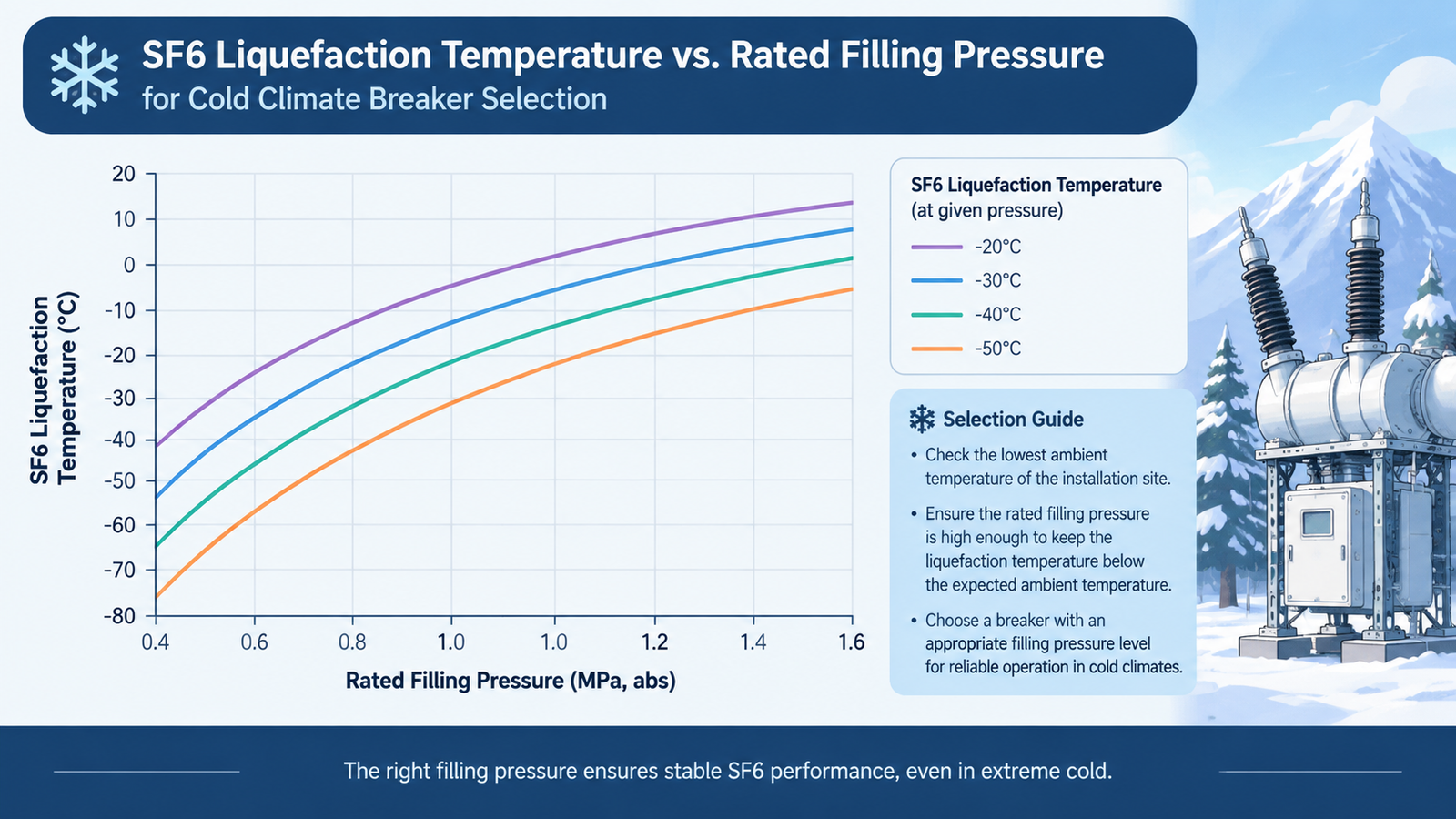
SF6 is stored as a gas at ambient temperature, but it has a saturation curve like any other substance. Cool the gas far enough and it begins to condense; once liquid forms, the pressure stops following the gas law and the number of molecules in the gas phase falls. Density in the gas phase — the quantity that determines dielectric strength — drops even though nothing has leaked.
The temperature at which this starts depends on the filling pressure. Higher pressure means a higher partial density and therefore a warmer liquefaction point.
Rated filling pressure (gauge, at 20 °C)
Approximate liquefaction temperature
Practical ambient limit
0.40 MPa
≈ −33 °C
−30 °C
0.50 MPa
≈ −27 °C
−25 °C
0.60 MPa
≈ −21 °C
−20 °C
0.70 MPa
≈ −16 °C
−15 °C
These figures are for orientation and assume a single gas. The authoritative curve comes from the manufacturer, because the exact value depends on the compartment design, the pressure at 20 °C, and whether any gas mixture is used. The pattern, however, is universal: every 0.1 MPa of filling pressure costs roughly five to six degrees of cold capability.
This is why a breaker rated at 0.5 MPa rated gas pressure is the standard cold-region choice at 40.5 kV. It is not a lower-performance product; it is the same platform deliberately filled to a lower density so that it keeps working at −30 °C.
What performance is lost, and what is not
Liquefaction degrades two things and leaves one intact, and knowing which is which prevents over-specifying.
Dielectric strength falls. With fewer molecules in the gas phase, the withstand voltage between contacts and to earth drops. This is the primary risk, and it is why lockout pressure exists.
Interrupting capability falls. Arc quenching depends on gas density and on the flow through the nozzle. At reduced density the breaker may still interrupt load current but lose margin on fault current.
The mechanism is unaffected. Springs, latches, and linkages do not care about gas density — but they do care about lubricant viscosity, which is a separate cold-climate issue covered below.
Note what does not happen: the breaker does not “run out of gas”. Nothing escapes. Warm it up and the density returns to normal, which is why a cold-weather alarm that resets by mid-morning is a liquefaction signature rather than a leak. The gas density monitor is the instrument that shows this, and its temperature compensation is what keeps the alarm meaningful.
Design responses to cold
Heater blankets and thermostats
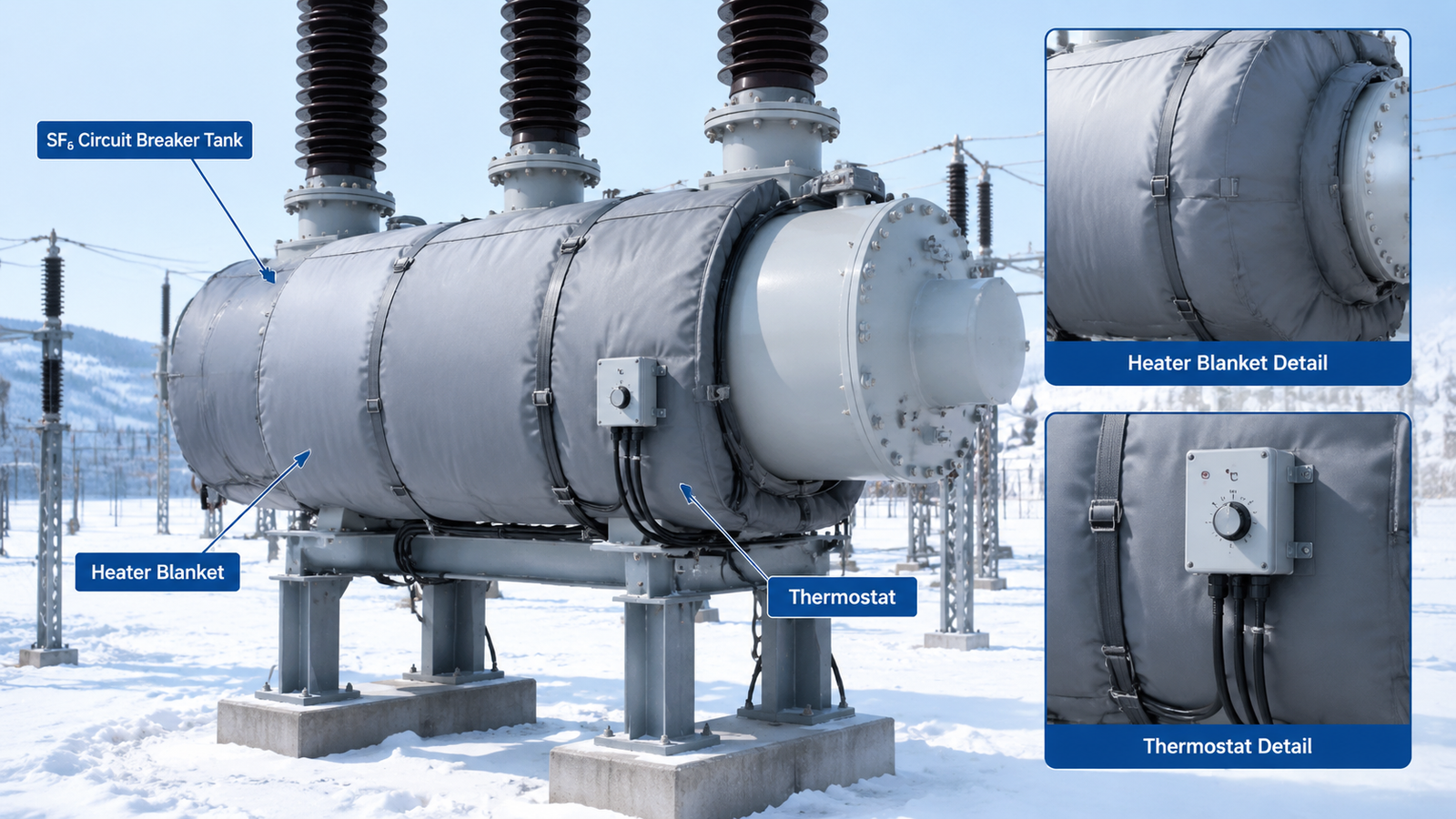
The most common solution is a thermostatically controlled heater blanket on the interrupter chamber or tank. It keeps the metal and the gas above the liquefaction point rather than changing the gas itself.
Three engineering details decide whether a heater actually works:
Power sizing. The heater must offset the heat loss from the tank surface at the design minimum ambient, with wind chill included. A heater sized for still air at −20 °C will not hold −35 °C with a 15 m/s wind.
Thermostat setpoints. A typical arrangement switches on around +5 °C and off around +15 °C, so the heater is dormant in summer. Setpoints close to the liquefaction temperature are too late — the gas has already begun to condense by then.
Temperature sensing location. The thermostat must sense the coldest part of the compartment, not the sun-exposed side. This is a mounting question, not an electrical one, and it is frequently wrong in retrofits.
Heaters need a reliable auxiliary supply. A site where the station battery is the only backup should treat heater failure as a monitored alarm, because a silent heater failure only shows up on the coldest night of the year.
Lower filling pressure
Where the voltage class allows it, reducing the filling pressure moves the liquefaction point down and eliminates the need for heaters entirely. The cost is a larger envelope for the same dielectric performance — the breaker gets bigger because the gas is less dense.
At 40.5 kV and 72.5 kV this trade is usually worth taking: a slightly larger porcelain column is cheaper than a heater system, its auxiliary supply, and the maintenance burden over 25 years.
Gas mixtures
Mixing SF6 with CF4 or nitrogen lowers the liquefaction temperature substantially, because the mixture’s saturation behaviour is dominated by the more volatile component. SF6/CF4 mixtures have been used for decades in very cold climates for exactly this reason.
The trade-off is dielectric strength: the mixture is weaker per unit pressure than pure SF6, so the breaker must run at higher pressure or be physically larger. Mixtures also complicate gas handling — topping up requires the right ratio, and gas analysis has to measure composition, not just purity and moisture. For most 40.5–126 kV cold-climate projects, heaters or lower pressure are simpler; mixtures come into their own at very low temperatures or where heater power is unavailable.
Mechanical and control-cabinet measures
Cold affects more than the gas. Four items belong in the cold-climate specification:
Low-temperature lubricant in the mechanism, rated to the site minimum with margin. Standard grease stiffens below −20 °C and raises operating times beyond the reclose dead time.
Damper and buffer review — hydraulic dampers change behaviour with viscosity; some designs need a cold-weather variant.
Cabinet heaters and anti-condensation for the control and terminal box, so that ice does not form on auxiliary contacts and terminal blocks.
Battery and charger rating — capacity falls with temperature, and a cold cabinet can halve the available DC supply just when the heater load peaks.
Heater power, thermostat setpoints and sensor location decide whether a cold-climate breaker holds density.
Altitude: the correction that applies outside the tank
Why air density matters and SF6 density does not
At altitude, atmospheric pressure and air density fall. The flashover voltage of an air gap or an external bushing surface is a function of air density, so external insulation loses margin as elevation rises. Internal SF6 insulation is unaffected, because the gas is sealed at a fixed density and does not care what the atmosphere outside is doing.
This distinction is the whole basis of altitude correction. The correction applies to bushings, external clearances, phase-to-phase spacing, and creepage paths in air. It does not apply to the interrupter, the gas compartment, or the internal insulation of the breaker.
The IEC correction factor
IEC 62271-1 corrects required withstand voltage above 1,000 m using an exponential factor:
Ka = e^(m × (H − 1000) / 8150)
where H is the installation altitude in metres and m is 1.0 for power-frequency and lightning impulse withstand. The factor multiplies the required withstand voltage at sea level, so the equipment must be selected or designed for a higher insulation level than the nominal rating suggests.
Altitude
Correction factor Ka
Effect on required withstand
1,000 m
1.00
Nominal rating applies
2,000 m
1.13
+13%
3,000 m
1.28
+28%
4,000 m
1.45
+45%
5,000 m
1.63
+63%
The practical consequence is that a breaker rated for a 350 kV lightning impulse withstand at sea level is not adequate at 4,000 m for the same nominal system voltage — the requirement has moved to roughly 507 kV. Selecting a unit with 350 kV lightning impulse withstand is the right move for a standard site; for a high-altitude site the specification has to call for the next insulation level up, or for a design with extended external clearances.
Creepage, clearance and bushing selection
Altitude correction and pollution correction are separate and additive in effect. A site at 3,500 m with heavy industrial pollution needs both a higher insulation level and a longer creepage path. In practice this means specifying creepage distance explicitly — 25 mm/kV for heavy pollution is a common starting point — and confirming the bushing shed profile for the site’s pollution class.
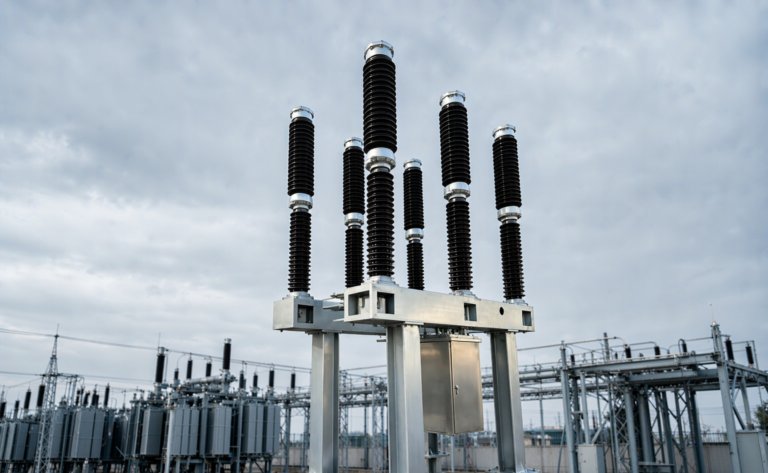
The outdoor configuration matters here too. A porcelain column design with 4,000 A rating gives long external creepage in a compact footprint, which is exactly the combination high-altitude substations need. The trade-offs between indoor and outdoor configurations at altitude are covered in indoor vs outdoor SF6 circuit breakers.
When cold and altitude combine
Central Asia, the Tibetan plateau, the Andes, Mongolia, and northern Canada combine both conditions, and this is where standard products stop working.
The design problem is that the two fixes pull in opposite directions. Altitude wants a larger external envelope and higher insulation level; cold wants lower gas pressure and heater power. A larger tank surface loses more heat, so heater sizing goes up; a longer bushing means more external surface to keep clear of ice; and the control cabinet that houses the heater controls also needs its own heating.
The practical answer is a custom outdoor configuration rather than a catalogue unit. A customized 252 kV outdoor breaker built for the site conditions is the realistic route at transmission level — with the ambient minimum, altitude, pollution class, and seismic requirement all stated in the order specification, and the insulation level verified by type test at the corrected withstand rather than by calculation alone.
Every 0.1 MPa of filling pressure costs roughly five to six degrees of cold capability.
Specifying for the site: what to write in the datasheet
Six lines prevent most cold and altitude problems. Each one is a number the manufacturer needs, not an adjective.
Minimum ambient temperature — the design minimum, not the average winter low. State whether wind chill is included.
Maximum ambient temperature — needed for the current rating and for thermostat setpoints.
Installation altitude in metres — with the resulting Ka factor stated, so both sides are using the same correction.
Pollution level and required creepage — in mm/kV, with the site classification.
Required insulation level — power-frequency and lightning impulse withstand, already corrected for altitude.
Heater provisions — required or not, power, supply voltage, and whether heater failure must be alarmed.
Add the seismic requirement and the required operating sequence, and the specification is complete enough to price without assumptions. The 4,000 A high breaking capacity 72.5 kV unit is a useful reference for how these lines appear on a real datasheet.
Commissioning and operating practice in cold sites
Cold-climate installations need three checks that temperate sites can skip.
Timing test at minimum temperature. If the site reaches −30 °C, the mechanism timing should be verified at or near that temperature, not only at +20 °C in a factory. Lubricant behaviour is the variable that changes.
Heater function test with the thermostat in circuit. Confirm the heater draws its rated current, that the thermostat switches at the set points, and that a heater failure raises an alarm.
Density baseline recorded at two temperatures. Record the density reading warm and cold at commissioning, so that a future winter alarm can be compared against a known-good cold reading rather than argued about.
Operating practice follows from the same logic. Before the first cold season, verify heater supply and thermostat function. During cold snaps, treat a density alarm differently from a summer alarm: check the ambient temperature first, then the trend, then send a leak survey only if the reading does not recover with the temperature.
Conclusion
Cold and altitude are two corrections, not one. Cold reduces the gas density available for insulation and interruption, and is answered with lower filling pressure, heater blankets, or a gas mixture. Altitude reduces the air density around the bushings, and is answered with a higher insulation level, longer creepage, and larger clearances — while leaving the sealed SF6 compartment untouched.
The specification work is unglamorous and entirely numeric: minimum ambient, altitude, pollution class, corrected insulation level, heater provisions. Get those five numbers into the enquiry and the manufacturer can propose a configuration that will still interrupt fault current on the coldest night of the tenth winter. Leave them out and the default product will be quoted, which is a temperate-climate design. Browse the SF6 circuit breaker library for the adjacent topics, or send us your site conditions for a configuration review.
FAQ
At what temperature does SF6 liquefy in a circuit breaker?
It depends on the filling pressure. At 0.5 MPa gauge, liquefaction begins around −27 °C; at 0.6 MPa, around −21 °C; at 0.4 MPa, around −33 °C. Always confirm against the manufacturer’s curve for the specific compartment.
Do all cold-climate breakers need heaters?
No. If the filling pressure is low enough that the liquefaction point sits well below the site minimum, heaters are unnecessary. Heaters are the standard answer when the voltage class requires a higher pressure than the climate allows.
Does altitude affect the SF6 inside the breaker?
No. The gas is sealed at a fixed density, so external atmospheric pressure has no effect on internal insulation or interrupting performance. Altitude correction applies only to external insulation in air — bushings, clearances, and creepage.
What is the altitude correction factor at 3,000 m?
Approximately 1.28, meaning the required withstand voltage increases by 28% compared with sea level. At 4,000 m it is about 1.45, and at 5,000 m about 1.63.
Can a standard breaker be used at 3,000 m if the system voltage is low?
Sometimes, but it must be verified rather than assumed. The check is whether the corrected required withstand voltage still falls within the breaker’s rated insulation level. If it does not, a higher insulation level or a design with extended clearances is required.
Why does a cold-weather density alarm sometimes clear by itself?
Because it was caused by liquefaction, not leakage. As the temperature rises the liquid returns to the gas phase, density recovers, and the alarm resets. A genuine leak does not recover without a top-up.
Why a breaker rated 40 kA may still restrike on 50 A: the four capacitive duties, preferred current values by voltage class, C1 vs C2 tests and what to check.