SF6 vs Vacuum Circuit Breaker: Which One Is Better?
Vacuum or SF6? Compare arc quenching, voltage limits, switching behaviour, maintenance, F-gas rules and cost to pick the right circuit breaker for your network.
Read More
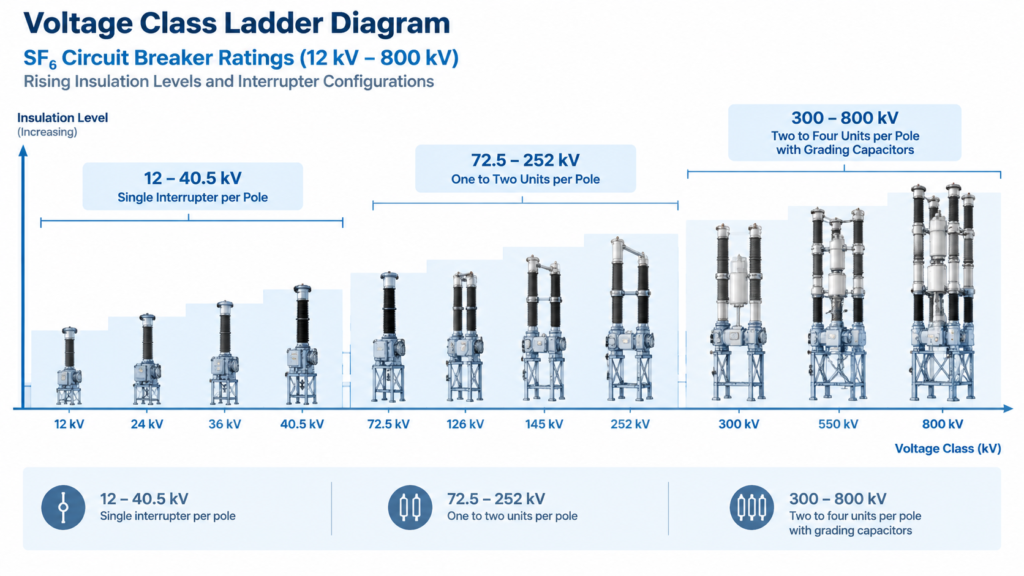
Specifying a high voltage SF6 circuit breaker starts with one number: the voltage class. Current rating, breaking capacity and mechanism type all matter, but they are chosen after the voltage class is fixed. A 12 kV breaker and an 800 kV breaker use the same electronegative gas and the same puffer arc-quenching physics — yet they share almost nothing else. Pole spacing, interrupter count, insulation envelope, mechanism energy and even the test regime change as you climb the voltage ladder.
This guide maps that ladder from 12 kV to 800 kV. You will see what each class actually means, how insulation levels scale, which classes still use a single interrupter per pole and which need several in series, and how to match a breaker’s rated voltage to the system voltage you really have.
The term is used loosely in procurement conversations, so it is worth separating the two voltages that people confuse.
Rated voltage is a nameplate property of the breaker. It is the highest voltage at which the manufacturer has proven the interrupting and insulation performance through type tests. Maximum system voltage is a property of the network — the highest phase-to-phase voltage that can appear at the breaker terminals in service, including normal operating tolerances and temporary overvoltages.
The selection rule is one-directional: the breaker’s rated voltage must be equal to or higher than the system’s maximum voltage. It is never correct to specify a breaker rated at exactly the nominal system voltage. A 10 kV distribution network requires a 12 kV class breaker; a 110 kV transmission line requires a 126 kV class unit. The gap between nominal and rated voltage is the engineering margin for voltage regulation, switching surges and lightning overvoltages.
Voltage stress does not scale linearly with a single component. As the class rises, four things must change together:
This is why voltage class, not current, is the primary axis of an SF6 breaker product family. Within one class you can order 1250 A or 4000 A versions of essentially the same breaker. Across classes, you are buying a different machine.
The table below summarises the standard classes used in IEC and GB practice. Chinese and IEC standards run parallel series — 40.5 kV mirrors IEC 36 kV, 126 kV mirrors IEC 123 kV, and 252 kV mirrors IEC 245 kV — so a “40.5 kV” and a “36 kV” breaker serve the same system voltage with slightly different insulation levels.
| Voltage class (Ur) | Typical system voltage | 1-min power-frequency withstand | Lightning impulse withstand (BIL) | Interrupter units per pole | Typical application |
|---|---|---|---|---|---|
| 12 kV | 10 – 11 kV | 42 kV | 75 kV | 1 | Urban distribution, ring main units, industrial MV switchgear |
| 24 kV | 20 – 22 kV | 65 kV | 125 kV | 1 | Regional distribution, light rail traction, campus networks |
| 36 kV | 33 kV | 70 kV | 170 kV | 1 | Distribution substations, wind and solar collector systems |
| 40.5 kV | 35 kV | 95 kV | 185 kV | 1 | Industrial plants, substation outlets, renewable energy collectors |
| 72.5 kV | 66 kV | 185 kV | 450 kV | 1 | Sub-transmission, large industrial and utility substations |
| 126 kV | 110 kV | 230 kV | 550 kV | 1 | Transmission substations, transformer feeders, bus ties |
| 145 kV | 132 kV | 275 kV | 650 kV | 1 | Transmission lines in IEC and ANSI markets |
| 252 kV | 220 kV | 460 kV | 1050 kV | 1 – 2 | Backbone transmission, bus-tie and line breakers |
| 550 kV | 500 kV | 740 kV | 1550 kV | 2 | Extra-high voltage backbone transmission |
| 800 kV | 765 kV | 960 kV | 2100 kV | 2 – 4 | Ultra-high voltage transmission, long-haul corridors |
Treat these insulation figures as typical values for orientation only. Exact requirements depend on the edition of the standard you are working to, the pollution level of the site, the altitude, and whether the breaker sits inside gas-insulated switchgear or in an open-air yard. Always confirm against the project’s insulation coordination study.
This band is where SF6 competes hardest with vacuum, and where the gas earns its place for a specific reason: footprint. In a sealed gas compartment, the same insulation performance needs a fraction of the air clearance, which is decisive in urban substations, basement electrical rooms and retrofits where there is no space for a larger switchgear lineup.
Every class from 12 kV to 40.5 kV uses a single interrupter per pole. The dielectric recovery requirement is comfortably within what one puffer or self-blast chamber can deliver. Poles are commonly assembled as a three-pole unit sharing one mechanism, so all three phases open and close together — important for the phase-to-phase insulation coordination that this band relies on.
Mechanisms are almost always spring-operated, and the arc-quenching chamber is usually a puffer or self-blast design. Because the interrupting duty is lower, this band also sees the widest spread of current ratings, from 630 A feeder breakers up to 4000 A incomers. A representative example is the 40.5 kV outdoor SF6 breaker rated for 3000 mechanical operations, which pairs a compact single-interrupter pole with a mechanism sized for distribution-level switching frequency.
Between 72.5 kV and 252 kV, SF6 becomes the default technology rather than an option. Vacuum interrupters exist at the lower edge of this band, but above roughly 145 kV the physics of contact gap recovery in vacuum becomes impractical to scale, and gas interruption takes over completely.
The 72.5 kV and 126 kV classes still use one interrupter unit per pole. At 252 kV, designs split into two camps: single-interrupter breakers that rely on a very fast, high-energy puffer, and two-interrupter designs that divide the recovery voltage across two gaps. The two-unit approach reduces the energy each chamber must absorb, at the cost of more moving parts and a taller pole column.
Once you go beyond two units in series, grading capacitors become mandatory. Without them, the voltage recovery after current zero does not divide evenly across the gaps, and one interrupter carries a disproportionate share of the stress and fails prematurely. Grading capacitors equalise the distribution — a detail that matters enormously at 550 kV and above.
Both configurations appear across this band. Live-tank breakers mount the interrupter on top of insulating columns, with the enclosure at line potential; they use less gas and are lighter per pole. Dead-tank breakers place the interrupter inside a grounded metal tank, which allows current transformers to be mounted around the bushings and makes the unit more mechanically robust. Regional preference matters here — live tank dominates in Europe and Asia, dead tank in North America.
Two 72.5 kV units illustrate how widely the insulation envelope can vary within one class. A 72.5 kV outdoor SF6 breaker with 4000 A rated current and 40 kA breaking capacity is aimed at heavy sub-transmission duty, while a 126 kV breaker with 40 kA breaking capacity covers the 110 kV transformer feeder position. Both are single-interrupter designs, but the second carries roughly three times the insulation requirement of the first.
Above 252 kV, SF6 has no practical competitor. Every alternative arc-quenching technology — vacuum, clean air, fluoronitrile mixtures — is either in pilot deployment or unavailable at this scale. For a 500 kV or 765 kV corridor, a gas breaker is not a preference; it is the only proven option.
Design in this band is dominated by three concerns. First, series interrupter count: 550 kV units typically use two chambers per pole, and 800 kV designs use two to four, with grading capacitors across each. Second, mechanical energy: the mass being accelerated is large enough that hydraulic or spring-hydraulic mechanisms replace simple spring units. Third, switching overvoltage control: at these voltages the breaker may be fitted with closing resistors to damp the overvoltages generated when energising long lines.
A 252 kV outdoor SF6 breaker with 1050 kV lightning impulse withstand sits at the entry point of this design philosophy — one to two interrupters per pole, a 460 kV power-frequency withstand, and a pole structure that must be dimensioned for a BIL more than five times that of a 40.5 kV unit.
Voltage class sets the ceiling for three other ratings. Understanding how they move together prevents the common mistake of specifying a high-voltage class with an inadequate current or fault rating.
| Parameter | MV band (12 – 40.5 kV) | HV band (72.5 – 252 kV) | EHV / UHV band (300 – 800 kV) |
|---|---|---|---|
| Rated normal current | 630 – 4000 A | 1250 – 4000 A | 2000 – 5000 A |
| Rated short-circuit breaking current | 16 – 40 kA | 31.5 – 63 kA | 40 – 80 kA |
| Lightning impulse withstand | 75 – 185 kV | 450 – 1050 kV | 1550 – 2400 kV |
| Interrupter units per pole | 1 | 1 – 2 | 2 – 4 |
| Dominant mechanism | Spring | Spring or hydraulic | Hydraulic or spring-hydraulic |
| Typical enclosure | Metal-enclosed or compact outdoor | Live tank or dead tank outdoor | Large outdoor structure with grading capacitors |
The pattern is consistent: breaking capacity and insulation level both climb with voltage class, while the number of interrupter units and the complexity of the mechanism climb with them. Higher voltage does not automatically mean higher current — a 126 kV transformer feeder may carry less continuous current than a 40.5 kV industrial incomer — but it almost always means a higher fault level and a much heavier insulation burden.
Apply the “next standard class above” rule. Read the maximum system voltage from your network data, then select the lowest standard class that meets or exceeds it.
| System nominal voltage | Recommended breaker rated voltage | Minimum 1-min power-frequency withstand | Minimum lightning impulse withstand |
|---|---|---|---|
| 6.6 kV | 12 kV | 42 kV | 75 kV |
| 10 – 11 kV | 12 kV | 42 kV | 75 kV |
| 20 – 22 kV | 24 kV | 65 kV | 125 kV |
| 33 kV | 36 kV or 40.5 kV | 70 – 95 kV | 170 – 185 kV |
| 35 kV | 40.5 kV | 95 kV | 185 kV |
| 66 kV | 72.5 kV | 185 kV | 450 kV |
| 110 kV | 126 kV | 230 kV | 550 kV |
| 132 kV | 145 kV | 275 kV | 650 kV |
| 220 kV | 252 kV | 460 kV | 1050 kV |
| 500 kV | 550 kV | 740 kV | 1550 kV |
| 765 kV | 800 kV | 960 kV | 2100 kV |
Three adjustments override the plain rule. At altitudes above 1000 m, reduced air density lowers the effective external dielectric strength, so the breaker may need a class above what the system voltage alone would suggest. In heavily polluted or coastal environments, creepage distance per kV must be increased, which often pushes the specification to the higher insulation variant within the same class. And where the fault level at the installation point exceeds what the standard class offers, you may need the high-breaking-capacity variant rather than the standard one.
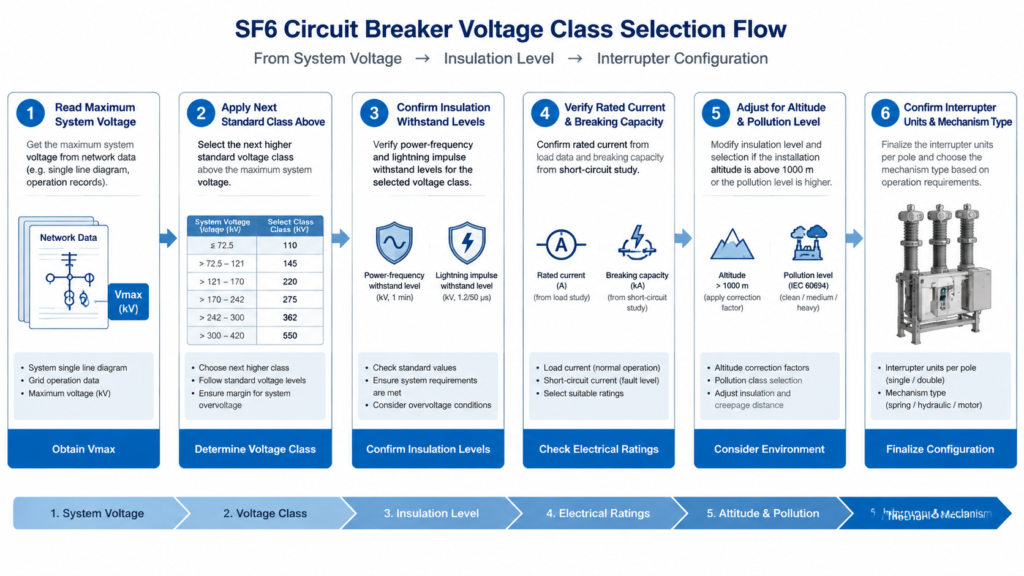
The voltage class of an SF6 circuit breaker is not a label — it is the design decision that determines insulation envelope, interrupter architecture, mechanism type and pole geometry. Get the class right first, and the remaining ratings fall into a logical order: rated normal current from the load, breaking capacity from the short-circuit study, insulation level from the coordination study, and configuration from the installation environment.
If you are working through a specification and want to confirm which class and insulation level fits your system, the quickest path is to share your system voltage, maximum fault level and site conditions — the technical team at Hairui Electric can match them to a specific breaker configuration. For background on how these breakers interrupt fault current in the first place, see our guide to what an SF6 circuit breaker is and how it works, and for how the class determines which interrupter technology is used, read about puffer, self-blast, dead tank and live tank SF6 breaker types.
The commonly manufactured classes are 12 kV, 24 kV, 36 kV, 40.5 kV, 72.5 kV, 126 kV, 145 kV, 252 kV, 550 kV and 800 kV. Chinese and IEC series run in parallel — 40.5 kV corresponds to IEC 36 kV, 126 kV to IEC 123 kV, and 252 kV to IEC 245 kV. The upper limit of commercial production is 800 kV.
Rated voltage is a property of the breaker, proven by type test. Maximum system voltage is a property of the network, including operating tolerances and temporary overvoltages. The breaker’s rated voltage must always be equal to or greater than the system’s maximum voltage, which is why a 10 kV network uses a 12 kV class breaker.
A single contact gap can only recover dielectric strength so quickly after current zero. Above roughly 145 – 252 kV, manufacturers split the recovery voltage across two or more interrupter units in series and add grading capacitors to distribute the voltage evenly. Without grading capacitors, one unit would carry disproportionate stress and fail prematurely.
Yes. SF6 breakers are manufactured from 12 kV upward and are common in compact switchgear, ring main units and space-constrained indoor installations where the smaller gas-insulated clearance is the deciding factor. At medium voltage, vacuum is the more common choice, so SF6 competes mainly on footprint rather than on interrupting performance.
No. Voltage class and breaking capacity are independent ratings. A 126 kV breaker may be rated 40 kA while a 40.5 kV breaker is also rated 40 kA. Breaking capacity must come from the prospective short-circuit current at the installation point, not from the voltage class.
800 kV is the highest commercial class, serving 765 kV transmission systems. Above 252 kV, SF6 remains the dominant and in most cases the only proven technology, since vacuum and clean-air alternatives are not yet available at transmission-scale ratings.