SF6 Gas Handling on Site: Filling, Top-Up, Leak Detection & Safety
Published: Author: Lisa
Every SF6 breaker will be opened to gas at some point — at commissioning, at a leak repair, at a pole replacement. What separates a routine job from an incident is rarely the equipment. It is whether the person doing the SF6 gas handling understood that they are working with a gas that displaces oxygen in a pit and turns corrosive after an arc.
This guide covers on-site gas handling for outdoor high-voltage breakers in the 40.5 kV to 252 kV range, including the filling and top-up procedures, recovery and purification, leak detection, and the safety rules that apply throughout. It is written for field crews and commissioning engineers working on units such as the high voltage SF6 circuit breakers range. Local regulations on fluorinated gases take precedence over anything here.
What On-Site Gas Handling Actually Involves
There are only five operations, and every one of them has a failure mode that damages the breaker rather than the operator.
Operation
Purpose
Main risk if done wrong
Evacuation
Remove air and moisture before filling
Air and water left in the compartment; dielectric strength lost
Filling
Bring a new or emptied compartment to rated density
Overfill or underfill; relief device operation or reduced interruption capability
Top-up
Restore density lost to leakage
Masking a leak, adding moisture, overfilling on a cold day
Recovery
Remove gas before opening a compartment
Venting to atmosphere; regulatory breach and personal exposure
Measurement
Confirm density, moisture, purity and leak rate
Acting on uncorrected or uncalibrated readings
The order matters. Filling without evacuation puts air into the compartment. Topping up without measuring the leak rate hides the fault. Recovery without testing the gas first exposes the crew to decomposition products.
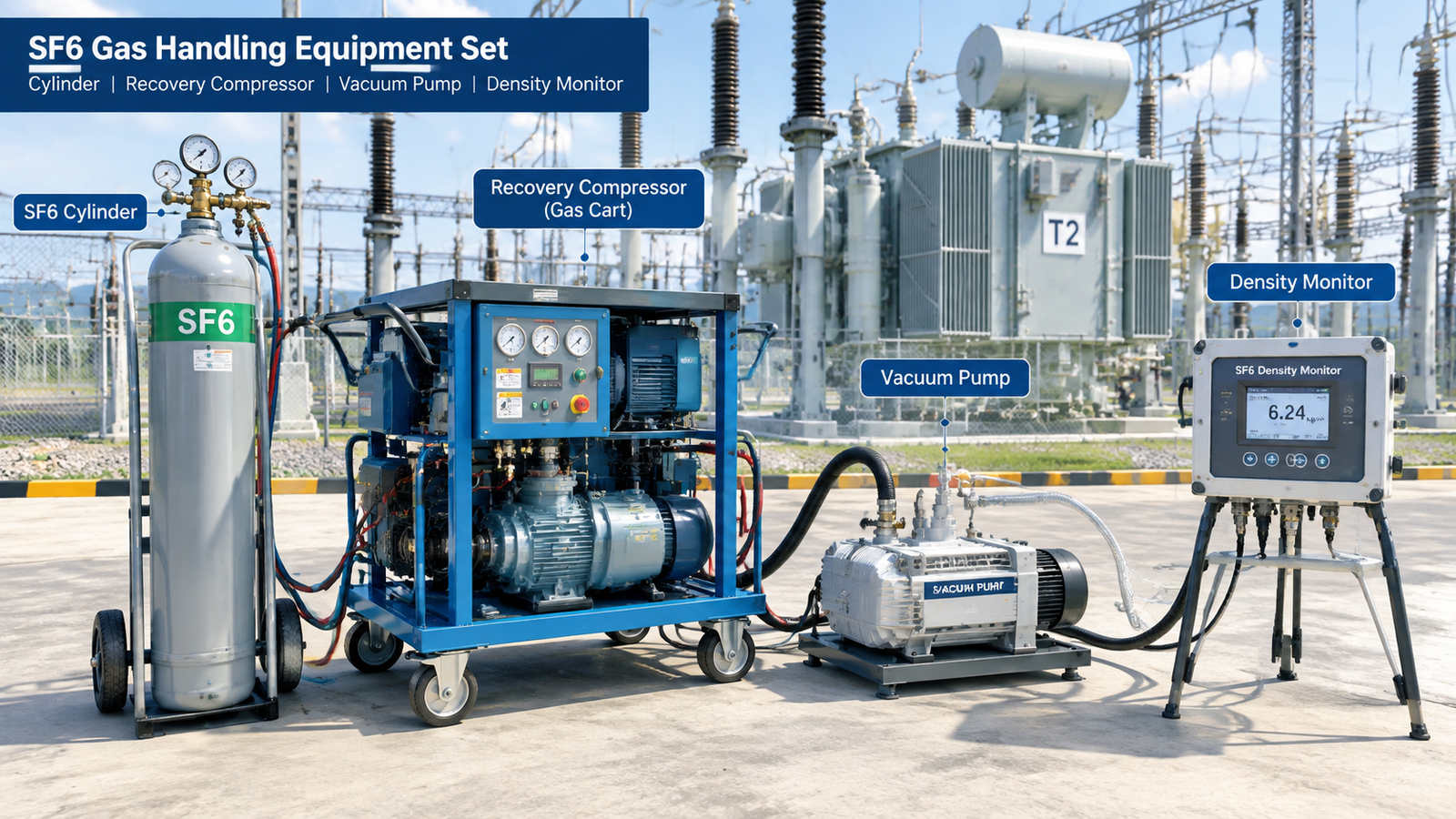
Equipment You Need on Site
A complete handling set: cylinder, cart, vacuum pump, manifold, density gauge and moisture meter.
A complete handling set is small enough to fit in a van, and every item on this list exists because leaving it behind stops the job.
SF6 cylinder with a valve protection cap and a clear content label, weighed before and after use.
Gas cart or service trolley with a compressor, vacuum pump, filters and a manifold — the single most useful piece of equipment for any job beyond a top-up.
Pressure regulator and manifold rated for the cylinder pressure, with a relief device and self-sealing couplings.
Vacuum pump capable of reaching below 100 Pa, with a gauge that can actually read that range.
Density or pressure gauge with temperature correction — the reference instrument, not the breaker’s own gauge.
Dew point or moisture meter for confirming dryness after evacuation and before filling.
Purity analyzer where reclaimed gas is being reused rather than fresh gas.
Portable leak detector , plus bagging material for quantitative checks.
Personal protective equipment : chemical goggles and face shield, acid-resistant gloves, coveralls, and respiratory protection with acid-gas filters.
Oxygen meter for any pit, basement or enclosed compound.
The hoses deserve a mention of their own. Use only hoses intended for SF6 service, keep them capped when disconnected, and purge them before every connection. A dirty or moisture-laden hose will contaminate a clean compartment faster than any leak.
Before You Open a Valve
Five checks take ten minutes and prevent most of the incidents that appear in gas handling reports.
Confirm the switching state and the permit. The compartment must be de-energised, isolated and earthed. Gas work on an energised compartment is not a shortcut, it is an event waiting to happen.
Test the gas if the breaker has interrupted a fault. Arced gas contains decomposition products and must be treated as hazardous. Test before recovery, and never open a compartment that has been through a heavy fault without confirming the gas condition.
Identify the cylinder. Read the label, check the batch and confirm it is SF6 and not a mixture. Weigh it so you can calculate how much you actually put in.
Check the weather and the workspace. Wind disperses leaking gas and defeats detection; rain introduces moisture. In still air, remember SF6 is roughly five times denser than air and will collect in low points.
Confirm the density relay settings from the breaker manual so you know what “full” means for this specific compartment, at this specific ambient temperature.
Filling a Compartment Step by Step
Filling is where most commissioning errors occur, because the two things that look like success — a pressure reading and a closed valve — are both easy to get wrong.
Evacuate first, always. Pull the compartment down below 100 Pa and hold it there. Evacuation is not just about removing air; it is the most effective moisture removal step available on site. If the pressure rises after the pump is isolated, you have a leak and filling will waste gas.
Confirm dryness. Measure the moisture level of the evacuated compartment or of a gas sample taken immediately after filling. If it is above the limit for the voltage class, evacuate again rather than proceeding.
Connect and purge the hose. Connect to the filling valve with a self-sealing coupling, then purge the hose with SF6 to displace air before opening the compartment valve. A short purge costs a few grams and prevents an air slug entering the breaker.
Fill in the gas phase, slowly. SF6 is drawn from the top of the cylinder as gas while the liquid boils underneath. Fill slowly enough that the compartment and the gas reach thermal equilibrium; a fast fill produces a cold compartment and a misleading pressure reading.
Fill to density, not to pressure. Use the temperature correction table from the manual. At 15 °C a compartment might need 0.55 MPa; at 35 °C the same density reads around 0.62 MPa. Filling to a fixed pressure regardless of temperature is the most common cause of overfilling.
Let it stabilise. Wait for the compartment to reach ambient temperature — commonly one to two hours on a large 252 kV pole — then re-check density and top up if needed.
Verify the density relay. Confirm the gauge and the relay agree, and that the alarm and lockout stages are not active. Where the design permits, test the relay by simulation rather than by letting the pressure fall.
Leak test every joint you touched. A detector pass over the filling valve, the hose coupling and any disturbed flange closes the job properly.
Record everything. Compartment, date, ambient temperature, starting and finishing density, cylinder weight before and after, and the calculated quantity added.
On a 252 kV split-type breaker, each pole is a separate compartment and must be filled and recorded separately. Units specified for 1050 kV lightning impulse withstand rely on gas density for a large part of that insulation margin — a pole left 5% low is not a small deviation, it is a reduced withstand level.
Top-Up: When It Is Right and When It Is Wrong
Top-up is the most abused procedure in SF6 maintenance, because it is easy and it makes the alarm go away.
Situation
Top-up appropriate?
Correct action
New installation, density slightly low after stabilisation
Yes
Top up to the corrected density and record the quantity
Compartment topped up once in several years, leak rate within specification
Yes
Top up, then monitor the trend
Second or third top-up within two years
No
Find and repair the leak; the compartment is out of specification
Density falling quickly after a repair
No
The repair failed; re-open and re-seal
Alarm in cold weather only, clears when warm
No
Investigate the density relay setting, not the gas quantity
Breaker in lockout
Only after the cause is known
Do not restore density and immediately re-energise without confirming the interrupter condition
Two rules make top-up safe. First, always top up to a density value corrected for the current temperature, never to a pressure copied from a previous job sheet. Second, always record the quantity added — a top-up without a record destroys the leak rate trend, which is the only diagnostic the gas system gives you.
Compartment design pressures vary by voltage class and design. A 40.5 kV breaker rated at 0.5 MPa and a 252 kV pole operate on different density curves; using one breaker’s filling table for another is a reliable way to overfill.
Recovery, Reclaim and Purification
SF6 is not vented. It is recovered, and depending on its condition it is either reclaimed for reuse or sent for destruction. This is both an environmental requirement and, in most jurisdictions, a legal one.
Recovery means pulling the gas out of the compartment into a storage vessel or a gas cart. Recover down to the residual pressure specified in the manual — commonly in the region of 0.02 MPa absolute or lower — then evacuate the remainder with the pump. A compartment that is merely “at atmospheric pressure” still contains a substantial quantity of gas.
Reclaim means cleaning recovered gas so it can be reused. Reclaimed gas is judged against the reuse standard, not the new-gas standard, and it must be tested for moisture, purity, air content and decomposition products before it goes back into any breaker. Gas that fails the reuse criteria is not “good enough for a spare bay” — it goes for destruction.
Purification uses filters and separators on the gas cart to remove moisture, oil and acidic decomposition products. Filters are consumable and have a finite capacity; a saturated filter passes contaminants straight through. Change them on schedule, not on suspicion.
Whatever the route, label the vessel. Recovered gas from a faulted breaker is hazardous, and the next person to handle that cylinder needs to know what is inside it without having to ask.
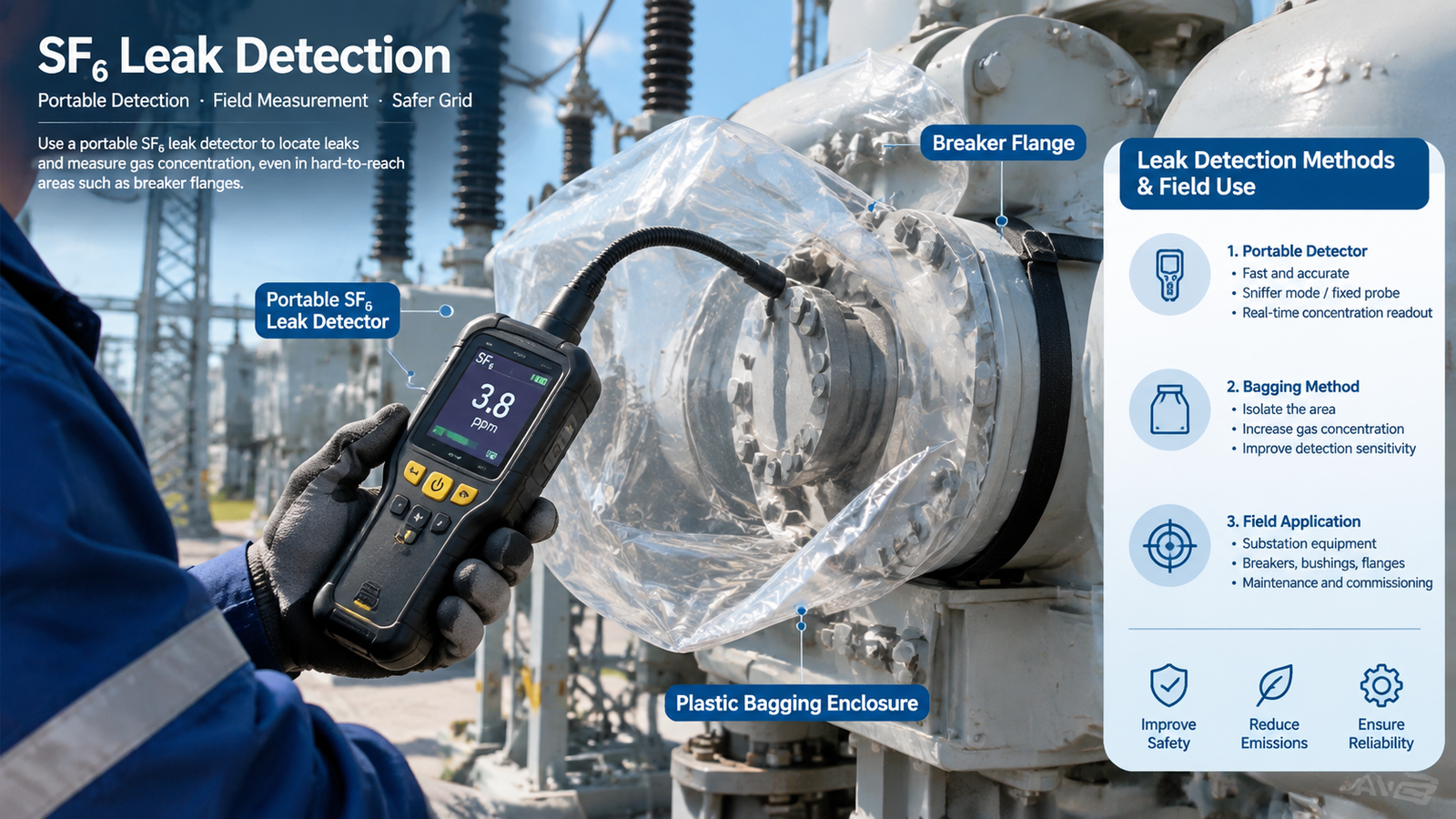
Leak Detection on Site
Probe low and slow: SF6 sinks, and the leak is usually at a joint somebody touched.
Three methods cover nearly every situation. They are complementary, and using only one of them is why leaks get “found” three times without being fixed.
Method
How it works
Best use
Limitation
Sniffer detector
Samples air and responds to SF6 concentration
Localising an active leak on accessible joints
Wind disperses the plume; requires slow, close passes
Bagging
Encloses the joint and measures concentration build-up over time
Quantifying a suspected leak and proving a repair
Needs a baggable joint and time on site
Ultrasonic
Detects the high-frequency noise of gas escaping
Very small leaks, and joints that are hard to reach
Background noise in an energised substation
Practical technique matters as much as the instrument. Move the probe slowly — a few centimetres per second — and start low, because SF6 sinks. Check the predictable points first: density relay and gauge roots, flange gaskets, the burst disc, the operating rod seal where the mechanism enters the tank, welded seams, and every valve or test point that has ever been opened. A leak that appears after a maintenance visit is almost always at a joint somebody touched.
Where the detector gives an ambiguous response, bag the joint and measure. A quantitative leak rate lets you decide between “repair at the next outage” and “repair now”, and it gives you a number to compare against after the repair.
Gas Cylinder Handling
Cylinders are the part of gas handling most often treated casually, and they are the part that injures people.
Store upright, secured, with the valve cap on. A cylinder that falls and shears its valve becomes a projectile.
Keep them below the temperature limit on the label and out of direct sun. Never use an open flame or a steam line to raise cylinder pressure; a warm water bath within the stated limit is the correct method if faster transfer is needed.
Do not draw liquid. SF6 is withdrawn as gas from the top of the cylinder. Drawing liquid into a hose can overpressure the line and damage the regulator.
Calculate, do not guess. The quantity needed is the compartment volume multiplied by the density difference, with a margin for hose purge and residual. Weighing the cylinder before and after is the only reliable confirmation of what went in.
Return empty cylinders with the valve closed and the cap fitted , and record the return. A cylinder with residual SF6 is not an empty cylinder.
Safety: The Two Hazards That Matter
Asphyxiation. SF6 is heavier than air and displaces oxygen in pits, trenches, cable basements and enclosed compounds. It has no useful warning properties. Any work in a low-lying space where SF6 could accumulate requires oxygen monitoring with an alarm set at the standard threshold, plus forced ventilation before entry. A person who collapses in an SF6-filled pit cannot be rescued by a second person entering without breathing apparatus.
Decomposition products. After an arc, SF6 breaks down into species including sulphur dioxide, sulphuryl fluoride, thionyl fluoride and hydrogen fluoride, along with metal fluorides from the contacts. These attack lungs, eyes and skin, and they react with moisture to form acids. Gas from a breaker that has interrupted a fault is hazardous until proven otherwise.
Wear chemical goggles, a face shield, acid-resistant gloves and coveralls for any work involving arced gas.
Use respiratory protection with acid-gas filters, and switch to supplied air in confined spaces.
Never smell or waft gas to identify it. Odour is not a reliable indicator and the attempt is an exposure.
Recover arced gas through a filter; never vent it.
If skin or eyes are exposed, irrigate immediately with plenty of water and seek medical attention. Do not attempt to neutralise the exposure yourself.
Wash hands and change clothing before eating or smoking, and do not take contaminated clothing home.
The properties that make SF6 useful — density, stability, dielectric strength — are also why it is dangerous in the wrong place. The same inertness that makes it a good insulator means it does not irritate the throat and give you a warning before oxygen runs out.
Records That Make the Next Job Easier
Every gas operation should leave a record containing: the breaker and compartment identifier, the date and ambient temperature, the operation performed, density before and after, cylinder weight before and after, calculated quantity added or recovered, moisture reading where taken, leak test result, and the name of the person who did the work.
That record set does three things. It establishes the leak rate trend that tells you whether a compartment is healthy. It proves regulatory compliance where fluorinated gas reporting applies. And it stops the next crew from repeating a diagnosis that was already made.
Moisture and purity limits differ between new gas and reclaimed gas, and between voltage classes. The specific figures and the standards behind them are covered in the SF6 gas quality guide, while the acceptance tests the breaker itself must pass after any gas work are set out in the IEC 62271-100 and IEEE C37 series. Where gas work follows a fault, the maintenance programme is the right place to start, and the underlying reason the gas behaves the way it does is explained in why SF6 gas is used in circuit breakers.
Doing It Once, Properly
Good gas handling is unglamorous. Evacuate before you fill. Fill to density, not pressure. Purge the hose. Weigh the cylinder. Test the gas before you open a compartment that has seen a fault. Record what you did. None of these steps takes more than a few minutes, and each one eliminates a failure mode that otherwise appears months later as a low-density alarm, a rising dew point or a flashover.
For higher-voltage installations the margin for error shrinks, because the gas is doing more of the insulation work. A 252 kV pole rated for 460 kV power-frequency withstand is relying on correct density to hold that figure, and a 50 kA interrupter at 252 kV is relying on it to clear a fault. Both are only as good as the last fill.
Frequently Asked Questions
Can I fill an SF6 breaker without evacuating it first?
No. Filling over air traps nitrogen and oxygen in the compartment, reducing dielectric strength and contaminating the gas. Evacuation also removes moisture, which is the main reason the step exists.
How do I know when the compartment is full?
By density, corrected for the ambient temperature using the manufacturer’s table — not by a fixed pressure value. After filling, allow the compartment to reach thermal equilibrium and re-check, because a fast fill reads low.
Can recovered SF6 be reused?
Yes, if it meets the reuse criteria after testing for moisture, purity, air content and decomposition products, and if it has been properly reclaimed. Gas that fails those criteria must go for destruction, not into another breaker.
Why is my leak detector not finding a leak I know exists?
Usually wind, or the wrong search height. SF6 is heavier than air, so probe low and close, move slowly, and repeat the survey in calm conditions. If the detector remains inconclusive, bag the joint and measure concentration build-up.
Is it safe to work in a cable basement below an SF6 installation?
Only with oxygen monitoring and ventilation. SF6 is heavier than air and collects in low spaces, and it gives no warning before oxygen drops. Treat any unventilated pit or basement as a confined space.
How much gas does a top-up usually take?
It varies with compartment volume and the density shortfall, which is why the cylinder must be weighed before and after rather than estimated. A compartment needing repeated top-ups is leaking and should be repaired rather than refilled.
Why a breaker rated 40 kA may still restrike on 50 A: the four capacitive duties, preferred current values by voltage class, C1 vs C2 tests and what to check.