SF6 vs Vacuum Circuit Breaker: Which One Is Better?
Vacuum or SF6? Compare arc quenching, voltage limits, switching behaviour, maintenance, F-gas rules and cost to pick the right circuit breaker for your network.
Read More
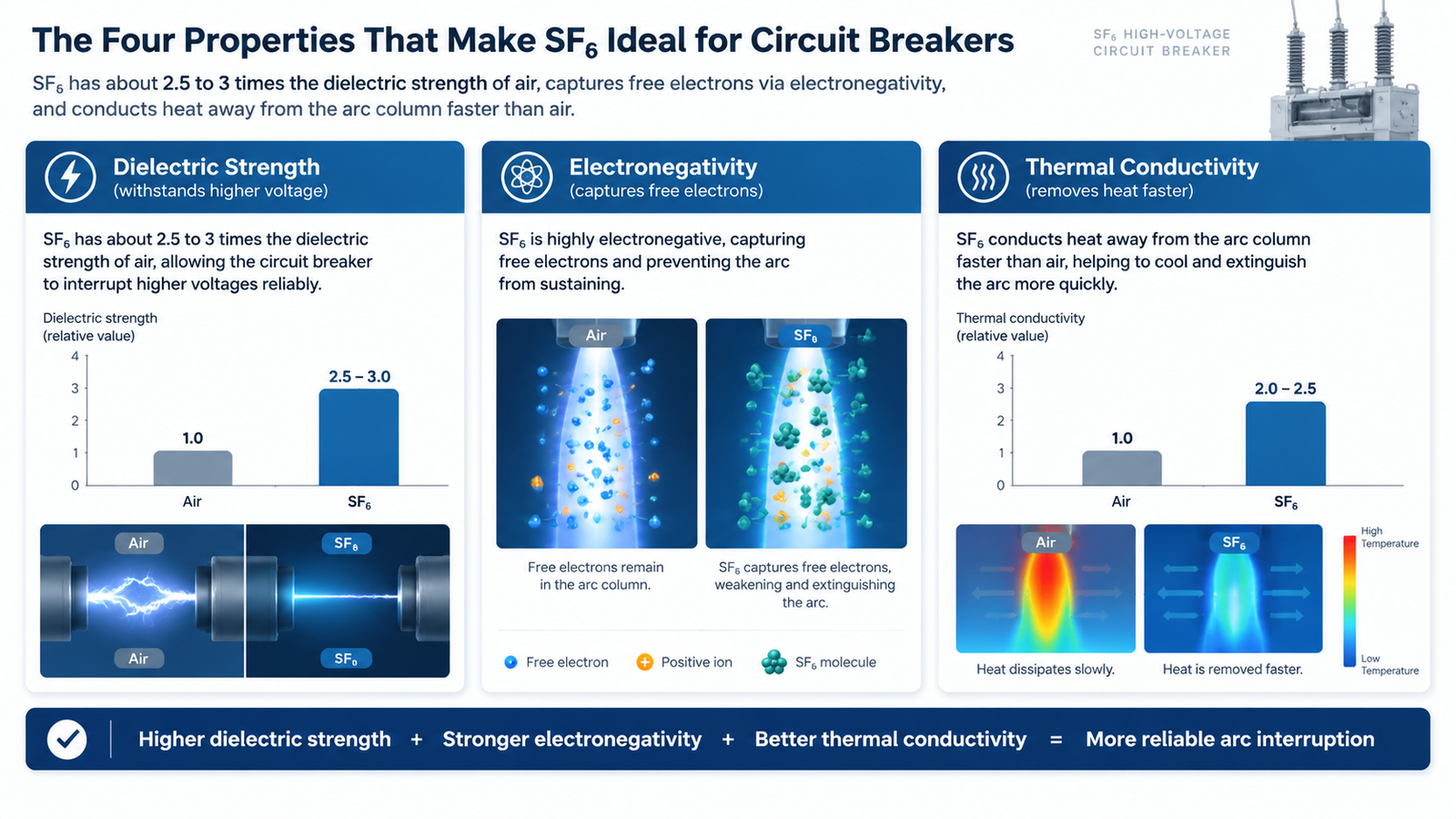
An SF6 circuit breaker uses sulfur hexafluoride (SF6) as both the insulating and arc-quenching medium inside a sealed interrupter chamber. The reason SF6 dominates high-voltage interruption is not one single property but a combination of four: very high dielectric strength, strong electronegativity, high thermal conductivity, and chemical stability. Together, they let an SF6 breaker interrupt tens of kiloamps of fault current in a few tens of milliseconds, recover its insulation almost instantly, and keep running for decades inside a quiet, sealed gas system.
This guide answers the question of why SF6 gas is used in circuit breaker design from a practical, datasheet-driven angle. It walks through each of the four properties, shows how they extinguish the arc, compares SF6 with air, oil, and vacuum media, and finishes with what those properties mean when you select an outdoor 40.5 kV or 72.5 kV SF6 breaker. If you are evaluating high-voltage switchgear for a substation, an industrial feeder, or a capacitor bank, this is the physics behind the ratings on the nameplate.
Sulfur hexafluoride (chemical formula SF6) is a synthetic, man-made gas. It is colorless, odorless, non-flammable, and roughly five times denser than air. Under normal switchgear conditions it is chemically inert, so it does not react with copper, silver, aluminum, or steel at the temperatures found inside an interrupter. The molecule is octahedral — one sulfur atom locked to six fluorine atoms — and the strong S–F bonds make it stable up to about 500 °C in dry environments.
SF6 was first used in a high-voltage circuit breaker in 1953 and quickly became the default interrupting medium for voltages from 12 kV to 800 kV. Today it is the working fluid in most outdoor transmission breakers, in distribution-class units, and inside gas-insulated switchgear (GIS). The reason it replaced oil, air, and air-blast designs is that it solves all four jobs a circuit breaker has to do at once: insulate live parts, carry load current, interrupt fault current, and recover dielectric strength fast enough to withstand the transient recovery voltage after the arc goes out.
No single property explains SF6’s success. It is the way high dielectric strength, electronegativity, thermal conductivity, and chemical stability reinforce each other that lets a sealed gas chamber do what an oil tank or an air-blast pipe cannot.
At the same pressure, the dielectric (insulating) strength of SF6 is roughly 2.5 to 3 times that of air. In numbers often cited by switchgear designers, the breakdown strength of SF6 is around 8–10 kV/mm at atmospheric pressure and reaches 25–30 kV/mm at typical interrupter fill pressures of 0.4–0.6 MPa. The practical consequence is straightforward: for a given voltage class, the contact gap inside an SF6 interrupter can be much shorter than in air, which shrinks the whole interrupter and the porcelain or composite insulators that support it.
Shorter contact gaps also reduce the mechanical energy the operating mechanism has to deliver. That is one reason a modern single-pressure puffer SF6 breaker can use a simple spring mechanism even at 245 kV, while an equivalent air-blast breaker needs a large compressor plant.
SF6 is strongly electronegative: its molecules readily capture free electrons and form heavy, relatively immobile negative ions such as SF6⁻. In an arc, those free electrons are the charge carriers that keep the gas column conductive. By sweeping them out of the gap, SF6 removes the very particles the arc needs to stay alive.
The attachment coefficient of SF6 is roughly two orders of magnitude higher than that of air. In practice, this means the gas between the contacts regains its dielectric strength within microseconds of current zero, and the arc cannot restrike against the transient recovery voltage that appears across the gap right after interruption. The same physics is the reason SF6’s arc-quenching ability is typically quoted as about 100 times that of air at the same pressure.
SF6 has higher thermal conductivity than air, especially at the elevated temperatures (above 2,000 K) found in the arc column. The gas carries heat away from the arc core and cools the surrounding gas rapidly, which keeps the post-arc channel cool enough to withstand recovery voltage. In a puffer interrupter, the opening stroke compresses the gas and forces a high-velocity jet (often above 200 m/s) through a PTFE nozzle directly across the arc. The combination of forced convection and electron capture is what lets an SF6 breaker interrupt 40 kA, 50 kA, or even 63 kA fault currents in a few tens of milliseconds.
Under normal switchgear conditions SF6 is inert. It does not burn, it does not support combustion, and small quantities that escape the chamber are non-toxic at room temperature. The same molecule survives the arc: any decomposition products formed in the hot zone (mainly SF4 and SF2) recombine into SF6 within about 10⁻⁴ seconds as the gas cools, so the gas stays usable operation after operation. Two practical caveats follow from this stability: any moisture in the chamber must be controlled to well below 200 ppm, because water vapor can react with SF4 decomposition products to form corrosive hydrofluoric acid; and at very low ambient temperatures the higher fill pressures can condense SF6 into liquid, so heaters and density switches are needed in cold climates.
| Property | SF6 behavior | Why it matters in a breaker |
|---|---|---|
| Dielectric strength | 2.5–3× air at equal pressure; up to ~30 kV/mm at 0.5 MPa | Shorter contact gap, compact interrupter, smaller porcelain column |
| Electronegativity | Captures free electrons; forms immobile SF6⁻ ions | Fast dielectric recovery at current zero; arc cannot restrike |
| Thermal conductivity | Higher than air above 2,000 K | Rapid arc cooling, lower arc energy, longer contact life |
| Chemical stability | Inert, non-flammable, recombines after arcing | Sealed gas system, long service life, low maintenance |
| Density vs air | ~5× air | Compact gas storage and density-monitor calibration |
When a protection relay trips the breaker, three things happen in the chamber within a few tens of milliseconds:
On the outside, you see a quiet, almost instantaneous current interruption. Inside the chamber, it is a tightly choreographed sequence of gas dynamics and plasma physics. The same sequence that lets a single 245 kV SF6 interrupter replace four or five vacuum bottles in series at 145 kV is the sequence that gives SF6 breakers their compact footprint in substations and inside GIS bays.
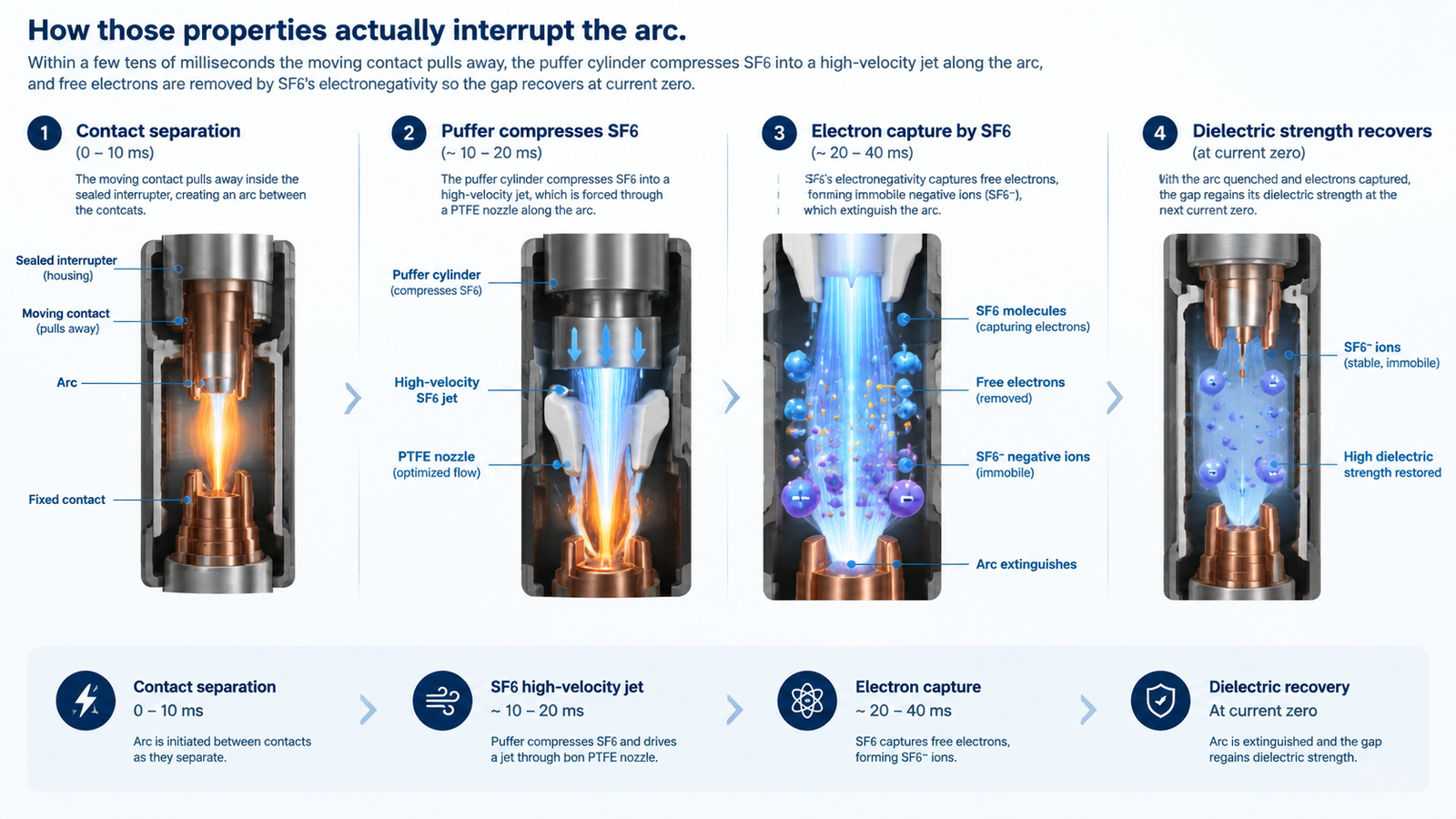
Every interrupting medium is a compromise. SF6 is unmatched in high-voltage transmission and sub-transmission, but it is not the right choice for every voltage class. The table below compares the four media on the properties that matter for switchgear selection.
| Medium | Dielectric strength | Arc-quenching mechanism | Typical voltage class | Main trade-off |
|---|---|---|---|---|
| SF6 gas | Very high (~30 kV/mm at 0.5 MPa) | Electron capture + forced gas blast | 12 kV to 800 kV (incl. GIS) | High global-warming potential; gas handling discipline required |
| Compressed air | Low (baseline) | Convective cooling, blasts arc out of nozzle | Historically up to 765 kV, now niche | Large compressors, hot exhaust, noisy |
| Vacuum | Very high across tiny gap | Metal-vapor condensation at current zero | Medium voltage, typically up to 36–40.5 kV | Hard to scale above ~72.5 kV; DC interruption needs special design |
| Mineral oil | High (~15–20 kV/mm) | Hydrogen gas generated by arc decomposes oil; cools arc | Distribution (mostly legacy) and some EHV historically | Fire risk, oil handling, maintenance-intensive |
The combination of compact footprint, very short arcing time, and quiet operation is what keeps SF6 the default at 40.5 kV and above, even with the F-gas regulatory pressure. In the medium-voltage range, vacuum interrupters increasingly take over below 40.5 kV, and that is one reason the SF6 cluster of articles on this site focuses on the 40.5 kV to 145 kV classes, where SF6 is still the natural choice.
Once you understand the physics, the datasheet starts to make sense. Three numbers on an outdoor SF6 breaker all come back to the four properties above.
The working principle behind each of those ratings is the same — how an SF6 circuit breaker interrupts current — but the rated gas pressure, mechanical life, and breaking capacity decide whether a particular breaker fits your substation.
SF6 is a very potent greenhouse gas, with a 100-year global warming potential of about 23,500 times that of CO2 and an atmospheric lifetime over 3,000 years. Modern sealed breakers leak less than 0.1% per year, but regulations under the EU F-gas regime, the Kigali Amendment, and equivalent national rules require strict leak monitoring, record-keeping, and end-of-life gas recovery. Operators need gas-handling carts, certified recovery cylinders, and trained personnel.
Two other limitations matter for designers:
Alternative gases (C4F7N fluoronitrile mixtures, CF3I, dry air, vacuum interrupters for MV, and g3 gas mixtures) are commercially available and reduce GWP by 99% or more. They are closing in on SF6 performance for voltages up to 145 kV, but at 245 kV and above SF6 remains the proven and most economical medium.
SF6 is used in circuit breakers because it is a synthetic, stable gas with a unique combination of high dielectric strength, strong electronegativity, high thermal conductivity, and chemical inertness. Those four properties let a sealed gas chamber interrupt enormous fault currents, recover its insulation in microseconds at current zero, and do it quietly and repeatedly for decades. The result is the compact, reliable, low-maintenance high-voltage breaker that protects substations from 12 kV distribution feeders up to 800 kV transmission lines.
When you compare SF6 breakers, the four properties are the same — what changes is how the manufacturer rates the gas pressure, the mechanical life, and the breaking capacity. Browse the full high-voltage SF6 circuit breaker lineup, or contact Hairui Electric with your system voltage, fault level, and ambient conditions for a specification-matched recommendation.
SF6 has about 2.5 to 3 times the dielectric strength of air at the same pressure, and it is strongly electronegative, so it captures the free electrons that sustain an arc. That lets a much smaller interrupter handle much larger fault currents than air can, with very short arcing time and almost instantaneous dielectric recovery at current zero.
The SF6 molecule has a high electron affinity — it readily captures a free electron and forms a heavy, relatively immobile SF6⁻ ion. In an arc, removing free electrons stops the conduction channel, and the gap regains its insulating strength in microseconds, which is what lets the arc go out and stay out at the next current zero.
At the same pressure, SF6 is roughly 2.5 to 3 times stronger than air as an insulator. At the fill pressures used in modern interrupters (0.4–0.6 MPa), its breakdown strength can reach 25–30 kV/mm — comparable to or higher than transformer oil at the gaps used in a circuit breaker. This is why SF6 interrupters can use much shorter contact gaps than air-blast designs.
Under arcing, a small fraction of the gas decomposes into SF4, SF2, and other by-products. As the gas cools, those species recombine into SF6 within about 10⁻⁴ seconds, so the gas stays usable operation after operation. The two failure modes operators actually watch for are moisture (which forms corrosive HF if it reacts with SF4) and gradual leakage, both of which are detected by the density monitor and periodic gas quality checks.
SF6 has a 100-year global warming potential of about 23,500 times that of CO2 and an atmospheric lifetime over 3,000 years, which is why F-gas regulations require leak monitoring and end-of-life recovery. Commercially available alternatives include fluoronitrile (C4F7N) mixtures with CO2 buffer gas, dry air, and g3 gas mixtures. They reduce GWP by 99% or more, but at 245 kV and above SF6 still offers the best combination of proven reliability, footprint, and cost.
SF6 fills the sealed interrupter chamber where the contacts open and close, the gas ducts and puffer cylinder that drive the gas flow during interruption, and the insulating spaces between live parts inside the chamber. In outdoor live-tank designs, the gas also provides the dielectric between the interrupter and the porcelain or composite insulators, while the insulators themselves provide the dielectric to ground.