Offshore Wind 66 kV Collection Systems: Breaker Selection for Salt Spray and Vibration
How 66 kV changed the collection system, what C5-M salt spray demands in measurable terms, and why the breaker boundary runs along the shoreline.
Read More
A buyer who has just approved the routine test report for a 145 kV breaker sometimes receives a photograph of the tank pressure gauge showing 0.03 MPa and assumes something is wrong. Nothing is wrong. The breaker left the works evacuated and back-filled with dry nitrogen, and it will stay that way until a commissioning engineer is standing next to it with a vacuum pump and a cylinder of SF6. Understanding sf6 circuit breaker shipping means understanding why the most expensive gas in the switchgear business is deliberately left out of the equipment for the entire journey.
The answer is a compound of regulation, physics, money and moisture. Transporting a high voltage SF6 circuit breaker at rated pressure is prohibited by dangerous-goods rules for pressurised equipment in most jurisdictions, invites leaks of a gas with a global warming potential around 25 200, puts a 0.5 MPa mass of gas at risk of loss through a single gasket disturbed by road vibration, and does nothing to keep moisture out. Nitrogen at a few tens of kilopascals does all four jobs at once: it is legal, it is cheap, it is dry, and it holds a positive pressure that keeps humid air from migrating inward.
This guide covers the transport pressure window, the shock and vibration limits that actually break porcelain, the moisture problem that sea freight creates, the storage clock that starts on arrival, and the unpacking inspection that decides who pays for a damaged shipment.
The practice is written into the standards rather than invented by exporters. JB/T 9694 requires each sealed gas compartment to be charged with a low-pressure dry gas before packing, and recommends 0.02–0.05 MPa gauge. DL/T 662 specifies 0.03–0.05 MPa of dry pure nitrogen for transport and storage, with all interfaces open to atmosphere fully sealed. Manufacturer manuals for dead-tank breakers state the same figure: 0.02–0.05 MPa of SF6 or high-purity nitrogen before packaging.
| Transport medium | Typical holding pressure | Why it is used | What it cannot do |
|---|---|---|---|
| Dry nitrogen (99.999 %) | 0.02–0.05 MPa gauge | Legal to ship, dry, cheap, positive pressure excludes moist air, no GWP liability | Cannot be used to energise; must be evacuated and replaced on site |
| Low-pressure SF6 | 0.02–0.05 MPa gauge | Allows a dielectric check on arrival without a gas change | Carries the full GWP liability and the leakage accounting with it |
| Dry air | 0.02–0.05 MPa gauge | Acceptable where nitrogen supply is difficult | Higher moisture risk than nitrogen if the dryer fails |
| Rated-pressure SF6 | 0.4–0.6 MPa gauge | Nothing — this is the practice that regulations prohibit | Illegal for most modes, and loses gas through any disturbed joint |
Two of these rows deserve a comment. Low-pressure SF6 is used by some manufacturers because it lets the receiving engineer take a gas sample and run a quick dielectric check before installation. It is a legitimate choice, but it means the shipment carries a greenhouse-gas inventory that must be accounted for in the importer’s F-gas records, and any loss in transit becomes a reportable event rather than a minor nitrogen top-up. Rated-pressure shipment, meanwhile, is not merely inadvisable — it is the thing the rules exist to prevent.
There is a second, quieter reason for nitrogen that rarely appears in the packing specification. A dry nitrogen blanket at positive pressure is a moisture barrier in its own right. Air at 30 °C and 80 % relative humidity carries roughly 24 g of water per cubic metre; a tank held at 0.03 MPa of dry nitrogen is held at a dew point far below the ambient, so any microscopic ingress dilutes into a dry buffer instead of condensing on an insulator surface. That is the difference between a breaker that passes its commissioning dew-point check and one that needs a dry-out procedure before energisation.
The 0.02–0.05 MPa band is narrow for a reason, and both edges are functional limits rather than round numbers.
At the lower edge, roughly 0.02 MPa, the tank is barely above atmospheric. Below this the gauge becomes an unreliable indicator of sealing, because a small leak produces almost no pressure change against a 0.03 MPa reference; a joint that has failed completely can still read 0.01 MPa for days. JB/T 9694 puts a floor on storage pressure at 0.01 MPa precisely because below that figure the reading no longer proves integrity.
At the upper edge, 0.05 MPa is low enough to stay outside the dangerous-goods thresholds for pressurised equipment and low enough that a seal failure produces a slow bleed rather than a jet. It is also high enough that the gauge responds visibly to a leak within a shift, which is what makes the arrival pressure check meaningful. Some UHV gas-insulated equipment uses a narrower nitrogen blanket of 0.05–0.20 bar(g), which is 0.005–0.02 MPa — even lower, because the enclosures are larger and the consequence of a seal failure greater.
Practically, the receiving engineer should record the gauge reading on arrival, note the ambient temperature, and compare against the packing list figure. A drop from 0.04 to 0.035 MPa after six weeks at sea is within the noise of temperature and gauge tolerance. A drop to 0.015 MPa is a leak, and the question becomes not whether to accept the unit but who owns the cost of the investigation.
Transport damage to a high-voltage breaker is rarely a bent steel frame. It is a hairline crack in a porcelain column, a micro-fracture in a cast epoxy insulator, or a dislodged grading shield inside a tank — all of which pass a visual inspection and fail a dielectric test three months later. This is why serious logistics specifications are written in acceleration, not in adjectives.
| Axis / parameter | Typical limit | What it protects |
|---|---|---|
| Vertical (Z) | ≤ 1.5 g peak | Porcelain column in compression and tension; interrupter internals |
| Lateral (Y) | ≤ 0.8 g peak | Cantilever bending moment on bushings during cornering |
| Longitudinal (X) | ≤ 0.8 g peak | Braking loads on the support structure and mechanism |
| Speed over bridge joints, rail crossings | ≤ 8 km/h | The single most common source of vertical shock spikes |
| Road class | Class 3 or better | Continuous high-frequency vibration that fatigues joints and loosens fasteners |
Two practical consequences follow. First, air-ride or hydraulic suspension is not a luxury for a live-tank breaker with a 3-metre porcelain column; it is the only way to stay under 1.5 g on a road that is not new. Second, a shock indicator on the crate is worth more than any amount of paperwork, because it records whether the limit was exceeded rather than whether anyone noticed. A tripped shock indicator at destination is a documented fact; a crack found at commissioning is an argument.
Vibration over a long sea voyage is a different mechanism from a single shock event. Weeks of low-amplitude, high-cycle motion at 5–30 Hz work on bolted joints, terminal clamps and shipping braces rather than on insulators. This is why the breaker travels bolted to a steel base frame inside a case that is itself lashed to the container floor, and why the mechanism is left de-energised with the spring discharged — a charged mechanism under continuous vibration is a latch waiting to release.
Buyers assume the enemy at sea is salt. For a breaker in a sealed case, it is not — it is condensation, and it is generated by the container itself. A steel container cycling between 15 °C at night and 45 °C in sun on deck drives moisture out of pallets, dunnage and cardboard, which then condenses on the coolest surface available. On a shipment of electrical equipment, the coolest surface is frequently the porcelain.
The defence is layered, and every layer is inspectable at destination.
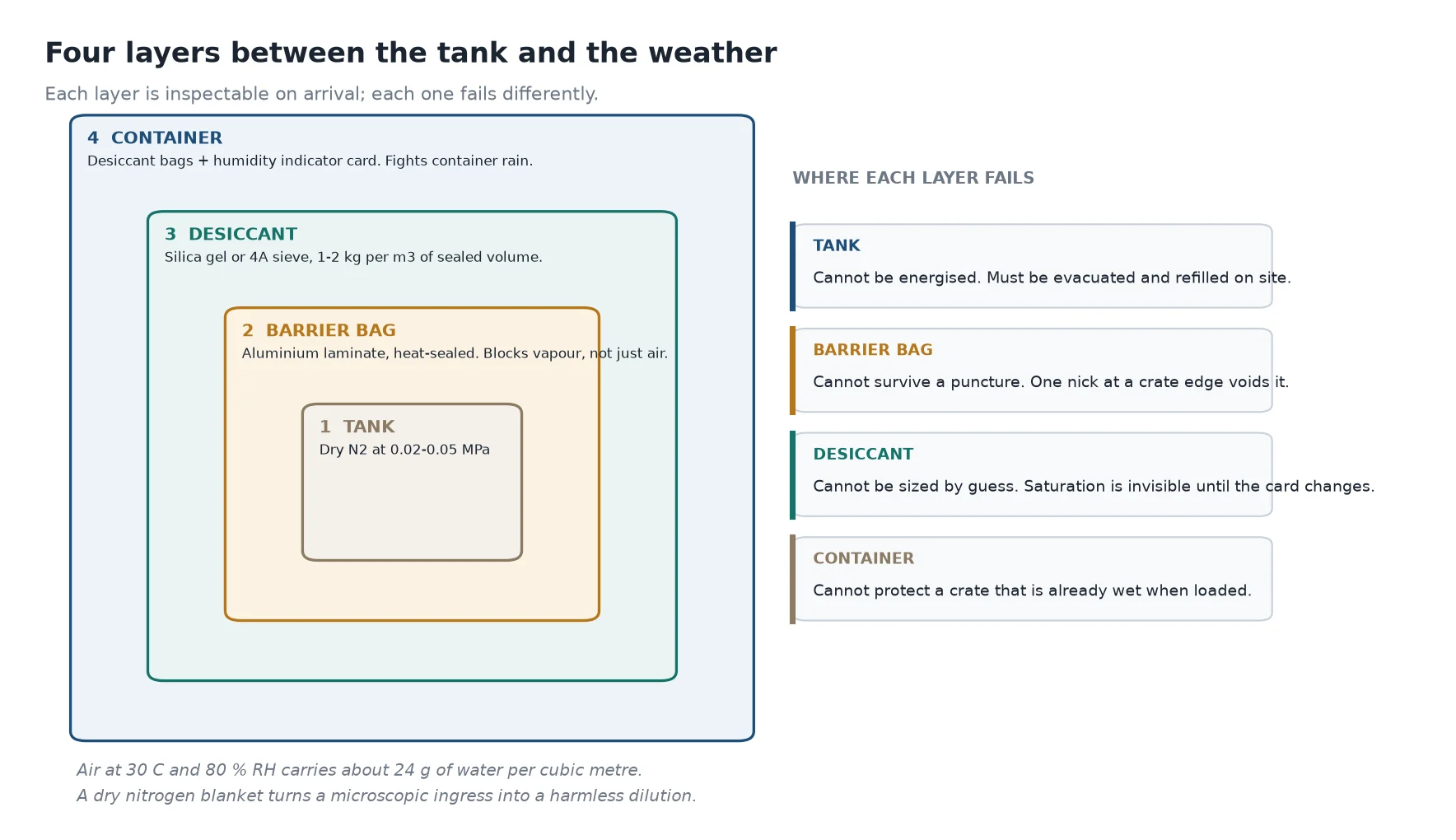
Rust is the visible failure and moisture is the invisible one. A breaker can arrive with bright, clean terminals and a dew point of −25 °C in the tank instead of the specified −40 °C, and nothing in the visual inspection will reveal it. That is why the humidity indicator card and the desiccant condition are inspection items, not packaging decoration, and why the commissioning dew-point measurement is not a formality.
The physical arrangement differs by construction, and the difference matters commercially because it drives freight cost. In SF6 circuit breaker shipping terms, the two architectures are not interchangeable cargo.
A dead-tank breaker travels as a single heavy body with bushings often removed and packed separately. The tank is the structural member, the centre of gravity is low, and the main risk is point loading on the base frame. A live-tank breaker with a porcelain column travels upright, with a high centre of gravity and a slender section that cannot tolerate side loads; it needs a purpose-built cradle, often a steel frame that carries the column in compression rather than relying on the porcelain itself. This is one of the practical differences covered in the live tank versus dead tank comparison, and it shows up in the freight quotation before it shows up on site.
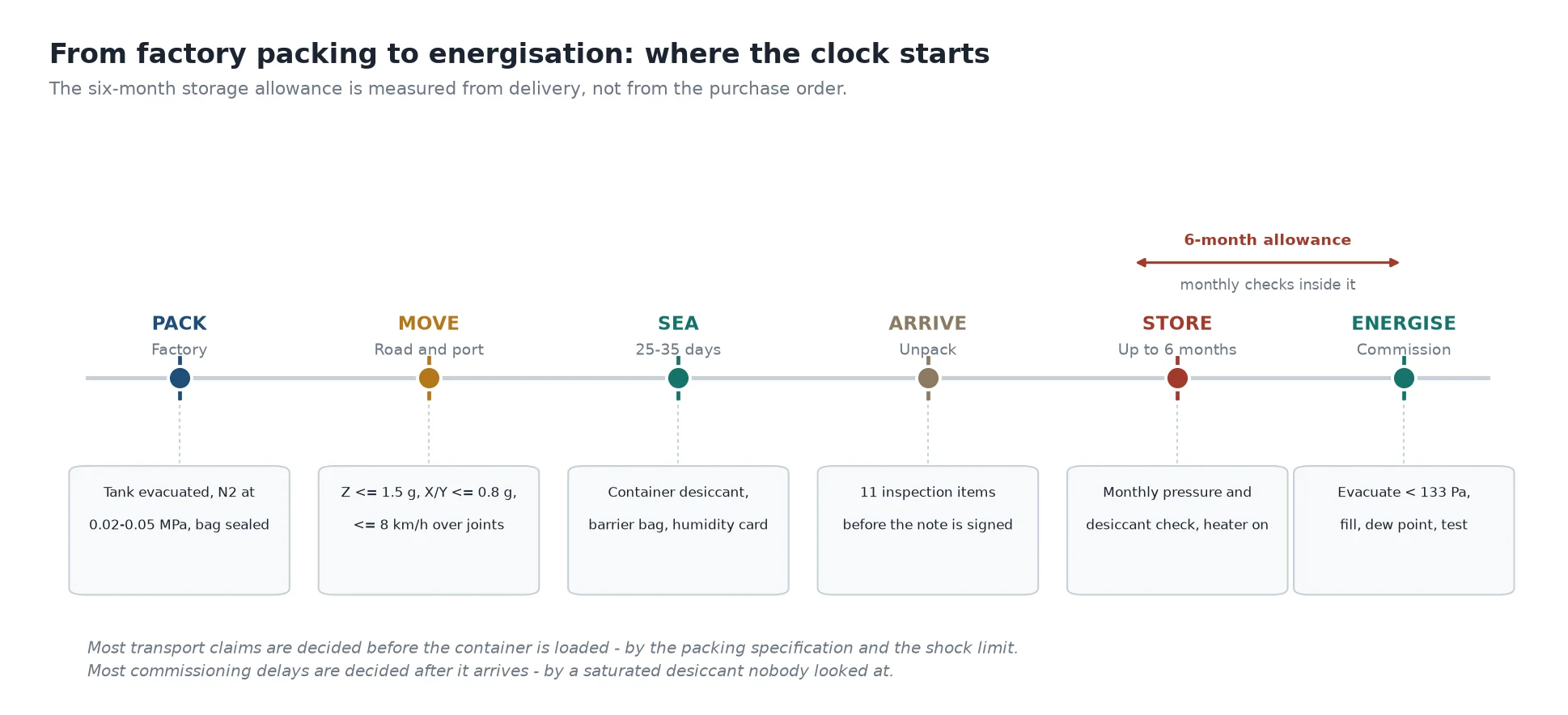
Three loading rules recur in every incident report. The case must be lashed to the container floor, not merely blocked, because blocking shifts as dunnage compresses. Nothing may be stacked on the breaker case, since the crate’s strength is designed for its own mass in one direction only. And the case must be marked for lifting points, centre of gravity and “this way up” — with the marks matching the actual crate, because a crane operator follows the stencil, not the drawing.
Porcelain deserves a specific mention. Transport breakage of bushings is the most common physical damage claim on HV breaker shipments, and it is almost always attributable to a sling placed on the porcelain rather than on the flange, or to a crate that was rolled. Where the destination is coastal or the route involves transhipment, the composite versus porcelain bushing decision is partly a logistics decision: composite sheds impact and weighs less, at a price.
Most manufacturers specify that a breaker should be energised within about six months of delivery, and that storage beyond that period triggers a re-inspection routine. The number is not arbitrary. Three things degrade with time in storage: the gas blanket pressure, the desiccant, and the insulation surface condition.
| Storage condition | Requirement | Check interval |
|---|---|---|
| Location | Dry, ventilated, dust-free; indoors or a weatherproof shelter for indoor-rated units | Continuous |
| Orientation | Upright, on its own base, never stacked or laid down | On placement |
| Gas blanket pressure | Not below 0.01 MPa; top up with dry nitrogen if it falls | Monthly |
| Desiccant | Present and still indicating dry; replace when the indicator changes | Monthly |
| Anti-condensation heaters | Energised where a supply is available; otherwise desiccant plus periodic inspection | Continuous / monthly |
| Mechanism | Springs discharged, no control supply connected, terminal clamps protected | On placement |
| Long-term (> 6 months) | Formal re-inspection: gas dew point, density relay calibration, contact resistance baseline, insulation resistance | At the six-month mark and annually |
The heater question is the one that decides outcomes in tropical projects. An outdoor breaker’s mechanism box and terminal chambers are fitted with anti-condensation heaters precisely because the equipment sits at ambient temperature and dew point all year. In storage, with no auxiliary supply, that heater is dead, and the box becomes a condensing chamber. The correct response is either to energise the heater from a temporary supply — which requires the buyer to plan for it before the crate is opened — or to keep the desiccant fresh and accept that a dry-out will be needed before energisation. What is not correct is to leave the breaker in a yard for eight months with the heater disconnected and the desiccant saturated, and then be surprised by a low insulation resistance reading in the cold-climate and high-altitude commissioning checks.
Coastal yards add the salt dimension. Stored equipment within a few kilometres of the sea accumulates conductive contamination on creepage surfaces at a rate that has to be cleaned before energisation, and a breaker specified for pollution class III installed in a class IV yard will show it within a few years regardless of how well it was stored.
The inspection window is short and the commercial stakes are asymmetric. Once the crate is opened and the delivery note signed without remarks, the burden of proving transport damage shifts to the buyer. Eleven items are worth recording, with photographs, before anything is moved.
| Item | What to record | Why it matters |
|---|---|---|
| Shock and tilt indicators | Tripped or not, with photograph | Direct evidence that an acceleration limit was exceeded |
| Case condition | Dents, punctures, water staining, crushed corners | Points to handling damage and water ingress |
| Gas blanket pressure | Gauge reading plus ambient temperature | Proves whether the tank seal survived |
| Humidity indicator card | Colour against the reference scale | The only record of the moisture history inside the bag |
| Desiccant condition | Dry, partially saturated or exhausted | Tells you whether the barrier held |
| Porcelain and composite parts | Cracks, chips, glaze damage, especially at flanges | The most common physical claim |
| Paint and galvanising | Scratches, corrosion, touch-up needed | Corrosion starting under a crate travels fast |
| Mechanism box | Door seal, internal condensation, heater wiring intact | Where moisture damage concentrates |
| Accessories and loose parts | Against the packing list, item by item | Missing hardware delays commissioning by weeks |
| Documents | Packing list, certificate of conformity, routine test report, manual, gas schematic | Without the routine report the warranty chain has a gap |
| Density relay reading | Value and temperature, compared with the transport figure | The first functional indication of a gas-side problem |
Two of these are routinely skipped and should not be. The humidity indicator card is the only artefact that records what the inside of the barrier bag experienced; once the bag is opened it is unrecoverable evidence. And the density relay reading on arrival is the earliest functional signal available, because the relay is a temperature-compensated instrument that will tell you the truth about the gas blanket even when the gauge is ambiguous — the same instrument described in the gas density monitor guide, doing its first useful job before the breaker is even installed.
Commissioning after storage follows a sequence that is worth stating because skipping a step is how moisture gets into a tank.
The nitrogen blanket is released, the tank is evacuated to below about 133 Pa (1 mbar) and held to confirm the seal, and the vacuum is broken with dry nitrogen or with SF6 vapour before the final fill. This double-purge step is what removes the residual air and moisture that a single evacuation leaves behind. The SF6 is then filled to the rated density, not to a pressure — the distinction matters because the gas quality specification is written in density and dew point terms, not in gauge pressure at whatever temperature the site happens to be. A dew-point measurement and a purity check follow, and only then does the breaker get its contact resistance baseline, timing test and interlock verification.
The gas handling itself has its own discipline, covered in the on-site SF6 gas handling guide: recovery rather than venting, service carts with appropriate pressure ratings, and a log that records mass in and mass out. A commissioning crew that vents the transport gas to atmosphere — even nitrogen — sets a bad precedent for the fill that follows.
Finally, a word on the commercial value of all this. The difference between a shipment that commissions in three days and one that sits for six weeks waiting for a dry-out, a replacement bushing or a missing accessory is usually decided before the container was loaded. A supplier who can produce a packing specification, a shock-limit statement and an unpacking checklist before the order is placed is telling you something about how the equipment was built. That is why the documents in this article are worth requesting alongside the price — see the porcelain column breaker documentation set for an example of what a complete delivery package looks like.
Because rated-pressure transport of pressurised equipment is restricted, because SF6 has a global warming potential around 25 200 and any transit loss becomes a reportable emission, because road and sea vibration can disturb seals under pressure, and because a dry nitrogen blanket at positive pressure keeps moist air out of the tank. The gas is filled on site after evacuation.
Between 0.02 and 0.05 MPa gauge, depending on the manufacturer’s packing specification. Below 0.01 MPa the reading no longer proves sealing and the unit should be investigated before acceptance. Record the value with the ambient temperature, since the gauge is not temperature-compensated on the transport blanket.
Yes, with a formal re-inspection. The six-month figure is the point at which most manufacturers require the gas dew point, density relay calibration and insulation condition to be re-verified rather than assumed. Beyond that, monthly checks of blanket pressure and desiccant condition, plus protection from condensation, are what keep the equipment fit for energisation.
It should be energised if a temporary supply is available, because an unheated mechanism box in a humid climate becomes a condensing chamber. If no supply exists, fresh desiccant and a sealed barrier bag are the substitute, and a dry-out before energisation should be planned rather than discovered.
Common practice is 1–2 kg per cubic metre of sealed volume for a long voyage, adjusted for voyage duration, destination climate and the moisture content of the packing. Molecular sieve rather than silica gel is used where very low humidity is required. The humidity indicator card, not the desiccant mass, is the evidence that the calculation was adequate.
Whoever cannot produce evidence. A tripped shock indicator, a photographed crack, a recorded gauge reading and a humidity card colour turn a dispute into a claim. A signed clean delivery note without remarks turns the same damage into the buyer’s cost.
For the full set of delivery, testing and installation criteria across the range, see the SF6 circuit breaker technical library.