Arc Furnaces and Mining Substations: Frequent Switching, Harmonics and Hard Environments
Furnace and mining breaker duty quantified: 16,300 operations a year, what E2 class proves, harmonic heating, and the dust and condensation fight.
Read More
An SF6 circuit breaker spare parts list written in year one reads like an insurance policy. The same list written in year twelve reads like a confession — it is a record of everything the plant has actually needed, in the order it needed it. Between those two documents sits one decision: whether the spares were bought against the equipment’s twenty-year failure profile, or against whatever the commissioning engineer happened to remember on the day the container was unpacked.
That distinction has a commercial shape. A high-voltage breaker is expected to run twenty-five to forty years, but almost none of its individual components are expected to last that long. Gaskets harden, density relays drift, anti-condensation heaters fail silently, and the desiccant sealed inside the pole saturates years before anyone thinks to look at it. None of these failures is dramatic. Each one, left unattended, ends the same way: moisture ingress, a slow rise in acidic decomposition products, and eventually a breaker that will not hold its rated insulation at the exact moment it is asked to.
The good news is that the twenty-year spares problem is finite. It has roughly nine line items, a defensible quantity for each, and a storage rule that decides whether the stock is still usable when you finally open the box. What follows is that list, with the reasoning behind every number.
A spare parts order is a purchase. A spares strategy is a schedule. The difference shows up around year eight, when the first pole needs a gasket set and the buyer discovers that the original gasket kit was bought in 2019, stored in an unventilated container in a coastal yard, and has been past its storage limit since 2021.
Two numbers frame the whole problem. The first is the breaker’s design life, typically twenty-five to forty years for outdoor live-tank and dead-tank equipment. The second is the shelf life of the elastomer that keeps the gas inside it. Under ISO 2230, a nitrile (NBR) seal has an initial storage period of seven years and an extended period of three more after inspection. An EPDM or FKM seal gets ten plus five. Neither figure reaches the breaker’s design life, which means a twenty-year strategy is not one purchase. It is at least two, with a rotation discipline in between.
For a buyer, that produces a simple rule that survives contact with reality: buy the consumables in two tranches, buy the electrical items in one, and never store either of them the way you store steel.
Field failure statistics for high-voltage breakers converge on a consistent picture. Operating mechanisms and their auxiliaries account for the largest single share of forced outages — CIGRE surveys have repeatedly put mechanism-related failures at roughly forty percent of the total, ahead of the interrupter itself. Within that bucket, the items that fail are mundane: seals, coils, heaters, thermostats, auxiliary switches, and the density monitoring chain. The maintenance interval planning guide covers how those items map onto a service calendar; this article is about what to hold in stock between intervals.
What matters for spares planning is the sequence. Seals fail first, but quietly — a slow permeation leak that takes years to trip an alarm. Heaters fail second and completely silently, because nothing monitors them. Density relays fail third, and they fail in the most deceptive way possible: the breaker still holds pressure, but the relay reports the wrong number. Coils fail last, usually at the worst moment, because a coil that has absorbed moisture for a decade tends to fail during a trip attempt rather than during a test.
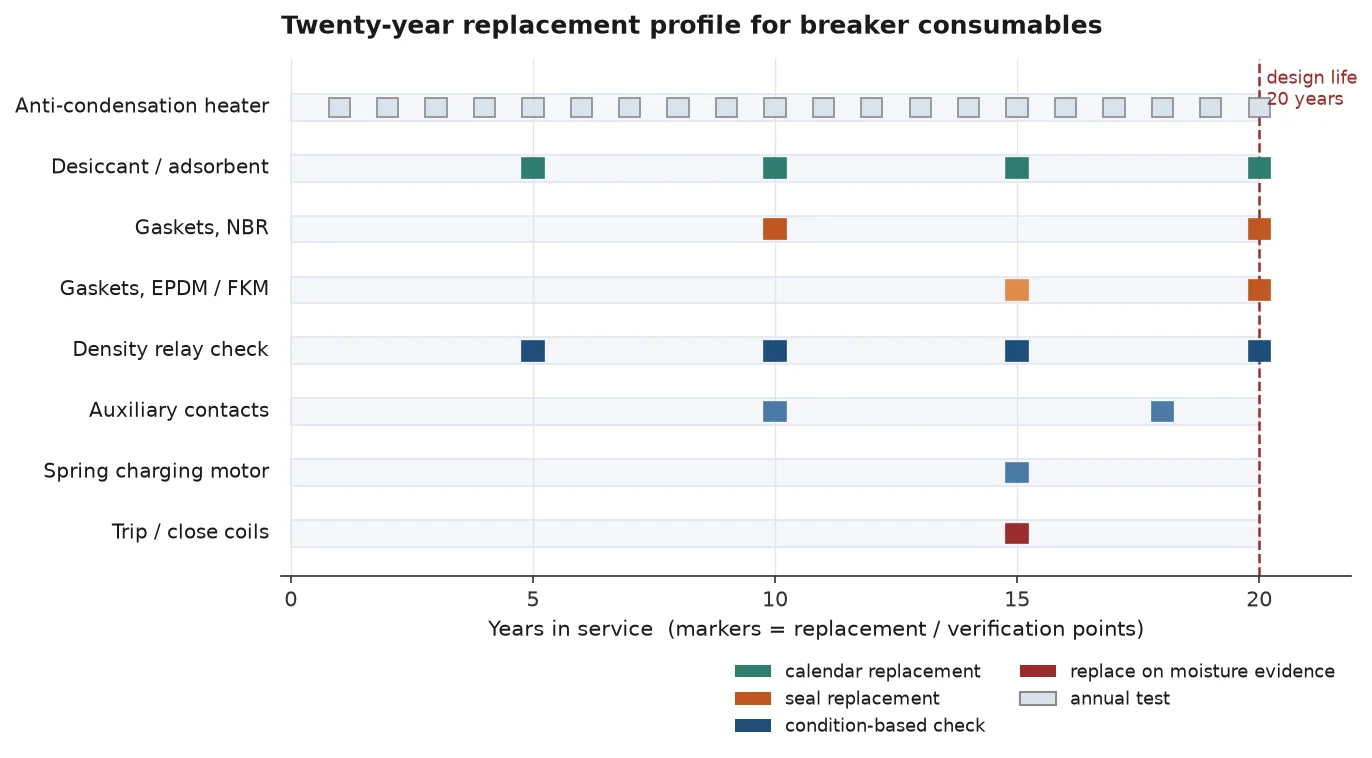
The chart above is the whole strategy on one axis. Everything on the upper band is replaced on a calendar; everything on the lower band is replaced on evidence. Confusing the two is how plants end up with eleven spare gasket sets and no spare density relay.
The list below is what a twenty-year spares holding should contain for outdoor SF6 breakers in the 40.5 kV to 252 kV range. Quantities are discussed in a later section; the point here is the specification, because a spare that does not match the original is not a spare.
| Item | What to record on the order | Replacement driver | Consequence if deferred |
|---|---|---|---|
| Gasket / O-ring set | Material, inner diameter, cross-section (to 0.1 mm), drawing number | Calendar and each gas work | Permeation leak, moisture ingress |
| Gas density relay | Rated pressure, alarm and lockout set points, compensation type | Drift at calibration check | False alarm or, worse, no alarm |
| Anti-condensation heater | Voltage, wattage, physical form, thermostat pairing | Open circuit on resistance test | Condensation in the cabinet, corrosion |
| Thermostat | Set point, differential, contact rating | Chatter or stuck closed | Heater runs continuously or never |
| Desiccant (molecular sieve / activated alumina) | Grade (13X or equivalent), mass, container type | Weight gain above 15 percent | Rising dew point, acid build-up |
| Trip coil | Voltage, DC resistance, stroke, mounting | Resistance drift, moisture | Breaker fails to trip |
| Close coil | Voltage, DC resistance, stroke | Resistance drift | Breaker fails to close |
| Auxiliary contact block | Contact count, NO/NC split, cam profile | Pitting, misalignment | Wrong position indication, interlock failure |
| Spring charging motor | Voltage, power, gear ratio | Brush wear, gear wear | No recharge after a close-open cycle |
Two entries on that table deserve more than a row. The gasket set is the item most often bought wrong, and the density relay is the item most often bought late.
Elastomer seals are the cheapest line on the list and the one that decides whether the other eight items are ever needed. They are also the only item whose failure mode begins in the warehouse rather than in service.
ISO 2230 sorts vulcanised rubber into three storage groups. Group A, which covers natural rubber, SBR and polyurethane, gets an initial storage period of five years plus two after inspection. Group B — nitriles, acrylics, butyls — gets seven plus three. Group C, which covers EPR, EPDM, silicones and fluoroelastomers, gets ten plus five. The initial period runs from the date of manufacture, not the date of purchase, which is why the manufacture date on the bag matters more than the invoice date in the file.
In SF6 service the material choice then sets the in-service clock. Nitrile is common and cheap and behaves acceptably in clean gas, but it is the least ozone-resistant of the three and tends to harden at the ten-year mark. EPDM and FKM both tolerate the decomposed gas environment better and are commonly quoted at fifteen to twenty years in service. That difference is worth specifying at the original order, because a breaker bought with NBR seals will consume two gasket sets in twenty years where an FKM unit consumes one.
There is a dimensional trap that costs more than the material choice. An O-ring with the same outer diameter but a different cross-section is not interchangeable. A 5.7 mm section and a 6.0 mm section will both seat in the same groove, and the thicker one will be over-compressed axially, which accelerates compression set and produces exactly the leak the replacement was meant to stop. Record the cross-section to 0.1 mm on the spare parts order and verify it with a caliper before fitting.
Some manufacturers go further than ISO 2230 and impose their own shelf limit. Siemens, for example, states a two-year shelf life for spare gaskets and does not include them in the standard spare parts list at all — they are ordered against the twelve-year and twenty-five-year maintenance intervals instead. That is a defensible position for a manufacturer holding stock in a climate-controlled warehouse. For a plant in a coastal or tropical yard, the practical answer is different: keep one gasket set per breaker type, keep it sealed in its original opaque packaging, and date-stamp it on receipt so the oldest set is used first.
A temperature-compensated density relay contains a sealed reference chamber, a bellows or Bourdon element, and two micro-switches. Nothing about it can be judged by looking. A relay that has drifted two percent low looks identical to a correct one, and its only symptom is a set of readings that no longer agree with a calibrated gauge.
This is why the density relay belongs on the shelf rather than on a wish list. On a 40.5 kV breaker rated at 0.5 MPa with an alarm at 0.47 MPa, the gap between rated and alarm is only 0.03 MPa — roughly six percent. A relay with a two percent positive drift consumes a third of that margin before the gas has moved at all. The result is an alarm that arrives early, a maintenance team that tops up a breaker that did not need it, and eventually a team that stops trusting the alarm.
The reverse error is worse. A relay reading high will not alarm until the density is genuinely low, and by then the breaker is operating below its minimum functional pressure. For a 0.5 MPa design with a 0.45 MPa lockout, that is a narrow band to discover by accident.
Two practices make the relay manageable. First, stock one spare relay per breaker type rather than per breaker — the relay is interchangeable across a model family, and the failure rate does not justify one per unit. Second, verify the relay against a calibrated reference at every major service interval rather than waiting for it to disagree with something. The density monitor guide covers the wiring and set-point logic in detail; the spares decision here is simpler — own a replacement before you need to diagnose one.
An anti-condensation heater is a resistive element in a control cabinet, switched by a thermostat, drawing somewhere between fifty and two hundred watts. It has no feedback. Nothing in the SCADA system knows whether it is working, and its failure produces no alarm, no event log entry, and no change in any reading a remote operator can see.
What it produces instead is condensation. In a humid climate, a cabinet that cycles between day and night temperatures will sit below dew point for part of every day. The heater exists to keep the interior a few degrees above ambient so that moisture condenses on the cabinet wall rather than on the coil insulation and terminal blocks. When the heater fails, nothing happens for a year. Then a trip coil that has been damp for eighteen months fails on the first operation after a long idle period — and the investigation starts at the coil, which is the victim rather than the cause.
Heater failures are almost always open-circuit, which makes them trivially detectable and almost never detected. Add heater resistance to the annual maintenance checklist, stock one heater and one thermostat per cabinet type, and treat a heater that reads open as a priority defect rather than a cosmetic one. The heater is the cheapest item on the list and the one with the highest ratio of consequence to cost.
The adsorbent inside an SF6 compartment has two jobs: hold the dew point down, and neutralise the acidic decomposition products that arcing creates. Molecular sieve handles the water; activated alumina handles the acids. Most high-voltage breakers use a combination of the two, mounted in the gas circulation path near the interrupter.
Quantity is where field practice and design practice part company. Design standards calculate the adsorbent mass from the mass of gas in the compartment, at roughly one to three percent by weight. Field tradition, in some regions, uses ten percent of the compartment volume instead. The two rules produce very different numbers, and the larger one is not the safer one: an over-filled filter housing releases molecular sieve dust into the tank, where the particles migrate to dynamic seals and to the exhaust nozzle, producing friction and blockage that the undersized version never would.
The mass-based rule also gives a defensible answer per breaker type, which is what a purchase order needs.
| Breaker | SF6 mass per unit | 1 percent (g) | 3 percent (g) | Ten percent rule (g) |
|---|---|---|---|---|
| LW8-40.5, 40.5 kV | approx. 8 kg | 80 | 240 | 800 |
| LW36-126, 126 kV | approx. 12 kg | 120 | 360 | 1,200 |
| LW9-72.5, 72.5 kV | approx. 9 kg | 90 | 270 | 900 |
| LW-252, 252 kV | approx. 23 kg | 230 | 690 | 2,300 |
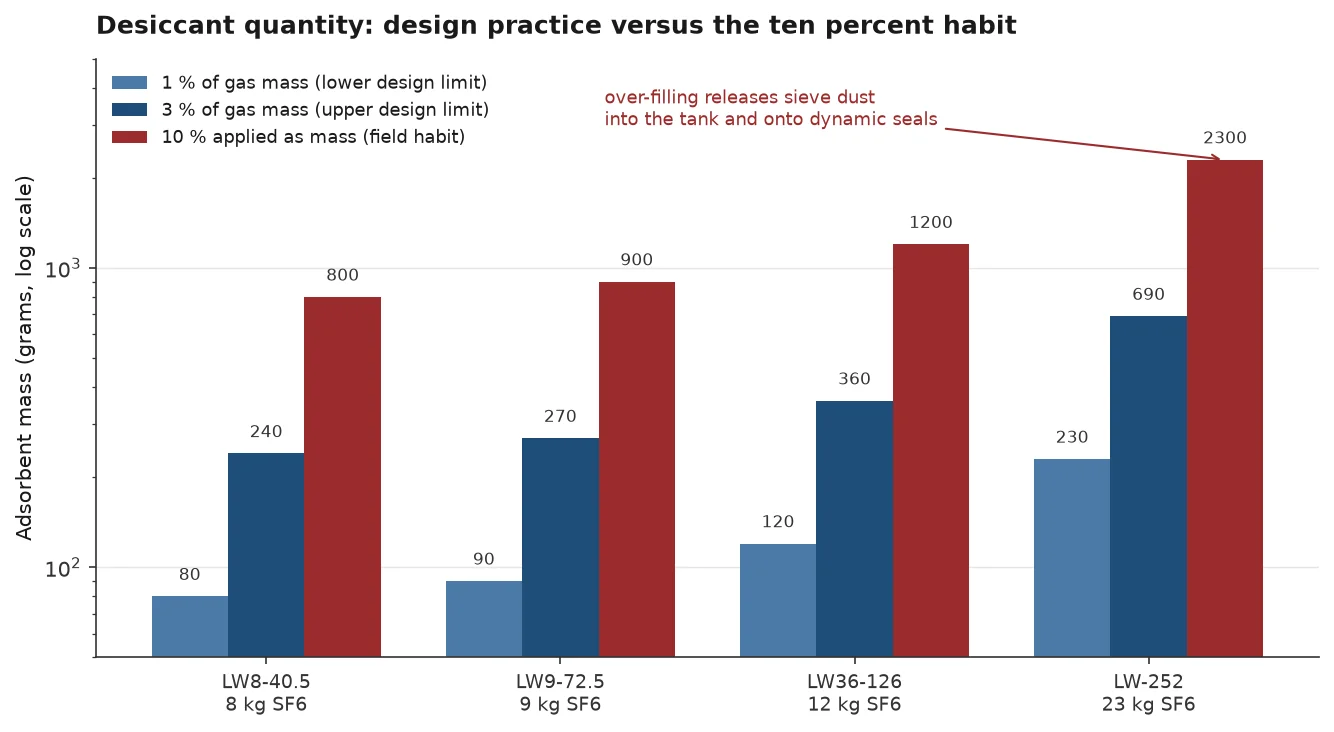
The replacement trigger is equally specific. Adsorbent is spent when its weight has increased by more than about fifteen percent, which is a moisture measurement rather than an age measurement — but most plants do not weigh their adsorbent, so the calendar stands in. Common practice replaces it at five-year intervals, with some utility standards stretching that to six to eight years where gas analysis is regular. A second trigger is mechanical: replace the adsorbent when the breaker reaches half its rated mechanical life. On a 3000-operation LW8-40.5 mechanical-life variant, that means the sieve gets changed at 1500 operations whether or not the calendar has come round.
Two handling rules decide whether the new adsorbent works. It must be baked dry before fitting — typically around 120 °C for several hours, or regenerated in dry nitrogen at 350 to 400 °C — and its exposure to ambient air during the change must stay under about fifteen minutes, because a molecular sieve starts re-adsorbing atmospheric moisture immediately. A sieve that sits open on the tank rim while the fitter looks for a spanner is a sieve that has already failed.
Coils are specified by voltage, and that is the least interesting of their three parameters. The one that matters for spares is DC resistance, because a coil with the right voltage and the wrong resistance changes the trip circuit supervision current, the coil current signature, and the time to full armature travel.
Two practices protect the spare. First, record the measured cold resistance of every coil at commissioning and keep that number with the spare parts record, not with the commissioning file that nobody opens after handover. Second, stock coils in matched pairs where the breaker uses dual trip coils. A dual-trip breaker with one original coil and one substitute of a different resistance will trip, but the two coils will not behave identically, and the asymmetry only shows up in a timing test.
Coil failure is usually a moisture story rather than a voltage story. The coil sits in the mechanism box, which is exactly where the heater is supposed to be keeping the interior dry. This is why the heater and the coil belong on the same checklist: replacing a failed coil without fixing the failed heater simply schedules the next coil failure.
Spare quantity is a function of fleet size, not of individual breaker importance. A single breaker justifies a full set because there is no redundancy to lean on. A fleet of twenty justifies a pool, because pooling is what turns nine line items into a manageable stock value.
| Fleet size | Gasket sets | Density relays | Trip / close coils | Heaters and thermostats | Desiccant |
|---|---|---|---|---|---|
| 1 to 3 breakers | 1 per breaker type | 1 per breaker type | 1 pair per breaker | 1 per cabinet | 1 charge per pole |
| 4 to 10 breakers | 1 per two breakers | 1 per three breakers | 1 pair per two breakers | 1 per two cabinets | 1 charge per two poles |
| 11 to 30 breakers | 1 per four breakers | 1 per five breakers | 1 pair per four breakers | 1 per four cabinets | 1 charge per four poles |
The relay column is deliberately more generous than the gasket column in proportional terms, because a relay cannot be improvised and a gasket sometimes can. Conversely the heater column is more generous still, because heaters fail more often than any other item on the list and cost almost nothing to hold.
One category is missing from that table on purpose: the interrupter assembly, the bushings, and the mechanism itself. These are not spares in any practical sense. They are capital items ordered against a specific failure, with lead times measured in months, and pretending otherwise inflates a spares budget by an order of magnitude without improving availability. The honest split is consumables on the shelf, capital items on a framework agreement with the manufacturer.
A spare parts store is an environment, not a shelf. The conditions that preserve an elastomer are not the conditions that preserve a coil, and neither set resembles the conditions in an unventilated container behind the workshop.
| Item | Temperature | Humidity | Specific prohibition |
|---|---|---|---|
| Gaskets and O-rings | 5 to 25 °C | 45 to 70 percent RH | No hanging, no folding, no ozone sources, no direct light |
| Density relays | Indoor, stable | Dry | No mechanical shock, keep in original packing until fitting |
| Coils | Indoor, stable | Dry, sealed bag with desiccant | No long-term exposure to humid air |
| Heaters and thermostats | Indoor | Dry | No physical deformation of bimetal elements |
| Desiccant | Indoor | Sealed, airtight container | Never store in an open bag; bake before use |
Two of those prohibitions get broken constantly. O-rings are hung on hooks because it is convenient, which stretches them into an oval that will not seal; they should lie flat in their original bags. And desiccant is decanted into a workshop jar, where it adsorbs the workshop’s humidity for a year before anyone fits it. If the store cannot hold a sealed container, the desiccant should be ordered against the job rather than held as stock. The same dew point logic that governs a nitrogen-charged breaker in a container, covered in the shipping and site storage guide, governs a spare gasket set in a store room: keep the dry boundary intact until the moment of use.
The storage question connects to a larger one that shipping and site storage practice already addresses for complete breakers: the same dew point logic that governs a nitrogen-charged breaker in a container governs a spare gasket set in a store room. Both are about keeping a dry boundary intact until the moment of use.
A spare parts order that says “one set of gaskets” will produce one set of gaskets that may or may not fit. The order needs five fields per line, and they cost nothing to add.
Record the breaker model and serial number the spare is intended for. Record the drawing or part number from the manufacturer’s renewal parts list rather than a description. Record the material specification where the part is elastomer. Record the manufacture date requirement, because a spare delivered with two years already elapsed on its shelf life is not a spare. And record the storage condition the supplier recommends, so that receiving can reject a shipment that arrives in a damp carton.
It is also worth asking, at the original breaker order rather than later, whether the manufacturer publishes a renewal parts list at all. A supplier who cannot produce one in year one will not produce one in year fifteen, and the plant will be reverse-engineering gasket dimensions from a failed seal. For a 40.5 kV breaker such as the LW8-40.5 at 0.5 MPa rated pressure, that reverse engineering is not difficult; at 252 kV, where a single pole holds around 23 kg of gas, it is expensive.
Under ISO 2230, nitrile seals have an initial storage period of seven years and EPDM or FKM seals ten years, counted from the date of manufacture and assuming storage below about 25 °C away from light and ozone. Some manufacturers impose a shorter limit of their own — two years is not unusual. Treat the manufacturer’s figure as the controlling one and the ISO figure as the maximum.
No. One spare per breaker type is normally sufficient, because the relay is interchangeable within a model family and its failure rate does not justify a unit-level holding. What does need to be unit-level is the calibration record: the set points and the last verification date for each installed relay.
Roughly one to three percent of the gas mass. For an LW8-40.5 holding about 8 kg of SF6, that is 80 to 240 grams. The widely repeated ten percent figure refers to a different calculation basis and, applied as mass, over-fills the filter housing and risks releasing sieve dust into the tank.
On three triggers, whichever comes first: weight gain above about fifteen percent, a five-year calendar interval where gas analysis is not routine, or half the breaker’s rated mechanical life. On a 3000-operation breaker the third trigger arrives at 1500 operations.
Indirectly, and commonly. A failed anti-condensation heater allows moisture to condense on coil insulation and terminal blocks over months. The heater itself produces no alarm, so the first indication is usually a coil that fails to operate — which is the consequence, not the cause.
Interrupters, bushings, complete poles and operating mechanisms. These are capital items with lead times measured in months, and holding them ties up more capital than the availability gain justifies. Cover them with a framework agreement or a documented supplier lead-time commitment instead.
It can support a maintenance-interval argument. Manufacturers that specify a twelve-year and twenty-five-year service interval are implicitly assuming that consumables are replaced on schedule; a plant that can show dated gasket and desiccant records is in a stronger position when a warranty question arises.
The pattern that emerges across twenty years is not a long list of failures. It is a short list of consumables replaced on a rhythm, plus a handful of electrical items replaced on evidence, plus one discipline that holds the whole thing together: knowing what is on the shelf and how old it is.
That discipline is cheap to install. Date-stamp every elastomer on receipt. Keep the density relay and the coils in sealed packaging with desiccant. Weigh or calendar the adsorbent rather than guessing at it. Test heaters annually, because they are the only item on the list that fails without telling anyone. And write the part numbers down at the original order, while the renewal parts list is still a current document rather than an archive request.
A breaker that reaches year twenty in good condition is rarely the one that was maintained most often. It is the one whose owner bought the right nine items, in the right quantity, and stored them properly. When a spares holding is thin and something does fail, the diagnostic sequence in the failure troubleshooting guide is the faster path than waiting for a replacement part. The full range of outdoor SF6 breakers these lists apply to sits in the SF6 circuit breaker knowledge base and the high voltage SF6 circuit breaker range; if a specific model’s renewal parts list needs to be confirmed against a serial number, send the nameplate details through the contact form and the list will be matched to the unit.