Arc Furnaces and Mining Substations: Frequent Switching, Harmonics and Hard Environments
Furnace and mining breaker duty quantified: 16,300 operations a year, what E2 class proves, harmonic heating, and the dust and condensation fight.
Read More
A composite bushing on a 252 kV breaker is 30 to 50 percent lighter than the porcelain one it replaces, does not throw shrapnel when it fails, and costs more per unit. Those three facts settle most of the argument, and the rest of this guide is the arithmetic behind them.
When you specify a circuit breaker bushing, the composite versus porcelain question looks like a materials debate. It is not. It is a decision about crane capacity, seismic load on a tank flange, what happens to the yard when a condenser core punctures, and which number you are willing to pay now versus later. Buyers who treat it as a line item on a quotation usually end up revisiting it at the first pollution flashover or the first broken delivery.
This guide covers what the two housings actually do, the weight and strength numbers that differ, the failure mode that decides safety cases, and how to compare the price honestly. It also covers the part most comparison pages skip: choosing the housing does not change the insulation core inside it, and that distinction affects what you are really buying.
A circuit breaker bushing is not a cover over a terminal. On an outdoor SF6 breaker it performs three jobs at once, and the housing only does one of them.
Inside the housing there is a separate component: the condenser core. It is oil-impregnated paper (OIP), resin-impregnated paper (RIP), or resin-impregnated fibreglass (RIF), with foils graded to spread the electric field from the conductor to the flange. That core is what actually withstands the voltage stress, and it is largely the same core whether the outside is porcelain or silicone. A composite housing with a cheap core is not an upgrade; it is a porcelain-grade bushing in a lighter coat.
So when a supplier quotes “composite”, the useful follow-up question is which core sits inside it, because the price difference between core types is often larger than the difference between the two housings.
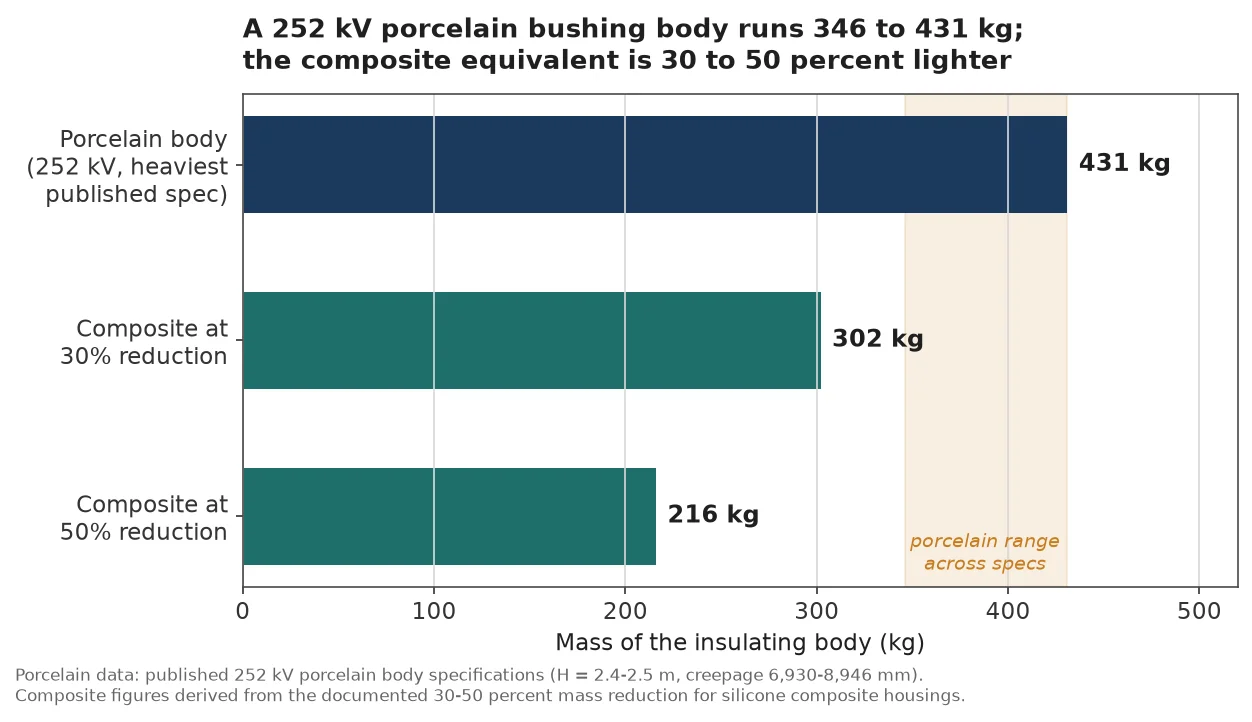
Weight is the most measurable difference and the one with the widest consequences. For the 252 kV class, published porcelain body data from a major insulator manufacturer gives a useful anchor.
| Parameter | 252 kV porcelain body | Composite equivalent |
|---|---|---|
| Mass of the insulating body | 346 to 431 kg across the standard range | Roughly 170 to 300 kg, from a 30 to 50 percent reduction |
| Body height | 2,400 to 2,500 mm | Comparable, sometimes shorter for the same creepage |
| Creepage distance | 6,930 to 8,946 mm | Comparable or longer in the same height, because sheds can be thinner and more closely spaced |
| Bending moment rating | 19.2 to 32 kN·m depending on wall thickness | Set by the GFRP tube, typically quoted as a bending load in newtons |
| Handling on site | Crane, spreader beam, two riggers, upright crating | Two people and a rope in many cases |
The 30 to 50 percent figure is not marketing. Independent comparison work on medium-voltage bushings puts composite bodies at least 30 percent lighter than porcelain equivalents, and 40 to 50 percent at the higher end of the voltage range, because the porcelain wall thickness needed for mechanical strength grows faster than the composite tube diameter does.
Why the mass matters beyond lifting: the bending moment at the flange is mass times the height of the centre of gravity times the horizontal acceleration. Halve the mass and you halve the moment at the same acceleration. That moment is what the tank shell, the flange weld and the internal support have to resist, and on a dead tank breaker it is also what decides whether the bushing needs a support insulator or a tie rod. In a seismic zone, the acceleration is not a design assumption you can negotiate, so mass is the only lever left.
There is a logistics consequence too. A 252 kV breaker with three porcelain bushings usually ships with the bushings crated separately and fitted at site, because a fully assembled unit exceeds normal transport envelopes and because the porcelain cannot take the road vibration over a long route. Composite assemblies are more often shipped fitted, which removes one site operation and one opportunity to damage a flange gasket.
Porcelain is strong in compression and weak in bending. Published material data for glazed electrical porcelain puts flexural strength around 35 MPa, against roughly 280 MPa for a silicone composite housing and over 400 MPa for a cast epoxy alternative. Those are material-level numbers and the housing geometry changes the outcome, but the ratio explains the field behaviour.
Porcelain also fails without warning. It is brittle, so a crack initiated by an over-torqued terminal clamp or a knock from a crane hook propagates to fracture instead of deforming. Composite fails differently: the GFRP tube bends, the silicone housing absorbs impact and recovers, and a damaged housing shows as a tear or a track rather than a break.
The standards reflect this. Bushings are type tested to IEC 60137, which for porcelain requires a cantilever test on the assembled bushing. Composite hollow insulators are additionally tested to IEC 61462, which requires a bending load test on the insulator body itself, and requires the test to be repeated after any change in design, material or manufacturing process. A 252 kV composite bushing datasheet typically quotes a bending load in the region of 5,000 N, with the direction of the load specified, and a partial discharge limit around 5 pC at rated voltage.
Two practical points follow. First, if your site has a history of broken bushings from handling rather than from electrical failure, the material is the fix, not the maintenance procedure. Second, when you compare datasheets, check that the cantilever or bending figure is quoted for the direction your conductor load actually acts, because a bushing that is strong in one axis can be ordinary in the other.
This is where the material choice stops being a procurement preference and becomes a safety case input.
The failure mechanism is the same for both materials. A defect in the condenser core starts partial discharge. The discharge erodes the paper or resin, the erosion becomes a puncture, and an arc forms inside the housing. The arc vaporises oil or gas, pressure builds faster than the housing can vent, and the housing bursts. Everything upstream of the burst is a manufacturing and quality-control problem. The burst itself is where the two materials diverge.
A porcelain housing shatters into high-velocity fragments. That is not a theoretical concern. In November 2019, a 1,000 kV transformer at a substation in Shandong failed when a defect in the bushing condenser core caused partial discharge, the lower porcelain housing broke and exploded, an arc went to earth, the oil vaporised, the tank over-pressured and ruptured, and the escaping oil and gas ignited. The official investigation recorded one fatality and two serious injuries. The host equipment was a transformer rather than a breaker, but the physics of a porcelain housing containing an internal arc is identical, and it is why utilities draw exclusion zones around porcelain bushings in populated yards.
A composite housing does not shatter. It tears, tracks, burns, or drops sheds. It can still be destroyed by the arc and it still needs to be replaced, and a fire on a silicone housing is a real fire. What it does not do is send fragments across the yard. For a substation next to a road, a factory wall or a public footpath, that difference is often the deciding factor in a risk assessment, independent of price.
Be clear about what the material does not buy. Composite is not explosion-proof, it does not prevent the internal fault, and it does not replace partial discharge monitoring, gas density supervision or correct protection settings. It removes one consequence of a failure, not the failure.
Silicone rubber is hydrophobic: water beads on it instead of sheeting, so a continuous conductive film does not form, and the low-molecular-weight chains in the compound migrate across a polluted surface and encapsulate the contamination. Porcelain is hydrophilic and depends on shed geometry, surface condition and cleaning. The practical effect is that the same creepage distance performs better on silicone in a wet polluted site, or the same performance is achieved with less creepage and a shorter bushing. If your site is class III or IV, the housing choice is settled before the price is discussed; the creepage and salt spray requirements themselves are covered in the guide to pollution class, creepage and salt spray for outdoor breakers.
If you are keeping porcelain, RTV coating is the retrofit path. A room-temperature-vulcanising silicone coating transfers the hydrophobic behaviour to an existing porcelain surface at a fraction of the cost of replacement, and it needs re-application on a cycle rather than being permanent.
At distribution voltage, the price multiples are published and consistent. In a like-for-like comparison at 15 kV, cast epoxy units run about 1.8 times the porcelain price and silicone composite about 2.5 times, against a mass of 3.2 kg and 4.1 kg respectively versus 7.8 kg for porcelain.
At 252 kV the multiple narrows sharply, because the porcelain body itself becomes large, heavy, difficult to fire without defects and expensive to ship. Treat the 252 kV comparison as a tier rather than a number: composite typically sits above porcelain by a margin that varies with core type, shed count and test scope, and the margin can invert entirely when the porcelain option needs extra crating, a heavier crane or a reinforced foundation.
| Cost element | Porcelain | Composite |
|---|---|---|
| Unit price, 15 kV class (index, porcelain = 100) | 100 | About 250 |
| Unit price, 252 kV class | 100 | Above 100, margin narrows with size |
| Transport | Upright crating, fragile, volume driven by protection | Lighter, can ship fitted in some builds |
| Site handling | Crane and rigging crew | Often manual or light lift |
| Routine cleaning in polluted sites | Periodic washing or RTV recoat | Substantially less frequent |
| Consequence of a failure | Shrapnel, adjacent equipment damage, exclusion zone | Tear or burn, housing replaced |
| Spare holding | One spare per position is common, crated and upright | Same logic, smaller store |
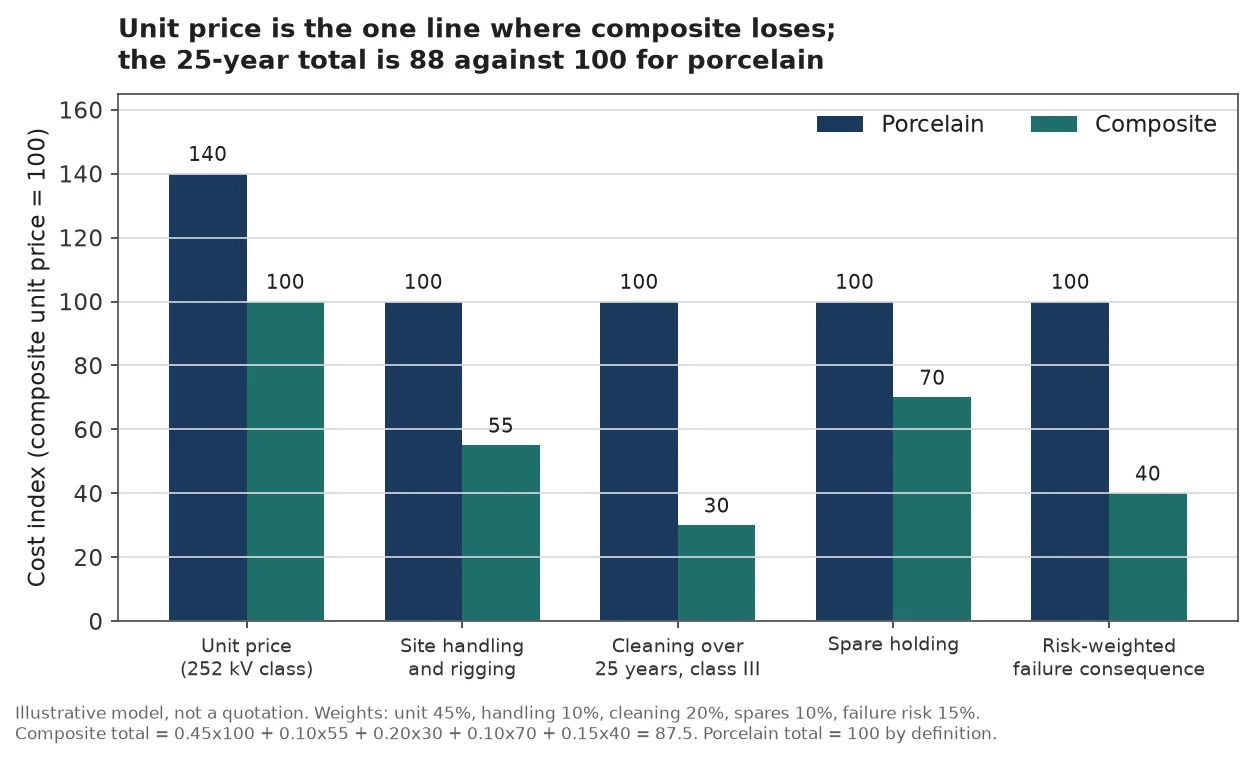
The comparison that matters is a 20 to 25 year cost, and it is dominated by items that never appear on a quotation: the crane, the cleaning cycles, the outage duration, and the probability-weighted cost of a fragment event. A composite bushing that costs more per unit and needs no washing for a decade, on a site where washing means an outage, is cheaper. A porcelain bushing on a clean inland site with a 100-year service record and cheap local spares is cheaper. Both statements are true; the site decides which one applies.
For a wider view of what moves breaker cost overall, see the breakdown of SF6 circuit breaker price and cost drivers.
The two materials fail inspection in opposite ways, and this catches buyers out.
Porcelain damage is visible. A chip at the flange, a crack at the shed root, a glaze loss exposing the body: all of it is a reject on receipt, and a buyer who inspects properly catches it before installation. Composite damage is harder. An impact can crush the housing against the core without breaking the surface, and a partial separation between housing and tube may not show until the bushing sees voltage in wet weather. Receiving inspection therefore needs a different routine: a close look along the housing-to-core interface, a tap test for a change in sound, and a check that the bushing was stored horizontally and not resting on a shed.
Storage rules matter for both. Porcelain should never stand on its flange unsupported or hang by the terminal. Composite should be kept out of sustained direct sunlight and away from solvents, because the housing is a polymer. Neither should be stored with the crate resting on the sheds.
One number you will not find reliably in public sources is the in-transit breakage rate, because it depends almost entirely on the route, the packing and the handler. What is reliable is the consequence: a single broken 252 kV porcelain body is not a cost, it is a schedule event, because the replacement comes from a firing batch, not from a shelf.
| Site or project condition | Recommendation | Reason |
|---|---|---|
| Coastal site, salt fog, class III or IV pollution | Composite | Hydrophobicity, fewer cleaning outages, better wet performance at equal creepage |
| High seismic demand | Composite | Lower mass cuts the flange moment; non-brittle failure protects adjacent equipment |
| Urban yard with public access or adjacent buildings | Composite | No high-velocity fragments in a failure |
| Heavy industrial dust, cement, steel plant | Composite, or porcelain with RTV | Contamination tolerance; RTV is the cheaper retrofit |
| Clean inland site, tight first cost, proven local spares | Porcelain | Lowest unit price, very long service record, easy like-for-like replacement |
| Existing porcelain installation with pollution flashovers | RTV coating first | Addresses the surface problem without replacing the assembly |
| Remote site, difficult crane access | Composite | Mass and handling, not electrical performance, drive the choice |
| Desert, very high UV, dry heat | Either; check silicone formulation | UV resistance depends on the compound, not on the material family |
The construction of the breaker itself matters too. On a dead tank unit the bushings also carry the CT cores, so a bushing change is a protection change; that relationship is set out in the comparison of live tank and dead tank SF6 circuit breakers.
Most disputes about bushing quality trace back to a specification that named the material and nothing else. Eight items close the gap.
Standards references for the surrounding requirements are collected in the overview of SF6 circuit breaker standards.
Buy composite when the site is polluted, seismic, crowded or hard to reach, and accept the unit price as the cost of not washing, not lifting and not clearing fragments. Buy porcelain when the site is clean, inland, accessible, and the budget is genuinely fixed, and specify RTV coating if the pollution class ever rises. The mistake in both directions is the same: choosing on unit price alone and discovering the difference in an outage or an incident report.
Both housing types are available across the range of LW9-72.5 porcelain column breakers and the larger LW-252 1050 kV BIL breakers. If you are configuring a unit and need to know which bushing option suits your site conditions, send the pollution class, the seismic zone and the terminal load, and we will come back with the configuration rather than a catalogue page. The full range sits under SF6 circuit breaker articles and guides.
For the housing, yes within the limits of the data. Porcelain has a service record over a century; silicone composite housings have roughly four decades of field experience, and modern formulations hold hydrophobicity and resist tracking and UV well. The weak point to watch is not the housing but the bond between housing and core, which is why the moulding process belongs in the specification.
Usually yes, if the flange interface, terminal height and creepage class match, but it is an engineering change rather than a part swap. The bending load path changes, the mass changes the seismic response, and on a dead tank breaker the bushing may carry CT cores that have to be transferred or replaced with the housing.
In principle yes, because hydrophobicity improves wet performance at equal creepage, and some specifications allow a shorter composite bushing for the same pollution class. In practice most utilities keep the creepage and take the performance margin instead, because the purchase specification is written against a pollution class table and changing it needs a justification.
Because the cost is in the process, not the mass. Moulding silicone onto a GFRP tube with a reliable bond, plus the bending test regime of IEC 61462 and the design-change retest rule, is a more expensive production route than firing and glazing a porcelain body. The gap closes as the voltage class rises and the porcelain body becomes harder to make and ship.
An internal defect in the condenser core that starts partial discharge, erodes the insulation, and lets an arc form inside the housing. The arc vaporises the insulating medium, pressure rises faster than the housing can relieve, and the housing bursts. The material decides whether the burst produces fragments; it does not prevent the fault.
No. RTV coating exists to give a porcelain surface the hydrophobic behaviour that silicone already has. Applying it to a composite housing adds a maintenance cycle without adding performance. The equivalent question for composite is whether the compound retains hydrophobicity after years of dry-band arcing, which is a formulation and type-test question.