Arc Furnaces and Mining Substations: Frequent Switching, Harmonics and Hard Environments
Furnace and mining breaker duty quantified: 16,300 operations a year, what E2 class proves, harmonic heating, and the dust and condensation fight.
Read More
Most of the ce marking switchgear guidance published online is written for low-voltage assemblies, and it breaks the moment you apply it to a 72.5 kV or 252 kV circuit breaker. The Low Voltage Directive has a voltage window. Above 1 kV that window closes, and a large part of what a low-voltage panel builder does to earn a CE mark simply has no legal basis at high voltage. Suppliers who do not notice this end up issuing a declaration that cites a directive their product is not in scope of — which is worse than having no declaration at all, because it is a document an importer can point at when customs asks why the paperwork is wrong.
This article is about the actual route to the EU market for high-voltage SF6 circuit breakers and the switchgear they sit in. It covers which directives genuinely apply, what a technical file has to contain, what belongs on a declaration of conformity, who is legally responsible inside the EU, and why the fluorinated gas regulation — not the CE mark — is the gate that actually stops shipments in 2026.
The Low Voltage Directive, 2014/35/EU, applies to electrical equipment rated between 50 and 1,000 V AC, or 75 and 1,500 V DC. A 72.5 kV circuit breaker has a rated voltage roughly seventy times the upper limit. It is not “a bit above” the scope; it is categorically outside it. The same is true of a 40.5 kV breaker, a 126 kV breaker, and every GIS enclosure built around them.
This is not a loophole and it is not a gap in EU law. High-voltage switchgear was deliberately left out of the low-voltage regime because the safety case for it is built on a different set of documents — type tests to IEC 62271-100, insulation coordination to IEC 60071-1, installation rules to EN 61936-1 — and because it is installed by utilities and contractors under national network codes rather than sold to the public. The consequence for a supplier is simple to state and easy to get wrong: you cannot claim LVD conformity for a 145 kV breaker, because the directive does not reach it.
Where the LVD does bite is at the edge of the product. A live-tank breaker ships with a mechanism cabinet containing auxiliary relays, a heater circuit, terminal blocks, a motor for spring charging, and often a density relay with alarm contacts. That cabinet, taken as a low-voltage assembly in its own right, is inside the LVD window and is normally assessed against EN 61439-1 and EN 61439-2. The clean way to handle this is to treat the cabinet as a bounded sub-assembly with its own conformity evidence, and then reference that evidence in the file for the breaker as a whole. Trying to apply LVD logic to the interrupter chamber is where declarations go wrong.
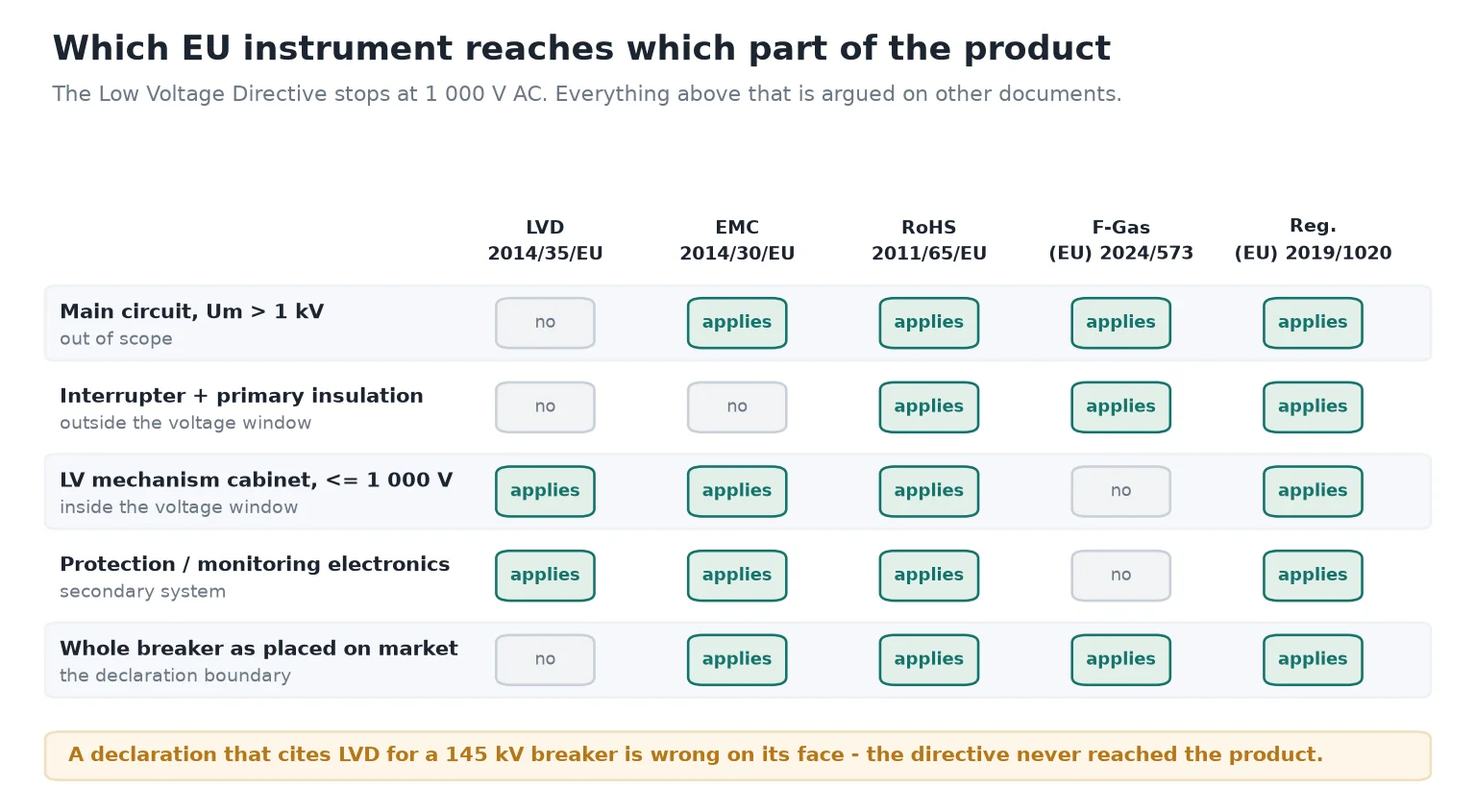
The table below is the working version of that decision. Read it by asking which circuit you are talking about, not which product.
| Instrument | Scope trigger | Applies to a 72.5 kV outdoor breaker? | What it actually demands |
|---|---|---|---|
| LVD 2014/35/EU | 50–1,000 V AC / 75–1,500 V DC | No for the main circuit. Yes for the LV mechanism cabinet if its own rating is at or below 1,000 V. | Safety objectives, technical file, declaration, CE on the assembly in scope |
| EMC 2014/30/EU | Apparatus liable to cause or suffer electromagnetic disturbance; no voltage limit | Yes, through the protection, monitoring and communication circuits | Emission and immunity evidence, typically to EN 61000-6-2 and EN 61000-6-4 |
| RoHS 2011/65/EU | Electrical and electronic equipment, ten restricted substances | Yes, normally resolved line by line on the bill of materials | Substance declarations for relays, terminals, heaters, wiring, plating |
| F-Gas (EU) 2024/573 | Equipment containing fluorinated greenhouse gases | Yes, whenever SF6 is the interruption or insulation medium | Leak-tightness, labelling, certified personnel, phase-out dates, reporting |
| Machinery Reg. (EU) 2023/1230 | Assembly of parts where at least one moves, driven by energy other than human effort | Normally no for a standalone breaker; applies from 20 January 2027 | Only becomes relevant when the breaker is embedded in a driven assembly |
| Reg. (EU) 2019/1020 | Any product placed on the EU market | Yes | An economic operator established in the EU who is answerable for the product |
| EN 61936-1 | Design and erection of installations above 1 kV | Not a product requirement | Site rules the buyer or EPC must satisfy around your equipment |
The EMC Directive has no voltage threshold, and that is precisely why it is the directive most often misapplied at high voltage. The disturbance mechanism is not the arc — it is the secondary system. A trip coil driven at 220 V DC draws a step current that couples into adjacent control wiring. A spring-charging motor is a commutated load. A modern breaker with IEC 61850 process bus carries fibre, but the merging unit and the intelligent terminal behind it are electronics sitting in a switchyard with a 40 kA fault occurring a few metres away.
In practice the assessment is scoped to that secondary system, and the usual evidence set is immunity to EN 61000-6-2 (industrial environments) and emission to EN 61000-6-4, plus the disturbance tests already required by IEC 62271-1 clause 6.9 — damped oscillatory magnetic field, fast transient burst on auxiliary circuits, surge on auxiliary and control circuits, and radiated radio-frequency field. Much of the EMC evidence a switchgear builder needs is therefore already generated for the type test programme. The mistake is to assume that because those tests exist, the EMC Directive is satisfied. It is not the same paper: the type test proves the equipment meets a product standard, while the directive requires a conformity assessment and a declaration that names it.
There is a persistent belief that citing EN 62271-1 and EN 62271-100 gives you presumption of conformity for CE marking. It does not, for a structural reason. Presumption of conformity only exists for harmonised standards cited in the Official Journal under a specific directive. Because high-voltage switchgear falls outside the LVD, EN 62271-1 is not a harmonised standard that can carry a CE mark for the main circuit. It remains the state of the art — the document a court or a market surveillance authority would look at to decide whether your design was reasonable — but it is not a legal shortcut.
What that means practically is that the CE declaration for an HV breaker is usually a short document citing EMC and RoHS, with the IEC 62271 evidence sitting behind it in the technical file as the safety justification. That is a defensible position, and it is the position most European manufacturers actually take. It is also why the type test report package matters more in Europe than the CE certificate does: the buyer’s engineer will read the test report, and the customs officer will read the declaration, but nobody will read the CE mark itself.
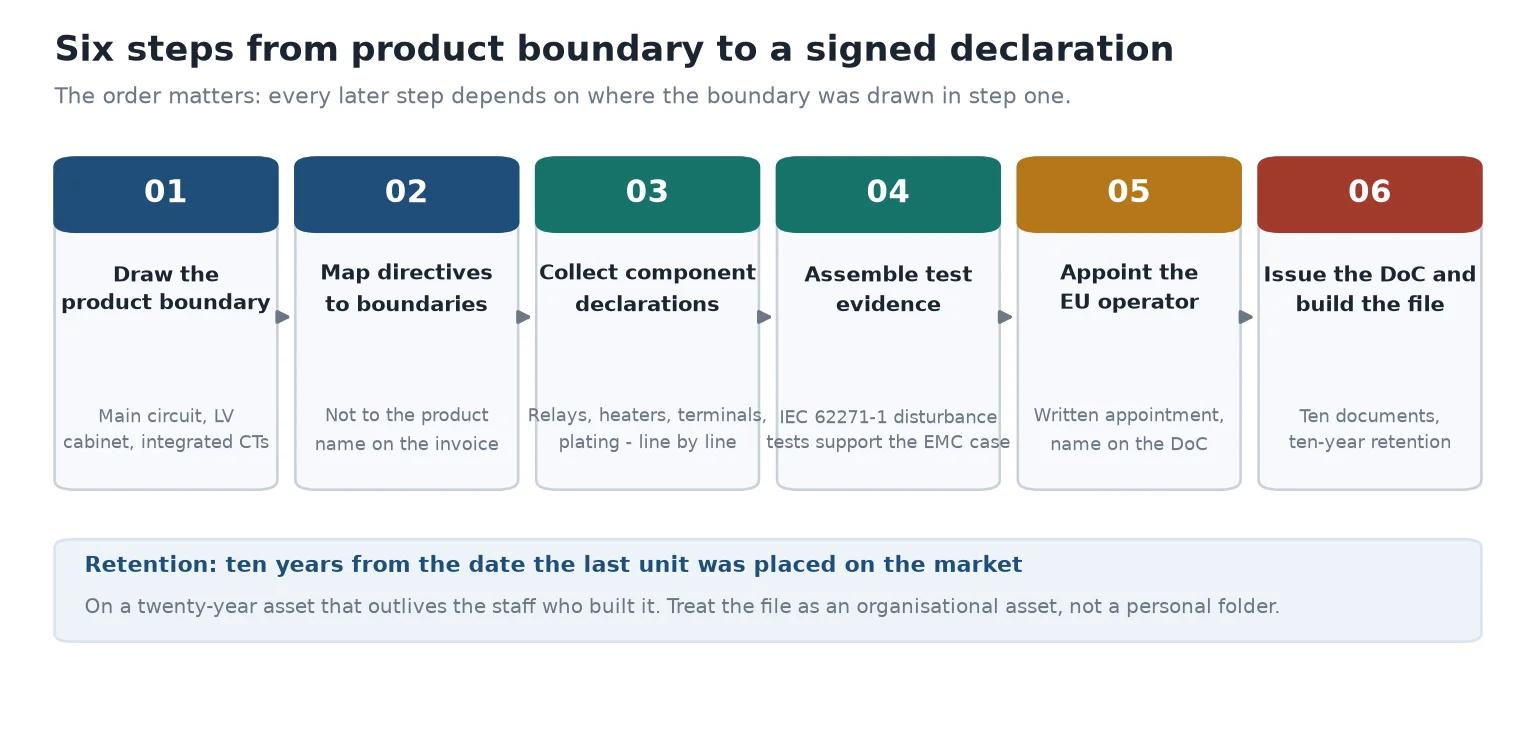
Retention is ten years from the date the last unit was placed on the market, under both the LVD and the EMC Directive. Ten years is a long time for a project-based business, so the file needs to be a standing package, not something assembled per shipment. In audits and in importer due diligence, the same ten items come up.
| # | Document | What auditors look for |
|---|---|---|
| 1 | General description and identification | Model designation on the file must match the nameplate and the invoice, character for character |
| 2 | Drawings and schematics | Outline drawing, single-line diagram, wiring diagram, with revision letters |
| 3 | Bill of materials with declarations | Every bought-in electrical component traceable to a CE or RoHS declaration |
| 4 | Risk assessment | Electric shock, arc, stored energy in springs, gas overpressure, mechanical, thermal |
| 5 | Type test reports | IEC 62271-100 duties, insulation, temperature rise, mechanical endurance, IP |
| 6 | Routine test records | Per-unit evidence that the delivered breaker matches the type tested design |
| 7 | Insulation coordination calculation | Clearances, creepage, altitude correction, pollution level |
| 8 | Instructions and safety information | In the language of the destination Member State, covering installation, operation, maintenance |
| 9 | Declaration of conformity | Signed, dated, directive list, standards list, authorised signatory |
| 10 | Traceability record | Serial number to file revision to shipping date, so a unit in the field can be tied back |
A declaration of conformity is one page. It is also the only document that a market surveillance authority is guaranteed to read, and the one an importer will refuse to accept if it is wrong. Six elements are non-negotiable, and the errors are repetitive enough to list.
| Element | Requirement | Common error |
|---|---|---|
| Product identification | Type, batch or serial, unambiguous | “SF6 circuit breaker” with no model — unenforceable and rejected |
| Manufacturer identity | Name and address of the entity legally responsible | Trading company named as manufacturer while the factory is a different legal entity |
| Directive list | Only directives actually in scope, with the current consolidated number | Citing 2014/35/EU for a 145 kV breaker |
| Standards list | Full designation with year of publication | “IEC 62271” with no part number or edition |
| Authorised signatory | Named individual, function, place and date of issue | Undated or signed by a function that no longer exists |
| EU representative | Where one is mandated, name and address inside the Union | Absent, or an address outside the EU |
One further point that catches exporters: a “CE certificate” issued by a Chinese testing laboratory is not a legal basis for CE marking. There is no notified body requirement for either the LVD or the EMC Directive — self-declaration is the normal route — and for high-voltage switchgear there is no notified body route at all, because the product is outside the directive that would have created one. A voluntary certificate from a commercial lab can be useful supporting evidence in a technical file. It cannot substitute for the manufacturer’s own declaration, and presenting it as the CE basis is a factual error that an experienced importer will spot immediately.
Since 16 July 2021, Regulation (EU) 2019/1020 has required that a product covered by Union harmonisation legislation can only be placed on the market if there is an economic operator established in the EU who is responsible for it. For a Chinese breaker manufacturer selling directly to a European EPC, that role is normally filled by one of three parties: an authorised representative appointed in writing by the manufacturer, the importer who brings the goods in, or a fulfilment service provider. The regulation exists so that a market surveillance authority has someone inside its jurisdiction to serve a notice on.
The practical effect is that the appointment letter has to exist before the first shipment, and the declaration of conformity has to name the representative. Suppliers who treat this as paperwork to be sorted after arrival routinely have containers held at Rotterdam while a document is couriered. It is also worth noting that the representative’s name and address must appear on the product or its packaging, or in an accompanying document where the product cannot carry it — for a breaker in a shipping frame, the accompanying document route is the normal one, which means the shipping documentation set and the conformity file have to be assembled together rather than separately.
CE marking is a paperwork exercise that, done properly, is achievable in weeks. The regulation that genuinely limits market access for an SF6 breaker is Regulation (EU) 2024/573 on fluorinated greenhouse gases, and it operates on a timetable rather than on documents. The first closure date — 1 January 2026 for switchgear rated below 24 kV — has already passed. Further tranches follow through 2030 and 2032, with a final restriction in 2035 that leaves reclaimed or recycled gas as the only permitted medium for certain equipment. The full phase-out timetable is set out separately; what matters here is the interaction with CE.
Three obligations sit on top of the CE file and are checked at the border and at commissioning. First, equipment containing SF6 must be labelled in the prescribed form, and the label must state the gas and its CO2 equivalent. Second, the quantity of gas has to be declared and, for the importer, recorded against a reporting obligation. Third, the personnel who handle the gas during installation and maintenance must hold the appropriate certification, which is a service obligation that follows the equipment into the field rather than stopping at the factory gate. A declaration of conformity that is perfect in every respect will not move an SF6 breaker into a Member State whose procurement rules have already excluded that voltage class — which is why the SF6-free alternatives question now arrives at the same meeting as the CE question.
Decommissioning is part of the same chain. The F-Gas Regulation requires recovery of the gas at end of life, and the documentation that proves recovery is increasingly requested at tender stage rather than at disposal. The recovery, reclaim and destruction paperwork therefore belongs in the commercial conversation, not only in the environmental one.
Buyers conflate these constantly, and the confusion costs time on both sides of the table.
| Document | Issued by | What it proves | What it does not do |
|---|---|---|---|
| Type test report | An accredited laboratory | That a specific design passed specific IEC 62271 clauses | Prove the delivered unit matches the tested one |
| IECEE CB certificate and report | A national certification body in the CB Scheme | That the design meets the standard, recognised across member countries | Constitute CE marking, or replace the EU declaration |
| EU declaration of conformity | The manufacturer, on its own responsibility | That the product meets the directives listed, and identifies who is answerable | Prove technical merit — it is a claim, backed by the file |
None of the three replaces another, and a tender response that offers a CB certificate where a declaration of conformity was requested is a common reason for a technical clarification round. The reverse is also true: a declaration of conformity without a type test report behind it is a claim with nothing under it, which is exactly the situation the auditor checklist is designed to expose.
For a Chinese manufacturer shipping a 72.5 kV outdoor breaker into the EU for the first time, the order that avoids rework is this. Establish the product boundary first — main circuit, mechanism cabinet, and any integrated CTs — because every later decision depends on where that line is drawn. Map directives to those boundaries rather than to the product name. Generate or collect the component declarations for the bill of materials, since RoHS cannot be resolved at assembly level. Scope the EMC assessment to the secondary system and reuse the IEC 62271-1 disturbance tests as supporting evidence. Appoint the EU economic operator and get the appointment letter signed. Then write the declaration, in the destination language, and build the ten-document file around it. Check the F-Gas position for the voltage class and the destination country before the first quotation, not before the first shipment.
Two habits make the difference between a file that survives an audit and one that does not. The first is version control: the declaration must name the same revision of the drawing set that the type test report covers, and that link has to be visible. The second is keeping the conformity argument separate from the marketing argument. A breaker sold on 40 kA breaking capacity and 350 kV lightning impulse is sold on standards compliance, and the CE mark is a separate, narrower statement about a defined set of directives. Blurring the two is how suppliers end up over-claiming in a tender document and then having to walk it back.
It needs to comply with the directives that apply to it, and the practical way to demonstrate that is a declaration of conformity and a CE mark. The directives in scope are EMC and RoHS, plus the F-Gas Regulation as a separate obligation. The Low Voltage Directive does not apply to the main circuit because its scope stops at 1,000 V AC.
No. Citing a directive the product is outside the scope of makes the declaration incorrect, which is a weaker position than declaring correctly under the directives that do apply. Market surveillance authorities and experienced importers both check the voltage window against the directive list.
No. Neither the LVD nor the EMC Directive requires notified body involvement, and for HV switchgear there is no applicable directive that would create such a route. Self-declaration against the technical file is the normal path.
Not for CE marking on the main circuit, because those standards are not harmonised under a directive that covers the product. They remain the state of the art and the technical justification behind the file, which is a different and still important role.
Ten years from the date the last unit covered by the declaration was placed on the market. For long-life capital equipment with a twenty-year service life, that means the file outlives most of the staff who built it, so it needs to be an organisational asset rather than a personal folder.
Then no amount of CE documentation will create market access for that product in that application. The phase-out dates operate independently of product conformity, and they are the reason buyers in several Member States now ask for an SF6-free option at the specification stage rather than at the quotation stage.
If you are preparing an EU tender package and need the conformity documents and the type test reports to line up for a specific voltage class, send the model designation and the destination country and we will map the applicable directives and the gas regulation position before the quotation is issued. The customised 252 kV platform is the configuration most often requested for European projects, and its documentation set is available for review, alongside the wider SF6 circuit breaker technical library and the supplier qualification notes that procurement teams usually ask for next.