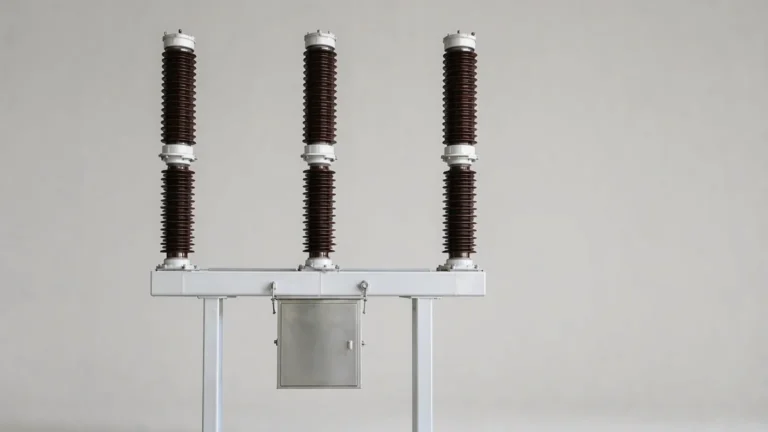
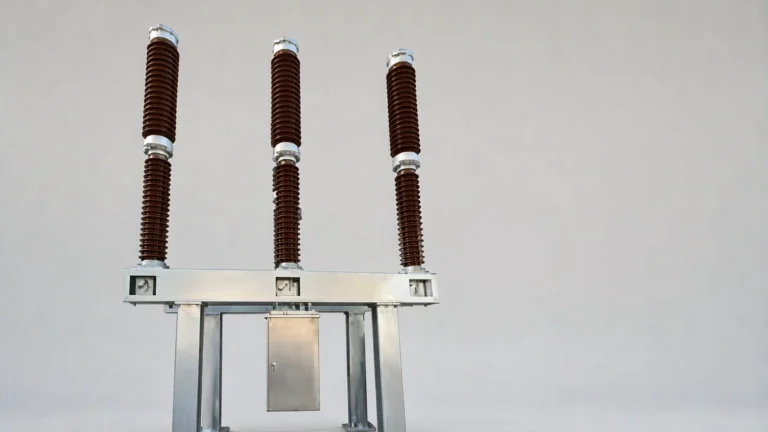
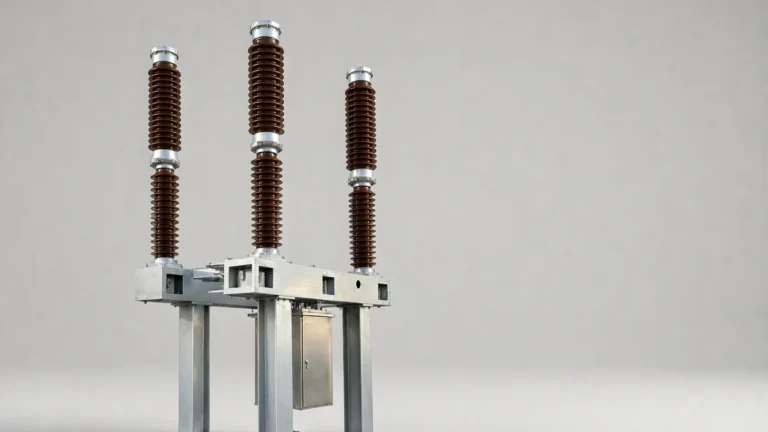
LW36-126 Explained: 3150 A, 40 kA and 40 kA/3 s in Practical Terms
What the LW36-126 model number covers, what it does not, and how to pick between the six variants and specify the items the model omits.
Read More
Buying an SF6 circuit breaker from an overseas manufacturer is not like buying a transformer or a cable. The unit is engineered to order, the price is negotiated against a specification rather than a catalogue number, and the thing that determines whether the project runs on time is not the price on the quotation but the quality of the documentation that comes with it. Choosing the wrong SF6 circuit breaker manufacturer costs you a season, not a discount.
This guide covers the four things that actually decide a purchase: what to put in the enquiry so the quote is real, what drives the minimum order quantity, how factory quality control should be structured and witnessed, and how to read a lead time that is realistic rather than optimistic. It is written for procurement engineers, EPC buyers and utility project managers sourcing from Chinese and other Asian manufacturers, and it assumes you already know which class of high voltage SF6 circuit breaker your project needs.
The first filter is structural. A manufacturer owns the assembly line, the test bay and the type-test history. A trading company owns none of those and buys from a factory you never see. Both can deliver a good breaker, but only one can give you a factory acceptance test you can witness, a root-cause analysis on a failed unit, and spare parts five years after the order.
Five questions separate them quickly:
A trading company will answer the first four with generalities. A manufacturer will name the factory, the component suppliers and the test standard. That difference matters more than the price gap between them, which is usually small.
Most quotation problems start with an incomplete enquiry. If the manufacturer has to assume a rating, they will assume the cheapest one that satisfies the words on the page. The table below lists the data that should be in the first enquiry document.
| Item | What to state | Why it changes the price |
|---|---|---|
| System voltage | Nominal and maximum operating voltage | Sets insulation level and creepage distance |
| Rated current | Continuous current, with ambient correction | Drives conductor size and terminal design |
| Breaking capacity | Short-circuit breaking current, symmetrical | Determines interrupter size and chamber volume |
| Short-time withstand | Current and duration, e.g. 40 kA / 3 s | Affects conductor and contact support structure |
| Frequency | 50 Hz, 60 Hz or non-standard | Non-standard frequency requires redesign, not just a label |
| Installation | Outdoor live-tank, dead-tank, indoor, split-type | Changes structure, footprint and cost materially |
| Operating mechanism | Spring, with or without combined reclosing | Reclosing adds control and mechanical complexity |
| Site conditions | Ambient range, altitude, pollution level, seismic | Triggers creepage, derating and structural upgrades |
| Standards | IEC 62271-100, IEEE C37.04/09, or national standard | Different test regimes and documentation packages |
| Quantity and schedule | Units now, options later, required delivery | Sets the production slot and the MOQ discussion |
| Documentation | Type-test, routine-test, FAT, packing list, language | Some documents are chargeable and take weeks |
| Destination and terms | Port, Incoterms, packing standard | Export packing for switchgear is a real cost line |
If you send all twelve items, you will get a comparable quotation from three suppliers. If you send five, you will get three quotations that cannot be compared, and the cheapest one will be cheapest because it assumed less. The rating sequence behind those twelve items is explained step by step in our guide to how to select an SF6 circuit breaker.
Minimum order quantity for high-voltage breakers is rarely a policy number. It is a consequence of how the factory is set up, and it varies by configuration.
| Configuration | Typical MOQ | What drives it |
|---|---|---|
| Standard rating, catalogue specification | 1 unit | Built from existing drawings and jigs; no engineering charge — typical of standard 126 kV grid-protection units |
| Standard rating with site-specific options | 1 – 2 units | Drawing revision and option engineering, amortised over the batch |
| Non-standard frequency or voltage | 2 – 3 units | Interrupter and insulation redesign; test programme must be repeated |
| Custom structure or layout | 3 – 5 units | New tooling, structural calculations and type-test evidence |
| Full type-test programme in buyer’s name | 5+ units | Test laboratory slot and destructive specimens |
Two practical notes. First, a “MOQ of 1” on a standard unit is normal and not a red flag — high-voltage breakers are engineered-to-order products, so a factory that insists on ten units for a standard 126 kV rating is either reselling or has no real production line. Second, customisation is where MOQ becomes negotiable: if you accept a standard internal design with a modified external arrangement, the MOQ often drops because the expensive engineering is reused. Designs such as the LW-252 customized split-structure breaker exist precisely because buyers want a standard core in a non-standard envelope.
Quality in high-voltage switchgear is not verified at the end. It is verified at four gates, and the buyer should agree in advance which gates will be witnessed and which will be documented only. The structure follows the test hierarchy in SF6 circuit breaker testing: type tests prove the design, routine tests prove the individual unit, and commissioning tests prove the installation.
| Gate | What is checked | Evidence to require | Witness? |
|---|---|---|---|
| Incoming material | Interrupter, bushing, casting and gas certificates | Material certs, interrupter routine test sheet | Usually no |
| In-process | Assembly torque records, gas tightness of sub-assemblies, wiring continuity | Traveler sheet signed at each station | Optional |
| Routine test | Power-frequency withstand, mechanical operation, contact resistance, gas tightness, density switch check | Routine test report per serial number | Recommended |
| Factory acceptance test | Full functional test including control, interlocks, alarm and trip circuits | FAT report, signed by both parties | Yes, for critical projects |
| Packing | Gas charge state, desiccant, shock indicators, sea-worthiness | Packing list and photographs | Optional |
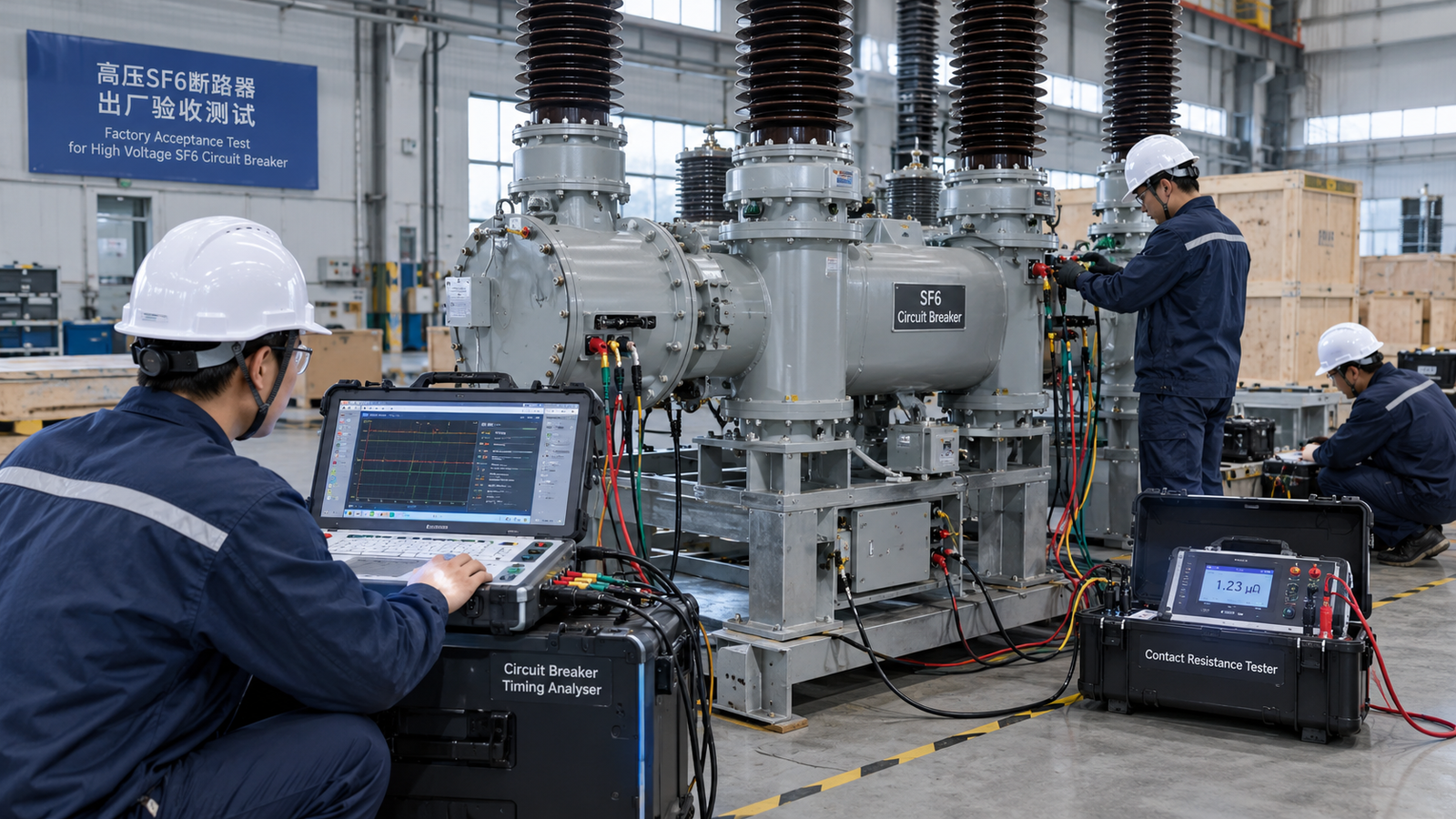
Three specifics are worth insisting on. Ask for the routine test report to be issued per serial number, not per batch — a batch report tells you nothing about the unit you received. Ask for the mechanical operation test to include the full open-close-open sequence at rated control voltage and at the minimum specified control voltage, because mechanism faults usually appear at low voltage — and check the declared mechanical endurance class against the duty, since a 3000-operation mechanical life rating is a different proposition from an M2 class unit. And ask for the gas tightness result to be expressed as a measured leak rate in percent per year, not simply “passed”, since that number is what your environmental reporting will depend on.
The standards basis for all of this is worth pinning down in the purchase order. Our guide to IEC 62271-100 and the IEEE C37 series explains which document governs which test, and where the two regimes differ.
Quoted lead times are usually production time, not delivery time. The difference matters because drawing approval, type-test evidence and export packing sit outside the production window, and they are the stages that slip.
| Stage | Typical duration | What can go wrong |
|---|---|---|
| Technical clarification and quotation | 3 – 10 days | Incomplete enquiry causes a second round |
| Drawing approval | 1 – 3 weeks | Buyer-side review delay is the most common cause of slippage |
| Material procurement | 2 – 6 weeks | Bushing and interrupter lead times dominate |
| Assembly | 2 – 4 weeks | Depends on line loading and options |
| Routine test and FAT | 3 – 7 days | Witness scheduling adds a week if the buyer travels |
| Export packing and inland transport | 3 – 7 days | Sea-worthy crating for bushings takes time |
| Ocean freight | 2 – 6 weeks | Port congestion and routing |
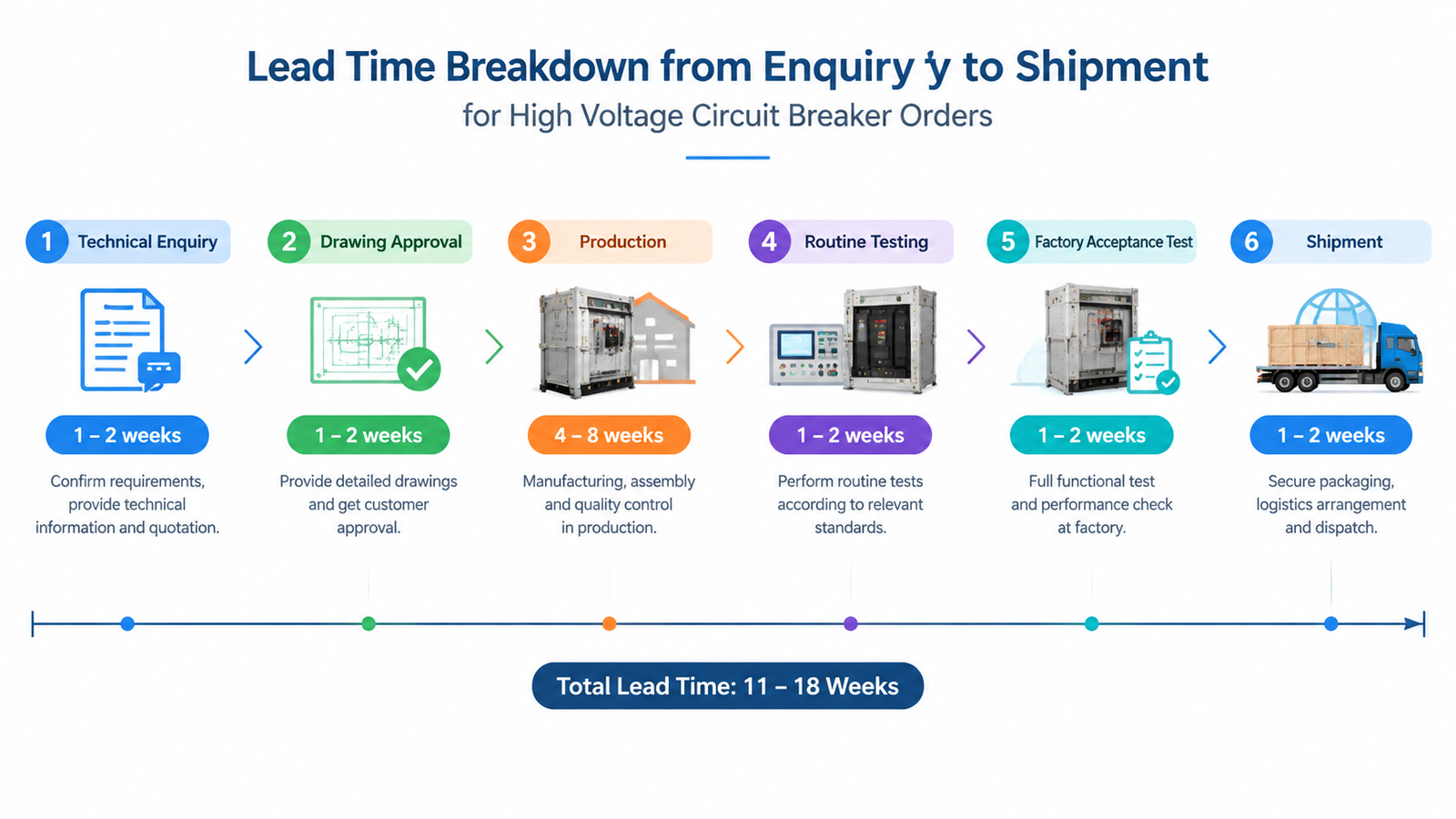
For a standard 126 kV unit, a realistic door-to-door figure is 10 to 16 weeks, of which roughly 6 to 10 are production and testing. Custom configurations add four to eight weeks. If a supplier quotes six weeks for a custom 252 kV breaker, the honest interpretation is that the clock starts after drawing approval and excludes freight — ask them to confirm both points in writing. A porcelain-column 72.5 kV unit with 4000 A rating, such as the LW9-72.5 porcelain column breaker, sits at the fast end of that range because the design is mature and tooling already exists.
For utility and EPC projects, the paperwork is often worth more than the discount. Require the following with the shipment, and specify the language:
Four clauses do most of the work. A performance warranty that names the guaranteed leak rate and the guaranteed breaking capacity, rather than a general statement of conformity. A spares commitment with a defined period, typically ten years, and a price basis for consumables. A packing specification that states the gas charge condition at shipment and who bears the cost of a top-up on arrival. And a FAT clause that makes the test a contractual milestone rather than a courtesy, with a defined remedy if the unit fails.
Payment structure deserves equal attention. A typical arrangement is 30% with the order, 60% after FAT, and 10% after arrival or commissioning. A supplier that demands full payment before FAT is transferring all the risk to you, and a supplier that accepts a large retention is signalling confidence in its own test results.
Sourcing an SF6 breaker from a manufacturer comes down to four disciplines: send a complete enquiry so the quotation is comparable, understand that MOQ is driven by engineering content rather than policy, agree the QC gates and the evidence before production starts, and read the lead time as door-to-door rather than production-only. A buyer who does those four things gets a unit that passes commissioning first time. A buyer who negotiates only on price usually discovers the gap at the factory acceptance test, when the schedule no longer allows a second attempt.
If you are preparing an enquiry for high-voltage breakers, send us the twelve data points above and we will come back with a configuration, a test plan and a realistic schedule. The range covers live-tank, dead-tank and split-type designs from 40.5 kV to 252 kV — start from the high voltage SF6 circuit breaker range, or ask for a specification review before you issue the tender.
One unit for a standard catalogue rating. Two to five units is typical when the frequency, voltage or structure is non-standard, because the engineering and type-test evidence have to be amortised across the batch.
Roughly 6 to 10 weeks of production and testing for a standard 126 kV unit, plus 2 to 6 weeks of ocean freight. Custom configurations typically add four to eight weeks. Always confirm whether the quoted time starts at order or at drawing approval.
Yes for critical or first-time orders. The FAT is where control circuits, interlocks and alarm logic are proven. If travel is impractical, request a video walkthrough of the full functional test with the serial number visible.
A type test proves the design once and is documented in a certificate. A routine test proves each individual unit before shipment and must be issued per serial number. Both should be in the documentation package.
Often yes, but confirm the test evidence exists. Some factories hold IEC type tests only and will offer an IEC unit with an IEEE label, which is not the same thing. Ask for the actual certificate and the standard revision it references.
Eighteen to twenty-four months from commissioning or thirty months from shipment is typical, whichever comes first. Ask specifically whether the warranty covers gas leakage, since that is the most common claim.