LW36-126 Explained: 3150 A, 40 kA and 40 kA/3 s in Practical Terms
What the LW36-126 model number covers, what it does not, and how to pick between the six variants and specify the items the model omits.
Read More
An SF6 circuit breaker price is not a single number you can look up, because almost nothing about a high-voltage breaker is standardised at the point of sale. Two units that look identical in a photograph can differ by a factor of three in cost depending on voltage class, breaking capacity, current rating, structure type and the documentation package attached to them. The number on a quotation is the end of a cost chain, and understanding that chain is what turns price negotiation into value engineering.
This guide breaks the cost down in the order that actually drives it: what the unit is made of, how voltage class multiplies everything, why breaking capacity is the second multiplier, which options quietly add 20% without adding a single ampere of rating, and where the real savings sit when you compare high voltage SF6 circuit breakers across suppliers.
A typical outdoor live-tank breaker at 126 kV splits roughly as follows. The proportions shift with voltage and rating, but the structure holds.
| Cost element | Share of ex-works price | What drives it |
|---|---|---|
| Interrupter unit and gas chamber | 20 – 28% | Breaking capacity, arc-quenching design, pressure rating |
| Porcelain or composite bushings | 15 – 22% | Creepage distance, insulation level, pollution class |
| Operating mechanism and control | 15 – 20% | Spring vs hydraulic, reclosing, auxiliary contacts |
| Steel structure and base frame | 10 – 15% | Seismic requirement, height, split vs single structure |
| Gas system and density monitoring | 5 – 8% | Number of compartments, density relay grade |
| Testing and certification | 5 – 10% | Routine test only, or witnessed FAT and third-party certificates |
| Overhead, export packing and margin | 10 – 18% | Order size, packing standard, payment terms |
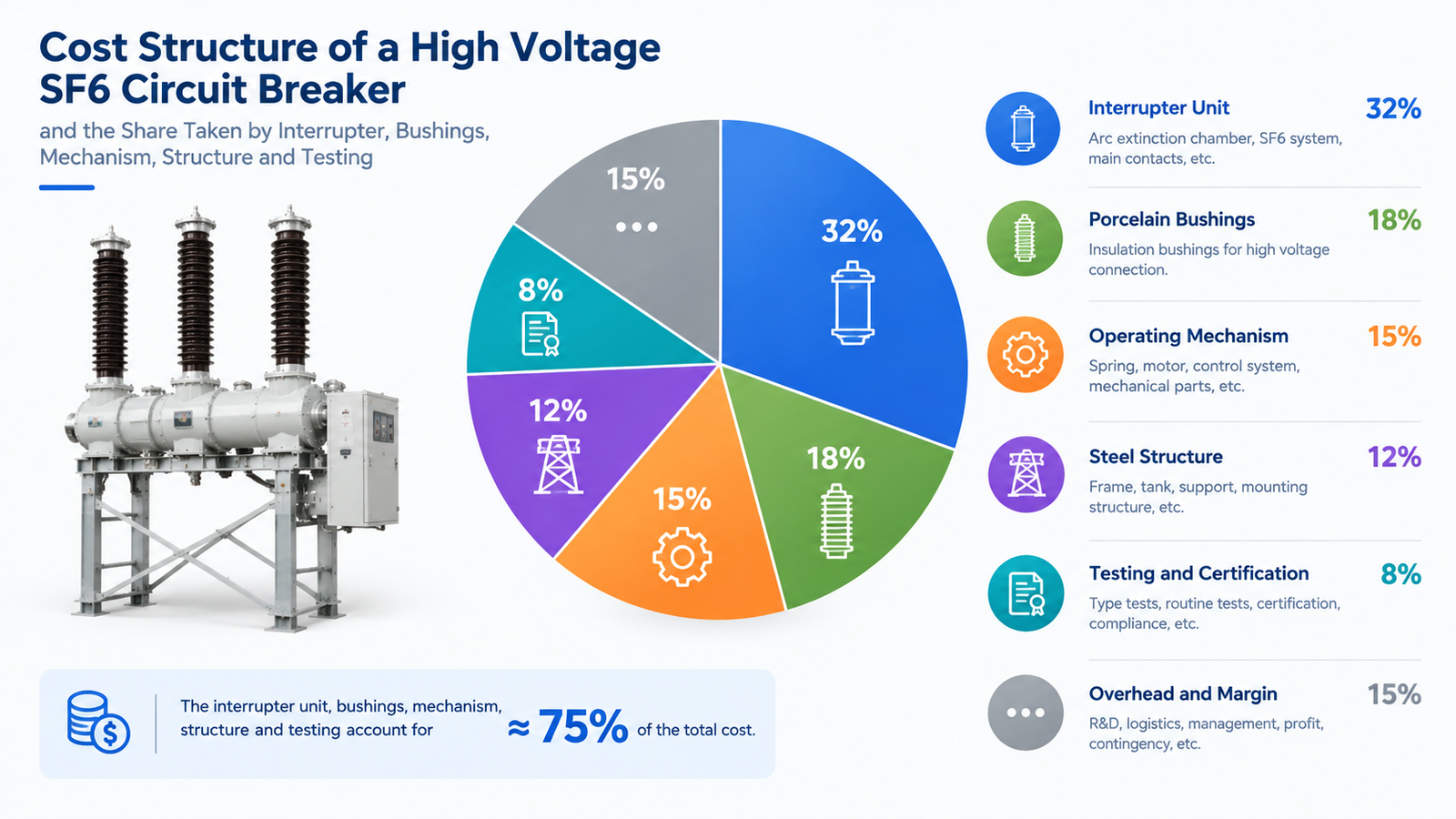
Two conclusions follow immediately. First, roughly a third of the price sits in the interrupter and the bushings, so those are the components to interrogate when a quotation looks unusually low. Second, testing and documentation are a real cost line of five to ten percent, which is why a supplier who offers “free” third-party certification is either absorbing it into the unit price or not doing it.
Cost does not rise linearly with voltage. It rises roughly with the square of the insulation requirement, because clearances, bushing length, structure height and gas volume all grow together. The table below uses a 40.5 kV outdoor breaker as the base index of 1.0 and shows indicative ex-works planning bands for Chinese-manufactured outdoor units.
| Voltage class | Relative cost index | Indicative ex-works band (USD) | What changes |
|---|---|---|---|
| 40.5 kV | 1.0 | 5,000 – 12,000 | Base case; single interrupter per pole |
| 72.5 kV | 1.8 – 2.4 | 9,000 – 22,000 | Longer bushings, larger gas volume |
| 126 kV | 3.5 – 5.0 | 18,000 – 40,000 | Higher structure, two-part interrupter on some designs |
| 252 kV | 9 – 14 | 55,000 – 130,000 | Split structure, multiple interrupters per pole, transport constraints |
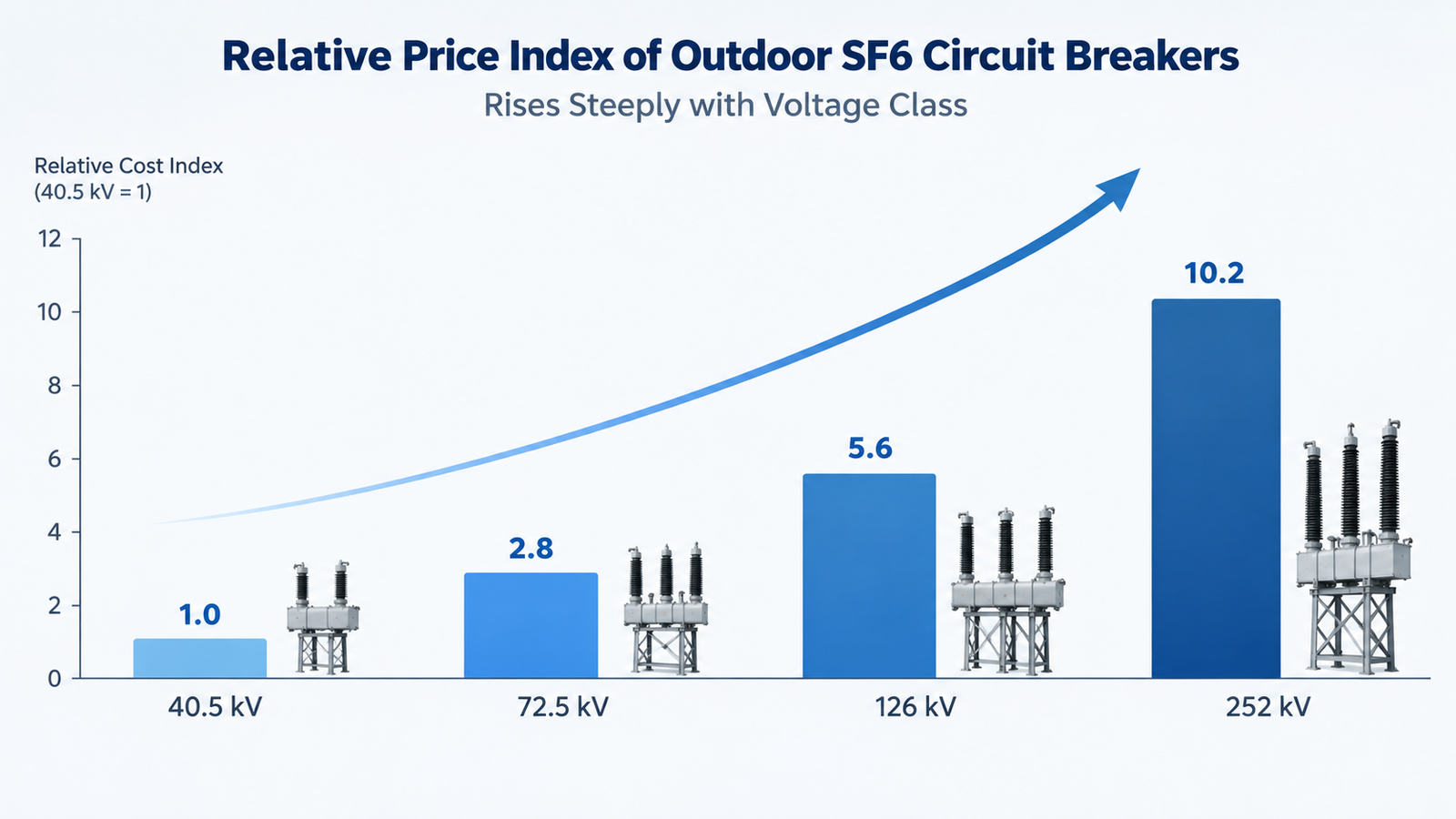
Those bands are planning references, not quotations. They move with copper and steel prices, with the exchange rate, with order quantity and — most of all — with the rating and option package. A 252 kV breaker specified at 4000 A and 50 kA with a split structure sits at the top of its band; the same voltage at 3150 A and 40 kA in a single structure sits near the bottom. Units such as the LW-252 252 kV 4000 A split-type breaker are a useful reference point for what the upper end of that class actually contains.
Breaking capacity is the parameter that most directly changes the interrupter, and the interrupter is the most expensive single assembly. Moving from 31.5 kA to 40 kA at the same voltage typically adds 10 to 20% to unit price. Moving from 40 kA to 50 kA at 252 kV adds more, because it usually requires a different interrupter design rather than a larger version of the same one.
The reason is physical. Higher breaking current means more arc energy to dissipate, which means larger chamber volume, higher gas pressure and stronger nozzle and contact erosion resistance. Those changes propagate into the mechanism, because the moving mass increases and the energy required per operation rises.
There is a genuine engineering trade here, and it is where a lot of money is wasted. Utilities often specify 40 kA because it is a familiar number, when the actual system fault level is 25 kA and will remain so for the life of the asset. Specifying 31.5 kA where the fault level justifies it saves 10 to 15% per unit with no loss of protection. Conversely, specifying too low and discovering the fault level has grown after a network reinforcement is far more expensive than the original margin would have been. A 126 kV unit at 40 kA breaking capacity, such as the LW36-126 40 kA design, is the mainstream choice for exactly this reason — it covers realistic growth without paying for capability that will never be used.
Continuous current affects conductor cross-section, terminal design and thermal performance, and its price effect is gentler than breaking capacity: typically 5 to 12% to move from 2000 A to 3150 A, and a further 10 to 20% to reach 4000 A.
But the interesting number is not the unit price, it is the cost per ampere delivered. A 4000 A breaker at 72.5 kV that replaces two 2000 A bays eliminates one set of disconnectors, one set of current transformers, one foundation, one protection relay panel and one bay of land. In a constrained substation, that saving routinely exceeds the price premium on the breaker. The LW9-72.5 4000 A high breaking capacity unit is a good example of where the higher unit price is the cheaper engineering decision once the whole bay is counted.
This is where budgets quietly drift. None of the items below change the voltage, current or breaking capacity, and all of them appear on real specifications.
| Option | Typical price effect | When it is genuinely needed |
|---|---|---|
| Combined reclosing capability | +8 – 15% | Overhead line protection where transient faults dominate |
| Increased creepage for heavy pollution | +5 – 12% | Coastal, industrial or desert sites with high ESDD |
| Seismic qualification and reinforced frame | +6 – 15% | Zones with meaningful seismic hazard |
| Non-standard frequency (60 Hz or 52 Hz) | +5 – 10% | Networks outside 50 Hz standard; requires test evidence |
| Integrated current transformers | +10 – 20% | Space-constrained sites; usually cheaper than separate CTs overall |
| Motorised disconnectors and interlocks | +8 – 18% | Remote or automated substations |
| Third-party type-test certification | +4 – 9% | Utility or lender requirement for independent evidence |
| Witnessed FAT with buyer travel | +1 – 3% | First order from a new supplier |
A specification that quietly includes all eight can add 40 to 60% to the price of the breaker. None of them is wrong, but each should be justified against the site rather than copied from a previous project. The 52 Hz case is a good illustration: for networks that do not run at exactly 50 Hz, the correct approach is a purpose-built unit such as the LW36-126 for 52 Hz distribution, not a standard 50 Hz breaker with a modified nameplate.
The purchase price of a breaker is typically 25 to 40% of what it costs to own over thirty years. The rest sits in installation, civil works, protection, maintenance and end-of-life handling. Four items dominate the difference between a cheap unit and a good one.
Where the technology itself is being questioned, our comparison of SF6-free alternatives sets out where a higher purchase price is offset by lower lifetime compliance cost, and our analysis of SF6 versus vacuum covers the medium-voltage crossover point.
Most price surprises come from what a quotation excludes rather than what it includes. Before comparing two numbers, confirm that both cover the same scope:
A 15% price difference between two quotations is usually a scope difference, not a commercial one. The full enquiry checklist that prevents this is in our guide to buying SF6 circuit breakers from a manufacturer, and the rating sequence behind the numbers is in how to select an SF6 circuit breaker.
Three levers consistently produce more saving than price negotiation. Standardise on one or two configurations across a project so the factory can batch-build rather than engineer each unit — this alone is often worth 8 to 15%. Buy the whole project in one order rather than splitting it across suppliers, because the second order always costs more per unit. And specify ratings against actual system studies rather than inherited habits, which is where the 40 kA versus 31.5 kA decision pays for itself.
What does not work is squeezing the supplier on a fixed specification. A supplier who accepts a 20% cut on a fully specified breaker will recover it somewhere in the components, the testing or the packing, and the recovery point is rarely visible until commissioning.
SF6 circuit breaker price is driven by three things in order: voltage class, breaking capacity and the option package. Voltage multiplies everything, breaking capacity changes the most expensive assembly, and options add cost without adding rating. The cheapest way to reduce the number on the quotation is not to negotiate harder but to specify more precisely: match breaking capacity to the system study, choose current rating to reduce bay count, and justify every option against the site. Buyers who do that typically land 10 to 20% below an equivalent but loosely specified enquiry, without giving up anything they actually need.
If you want a cost comparison for a specific configuration, send us the voltage class, continuous current, breaking capacity and site conditions. We will come back with a configured price, the option effects separated out, and the documentation package itemised. Start from the high voltage SF6 circuit breaker range to see the configurations available at each voltage.
Indicatively, Chinese-manufactured outdoor units run from roughly USD 5,000 to 12,000 at 40.5 kV, 9,000 to 22,000 at 72.5 kV, 18,000 to 40,000 at 126 kV and 55,000 to 130,000 at 252 kV ex-works. Rating, options and documentation move the figure within or beyond those bands.
Because cost scales with insulation requirement rather than voltage linearly. Bushing length, structure height, gas volume and often the number of interrupters per pole all increase, and transport and civil works become significant constraints. The index typically rises by a factor of three or more.
Yes, because it changes the interrupter chamber, gas pressure and mechanism energy. Moving from 31.5 kA to 40 kA at the same voltage typically adds 10 to 20%. Above 40 kA the increase is steeper because the interrupter design itself usually changes.
Only with independent type-test evidence and a witnessed factory acceptance test. The price gap is usually explained by component sourcing, test scope or documentation depth, and those are exactly the areas where a saving becomes a commissioning problem.
Purchase price is typically 25 to 40% of the thirty-year cost. Installation, civil works, protection, maintenance, gas handling and end-of-life recovery make up the remainder, and low-leak sealed designs reduce the maintenance and gas share substantially.
At 12 kV to 24 kV, no — vacuum and solid-dielectric designs are at or below SF6 cost. At 52 kV and above, clean-air designs carry a premium of roughly 10 to 40%, partly offset by lower lifetime compliance and gas-handling costs.