Railway Traction 25 kV: SF6 vs Vacuum for Trackside and AT Feeding
Traction breaker duty explained: single-pole feeders, 55 kV AT pairs, reclosing duty and the endurance arithmetic that decides vacuum vs SF6 at 25 kV.
Read More
An arc furnace circuit breaker is the one medium-voltage device in your plant whose duty profile looks nothing like the distribution specification it is usually bought from. A 100-tonne electric arc furnace cycles its furnace breaker up to twice per heat, runs 20–40 heats a day, and exhausts the M2 mechanical endurance class (10,000 operations) inside a single year of round-the-clock melting. Mining substations fail for the opposite reason: the interrupter is barely stressed, but conductive dust, condensation and vibration attack the insulation and the connections until something flashes over. Both applications punish the same assumption — that a standard MV breaker rating table is a duty description.
This article quantifies the duty arithmetic for furnace and mining service, explains what electrical endurance class E2 does and does not prove, and lays out the specification differences between vacuum and SF6 for these loads. If you are starting from the product side, our high-voltage SF6 circuit breaker range covers the 40.5 kV and 126 kV frames that typically sit at the furnace and mine incomers.
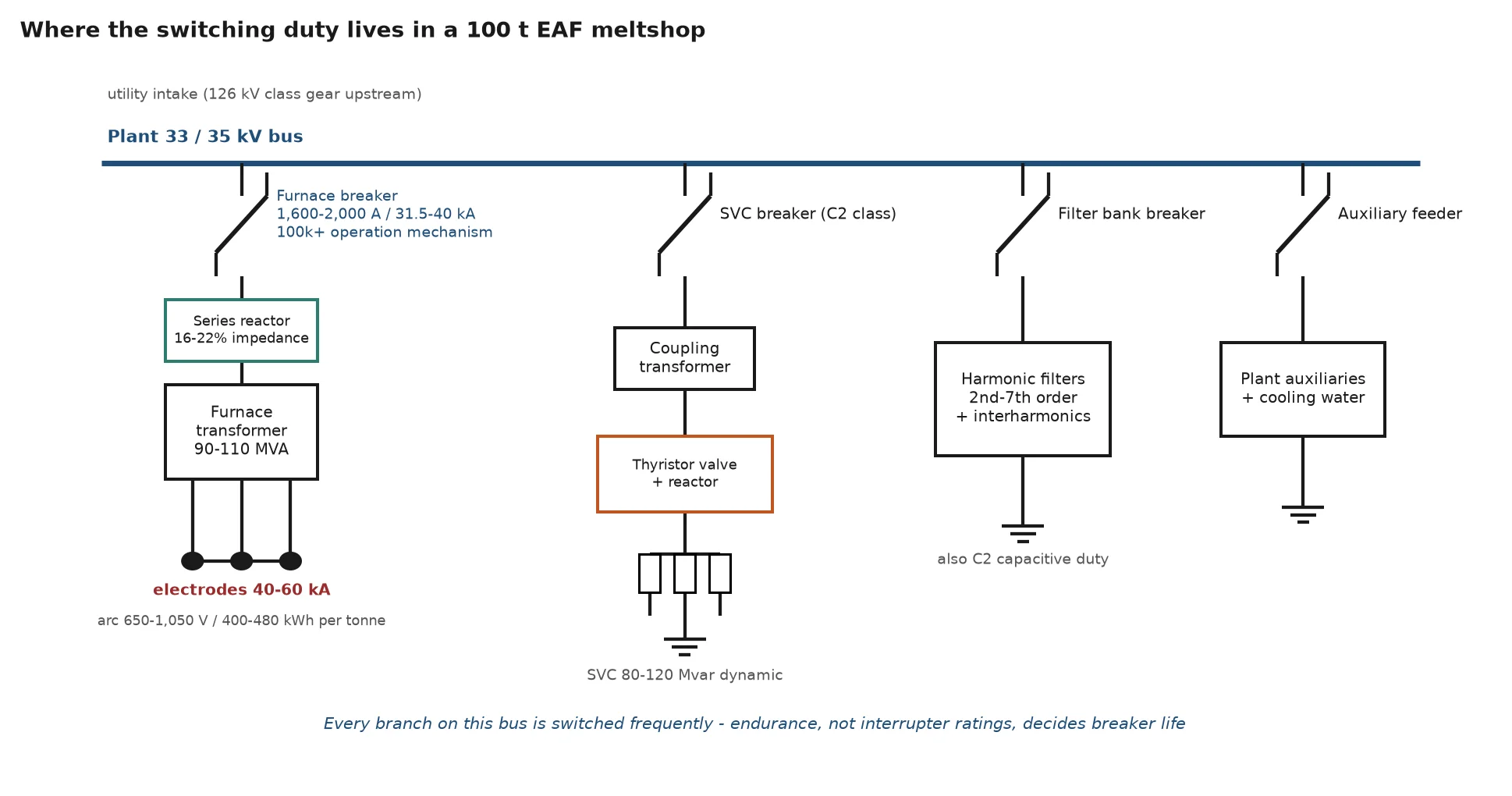
Start with the numbers, because they are larger than most engineers expect. A modern ultra-high-power EAF is designed at roughly 0.8–1.1 MVA of furnace transformer per tonne of tapping weight, so a 100 t furnace carries a 90–110 MVA transformer fed from a 33–35 kV primary. Secondary voltages step through multiple taps — typically 650–1,050 V — pushing 40–60 kA through the electrode arms. Energy per heat is 400–480 kWh per tonne, so a 100 t heat consumes 40–48 MWh, with power-on time of 35–40 minutes and a tap-to-tap cycle of 50–70 minutes.
The breaker sits on the high-voltage side, between the plant’s 33/35 kV bus and the furnace transformer. Its ratings look ordinary: about 1,600–2,000 A continuous current at 33 kV for a 90 MVA transformer, and a short-circuit rating of 31.5–40 kA for the furnace-bus fault condition. What is not ordinary is the duty. Each heat is normally started with a closing operation and ended with an opening operation, and molten-metal logistics — ladle positioning, bucket swaps, oxygen lancing — only work when the cycle is repeatable.
| Parameter | 30 t furnace | 60 t furnace | 100 t furnace | 150 t furnace |
|---|---|---|---|---|
| Furnace transformer | 30–45 MVA | 55–70 MVA | 80–110 MVA | 105–130 MVA |
| Primary voltage | 33–35 kV | 33–35 kV | 33–35 kV | 33–35 kV |
| Secondary (electrode) current | ~20–30 kA | ~35–45 kA | 40–60 kA | 50–70 kA |
| Heats per day | 8–12 | 12–18 | 20–40 | 16–20 |
| Energy per heat | ~13.5 MWh | ~25 MWh | 40–48 MWh | ~57 MWh |
| Breaker operations per day | ~16–24 | ~24–36 | ~40–80 | ~32–40 |
The “operations per day” row assumes one close and one open per heat, plus occasional protection trips during scrap cave-ins and electrode breaks. That assumption is conservative for some plants and generous for others, so measure your own furnace log before quoting figures back to a supplier — but whichever way you count it, the magnitude is the message.
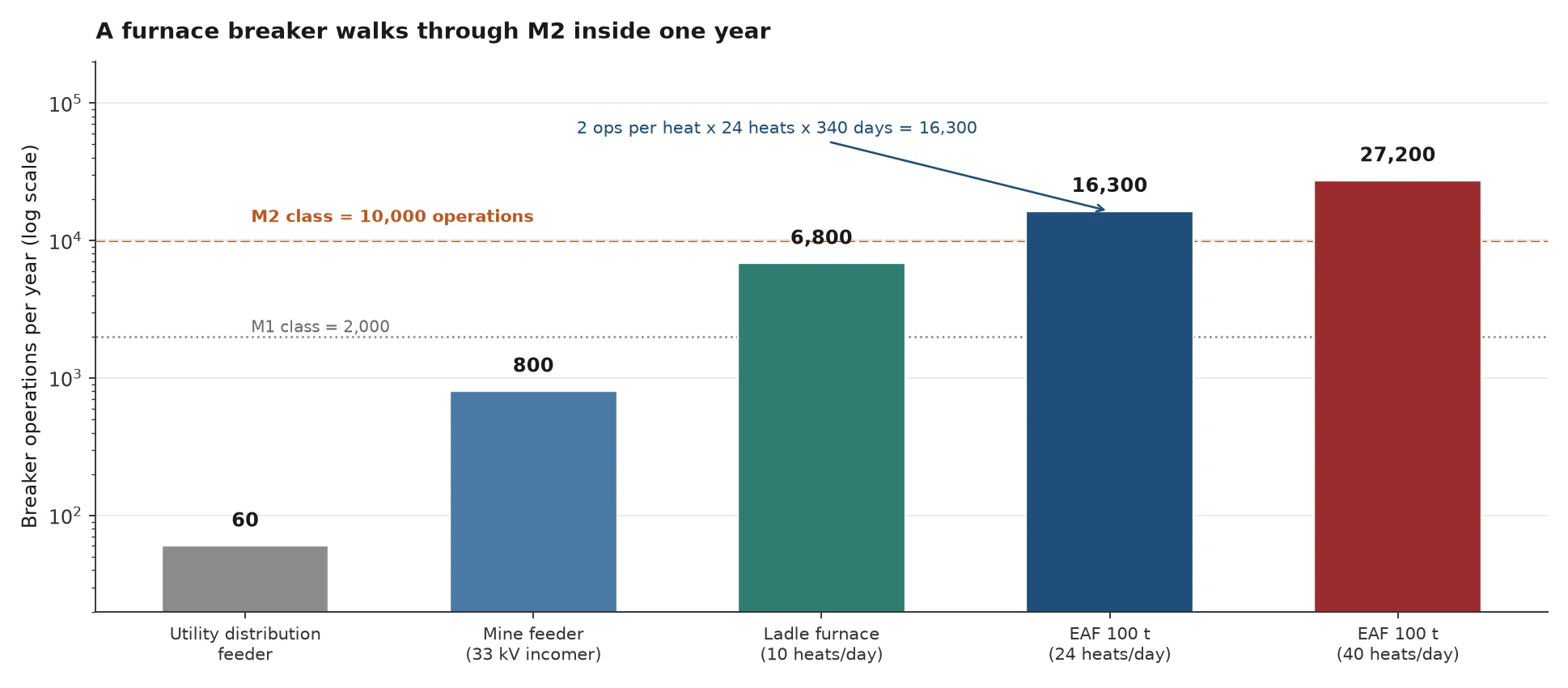
Run the numbers for a 100 t furnace at 24 heats per day and 340 operating days: 24 heats × 2 operations × 340 days ≈ 16,300 operations per year, before counting fault trips. Against a class M2 mechanical endurance rating of 10,000 operations, that breaker reaches its design maintenance threshold in roughly seven months. A distribution feeder breaker bought on the same specification sheet would take several decades to get there.
This is why furnace-duty breakers exist as a distinct product category. Dedicated designs built on servomotor-driven or electronically controlled actuation quote up to 150,000 mechanical operations without overhaul — an order of magnitude above the standard spring-charged mechanism — and pair that with monitoring that tracks operation count and mechanism health. The premium over a standard 36 kV breaker is real but small next to the cost of a furnace standing idle while its breaker is overhauled mid-campaign: at 24 heats a day, every day of breaker downtime is roughly 2,400 tonnes of steel not made.
The endurance classes behind these numbers are defined in IEC 62271-100: class M1 requires 2,000 no-load operations, class M2 requires 10,000, and electrical endurance classes E1/E2 (applicable up to 52 kV) qualify interrupter wear. Our endurance class guide covers the definitions; the furnace-specific step is using them correctly, which is the next section.
Class E2 is the label most often waved at furnace buyers, and it is widely misunderstood. The E2 test sequence — typically 274 interruptions distributed as 130 operations at 10% of rated breaking current, 130 at 30%, 8 at 60% and 6 at 100% — proves that the interrupter survives a realistic distribution of fault interruptions without maintenance. It says nothing about 16,000 load-current operations a year. A breaker can be fully E2-compliant and still be the wrong machine for a furnace, because its mechanism, not its arc chamber, is what wears out.
Industry practice handles the switching frequency explicitly. A commonly cited rule of thumb from furnace installation experience: if the furnace transformer is switched more than about 50 times per day, put a vacuum contactor — a device whose contact materials and mechanism are built for hundreds of thousands of switching cycles — between the transformer and the circuit breaker, and let the breaker handle fault protection only. Around 20 operations per day, a vacuum circuit breaker rated for the duty is the normal choice; below that, SF6 or vacuum are both defensible. The breaker-plus-contactor arrangement costs an extra panel and adds a device, but it moves the wear from the machine that is expensive to replace to the one that is not.
An arc is not a linear resistor. The furnace arc conducts in bursts, flattens the voltage wave, and generates a rich harmonic spectrum — significant 2nd through 7th order components plus interharmonics that drift with the melting stage — along with voltage flicker and phase unbalance that the electrode regulator cannot fully cancel. For the breaker itself, harmonics matter in three ways:
For the furnace breaker’s own terminals, the classic failure mode is switching overvoltage: interrupting the transformer’s magnetising or arc current before natural zero (current chopping) on a vacuum device leaves energy trapped in the transformer’s inductance, which can multiply into a steep front-edge overvoltage. The mitigation is routine — surge arresters at the breaker or transformer terminals, and RC snubbers on onerous installations — but it must be specified, because the furnace transformer’s insulation is the thing that pays when it is forgotten.
Closing onto a faulted furnace circuit — which is what happens when you close into a scrap cave-in that has already faulted an electrode arm to shell — puts the asymmetrical making peak across the contacts. At 50 Hz the first peak reaches 2.5 times the RMS breaking current, so a 31.5 kA breaker must make 80 kA peak; the physics behind that factor and the I²t thermal check are covered in our short-time versus peak withstand guide. Furnace duty adds two twists: the protection may trip and reclose several times during one unstable melt, stacking duty cycles on the interrupter, and the DC time constant of the furnace circuit is short (the loop impedance is mostly resistive at the electrode), so asymmetry decays quickly — but the first half-cycle is still the one that welds contacts.
Contact wear is therefore worth monitoring explicitly rather than inferring from operation count. The erosion behaviour of CuW and CuCr contact materials and the replacement criteria are covered in our arcing contact materials guide; on a furnace breaker, an operation counter plus a contact-wear inspection every campaign is the minimum that makes the endurance budget honest.
Mine power systems — 33 kV or 35 kV incomers feeding 11 kV and 6.6 kV distribution to conveyors, crushers, hoists, ventilation and dewatering — rarely stress a breaker electrically. Short-circuit levels at the mine incomer typically sit at 25 kA/3 s for grid-fed sites. What kills equipment is the environment:
For mine duty the pollution and creepage selection logic in our pollution class and creepage guide applies directly, and gas-insulated switchgear is often justified purely on sealing — an SF6 or dry-air C-GIS panel keeps dust and moisture out of the insulation path entirely, at the price of the gas-handling obligations we describe in the gas handling guide.
At 33–40.5 kV both technologies work; the decision is about duty and site, and the same framework as our vacuum versus SF6 comparison applies with furnace-specific weightings:
| Parameter | Vacuum (furnace/mining duty) | SF6 (furnace/mining duty) |
|---|---|---|
| Frequent load switching | Excellent — no gas system to cycle; dedicated furnace frames reach 100,000+ operations | Good; gas and seal system adds maintenance surfaces under frequent operation |
| Chopping overvoltage | 3–5 A chopping; arresters/snubbers required with furnace transformer inductance | Very low chopping; gentler on the transformer, no arrester needed for this reason |
| Harmonic-rich load | Contact heating manageable with derating; watch current-zero recovery | Soft interruption is tolerant; same heating derating applies |
| Dust and condensation | Solid-insulated poles remove exposed surfaces; sealed interrupter immune to the environment | Gas-filled tank or GIS excludes dust by design; monitor gas density |
| Gas regulation exposure | None | F-gas obligations, leak checks, end-of-life recovery |
| Best fit | Frequent-switching furnace duty, indoor panels, dust-heavy sites | Outdoor 40.5 kV and above, GIS where space or environment demands it |
The emerging default is vacuum below 40.5 kV for frequent-switching duty, with SF6 holding outdoor positions where a platform design already exists — the LW8-40.5 outdoor SF6 breaker remains a strong choice at the mine or plant incomer, while the 126 kV class handles the utility intake connection, as covered in our LW36-126 overview.
| Line item | Furnace duty | Mining duty |
|---|---|---|
| Rated current | 1,600–2,500 A with harmonic derating | 630–1,250 A feeders, 2,000 A incomers |
| Short-circuit breaking | 31.5–40 kA at the furnace bus | 25 kA/3 s typical grid-fed incomer |
| Mechanical endurance | M2 minimum; state ops/year and require extended-endurance mechanism for >10 ops/day | M2 comfortable; duty is low |
| Electrical endurance | E2 with full test report — but treat as interrupter, not mechanism, qualification | E2 routine |
| Overvoltage protection | Arresters at transformer terminals; RC snubber for onerous cases | Standard arresters at transformer and cable terminations |
| Protection rating / sealing | Indoor panel, IP4X; furnace-house dust is conductive too | IP44 minimum outdoors; sealed joints, hygrostat heaters |
| Vibration provisions | Furnace-house structure; anti-loosening hardware | Continuous mill/crusher vibration; re-torque schedule |
| Monitoring | Operation counter, mechanism health, contact wear per campaign | Earth-fault detection, cable and busbar temperature |
| Companion switching device | Vacuum contactor in series above ~50 switching ops/day | Not required |
Count two operations per heat plus trips. At 24 heats per day and 340 operating days that is roughly 16,300 operations a year — enough to exhaust the 10,000-operation M2 endurance class in about seven months, which is why furnace-duty frames are built for 100,000+ operations or paired with a vacuum contactor.
No. E2 proves the interrupter survives a defined distribution of fault interruptions (274 operations up to 52 kV). It says nothing about mechanical wear from 16,000 load operations a year. Both classes belong on the nameplate and neither substitutes for the other.
Vacuum interrupters chop 3–5 A before current zero, and interrupting the furnace transformer’s inductive current leaves trapped energy that can multiply into a steep overvoltage. SF6 arcs extinguish much closer to natural zero, so the chopping overvoltage mechanism is largely absent. Arresters are cheap either way and standard practice on furnace transformers.
The environment: conductive dust tracking across insulating surfaces, condensation cycles, and continuous vibration loosening terminals. Sealed or solid-insulated construction, IP44+ enclosures, hygrostat-controlled heaters and a first-year terminal re-torque address most of the recorded failures.
When the furnace transformer is switched more than about 50 times per day. The contactor’s contact materials and mechanism are built for hundreds of thousands of light-duty operations; the circuit breaker above it handles faults. The combination costs one panel and moves the wear to the cheaper device.
Furnace and mining loads sit at the extreme end of a spectrum that runs from utility distribution to traction to heavy industry. For the product side — 40.5 kV outdoor frames, 126 kV incomers and the ratings behind them — see the full range in our SF6 circuit breaker resource centre, or send us your load profile and single-line diagram for a duty-based configuration review.