Arc Furnaces and Mining Substations: Frequent Switching, Harmonics and Hard Environments
Furnace and mining breaker duty quantified: 16,300 operations a year, what E2 class proves, harmonic heating, and the dust and condensation fight.
Read More
Retiring a high voltage SF6 circuit breaker is not a scrap-metal job with an unusual gas cylinder attached. The gas inside the tank is worth recovering — financially, because reclaimed SF6 is reusable; legally, because regulations increasingly demand proof of what happened to every kilogram; and environmentally, because every kilogram vented equals roughly 25 tonnes of CO2-equivalent. Understanding sf6 end of life recovery starts with separating four verbs that are used interchangeably in casual conversation but mean different things in an audit: recovery, recycling, reclamation and destruction.
High voltage SF6 circuit breaker fleets across transmission utilities are ageing into their first major decommissioning wave at exactly the moment when F-gas rules are tightening, which is why the paperwork — the gas register, the certificate of recycling, the destruction record — has become as important as the pump and the hoses. This guide walks through the technical thresholds, the route decision, and the documents that prove the job was done properly.
| Term | What it means | Who does it | The evidence it produces |
|---|---|---|---|
| Recovery | Extracting the gas from the equipment into storage cylinders | Certified site personnel or contractor | Recovery record: mass in, mass out, final pressure |
| Recycling | Basic on-site cleanup (filtration of particulates and moisture) without full re-specification | Site crew with a recovery unit | Analysis report against the reuse limit |
| Reclamation | Re-processing the gas to meet the full specification for reuse in new equipment | Gas processor / specialised facility | Certificate of reclamation with batch analysis |
| Destruction | Irreversible chemical breakdown of the SF6 molecule | Licensed destruction facility | Destruction certificate and weight ticket |
One nuance matters more than the vocabulary. Reuse in HV equipment is only permitted when the gas meets the specification limits — in Europe, reclaimed or recycled gas only. Under EU Regulation 2024/573, Article 8(6), gas recovered from decommissioned equipment “shall not be used for filling or refilling equipment unless the gas has been recycled or reclaimed.” From 1 January 2035, SF6 used for maintenance or servicing must be reclaimed or recycled — virgin gas disappears from the servicing market. The in-service side of those rules is covered in the SF6 emissions and F-Gas regulation guide; this article is the end-of-life counterpart.
Two different “97 %s” circulate in SF6 conversations, and confusing them causes real audit findings. The first is a purity figure: IEC 60480:2019 sets the reuse specification for SF6 in electrical equipment, and reclaimed gas must contain more than 97 % SF6 by volume, with the impurity ceilings below. The second is a recovery figure: how much of the gas originally in the tank was actually extracted. A pump that recovers 97 % of the mass tells you nothing about purity, and gas that is 98 % pure may have been recovered with terrible efficiency. Reports that mix the two are the most common documentation defect we see in decommissioning files.
| Parameter | IEC 60480:2019 reuse limit |
|---|---|
| SF6 purity | > 97 % by volume |
| Air and/or CF4 | < 30 000 µL/L (ppm_v) |
| Moisture (H2O) | < 200 µL/L (≈ −36 °C frost point at 1 atm) |
| Mineral oil | < 10 mg/kg |
| Reactive gaseous decomposition products (as HF equivalent) | 50 µL/L total, or 12 µL/L (SO2+SOF2), or 25 µL/L HF |
Recovery efficiency, by contrast, is a mass or pressure calculation. The Chinese national guideline GB/T 8905 expresses it directly: R = (mass recovered / total gas mass) × 100 %, or equivalently from pressures, R = (P_initial − P_final)/P_initial × 100 %. Recovery ends when the compartment reaches the residual pressure the procedure specifies — around 20 kPa absolute in the GB/T 8905 vacuum-recovery method, with a residual fraction below about 0.5 % of the original gas volume. The arithmetic explains why the residual pressure target dominates the outcome: from a compartment filled to 0.5 MPa absolute, pumping down to 20 kPa leaves 4 % of the mass behind — a 96 % recovery. Getting to 5 kPa raises it to 99 %. This is also why the rated filling pressure matters when you plan the job: a compact 40.5 kV breaker such as the LW8-40.5 with 0.5 MPa rated gas pressure holds less gas per pole, so the residual-pressure maths lands you near the 96–97 % band with ordinary equipment, while larger tanks reward better vacuum.
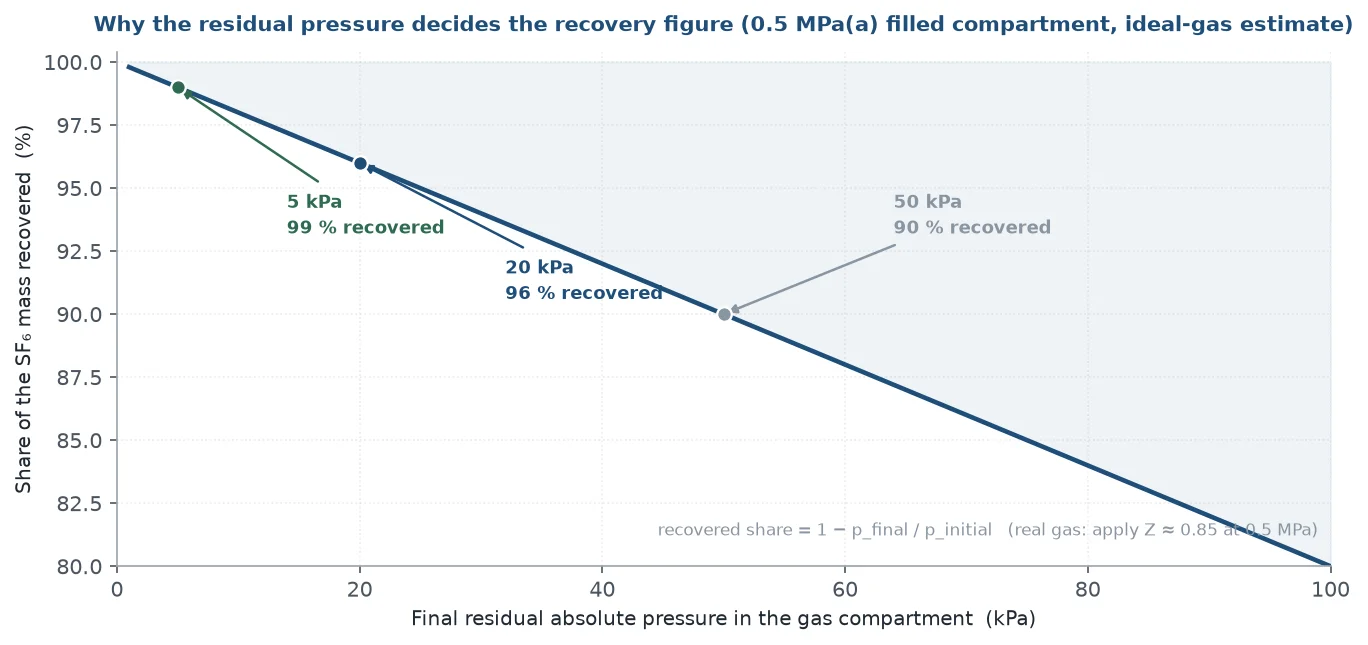
Real gas behaviour bends these numbers slightly — at 0.5 MPa the compressibility factor Z is around 0.85, so the ideal-gas estimate overstates the remaining mass a little. Treat the curve as a planning figure and record the actual weighed masses, which is what the register will ask for anyway.
The single most consequential decision in decommissioning happens before the first litre is extracted: analysing the gas. Moisture, purity and decomposition products determine whether the recovered gas can be cleaned for reuse or must go to destruction, and mixing a corrosive, arc-decomposed batch into a clean cylinder bank contaminates everything it touches. GB/T 8905 and IEC 62271-4 both place gas analysis before recovery for good reason. Faulted gas compartments should be kept on separate hoses, separate recovery equipment and separate cylinders — the SF6 gas quality, purity and moisture guide covers the analysis itself.
Standard recovery pulls the compartment down to the target residual pressure with a recovery unit and stores the gas liquefied in cylinders. Where the gas is contaminated or the target pressure cannot be reached, the sweep (wash) method recovers the bulk, then pressurises the compartment with nitrogen to 0.2–0.3 MPa and recovers again, repeating until the residual fraction meets the target. The sweep trades time and nitrogen for a lower residual fraction; it is the standard answer when a compartment has been opened for internal work, or when the recovery unit cannot reach deep vacuum on a large tank.
Recovered gas moves as dangerous goods: UN 3163 (sulfur hexafluoride) or UN 3308 (mixtures), under ADR/IMDG rules depending on the leg. Cylinders are labelled with the gas origin, analysis results, batch and mass; contaminated batches carry their own hazardous-waste coding (waste codes 16 05 04* and 16 02 13* in the European list). Storage between recovery and the processing plant matters more than crews expect: cylinders kept upright in a shaded, ventilated store, with a sample re-tested every three months, and the whole inventory tracked in the gas register. On-site handling of the gas during the breaker’s service life follows the same closed-loop logic described in the SF6 gas handling on site guide.
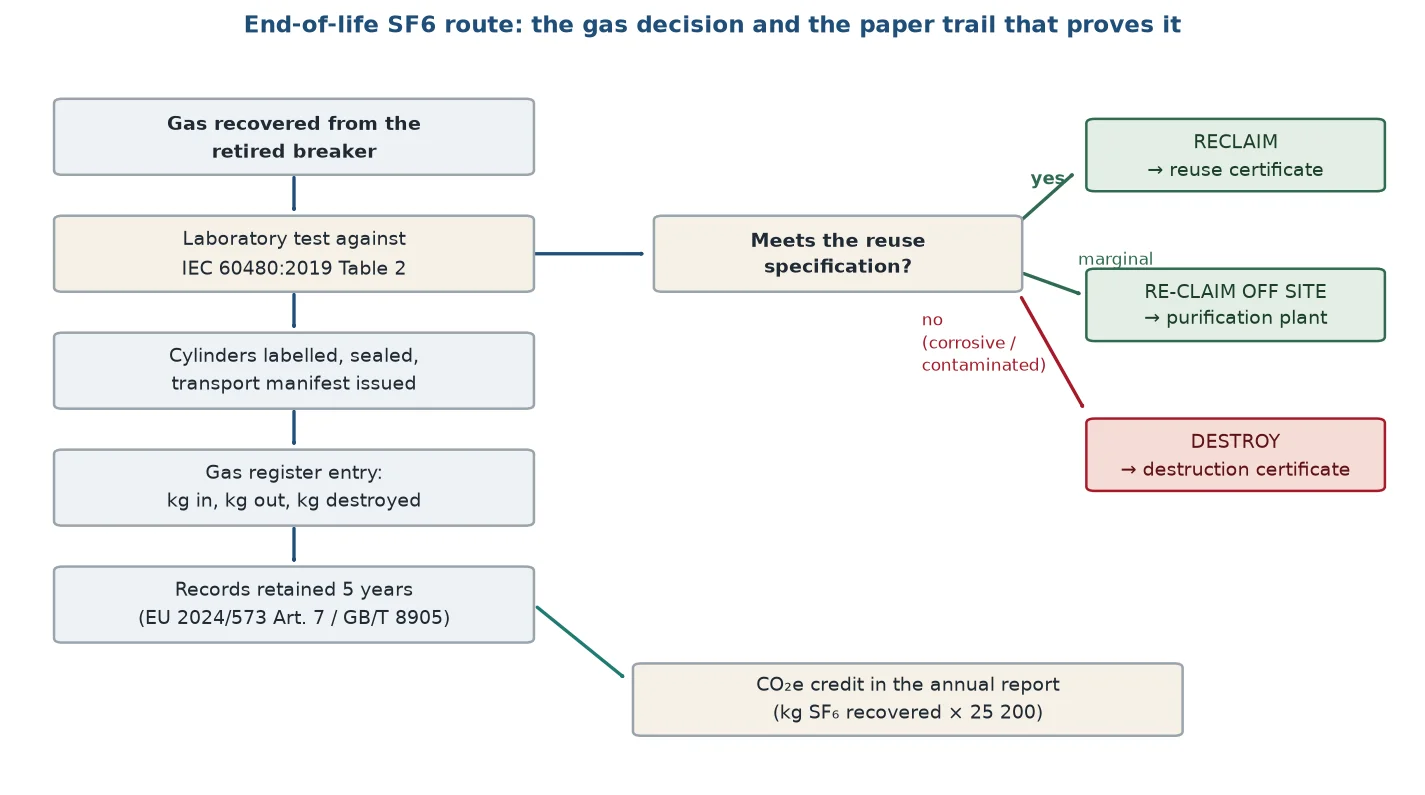
Reclamation is the default for gas in reasonable condition: clean, dry, above the purity floor and free of significant decomposition products. The economics are straightforward — reclaiming a kilogram of SF6 costs a small fraction of purchasing new gas at 25 200 CO2-equivalent kilograms per kilogram of climate impact, and regulation increasingly forces the point. Industry experience is that the overwhelming majority of recovered gas can be reclaimed for further electrical use; only gas that is badly contaminated, corrosive, or whose owner cannot document its origin must be destroyed.
Destruction is the terminal option for gas that cannot be economically re-specified. Three industrial routes dominate. High-temperature thermal cracking at 1200 °C or above breaks the SF6 molecule; the effluent — HF and SO2 — is neutralised in alkaline scrubbing. Plasma decomposition achieves destruction and removal efficiencies reported at 99.99 % or better, leaving residual SF6 concentrations below 1 µL/L. Cement kilns offer an elegant co-processing route: the CaO-rich clinker chemistry captures the fluorine and sulfur as CaF2 and CaSO4, locking the decomposition products into the product itself. All three require licensed facilities, chain-of-custody documentation and a certificate stating the mass destroyed.
| Situation | Route | Rationale |
|---|---|---|
| Gas meets or can be cleaned to IEC 60480 limits | Reclaim on site or at a processor | Reusable in electrical equipment; lowest climate cost |
| Marginal gas: elevated moisture or air, low decomposition | Off-site reclamation | Processor’s purification train can re-specify; reuse certificate returned |
| Corrosive, heavily decomposed, or undocumented origin | Destruction | Reuse risk unacceptable; destruction certificate closes the liability |
Regulators do not audit pumps; they audit records. EU Regulation 2024/573 requires operators to ensure gases are recovered and, after decommissioning, recycled, reclaimed or destroyed (Article 8), and records of installation and servicing are kept for at least five years (Article 7). China’s GB/T 8905 gas-management guideline places the same expectation on the register: purchase, filling, recovery and leak quantities for every asset. The following table is the practical minimum file for a single breaker decommissioning.
| Document | Content that must be on it | Why an auditor asks for it |
|---|---|---|
| Gas register (asset-level) | Asset ID, rated filling mass, top-up history, recovered mass, route, dates | Links each kilogram to a specific asset over its whole life |
| Pre-recovery analysis | Purity, moisture, decomposition products | Justifies the reclaim-or-destroy decision |
| Recovery record | Mass recovered per cylinder, initial and final pressures, residual fraction | Proves recovery efficiency and closed handling |
| Transport manifest | UN number, waste code, cylinder IDs, masses, carrier, destination | Chain of custody from site to processor |
| Certificate of reclamation / recycling | Batch analysis against IEC 60480, mass re-specified | Closes the loop: gas re-entered the supply, not the atmosphere |
| Certificate of destruction | Mass destroyed, method, facility licence | Proves irreversible breakdown for contaminated batches |
Where the equipment is destined for the European market, one more document class is worth insisting on from the supplier side: decommissioning instructions that match the actual hardware. A 252 kV class breaker such as the LW-252 customised outdoor SF6 circuit breaker ships with gas-mass data, valve specifications and recovery procedures in its documentation set — ask for these to be aligned with your contractor’s recovery plan before the unit is delivered, and the retirement file writes itself years later.
The climate value of a clean recovery is worth quantifying, because it is the number that turns a gas register into a board-level report. Take a 252 kV breaker with roughly 40 kg of SF6 at end of life. Recovered and reclaimed: 38.4 kg at 96 % recovery means roughly 38.4 × 25 200 = about 967 tonnes of CO2-equivalent kept out of the atmosphere — the annual footprint of dozens of households. The same breaker vented would emit over 1 000 tonnes CO2e in a single afternoon. The reporting methodology — how the recovered mass feeds the annual inventory — follows the worked example in the SF6 leak rate and CO2-equivalent reporting guide, and the avoided-emission credit belongs in the same report.
End-of-life SF6 handling is a compliance project that happens to involve a pump. The technical thresholds are few and learnable: test before you recover, chase residual pressure down to the target, decide reclaim versus destroy on measured data, and keep every kilogram traceable in a register that survives five years. Utilities planning fleet retirement should also weigh the replacement decision in the same project — the SF6-free alternatives guide covers what replaces the retired assets, and the day-to-day health work in between lives in the SF6 circuit breaker maintenance guide. Browse the full SF6 circuit breaker blog library for the standards, testing and specification references behind each step, or contact us to discuss decommissioning documentation for a specific model.
The share of the original gas mass extracted from the equipment — mass recovered divided by mass originally filled. It is a mass figure, unrelated to purity, and it is set by the final residual pressure: from 0.5 MPa(a) down to 20 kPa(a), about 96 % of the mass is recovered.
Recycled gas has had basic on-site cleanup (filtration, drying) without full re-specification. Reclaimed gas has been re-processed to meet the complete specification for reuse — IEC 60480:2019 limits, including purity above 97 %, moisture below 200 µL/L and decomposition-product ceilings. Only recycled or reclaimed gas may be used to refill equipment under EU rules.
When the gas is heavily contaminated, corrosive from arc decomposition, or its origin and analysis cannot be documented. Destruction — thermal cracking, plasma decomposition or cement-kiln co-processing — irreversibly breaks the molecule and closes the liability with a destruction certificate.
At least five years under EU Regulation 2024/573 Article 7, and effectively permanently in a well-run gas register, since the register links each asset’s whole gas history — purchases, top-ups, recoveries — across decades of service.
Roughly 25 200 kg CO2e on the IPCC AR6 100-year basis (23 500 on AR5). A 40 kg breaker charge therefore represents about 1 000 tonnes of CO2-equivalent — the reason a verified recovery and reclamation record is a climate achievement, not just a compliance task.
Yes — after it has been recycled or reclaimed to specification, and with the batch analysis documented. Under EU Regulation 2024/573, gas recovered from decommissioned equipment may not be used for filling or refilling unless it has been recycled or reclaimed, and from 2035 servicing must rely on reclaimed or recycled gas rather than virgin SF6.