Arc Furnaces and Mining Substations: Frequent Switching, Harmonics and Hard Environments
Furnace and mining breaker duty quantified: 16,300 operations a year, what E2 class proves, harmonic heating, and the dust and condensation fight.
Read More
If you are comparing the LW36-126 vs LW9-72.5, the answer is almost never decided by the model number. It is decided by two numbers on your system study: the highest system voltage, and the prospective short-circuit current. Everything else — continuous current, mechanical life, mounting, reclosing — narrows the choice inside a frame that those two numbers have already selected. This comparison sets the four frames in the Hairui LW range side by side and, more usefully, identifies the exact conditions that force you one step up the range.
The four frames are LW8-40.5 at 40.5 kV, LW9-72.5 at 72.5 kV, LW36-126 at 126 kV and LW-252 at 252 kV. All four are outdoor live-tank designs with SF6 arc extinction and spring operating mechanisms, built to IEC 62271-100. They are the same family, built in the same factory, on the same routine test sequence. The differences below are real engineering differences, not marketing tiers.
| Parameter | LW8-40.5 | LW9-72.5 | LW36-126 | LW-252 |
|---|---|---|---|---|
| Rated voltage | 40.5 kV | 72.5 kV | 126 kV | 252 kV |
| Rated current | 1600 / 2000 A | 3150 / 4000 A | 3150 A | 4000 A |
| Rated breaking current | Project-confirmed | 40 kA | 40 kA | 50 kA |
| Short-time withstand | Project-confirmed | 40 kA / 3 s | 40 kA / 3 s | 50 kA |
| Peak withstand | — | 100 kA | — | 125 kA |
| PF withstand to earth | 95 kV | 160 kV | Per project study | 460 kV |
| Lightning impulse to earth | Per project study | 350 kV | Per project study | 1050 kV |
| Mechanical life | 3000 operations | IEC class | IEC class | IEC class |
| Poles | 3 | 3 | 3 | 3 |
| Rated gas pressure | 0.5 MPa | Per build | Per build | Per build |
| Construction | Porcelain column | Porcelain column | Live tank | Split type |
Two cells in that table deserve a warning. “Project-confirmed” is not a gap in the datasheet — it is a deliberate position. A 40.5 kV breaker installed on a 25 kA bus and one installed on a 31.5 kA bus are different interrupters, and publishing a single number invites buyers to specify the wrong one. Send the fault level and it is fixed in the quotation. The same applies to the insulation columns: at 126 kV and 252 kV the insulation level is a function of your overvoltage study, your altitude and your pollution level, not of the frame.
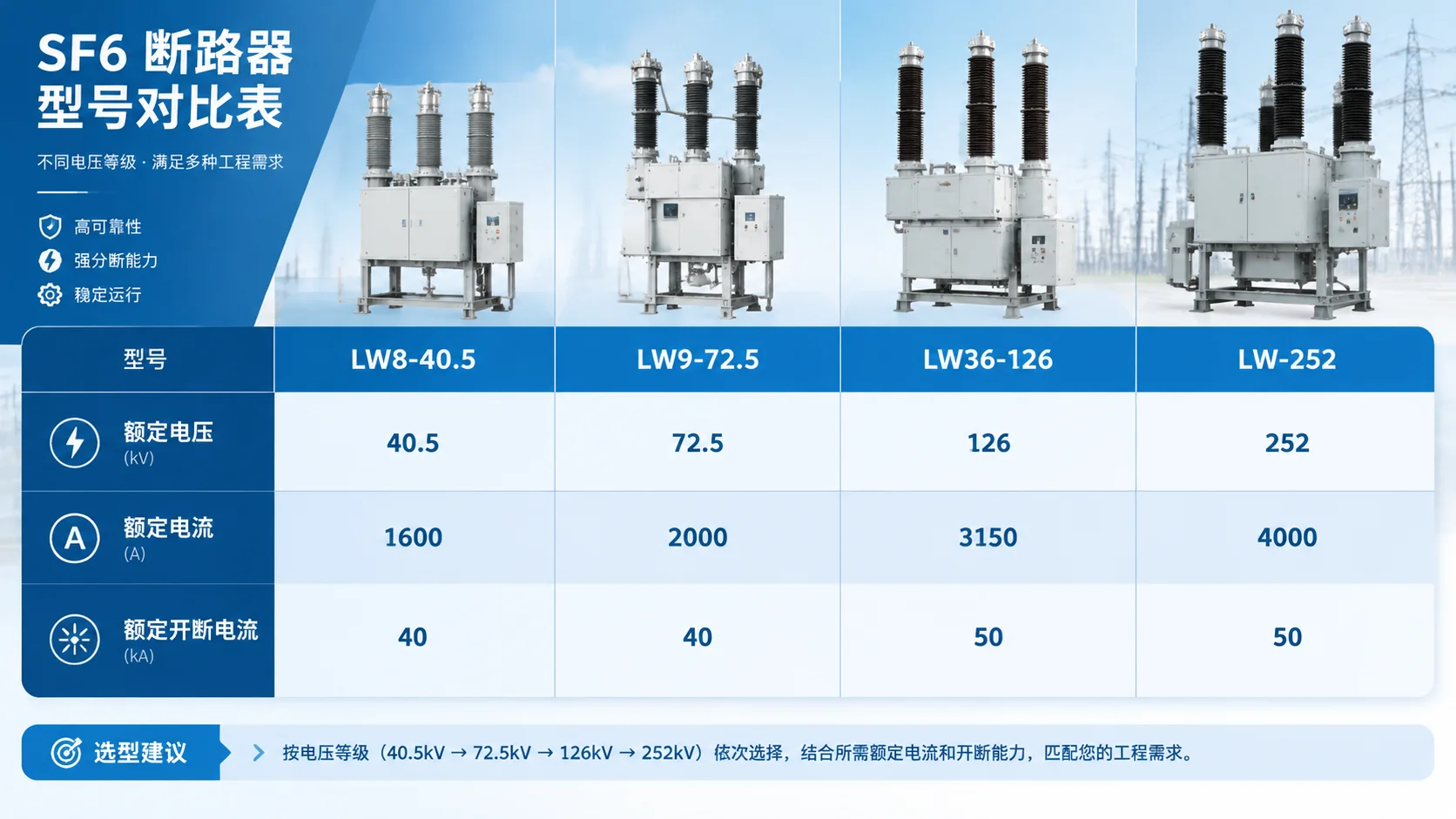
Read the table by column, not by row. Voltage is the first gate; everything to the left of a column is what you cannot get from that frame.
This is the pair buyers actually agonise over, because both are quoted at 40 kA and the impulse is to treat them as interchangeable above and below some arbitrary load threshold. They are not interchangeable, and the breaking capacity — the number people compare first — is identical. What separates them is voltage, and voltage is not negotiable.
| LW9-72.5 | LW36-126 | |
|---|---|---|
| Highest system voltage it can serve | 72.5 kV | 126 kV |
| Typical nominal systems | 66 kV, 69 kV | 110 kV, 132 kV |
| Maximum continuous current | 4000 A | 3150 A |
| Breaking capacity | 40 kA | 40 kA |
| Short-time withstand | 40 kA / 3 s | 40 kA / 3 s |
| Insulation, lightning impulse | 350 kV to earth | Per project study |
| Reclosing | Combined single and three-pole | Per protection scheme |
| Where it is the only correct answer | 66 kV systems needing 4000 A | 110 kV systems, regardless of current |
The counter-intuitive row is the third one. The 72.5 kV frame carries more continuous current than the 126 kV frame — 4000 A against 3150 A. That is not an error in the range; it reflects how the two networks are used. A 66 kV industrial bus often carries a very high load current across a short distance, while a 110 kV transmission bay typically sits at 2000 A to 3000 A with the constraint on fault level rather than load. So a buyer who assumes “higher voltage frame equals higher rating” will specify the LW36-126 for a 66 kV bus at 3800 A and discover it cannot be built.
The decision therefore runs in one direction only:
There is a second-order factor that decides some projects: current transformers. On the LW-252 the split-type construction allows CTs to be mounted on each pole column independently; on the smaller frames CTs are typically a separate metering unit. If your protection scheme needs multiple cores with different accuracy classes, work that out before the frame is fixed rather than after.
The 40.5 kV frame is judged unfairly because it sits at the bottom of the range. In distribution work it is the right answer more often than the other three combined, and the criteria are different. On a 35 kV collector substation at a wind farm, the breaker may operate several thousand times over its life but will rarely see a fault anywhere near its rating. Mechanical life and gas stability matter; breaking capacity does not.
The LW8-40.5 is built around that duty. It carries 3000 operations of mechanical life, a 95 kV power-frequency withstand level, and a two-stage gas pressure scheme — 0.5 MPa rated, 0.47 MPa alarm, 0.15 MPa minimum functional. The two-stage warning is a design decision worth understanding: the alarm fires long before interrupting performance degrades, so a slow leak on an unmanned site is a scheduled maintenance task rather than an unplanned outage.
What the 40.5 kV frame cannot do is grow with your network. If the short-circuit level at that busbar rises past what the interrupter can clear — a common outcome when a substation adds a transformer or a neighbouring plant adds generation — no amount of maintenance saves the breaker. It has to be replaced with a higher frame, which means new foundations, new bushings, new CTs and a new protection study. If your network plan shows load growth, that is the moment to consider the 72.5 kV frame even though 40.5 kV would work today.
The 252 kV frame is selected by two independent conditions, and either one alone is sufficient: system voltage above 145 kV, or a prospective fault level above 40 kA. The second condition catches projects that assumed voltage alone drives the choice. A 110 kV bus close to a large generating station can exceed 40 kA without any voltage increase, and at that point the LW36-126 is out of range regardless of its other merits.
The frame carries 4000 A continuous, 50 kA breaking and 50 kA withstand, 125 kA peak making current, 460 kV power-frequency withstand and 1050 kV lightning impulse to earth. The across-fracture values — 460 + 146 kV power frequency and 1050 + 206 kV impulse — are the ones that matter on a breaker and a half scheme, because they define what happens when one side of the open gap is at a different potential from the other. Simplified datasheets routinely omit them.
Split-type construction is the other practical difference. Each pole column is a separate assembly. On a 220 kV site that means easier transport, independent alignment to the structure, and the ability to service one pole without dismantling the other two. On a remote transmission substation where a crane mobilisation costs more than the labour, that access difference is a genuine lifecycle cost line.
Run these in order and the frame falls out. Running them out of order is how projects end up buying breaking capacity they do not need, or discovering too late that the frame cannot reach the required current.
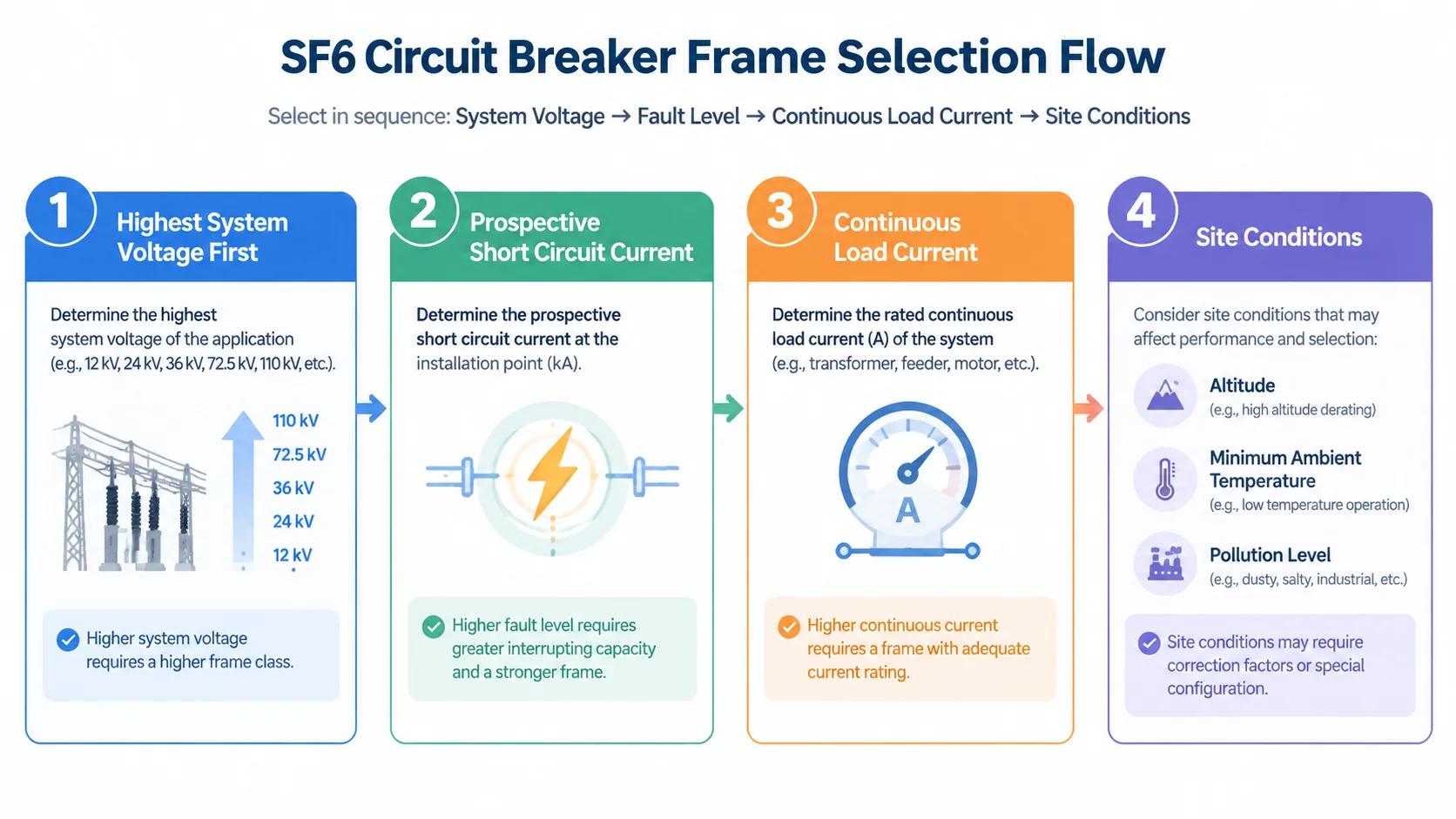
| Step | Question | What it fixes |
|---|---|---|
| 1 | What is the highest system voltage, not the nominal? | Eliminates every frame below that class. LW8-40.5 for 35 kV systems, LW9-72.5 for 66/69 kV, LW36-126 for 110/132 kV, LW-252 for 220 kV. |
| 2 | What is the prospective short-circuit current? | Above 40 kA, only the LW-252 remains, whatever the voltage. |
| 3 | What is the maximum continuous load current, derated for ambient? | Chooses between 1600 and 2000 A on the 40.5 kV frame, between 3150 and 4000 A on the 72.5 kV frame. |
| 4 | What does the site impose — altitude, minimum ambient, pollution, seismic? | Adds cold-climate or high-altitude packages and may force the external insulation one class up. |
Step one and step two are frequently confused, and the confusion runs both ways. Buyers sometimes specify a 252 kV frame for a 110 kV bus because they are “planning for growth” in voltage — that is almost never the right call, because voltage growth means a new substation, not a new breaker. Equally often, a 126 kV bay is specified at 40 kA because that is the frame’s number, without anyone checking whether the network actually calculates to 45 kA. The full ranked method is set out in how to select an SF6 circuit breaker, and the parameters of the 126 kV frame specifically are walked through in LW36-126 explained.
Once the frame is fixed, the configured price varies far more than buyers expect. These are the items that actually change the quotation, in descending order of impact:
The relative weight of these items, and where the money actually goes at each voltage class, is covered in SF6 circuit breaker price and cost drivers. For budgeting, that breakdown is more useful than a single number with no specification behind it.
Construction choice is a separate decision that sits alongside frame selection: live tank or dead tank changes where the current transformers mount, how much ground area the bay needs and how maintenance access works. The LW range is live tank throughout, which suits most outdoor substation layouts but is not universally the right answer.
Voltage class, and that is the only decisive difference. Both are rated at 40 kA breaking and 40 kA/3 s withstand. The LW36-126 serves 110 kV and 132 kV systems; the LW9-72.5 serves 66 kV and 69 kV. Counter-intuitively, the lower voltage frame carries more continuous current — 4000 A against 3150 A — so current rating cannot be used to rank them.
Electrically the insulation would be adequate, but it is almost never the right commercial decision. You would pay for a larger frame, larger foundations, larger bushings and a higher-priced CT set to protect a 66 kV bus. The exception is standardisation: if the whole substation is already built on the 126 kV frame and spares commonality outweighs unit cost, the argument is defensible.
None of the 40 kA frames. At 45 kA the only frame in the range that qualifies is the LW-252 at 50 kA, even though your voltage is 110 kV. This is exactly the case where voltage-first selection gives the wrong answer, and it is more common than buyers expect on buses near generation.
At 40.5 kV, vacuum and clean-air alternatives are credible and often preferable depending on your F-gas obligations and maintenance capability. The honest position by voltage class — including where SF6 remains the practical choice — is set out in SF6-free alternatives. Above 72.5 kV, SF6 remains the mainstream choice for most buyers today.
Split-type means each pole column is a separate assembly; single-tank means the three poles share one enclosure. Split-type is easier to transport, allows independent alignment and lets you service one pole without dismantling the others. Single-tank is more compact. In this range, the LW-252 is split-type and the smaller frames are porcelain column.
Yes — 12 months, and one unit minimum for a trial order across the range. The full ordering sequence, QC checkpoints and export documentation are in how to buy SF6 circuit breakers from a manufacturer.
Yes. All four frames are built in the same factory on the same routine test sequence, so a mixed order ships together with one documentation package — which matters on EPC projects where the switchyard and the collector substations are procured at the same time.
Four numbers produce a configured offer rather than a catalogue price: highest system voltage, prospective short-circuit current, maximum continuous load current, and site conditions — altitude, minimum ambient temperature and pollution level. Add your destination port if you want freight included, and your control voltage if it differs from the standard build.
Send those to us and we will confirm which frame applies, state plainly whether the breaking capacity has margin or is at its limit, and flag any item in the configuration that will move the lead time. Request an LW series quotation, or start from the full HV SF6 circuit breaker range if the voltage class is not yet fixed.