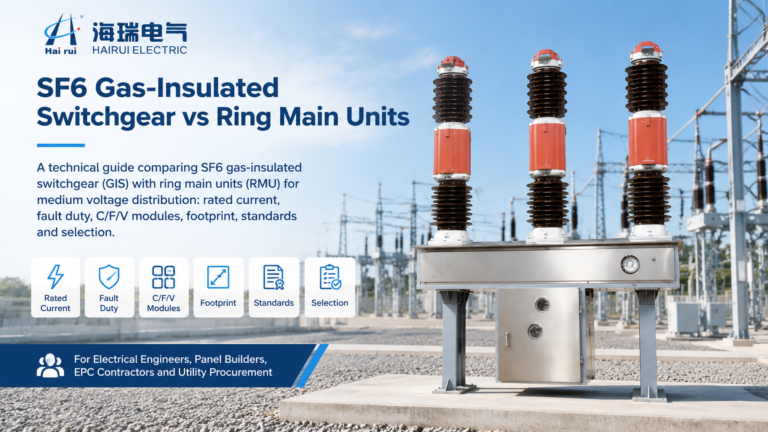
What Is an SF6 Circuit Breaker? Working Principle & Construction
Published: Author: Lisa
An SF6 circuit breaker is a high-voltage switching device that uses sulfur hexafluoride (SF6) gas to insulate its live parts and to extinguish the electric arc when it interrupts current. When a fault occurs, the breaker separates its contacts inside a sealed chamber filled with pressurized SF6; the gas absorbs the free electrons of the arc, rebuilds dielectric strength almost instantly, and snuffs the arc out at the next current zero. That simple mechanism is why SF6 breakers dominate transmission and distribution networks from 12 kV to 800 kV.
This guide explains what an SF6 circuit breaker is, why SF6 gas is such a powerful arc-quenching medium, how the breaker is constructed, and step by step how it interrupts current. If you are an engineer, a maintenance technician, or a buyer evaluating high-voltage switchgear, you will finish with a clear mental model of the technology and the practical details that matter on a datasheet.
What Is an SF6 Circuit Breaker?
An SF6 circuit breaker is a circuit breaker in which sulfur hexafluoride gas is the arc-quenching and insulating medium. Like any circuit breaker, it has two jobs: carry normal load current without overheating, and interrupt short-circuit current fast enough to protect lines, transformers, and other substation equipment.
What makes SF6 breakers special is how they interrupt. Instead of oil, compressed air, or a vacuum, they release or compress SF6 gas so that a high-speed gas flow blasts the arc between the opening contacts. Because SF6 is strongly electronegative, it captures free electrons and turns them into heavy, immobile negative ions. The arc path loses its charge carriers in microseconds, the gap recovers its insulating strength, and the arc cannot restrike.
Medium: sulfur hexafluoride (SF6) gas, sealed in the interrupter and insulating chambers.
Function: carries load current and interrupts fault current in power systems.
Voltage range: distribution classes from roughly 12–40.5 kV up to transmission classes of 800 kV.
Configurations: self-contained outdoor breakers in air-insulated substations or integrated into gas-insulated switchgear (GIS).
Key benefit: extremely short arcing time, low maintenance, and quiet operation compared with oil or air-blast designs.
Why SF6 Gas? The Properties That Make Arc Quenching Possible
SF6 was first used commercially for current interruption in the 1950s, and it quickly replaced oil and air for high-voltage duty because of a unique combination of electrical and physical properties.
High dielectric strength
At the same pressure, the dielectric (insulating) strength of SF6 is roughly 2.5 to 3 times that of air. This means the contact gap can be much shorter for the same voltage, which shrinks the whole interrupter and keeps outdoor breakers compact.
Strong electronegativity
SF6 molecules readily capture free electrons and form heavy negative ions that do not carry current. In an arc, this removes the charge carriers that sustain conduction, so the gas gap recovers its insulating strength far faster than air can.
Good thermal conductivity and arc cooling
SF6 conducts heat away from the arc efficiently and cools the hot gas column rapidly, which helps the gap withstand the transient recovery voltage that appears across the contacts after interruption.
Chemical stability and inertness
Under normal operating conditions SF6 is colorless, odorless, non-flammable, and non-toxic. It is stable at the temperatures found inside switchgear, so a sealed breaker can run for years without replacing the gas. One caveat: moisture inside the chamber must be controlled, because decomposition by-products formed during arcing become corrosive in the presence of water.
Property
SF6 behavior
Why it matters in a breaker
Dielectric strength
~2.5–3× air at equal pressure
Shorter contact gaps, compact interrupters
Electronegativity
Captures free electrons, forms immobile negative ions
Fast dielectric recovery; the arc goes out and stays out
Thermal conductivity
Higher than air; efficient heat removal
Rapid arc cooling, lower arc energy
Stability
Inert, non-flammable, non-toxic at normal conditions
Long gas life, low maintenance, safe handling with correct procedures
Construction of an SF6 Circuit Breaker
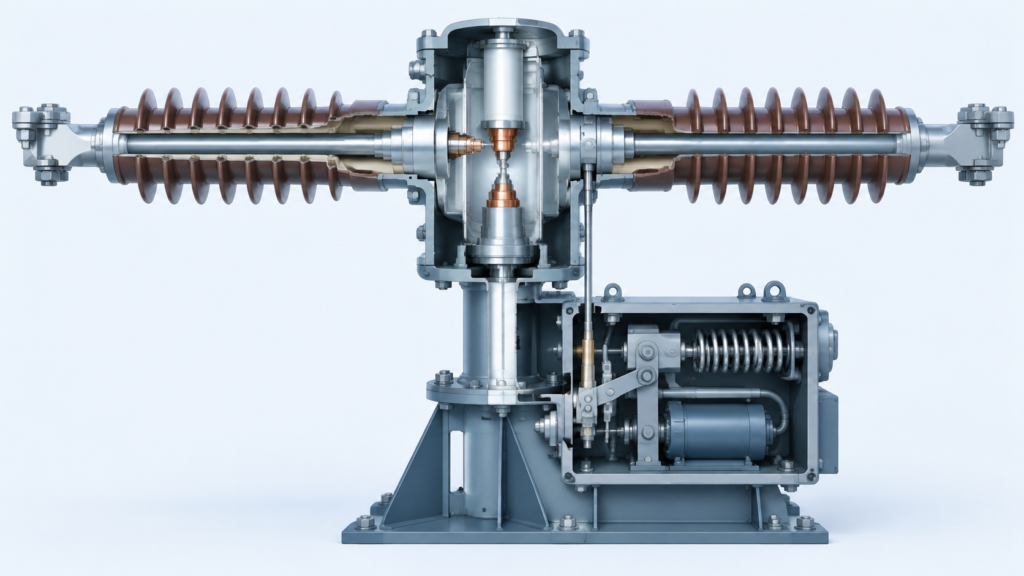
Every SF6 circuit breaker, from a 40.5 kV distribution unit to a 245 kV transmission breaker, is built around the same four functional groups. Understanding them makes datasheets and maintenance manuals much easier to read.
Interrupter unit
The interrupter is the heart of the breaker. It contains a fixed contact and a moving contact, plus arcing contacts made of copper–tungsten that take the damage of arcing so the main current-carrying contacts stay clean. Around the contacts is an insulating nozzle and, in puffer designs, a cylinder-and-piston assembly that compresses SF6 during the opening stroke to generate the gas blast.
Gas system
Because SF6 is expensive, the breaker operates as a closed gas system rather than exhausting to the atmosphere. A reservoir or the interrupter chamber itself holds gas at the rated pressure, and a density monitor (often called a density relay) continuously checks the gas. The monitor distinguishes normal temperature-related pressure changes from a real leak: it triggers an alarm at the first low-pressure threshold and can block operation at a second, lower threshold to protect the breaker from interrupting without enough gas.
Insulation
In a live-tank breaker, the interrupter sits on porcelain or composite insulator columns that provide insulation to ground, and the gas inside the chamber handles the insulation between live parts. In dead-tank designs the interrupter is inside a grounded metal tank, and SF6 provides all insulation to ground. Outdoor units are designed to withstand rain, pollution, and lightning impulses while keeping the internal gas sealed.
Operating mechanism
The operating mechanism supplies the energy to open and close the contacts. Spring mechanisms are now the norm for medium and high voltage because they are simple and reliable; hydraulic and pneumatic mechanisms appear on some large transmission breakers. The mechanism also charges the closing spring, supports auto-reclosing duty, and reports mechanical state to the control room.
Working Principle: How an SF6 Circuit Breaker Interrupts Current
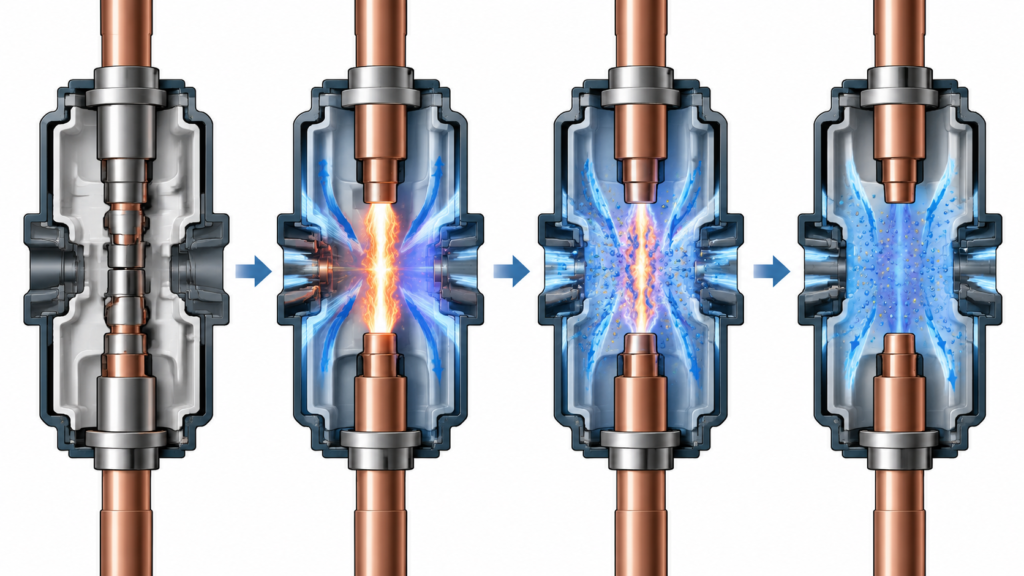
The interruption sequence happens in a few hundred milliseconds, but each stage matters. Here is what happens, step by step.
Closed position. The contacts are engaged inside the chamber and carry normal load current. The SF6 gas around them is at its rated pressure and provides insulation between phases and to ground.
Opening command. A protection relay detects the fault and sends a trip signal. The operating mechanism releases the stored energy and pulls the moving contact away from the fixed contact.
Arc formation. As the contacts separate, current does not stop instantly. The voltage across the small gap ionizes the gas and an arc forms between the arcing contacts, with temperatures in the range of 10,000–20,000 K.
Gas blast. In a puffer breaker the opening stroke compresses SF6 in the cylinder; in a self-blast breaker the arc’s own heat expands the gas. Either way, a high-speed jet of SF6 flows through the nozzle and along the arc, cooling it and sweeping away ionized particles.
Electron capture. SF6’s electronegativity does the decisive work: the gas absorbs free electrons from the arc and forms immobile negative ions. The arc path loses its charge carriers and the conductive channel collapses.
Current zero and dielectric recovery. The arc extinguishes at the next natural current zero. The gap has already recovered enough dielectric strength to withstand the transient recovery voltage, so the arc does not restrike, and the interruption is complete.
On a reclosing cycle, the mechanism closes the contacts again after a set dead time and is ready for the next operation. This closed gas cycle is why SF6 breakers run quietly and need no exhaust system, unlike air-blast breakers.
Main Types of SF6 Circuit Breakers at a Glance
Manufacturers have built SF6 interrupters in several ways over the decades, and the terminology still appears on datasheets. The most useful distinction for buyers is puffer versus self-blast, and live tank versus dead tank.
Type
How the gas blast is created
Where it is common
Single-pressure puffer
A piston driven by the opening stroke compresses SF6 to create the blast
Workhorse design for medium and high voltage; simple and proven
Self-blast (thermal expansion)
The arc heats and expands the gas to build pressure; the mechanism does less work
Modern high-voltage breakers with low-energy spring mechanisms
Double-pressure
High- and low-pressure reservoirs with a valve releasing the blast
Older early designs; rarely built today
Live tank
Interrupter on insulator columns, energized at line potential
Outdoor air-insulated substations; lighter and easier to maintain
Dead tank
Interrupter inside a grounded metal tank with bushings
Common in some markets; integrates current transformers
Most outdoor breakers sold today, including the LW8 and LW9 series used in distribution and sub-transmission substations, are single-pressure puffer or self-blast live-tank designs.
Advantages and Limitations
The advantages explain why SF6 became the default for high-voltage interruption:
Very short arcing time and low arc energy, which extends contact life.
Compact interrupters thanks to high dielectric strength.
Sealed gas system: noiseless operation and no hot-gas exhaust.
Low maintenance compared with oil breakers; no oil handling or fire risk.
Consistent performance independent of atmospheric conditions.
The limitations are equally important for operators and buyers:
SF6 is a potent greenhouse gas, so gas handling, leak monitoring, and end-of-life recovery must follow proper procedures.
Moisture ingress can form corrosive by-products; gas quality must be checked.
In very cold climates, heaters may be needed to prevent SF6 liquefaction at higher fill pressures.
Where SF6 Circuit Breakers Are Used
SF6 circuit breakers protect almost every level of the power network:
Transmission substations at 110 kV, 220 kV, and above, where breaking capacity demands are severe.
Distribution and sub-transmission networks at 12–40.5 kV, typically as outdoor pole- or frame-mounted breakers.
Power plants and industrial switchyards for generator and feeder protection.
Inside gas-insulated switchgear (GIS) for compact urban and high-voltage installations.
What to Check When Selecting an Outdoor SF6 Circuit Breaker
When you compare SF6 breakers on datasheets, the working principle is the same, but the ratings decide whether the breaker fits your substation. Check these points first:
Rated voltage and insulation level: the system voltage, plus power-frequency and lightning impulse withstand levels for the site.
Rated normal current: the continuous load the breaker must carry, including future load growth.
Short-circuit breaking capacity: the maximum fault current (in kA) the breaker can interrupt, and whether it covers the substation’s worst-case fault level.
Rated SF6 gas pressure and density monitoring: the fill pressure class and how the breaker alarms or locks out on low gas.
Mechanical and electrical endurance: the number of operations the mechanism and interrupter are rated for. For example, the LW8-40.5 with a 3000-operation mechanical life suits applications with frequent switching.
Operating mechanism and duty: spring or hydraulic, and whether the breaker supports auto-reclosing, such as the LW9-72.5 combined-reclosing breaker for sub-transmission lines.
Standards and type tests: compliance with IEC 62271-100 or IEEE C37 series, with type-test certificates for the specific rating.
Environmental conditions: altitude, pollution level, and minimum ambient temperature.
Insulation coordination matters just as much as breaking capacity. For outdoor installation at altitude or in lightning-prone areas, check the impulse withstand rating of the design, as on the LW8-40.5 lightning-impulse-tested outdoor SF6 breaker.
Conclusion
An SF6 circuit breaker interrupts current by separating contacts inside pressurized sulfur hexafluoride gas, letting the gas blast cool the arc and its electronegativity remove the free electrons that sustain it. The result is fast, quiet, and reliable interruption with low maintenance, which is why SF6 breakers protect power networks from distribution feeders to 800 kV transmission lines. When you evaluate a breaker, focus on the ratings, gas system, mechanical endurance, and type-test evidence rather than the marketing story.
SF6 stands for sulfur hexafluoride, a synthetic gas made of one sulfur atom and six fluorine atoms. It is used in high-voltage equipment because of its exceptional dielectric strength and arc-quenching ability.
How does an SF6 circuit breaker extinguish the arc?
When the contacts open, an arc forms between them. SF6 gas is blown along the arc to cool it, and because the gas is strongly electronegative it captures free electrons and forms immobile negative ions. The arc path loses its charge carriers and the gap regains its dielectric strength, so the arc is extinguished at the next current zero.
Why is SF6 gas used instead of air in circuit breakers?
SF6 has about 2.5 to 3 times the dielectric strength of air, absorbs free electrons efficiently, and cools the arc faster. This allows much shorter contact gaps, smaller interrupters, and interruption of much larger fault currents than air can handle.
Is an SF6 circuit breaker safe?
Yes, in normal operation. SF6 is non-toxic, non-flammable, and stable, and the breaker is a sealed system. Safety depends on correct gas handling: operators should avoid inhaling the gas or its decomposition by-products, monitor gas pressure, and follow recovery procedures during maintenance because SF6 is a potent greenhouse gas.
What voltage levels are SF6 circuit breakers used at?
SF6 circuit breakers are used from distribution voltages around 12 kV and 40.5 kV up to transmission voltages of 800 kV. Within a substation, the same technology also appears inside gas-insulated switchgear.
How long does an SF6 circuit breaker last?
A well-maintained SF6 circuit breaker can operate for 20 to 30 years. Its mechanical life is typically rated in operations (for example, 3000 to 10,000 operating cycles depending on class), while the sealed gas system needs only periodic checks of density and moisture.
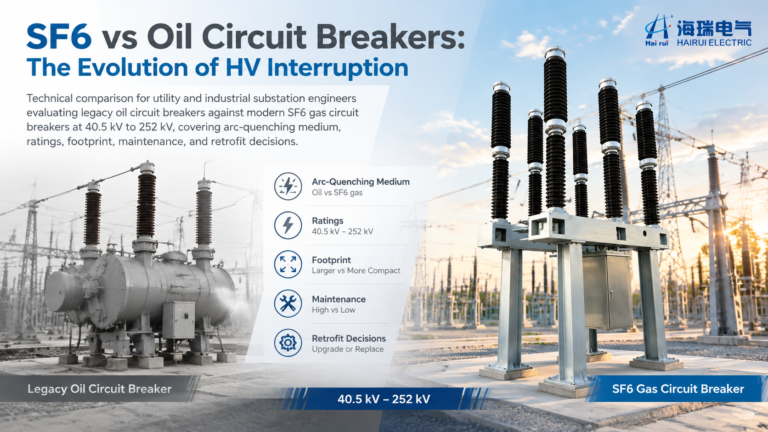
SF6 vs oil circuit breaker comparison: arc-quenching principles, bulk oil vs minimum oil, ratings, maintenance, fire risk, and a practical checklist for replacing legacy oil breakers with SF6 units.
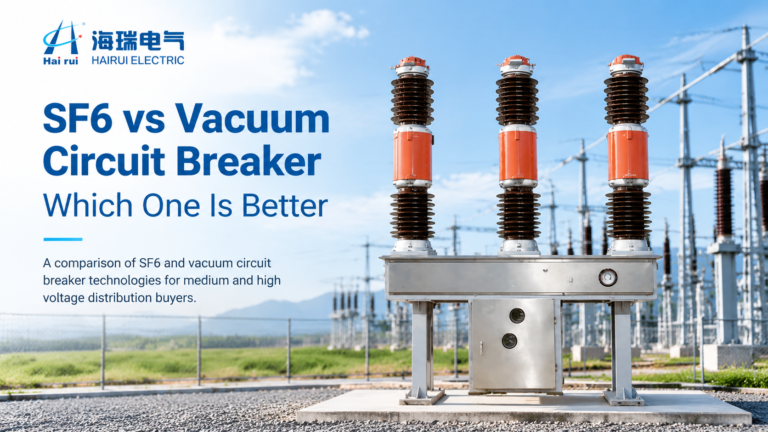
Vacuum or SF6? Compare arc quenching, voltage limits, switching behaviour, maintenance, F-gas rules and cost to pick the right circuit breaker for your network.
A practical comparison of SF6 gas-insulated switchgear (GIS) and ring main units (RMU) covering modules, ratings, fault duty, standards and how to choose.