Auto-Reclosing Explained: Why Line Breakers Reclose and How Combined Reclosing Works
Published: Author: Lisa
Most overhead line faults are not failures of the line. They are lightning flashes, bird strikes, wind-blown debris, and pollution flashover — events that clear themselves in a fraction of a second once the arc is extinguished. That single fact is why SF6 circuit breaker auto reclosing exists: instead of sending a crew to a line that has already healed, the breaker opens, waits a measured interval, and closes again.
Getting that interval right is the whole engineering problem. Too short and the breaker closes into an ionised arc path that has not yet deionised, converting a transient fault into a restrike and a second full short-circuit duty. Too long and the system spends unnecessary time in an abnormal configuration, with stability margins and customer supply both eroding. This guide covers the timing, the breaker duty, the protection logic, and the field checks that decide whether a reclose scheme works in service or merely looks correct on a drawing.
The hardware side matters too. A breaker specified without an auto-reclose duty class will not survive a scheme designed around one, which is why reclosing requirements belong in the SF6 circuit breaker specification and not only in the relay settings file.
What auto-reclosing actually does
Auto-reclosing is an automatic, single-attempt (or multi-attempt) close of a circuit breaker after a protection trip, performed without operator intervention and with a defined time delay. The purpose is to restore supply to a fault that has physically cleared, and to avoid an outage that would otherwise last from minutes to hours.
The numbers behind the practice are well established. On overhead transmission and distribution lines, roughly 80% of faults are transient — lightning-induced flashover, temporary contact with vegetation, wind-driven conductor clash, or animal contact. A further portion are semi-permanent, clearing after one or two reclose attempts. Only a minority are genuinely permanent: broken conductors, collapsed structures, failed insulators, or a fault inside a cable section.
Two consequences follow. First, a single reclose attempt recovers the large majority of outages at almost no cost. Second, reclosing must be able to tell the difference between a fault that has cleared and one that has not — because closing onto a permanent fault is a deliberate second short-circuit, and the equipment must be rated for it.
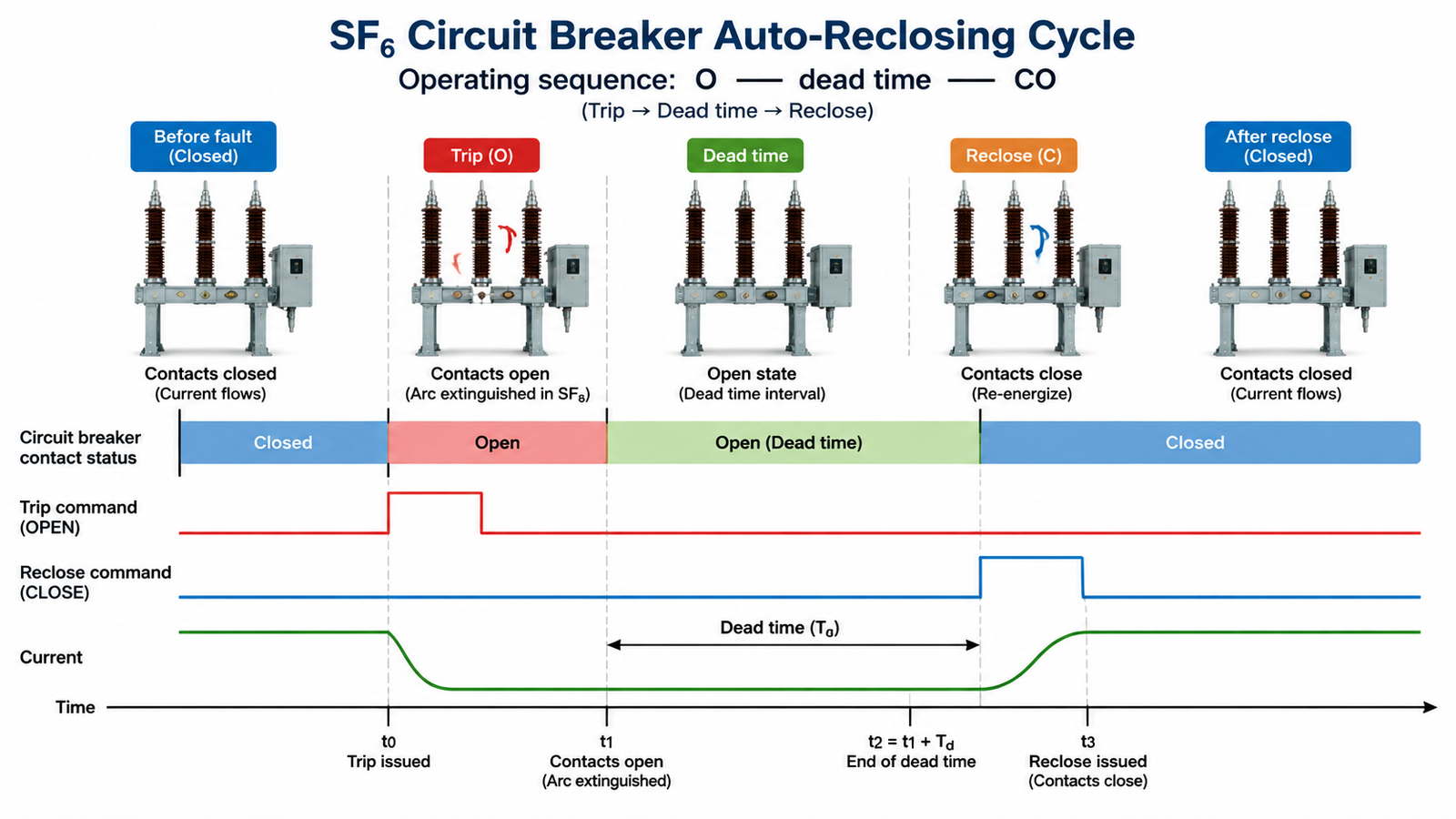
The reclose cycle, step by step
Reclosing is described by an operating sequence. The standard notation is compact but every symbol carries a setting:
Symbol
Meaning
Typical value
O
Opening operation by protection
Initiated at fault inception plus protection time
t1
Dead time — breaker open, line de-energised
0.3–0.6 s (EHV single-phase); 0.5–1.0 s (HV three-phase)
CO
Close onto the line, followed immediately by the ability to trip again
Reclose command issued at end of dead time
t2
Reclaim time — reclose scheme blocked from retrying
10–30 s
C
Final close, scheme reset
After successful reclose
The rated duty cycle that a breaker must be type tested to, when auto-reclosing is part of its duty, is O – 0.3 s – CO – 3 min – CO. That sequence is not a formality: it requires the interrupter to perform two fault interruptions within a few hundred milliseconds, with only the residual dielectric recovery of the first arc available before the second. A breaker that passes a single O–CO test but has never been tested on the reclose sequence is not qualified for the application, whatever its rated short-circuit current says. The test logic behind this is set out in IEC 62271-100 and the IEEE C37 series.
Dead time: the number that decides whether reclose works
Deionisation and the minimum dead time
When the breaker interrupts a line fault, the arc path does not vanish. Ionised gas, metal vapour, and hot air remain along the former arc channel, and their dielectric strength recovers over time. The interval needed for that recovery is the deionisation time, typically 0.1 to 0.3 s for a transmission line fault at nominal voltage.
The dead time must therefore cover four components in series:
Breaker opening time, from trip coil energisation to arc extinction — typically 30 to 60 ms for an SF6 HV breaker.
Protection reset and reclose relay pickup — 20 to 100 ms depending on scheme.
Deionisation margin at the fault point — 100 to 300 ms, longer for high fault current and low wind speed.
Breaker closing time, so that the contacts touch after the deionisation margin, not before — typically 60 to 120 ms.
Add those and a 0.3 s dead time is tight but achievable for a fast breaker on a strong system. It is the reason 0.3 s became the reference figure, and the reason slow mechanisms are excluded from EHV reclose schemes regardless of their interrupting rating.
Why single-phase schemes need the shortest dead time
In single-phase reclosing, only the faulted phase opens while the other two continue to carry load. During the dead time the line is operating in an unbalanced state, and the healthy phases induce a capacitive and inductive coupling voltage onto the open phase. That coupling voltage sustains a secondary arc across the fault point, which extends deionisation far beyond what a three-phase scheme would see.
Practical consequences: single-phase dead times of 0.3 to 0.6 s are common, and schemes that cannot achieve them either use a longer dead time with a compensated reactor, or revert to three-phase reclosing. The coupling voltage is also why single-phase reclosing on long, lightly loaded lines is harder than on short, heavily loaded ones.
Longer dead times at distribution level
Distribution networks use much longer dead times — 1 to 5 s is normal, sometimes longer. The reasons are different: downstream reclosers and fuses need time to operate and reset, motor loads need to decelerate so that reclose inrush stays within limits, and the fault itself is often cleared by a downstream device rather than by the source breaker. Applying a 0.3 s EHV dead time to a distribution feeder produces repeated trips, not restored supply.
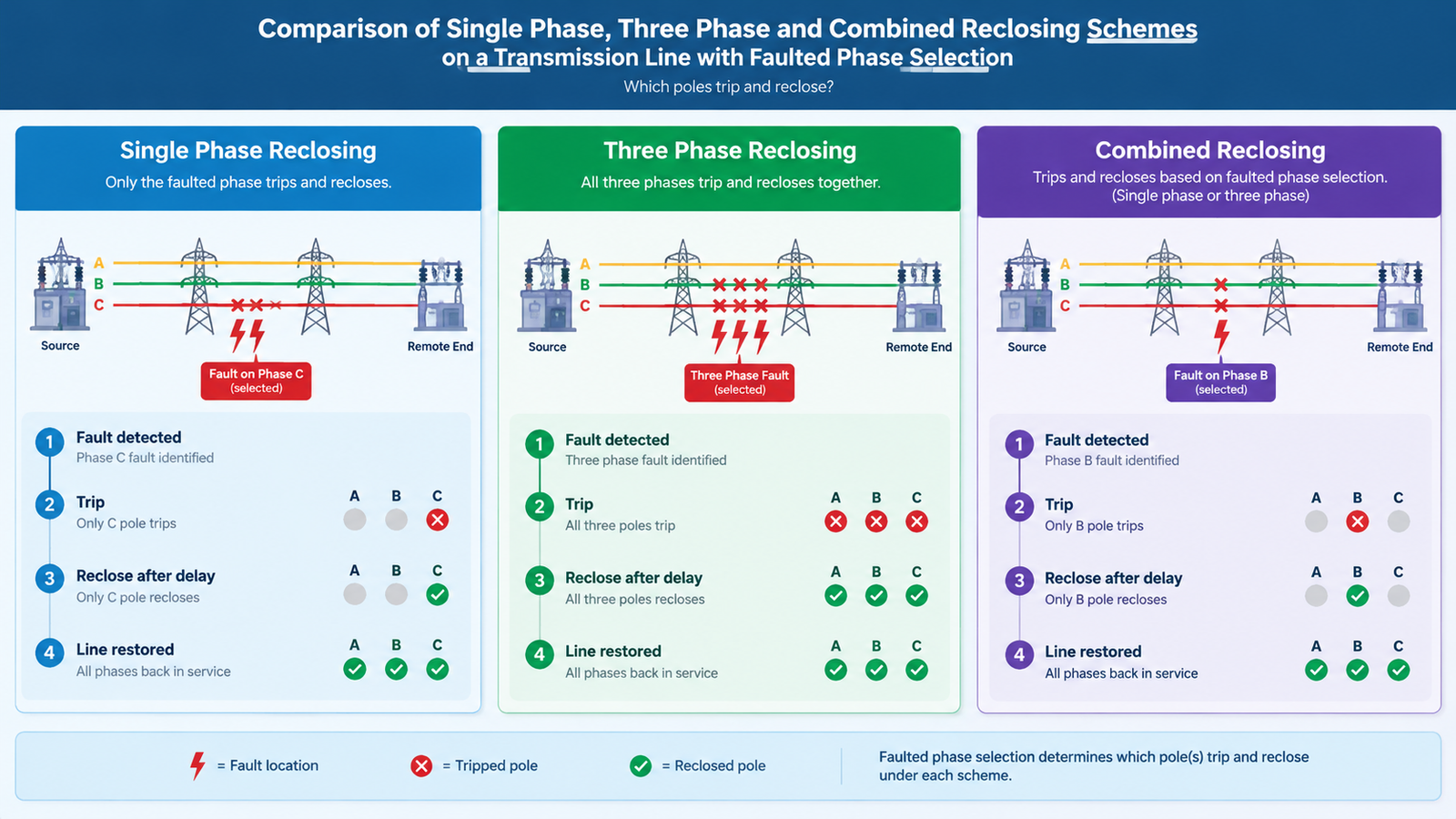
Single-phase, three-phase and combined reclosing
Scheme
How it operates
Best fit
Main requirement
Three-phase
All poles trip on any fault, all poles reclose
Distribution feeders, HV sub-transmission
Simple, no independent pole operation needed
Single-phase
Only faulted phase trips and recloses; other two stay closed
EHV transmission, single-phase-to-ground faults
Independent pole operation, phase-segregated current measurement
Combined
Single-phase for phase-to-ground faults, three-phase for multi-phase faults
HV and EHV lines where both fault types occur
Fault type discrimination in the relay logic
Single-phase reclosing has three real advantages on transmission: it keeps two phases in service so the line continues to transfer power, it reduces the mechanical and electrical duty compared with a full three-phase trip, and it avoids re-energising the whole line for a fault that affected one phase. The cost is hardware — the breaker needs independent pole operation, and the protection needs per-phase current inputs and a faulted-phase selection function.
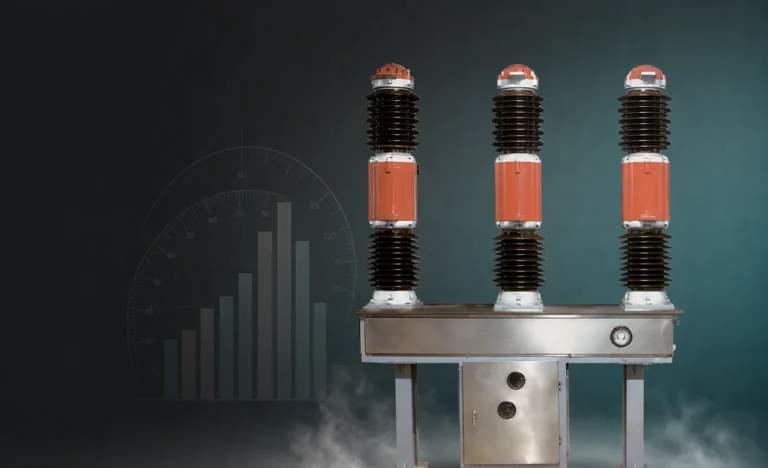
Combined reclosing is the pragmatic compromise for lines where 70–80% of faults are single-phase-to-ground but the remainder are not. A 72.5 kV breaker with combined reclosing and 3150 A continuous rating is built for exactly this duty: three independent poles, phase-segregated mechanisms, and an operating sequence rated for the reclose cycle rather than only for a single interruption.
Where lines are short, heavily interconnected, or operated close to the stability limit, three-phase reclosing is often preferred regardless of fault type, because the reclose is faster to coordinate and the stability calculation is simpler. Where lines are long and lightly loaded — the classic single-phase case — the coupling voltage problem described above pushes designers back toward three-phase.
Which poles trip and reclose decides the dead time, the hardware and the protection logic.
Coordination with protection
Reclosing is a protection function, not a breaker function, and it fails when the two are specified separately. Four coordination points decide the outcome.
Zone-based blocking
A fault inside protection zone 1 is, by definition, close to the breaker and almost certainly permanent — a broken conductor, a flashover at the terminal, a failed CT. Reclosing into zone 1 is usually blocked, or limited to a single attempt with a long dead time. Faults in zone 2 and beyond are more likely transient and are reclosed normally. Schemes that reclose unconditionally on every trip spend their breaker’s electrical endurance on the faults least likely to clear.
Synchrocheck before three-phase reclose
On an interconnected network, closing a breaker connects two systems that may have drifted apart in angle and frequency during the dead time. A synchrocheck element verifies voltage magnitude, angle, and slip before permitting the close. Without it, a three-phase reclose on a line that has lost synchronism applies a closing duty the breaker was never rated for, and can torque the generator shafts at the far end.
Reclaim time and attempt counting
Reclaim time is the interval after a successful reclose during which the scheme will not retry. It must exceed the time needed for the system to return to a normal state, and it must be long enough that a genuine second fault is handled as a new event rather than as a continuation. Typical values are 10 to 30 s. Attempt counters then limit the total number of recloses: one attempt on EHV transmission, one to three on distribution feeders, with lockout after the final attempt.
Interaction with the breaker’s own readiness
The reclose command must be blocked if the breaker is not ready — low gas density, spring not charged, trip circuit unhealthy, or a previous operation still in progress. A reclose issued to a breaker at lockout pressure is an open circuit, and the line stays dead while the scheme reports a successful reclose. Interlocking the reclose relay with the breaker’s density and readiness contacts is not optional.
What the breaker itself must be rated for
Auto-reclosing doubles the number of fault interruptions per event and compresses them into a few hundred milliseconds. Five rating items follow from that.
Rated operating sequence. Must include the reclose duty, typically O–0.3 s–CO–3 min–CO, not only O–t–CO.
Electrical endurance class. The number of rated short-circuit interruptions at the specified sequence. A breaker with 20 CO operations at rated current is a different asset from one with 50, and the difference only appears after years of reclosing.
Mechanical endurance. Each reclose cycle adds closing and opening operations. A 3,000-operation mechanism used on a scheme with three attempts per fault will consume its endurance faster than the annual operation count suggests.
Dielectric recovery. The interrupter must recover insulation between the first and second interruption. This is a design property of the chamber and nozzle, not something that can be compensated by derating the current.
Closing speed and pre-insertion resistors. Where switching overvoltages are a concern, closing resistors or controlled switching may be required — and they change the closing time, which in turn changes the achievable dead time.
These properties belong in the datasheet before the relay settings are calculated. A breaker that is technically capable of interrupting 40 kA but has only been type tested for a single O–CO sequence is the wrong asset for a reclosing scheme, however attractive its price. Our guide to operating mechanisms explains why spring mechanisms, rather than pneumatic or hydraulic ones, dominate auto-reclose applications: repeatability of closing time within a few milliseconds is what makes a 0.3 s dead time achievable at all.
Commissioning and field verification
A reclose scheme is verified by measurement, not by inspection. The checks that catch real problems are:
Breaker timing test — opening time, closing time, and pole discrepancy, measured at the actual control voltage and, where relevant, at minimum operating pressure.
Dead time measurement — inject a trip, let the scheme reclose, and record the interval between arc extinction and contact touch. Compare against the design value, not against the relay setting alone.
Reclose blocking tests — verify that zone 1 faults, low gas density, uncharged spring, and unhealthy trip circuits each block the reclose.
Synchrocheck verification — inject voltage pairs across the angle and slip window, confirm the close is permitted and blocked at the correct boundaries.
Gas density check before and after — a reclose cycle on a fault produces a pressure transient. Confirm the density relay does not alarm spuriously, and confirm recovery to normal.
Post-energisation monitoring then follows the routine in our SF6 circuit breaker testing guide: operation counters, density trends, and gas analysis after a defined number of fault interruptions.
The O – dead time – CO sequence, with reclaim time and attempt counting behind it.
Common misconfigurations and how they show up
Symptom in service
Likely cause
Fix
Repeated restrikes on the same line
Dead time shorter than deionisation time
Extend dead time; check actual breaker timing
Breaker wears out ahead of schedule
Reclosing on zone 1 or permanent faults
Add zone-based blocking and attempt limits
Reclose succeeds but line trips again immediately
Reclose issued before protection reset
Increase relay reset or reclose delay
Scheme reports reclose, line stays dead
Breaker at lockout or spring not charged
Interlock reclose with readiness contacts
High closing overvoltage or transformer inrush trips
Three-phase reclose onto loaded transformer bank
Controlled switching or longer dead time
Most of these are settings issues, which is good news: they can be corrected without touching the breaker. The exception is the first row — if the dead time cannot be extended because the breaker closes too slowly, the mechanism, not the relay, is the constraint.
Conclusion
Auto-reclosing pays for itself on any overhead network, because four out of five faults will clear on their own if the breaker gives them 300 milliseconds. The design work is in three places: the dead time must exceed deionisation plus breaker travel, the protection must block reclose where the fault is almost certainly permanent, and the breaker must be rated for the double interruption that a reclose cycle demands.
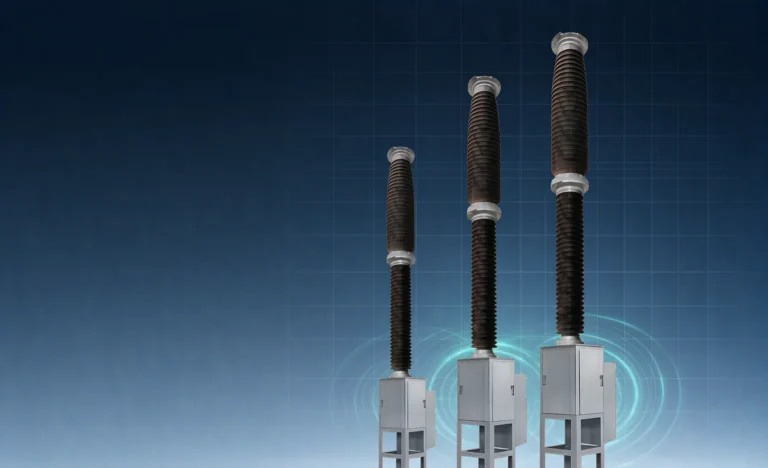
Get those three right and the scheme restores supply quietly for decades. Get the third one wrong and you will discover it in the electrical endurance figures long after the warranty has expired. If you are specifying a breaker for a reclosing duty, start from the operating sequence and the endurance class, then work outward to the mechanism and the mechanism’s closing time — a 126 kV unit configured for 52 Hz distribution networks and a 72.5 kV combined-reclosing unit are useful references for how the same platform changes when the duty changes. Browse the SF6 circuit breaker library for the adjacent topics, or send us your line data and protection scheme for a duty check.
FAQ
What is a typical dead time for auto-reclosing?
0.3 to 0.6 s for single-phase reclosing on EHV transmission, 0.5 to 1.0 s for three-phase reclosing on HV lines, and 1 to 5 s on distribution feeders. The value is set by deionisation time plus breaker opening and closing times, with margin.
How many reclose attempts are normal?
One attempt on EHV transmission, because a second attempt rarely succeeds on a permanent fault and doubles the breaker duty. Distribution feeders commonly use one to three attempts, since a larger share of their faults are semi-permanent and clear after a second try.
Can auto-reclosing be used on cable circuits?
Generally no. Cable faults are almost always permanent, and reclosing into them applies a second full short-circuit duty for no benefit. Reclosing is normally blocked on cable feeders, or restricted to a single attempt where a mixed overhead-cable circuit makes it unavoidable.
What is the difference between combined reclosing and single-phase reclosing?
Single-phase reclosing always trips and recloses only the faulted phase. Combined reclosing selects the mode per fault: single-phase for phase-to-ground faults, three-phase for multi-phase faults. Combined schemes need fault-type discrimination in the relay but cover the full range of fault types on one line.
Does reclosing reduce breaker life?
Yes, in proportion to the number of fault interruptions, not to the number of reclose commands. A reclose onto a healthy line costs one mechanical operation; a reclose onto a permanent fault costs a second full interruption and a meaningful slice of electrical endurance. Blocking reclose on permanent faults is the single most effective way to preserve breaker life.
Why does the breaker sometimes trip again immediately after reclose?
Either the fault was permanent, or the reclose happened before the arc path deionised. Distinguishing the two requires the fault record: a permanent fault shows a stable current waveform on the second trip, while a restrike shows a distorted, high-frequency recovery pattern in the first few milliseconds.
The relative leak rate formula, a mass-balance worked example, the pressure-trend cross-check, what 0.5% vs 1% costs in CO2e and the fields an audit-ready annual report needs.
UHF, acoustic and IEC 60270 partial discharge detection for GIS compared: sensitivity and calibration limits, sensor placement, PD pattern signatures and how to scope online monitoring.
The seven landmarks of a healthy trip coil waveform, the three fault signatures that separate low voltage from mechanical binding, and how to record a baseline worth comparing years later.