Oil Immersed Transformer vs Dry Type Transformer How to Choose
Published: Author: Lisa
If you are specifying transformers for a substation, an industrial plant, a commercial building, or a renewable energy project, the choice between an oil immersed transformer and a dry type transformer is one of the first decisions you will make. It affects installation location, fire protection requirements, maintenance schedule, and total cost over decades of operation. Neither type is universally better — each one solves a different set of problems.
This comparison goes beyond a simple feature list. You will find a practical breakdown of cooling performance, safety requirements, cost structure, and application-fit logic that helps you decide which technology matches your project conditions. By the end, you will have a clear framework for making the call — and a checklist you can share with your engineering team or procurement group.
What Is the Core Difference Between the Two Types?
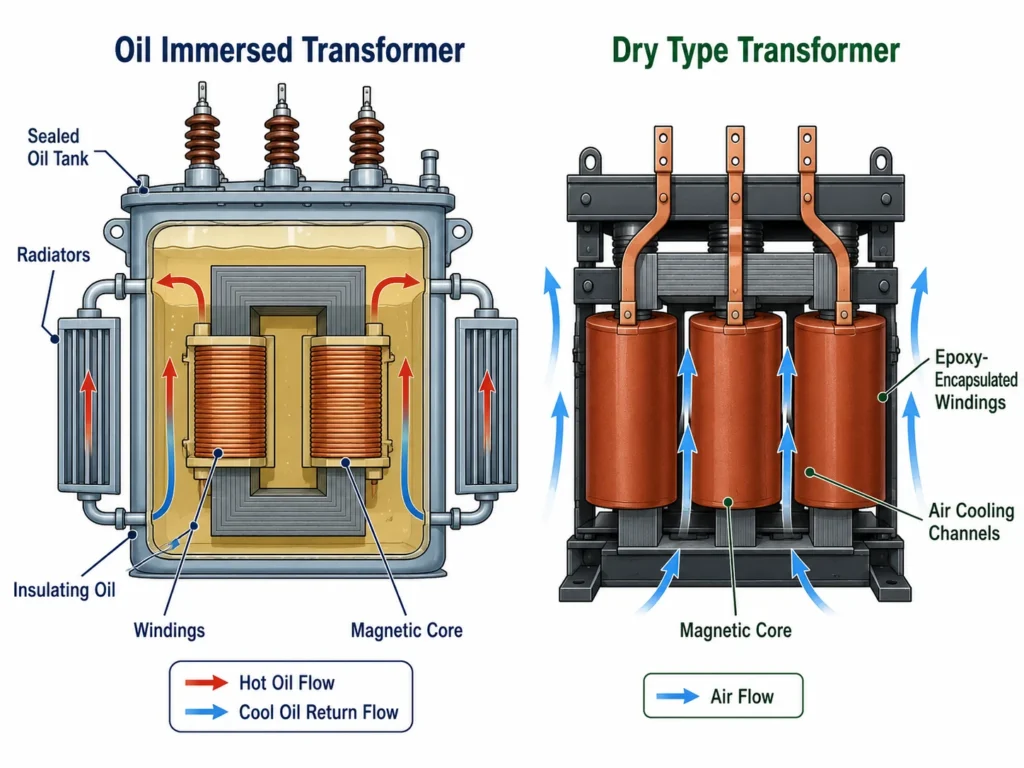
The single factor that separates an oil immersed transformer from a dry type transformer is the cooling and insulation medium:
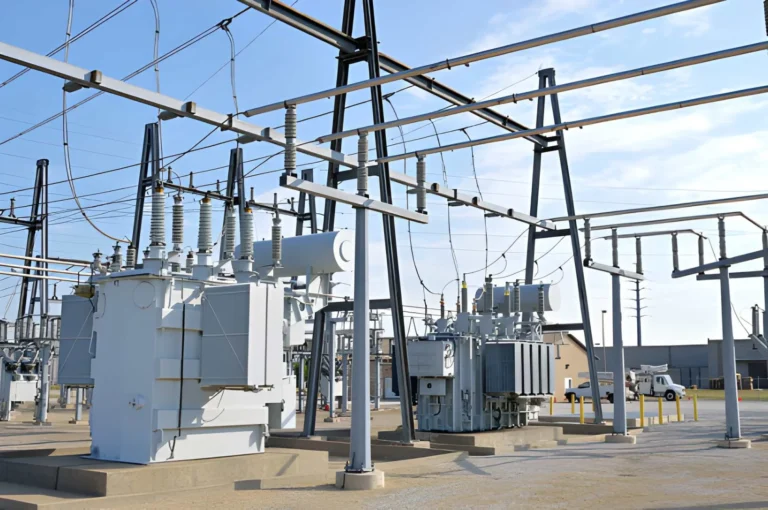
An oil immersed transformer has its core and windings submerged in insulating oil inside a sealed steel tank. The oil provides electrical insulation, carries heat away from the active parts, and protects internal components from moisture and oxidation.
A dry type transformer uses air as the cooling medium and solid materials — typically epoxy resin or varnish — for insulation. There is no liquid inside the enclosure, which eliminates oil-related fire risk and simplifies indoor installation requirements.
This single design choice cascades into every other difference: where you can install the unit, how much power it can handle, what safety measures you need, how often you maintain it, and what it costs over its lifetime.
Oil Immersed Transformer vs Dry Type Transformer: Side-by-Side Comparison
The table below summarizes the key differences across the criteria that matter most during technical evaluation and procurement. Use it as a reference when you create a shortlist or write an RFQ.
Comparison Factor
Oil Immersed Transformer
Dry Type Transformer
Cooling and insulation medium
Insulating oil (mineral or ester)
Air and solid insulation (epoxy resin or varnish)
Typical capacity range
From ~30 kVA to several hundred MVA
Typically up to ~2500 kVA, occasionally higher for special designs
Typical voltage range
6 kV to 220 kV and above; covers MV, HV, and EHV
Commonly up to 35 kV; best suited for MV distribution
Installation environment
Primarily outdoor substations and dedicated electrical rooms
Indoor, close to occupied spaces; outdoor with weatherproof enclosure
Fire safety
Oil is combustible; requires fire barriers, containment, and detection systems
No combustible liquid; lower fire load, preferred where building codes are strict
Overload capability
Strong — oil cooling handles temporary peaks well
More limited, especially for continuous overload
Purchase cost (same rating)
Lower — typically less expensive upfront
Higher — often 20-30% more for the same kVA
Maintenance type
Periodic oil sampling, DGA, filtration, and occasional regeneration
Cleaning, inspection, and thermal imaging; no oil-related tasks
No oil leak risk; epoxy and solid materials are stable
Noise level
Moderate; core hum plus cooling fan noise in forced-cooled designs
Generally lower; well suited for noise-sensitive indoor spaces
How Cooling and Performance Compare in Practice
The difference in cooling performance is the single largest technical reason to choose one type over the other. Oil has roughly 10 times the thermal conductivity of still air, which means an oil immersed unit pulls heat away from the windings far more efficiently. The oil circulates naturally through convection — rising as it warms, cooling in the radiators, and returning to the bottom of the tank. In larger units, fans (ONAF) or pumps (OFAF) accelerate this cycle.
In a dry type transformer, heat dissipates through the surface of the windings and the enclosure. Natural air cooling works well for smaller units in clean, moderate-temperature environments, but forced-air fans become necessary as load increases or when the installation site runs hot. Even with fans, the cooling ceiling is lower than what oil can achieve at comparable physical size.
What this means for your project:
If your load profile includes frequent peaks, motor starting surges, or seasonal overloads, an oil filled transformer gives you more thermal headroom before reaching insulation-damaging temperatures.
If your load is steady, predictable, and well within the nameplate rating, a dry type unit with adequate cooling margin will perform reliably without oil-related infrastructure.
Where Each Type Belongs: Installation Environment
Installation location often eliminates one option immediately, before you even compare specifications. Here is how the two types map to common site conditions.
When Oil Immersed Is the Right Fit
Outdoor substations, utility yards, and pole-mounted or pad-mounted installations where weather exposure is expected.
Industrial plants with dedicated electrical yards and existing oil containment infrastructure.
Renewable energy projects — wind farms, solar parks, and BESS sites — where outdoor step-up transformers must handle fluctuating output and harsh weather for 20-30 years.
Sites requiring high power capacity (multiple MVA) or high voltage (above 35 kV), where dry type designs are either unavailable or uneconomical.
When Dry Type Is the Better Choice
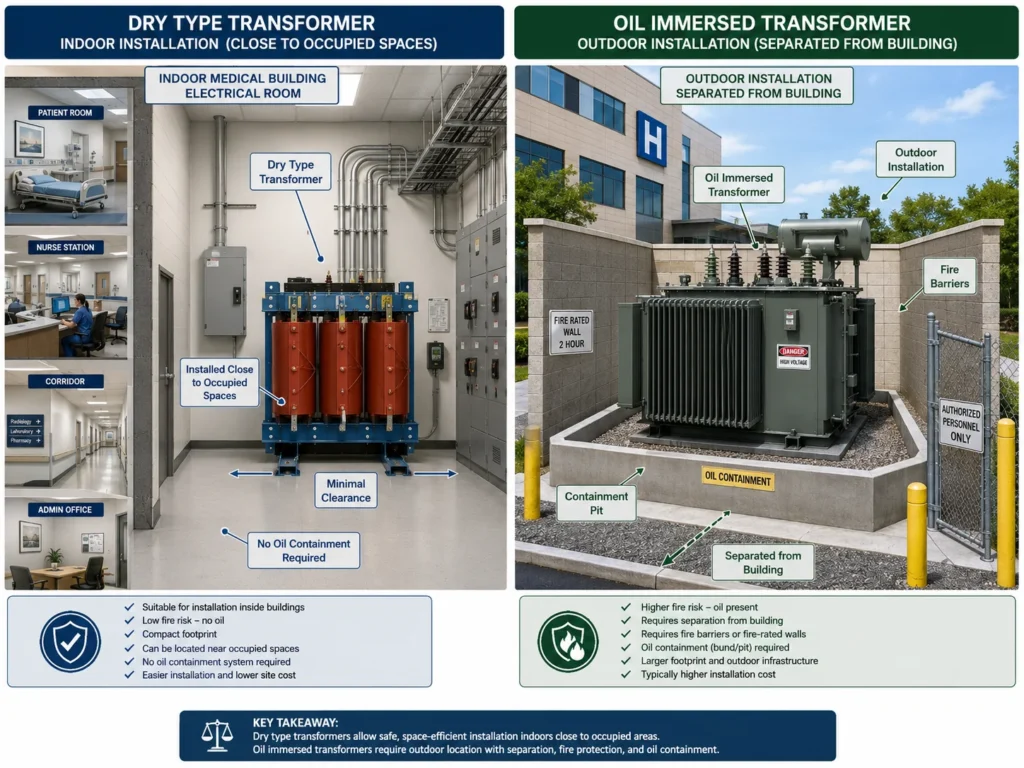
Indoor installations inside occupied buildings — hospitals, data centers, office towers, shopping malls, schools — where fire codes restrict or prohibit oil-filled equipment.
Basement or underground electrical rooms with limited ventilation and strict fire compartment requirements.
Retrofit projects where adding oil containment, fire barriers, and drainage would exceed the budget for the electrical room.
Small to medium capacity applications (typically up to 2500 kVA) where the space is available and ambient temperature and humidity are controlled.
Safety and Fire Protection: A Deciding Factor
Fire safety is the criterion that most often pushes a project toward dry type, regardless of cost or performance considerations. Mineral oil is combustible. A fault inside the tank can generate gas, increase pressure, and in a worst-case scenario lead to a tank rupture and oil fire. This is why oil immersed installations require fire-rated barriers, oil containment pits, and fire detection and suppression systems.
Dry type transformers eliminate this concern entirely because there is no combustible liquid inside the enclosure. For this reason, many local building codes and insurance requirements mandate dry type inside occupied structures or high-rise buildings.
However, the picture is not black and white. Two technology developments have narrowed the safety gap for oil-filled designs:
Ester insulating fluids — Natural ester (vegetable-based) and synthetic ester oils have fire points above 300C, compared to roughly 160C for mineral oil. They are classified as less-flammable liquids under IEC and IEEE standards and can simplify fire protection requirements in some applications.
Hermetically sealed tanks — Fully welded designs with no conservator and no air exchange eliminate the fuel-air mixture that fire needs. Combined with ester fluids, they can sometimes be approved for indoor use where mineral oil would be rejected.
If your project has an environmental or safety compliance team, bring them into the discussion early. The cost of fire protection infrastructure for an oil unit can sometimes outweigh the purchase price advantage, especially in dense urban sites.
Maintenance and Service Life: What to Expect Over Decades
The maintenance profiles of the two types are fundamentally different — but neither is maintenance-free.
Oil Immersed Transformer Maintenance
The core tasks revolve around the oil condition:
Dissolved Gas Analysis (DGA) — Measures gases dissolved in the oil that are produced by thermal and electrical faults. Typically performed annually for critical units; it can detect arcing, overheating, and partial discharge months before they cause a failure.
Breakdown Voltage (BDV) testing — Checks the oil’s dielectric strength. A dropping BDV value signals moisture ingress, particle contamination, or aging byproducts. Usually tested every 6-12 months.
Oil filtration or regeneration — Removes moisture, acids, and sludge that accumulate over years of thermal cycling. Frequency depends on loading and ambient conditions, but may be needed every 5-10 years for larger units.
Breather silica gel replacement — The desiccant in the conservator breather must be changed before it saturates and allows moisture into the oil.
Visual inspection — Oil level, temperature gauges, bushing condition, and leak checks are quick routine tasks.
The payoff: a well-maintained oil immersed distribution transformer commonly lasts 25-35 years, and well-built power transformers can exceed 40 years.
Dry Type Transformer Maintenance
Since there is no oil, the maintenance list is shorter but not empty:
Cleaning — Dust and debris on winding surfaces reduce heat dissipation and can create partial discharge paths. Regular cleaning is essential, especially in industrial environments with airborne particles.
Inspection — Check for cracks in epoxy encapsulation, signs of overheating or discoloration, loose connections, and corrosion on terminals and enclosure.
Thermal imaging — Periodic infrared scans identify hotspot development before insulation damage occurs.
Fan and ventilation checks — For forced-air cooled units, verify fans and airflow paths are unobstructed.
With clean, dry air and moderate loading, a dry type transformer can serve 20-30 years or more. In humid, dusty, or high-temperature environments, insulation ages faster and service life shortens.
The practical trade-off: oil immersed units need more specialized maintenance (oil testing, DGA), but the procedures are well established and globally available. Dry type units need less frequent intervention, but when the insulation degrades, repair options are limited compared to reconditioning oil or replacing bushings on an oil-filled unit.
Cost Comparison: Upfront Price vs Lifecycle Cost
Procurement teams often focus on the purchase price, but the real comparison is total cost of ownership (TCO) over 20-30 years. Here is how the numbers typically break down.
Cost Element
Oil Immersed Transformer
Dry Type Transformer
Equipment purchase price
Lower — for the same kVA rating, typically less expensive
Higher — often 20-30% more than an oil equivalent
Civil works and site preparation
Higher — oil containment pit, fire barriers, possibly a bund wall
Lower — simpler foundation, no oil containment needed
Fire protection systems
Higher — detection, suppression, and possibly deluge systems for large units
Lower — standard building fire protection usually sufficient
Energy losses
Similar range — depends on core material and design class, not the cooling medium
Similar range — efficiency standards apply equally to both types
Routine maintenance (annual)
Oil sampling and testing; moderate cost, predictable
Cleaning and inspection; lower cost but environment-dependent
Major maintenance (10-year)
Oil filtration or regeneration; moderate one-time cost
Typically none unless environmental damage requires reconditioning
Expected service life
25-40 years
20-30+ years
The bottom line: for outdoor, high-capacity applications, the oil immersed transformer usually wins on TCO because the purchase price advantage and longer service life outweigh the higher civil and fire protection costs. For indoor, small-to-medium applications in strict fire-regulated buildings, the dry type transformer wins because the civil and fire protection costs for an oil unit would be prohibitive — and the insurance savings alone can justify the higher equipment price.
How to Choose: Decision Framework by Application
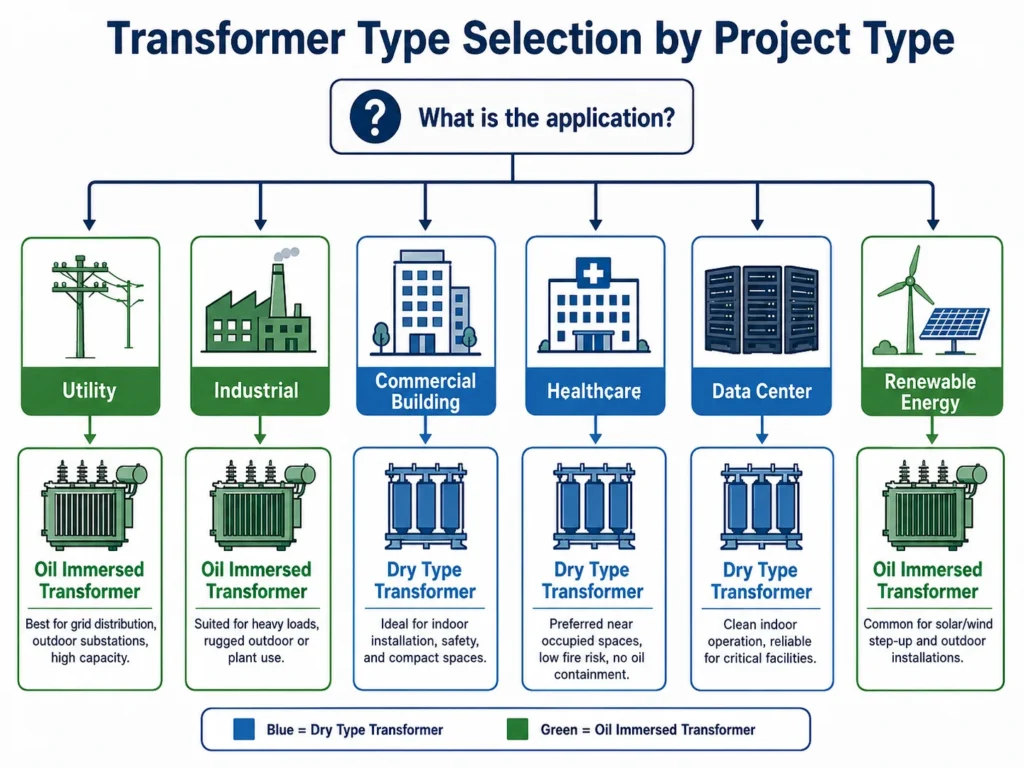
Rather than treat this as a tie-breaking exercise between two tables of pros and cons, use the scenarios below to identify which column your project falls into. Most real-world projects lean clearly toward one type early in the evaluation.
Utility and Distribution Networks
Typical choice: Oil immersed. Utilities deploy thousands of oil filled distribution transformers across outdoor substations, pole-mounted sites, and pad-mounted enclosures. The combination of outdoor rating, high reliability, wide capacity range, and lower upfront cost makes oil the default. Dry type is rarely competitive at distribution scale unless a specific urban indoor substation requires it.
Heavy Industry and Manufacturing
Typical choice: Oil immersed. Plants that run large motors, arc furnaces, compressors, and rolling mills need the overload capability and high fault withstand that oil immersed designs provide. Existing industrial sites almost always have the electrical yard space and oil containment infrastructure already in place. For new builds, the civil cost of adding containment is a one-time expense against decades of robust operation.
Commercial Buildings and High-Rises
Typical choice: Dry type. Building codes in most jurisdictions require or strongly prefer dry type for transformers installed inside occupied structures. The absence of combustible liquid simplifies permitting, reduces insurance premiums, and allows installation on upper floors or in basements where oil containment would be impractical. For these projects, the decision is usually made by the fire code before the technical comparison even starts.
Hospitals and Healthcare Facilities
Typical choice: Dry type. Safety, low noise, and indoor placement close to critical loads make dry type the standard choice. Fire risk near patients, staff, and sensitive equipment is simply not acceptable. Dry type units also avoid the vibration and oil-handling logistics that complicate maintenance in a sterile environment.
Data Centers
Typical choice: Dry type. Data center owners prioritize fire safety, clean environments, and the ability to place transformers close to server halls. Dry type units with low noise and no oil risk fit this profile. Some hyperscale data centers use outdoor oil immersed units for the main substation feed, but the transformers inside the building or serving individual data halls are almost always dry type.
Renewable Energy Projects (Solar, Wind, BESS)
Typical choice: Oil immersed. Outdoor step-up transformers at inverter stations and wind turbine bases need to survive decades of weather exposure, variable output, and occasional overload. Oil immersed units, especially hermetically sealed designs with ester fluids where environmental sensitivity is high, are the standard. Dry type is rare at these project scales.
Quick Decision Checklist
Run through these questions with your project team. If you answer “yes” to most of the questions in one column, that column points to your likely choice.
Question
If Yes, Leans Oil Immersed
If Yes, Leans Dry Type
Will the transformer be installed outdoors?
Oil immersed is the natural outdoor choice
Dry type needs a weatherproof enclosure
Is the installation inside an occupied building?
Possible but needs fire-rated room and containment
Dry type is the standard indoor solution
Does the project need more than 2500 kVA?
Oil immersed covers the full range
Dry type is limited at higher capacities
Is voltage above 35 kV?
Oil immersed handles MV through EHV
Dry type is uncommon above 35 kV
Do local fire codes restrict oil-filled equipment?
Consider ester fluids or move the unit outdoors
Dry type meets most strict fire codes
Is the load profile variable with frequent peaks?
Oil cooling provides more overload margin
Size generously or use forced-air cooling
Is upfront CAPEX the primary constraint?
Oil immersed costs less to purchase
Factor in the civil and fire savings
Is minimizing on-site maintenance a priority?
Oil needs periodic sampling and testing
Dry type has fewer routine tasks
Frequently Asked Questions
Can an oil immersed transformer be used indoors?
Yes, but only in a dedicated, fire-rated electrical room with proper ventilation, oil containment, and the protection devices required by local electrical codes. For most occupied indoor spaces, a dry type transformer is the safer and more practical choice. If indoor oil installation is unavoidable, consider ester-filled units for added fire safety and simpler compliance.
Which type costs less over the full lifecycle?
For outdoor, high-capacity applications, the oil immersed transformer usually wins on lifecycle cost because the lower purchase price and longer service life outweigh higher civil and fire protection expenses. For indoor, small-to-medium commercial applications where oil containment and fire systems would be expensive, the dry type transformer often delivers better total cost of ownership.
What happens if a dry type transformer runs too hot?
Prolonged overheating accelerates insulation aging, which can lead to partial discharge, winding shorts, and eventual failure. Unlike an oil unit, where oil sampling can detect early thermal problems through DGA, a dry type transformer gives fewer early warnings. Thermal imaging, embedded temperature sensors, and adequate cooling design are the best preventive measures.
Are ester-filled oil immersed transformers as safe as dry type?
Ester fluids have fire points above 300C, compared to roughly 160C for mineral oil, and are classified as less-flammable. They significantly narrow the safety gap, but they are not identical to dry type — the unit still contains a liquid that requires containment. Ester-filled transformers are a practical compromise when oil cooling performance is needed but fire risk must be reduced, such as in indoor substations or environmentally sensitive outdoor sites.
Which type has better energy efficiency?
Energy efficiency depends primarily on the core material (CRGO steel vs. amorphous metal) and winding design, not on whether the unit is oil immersed or dry type. Both types are available in multiple efficiency classes, and both are subject to the same eco-design regulations in most markets. Specify the loss class you need and compare quotes on equal efficiency terms regardless of the cooling medium.
Do I need to budget for oil replacement during the transformer’s life?
Not necessarily a full replacement. With regular sampling, filtration, and regeneration, the same oil can serve for the full service life of the transformer in many cases. Full oil replacement is typically considered only after a major internal fault, severe contamination, or when switching from mineral oil to ester fluid as a safety upgrade.
Making the Final Decision
Choosing between an oil immersed transformer and a dry type transformer is not a tie-breaker between two equal options. In most projects, the installation environment, capacity requirement, and fire code narrow the choice to one type early in the evaluation. The remaining work is about specifying the right rating, cooling class, and configuration within that type.
If your project involves outdoor substation work, high capacity, high voltage, or heavy industrial loads, start with an oil immersed specification. You can explore the full selection guide for oil immersed transformers to match cooling class, tank type, and tap changer options to your requirements. When the numbers are firm, review the key advantages for B2B buyers to strengthen your technical justification.
If your project requires indoor installation in an occupied building — think hospitals, data centers, commercial high-rises — start with a dry type specification. Browse dry type transformer articles and resources to compare resin-cast and VPI construction types, or view the dry type transformer product range directly.
For projects that do not fall cleanly into either category, or when local regulations create ambiguity, the fastest path forward is to discuss your specific site conditions, load profile, and compliance requirements with a manufacturer who builds both types. Contact the Hairui Electric engineering team with your single-line diagram and site constraints — a short technical conversation often surfaces the deciding factor that a generic comparison cannot capture.
If you build, retrofit, or service CNC lathes, machining centers, or any automated production line, the control transformer you specify decides whether the cabinet powers up cleanly or trips at every cycle. This guide walks procurement engineers, panel builders, and OEMs through how to select and size a CNC machine tool control transformer with confidence […]
When buyers ask me whether an Oil Type Single Phase Transformer is still worth serious attention in a market full of bigger systems and louder marketing, my answer is simple: absolutely. In real distribution work, especially in rural lines, light commercial loads, street lighting, remote facilities, and utility edge networks, the right single-phase unit is […]
Dry-type transformer operate without the use of insulating oil, relying instead on air cooling and solid insulation materials. This design makes them inherently safer and more environmentally friendly compared to traditional oil-filled transformers. They are widely used in schools, hospitals, factories, and commercial buildings. This blog explains what a dry-type transformer is, why it matters […]