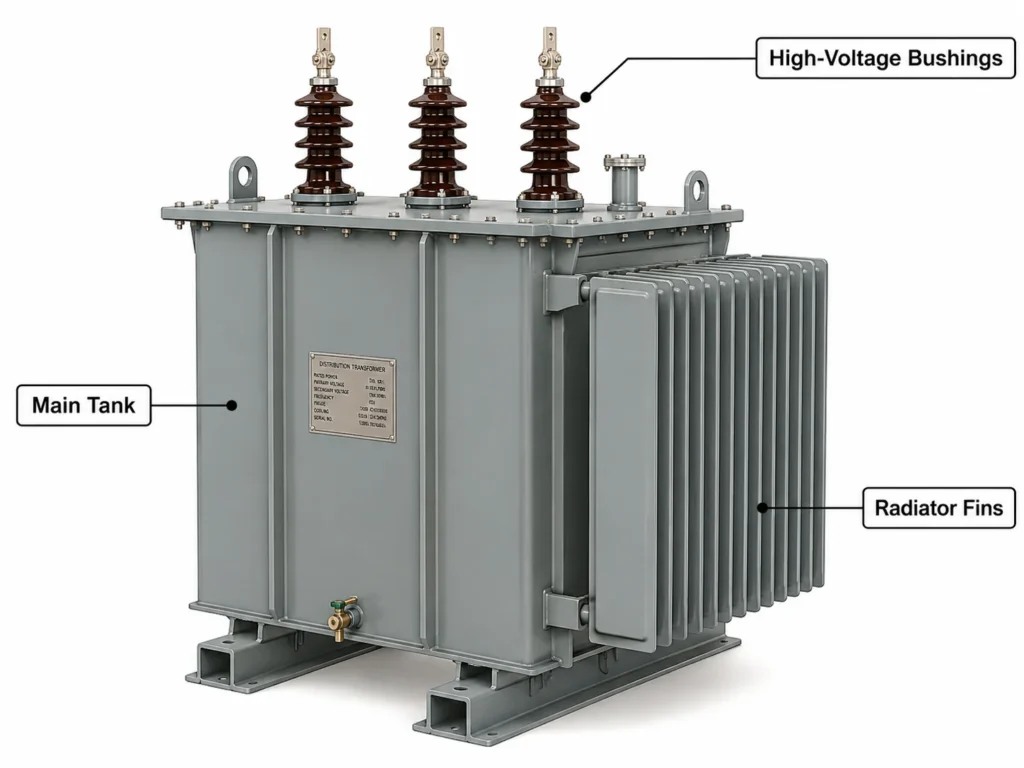
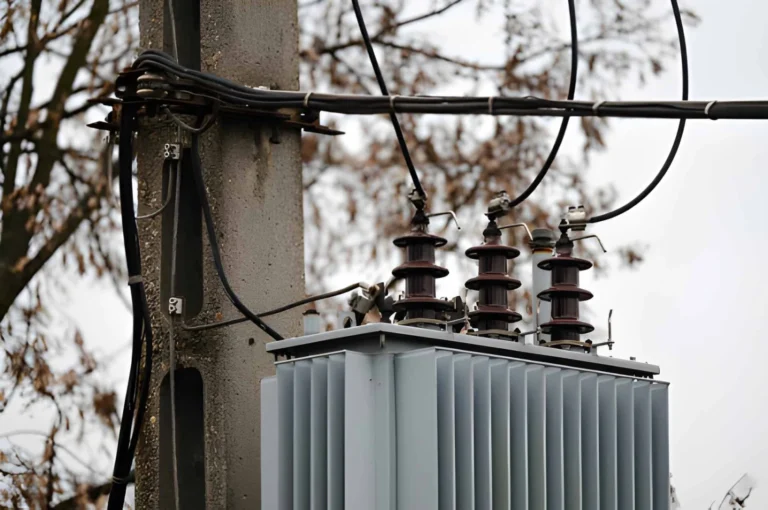
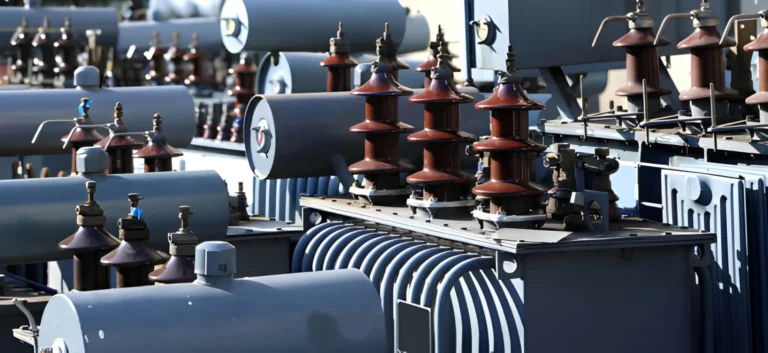
An oil immersed transformer is a transformer where the core and windings are submerged in insulating oil inside a sealed steel tank. That oil does more than just cool the unit — it also provides electrical insulation and protects the internal components from moisture, oxidation, and contamination. If you have ever walked past a substation and seen a large gray or green tank with radiator fins on the sides, you were looking at an oil immersed transformer.
This type of transformer is the standard choice for medium- and high-voltage power distribution worldwide. It handles the voltages and power levels that keep factories running, cities powered, and renewable energy flowing into the grid. Understanding what it is and how it works is the first step toward making informed decisions about power equipment — whether you are an engineering student, a project planner, or someone evaluating options for a new installation.
What Is an Oil Immersed Transformer?
At its simplest, an oil immersed transformer (also called an oil filled transformer or oil type transformer) is a static electrical device that transfers energy between circuits through electromagnetic induction, with its active parts fully submerged in insulating oil. The oil performs three essential jobs: it insulates the high-voltage windings from each other and from the grounded tank, it carries heat away from the core and coils, and it seals out air and moisture that would otherwise degrade the insulation over time.
Because oil has far higher dielectric strength and thermal conductivity than air, an oil immersed design can handle higher voltages and power levels than a comparable dry type unit. This is why you will find them in outdoor substations, industrial plants, and utility networks rather than inside office buildings or shopping malls.
Attribute
Typical Value / Description
Insulating medium
Mineral oil, natural ester oil, or synthetic ester oil
Cooling mechanism
Oil circulates naturally (or with pumps) to radiators, where air removes the heat
The operating principle is electromagnetic induction. Alternating current flowing through the primary winding creates a changing magnetic flux in the laminated steel core. That flux passes through the secondary winding and induces an output voltage. The voltage ratio follows the turns ratio: if the secondary has fewer turns than the primary, the voltage steps down; if it has more turns, it steps up.
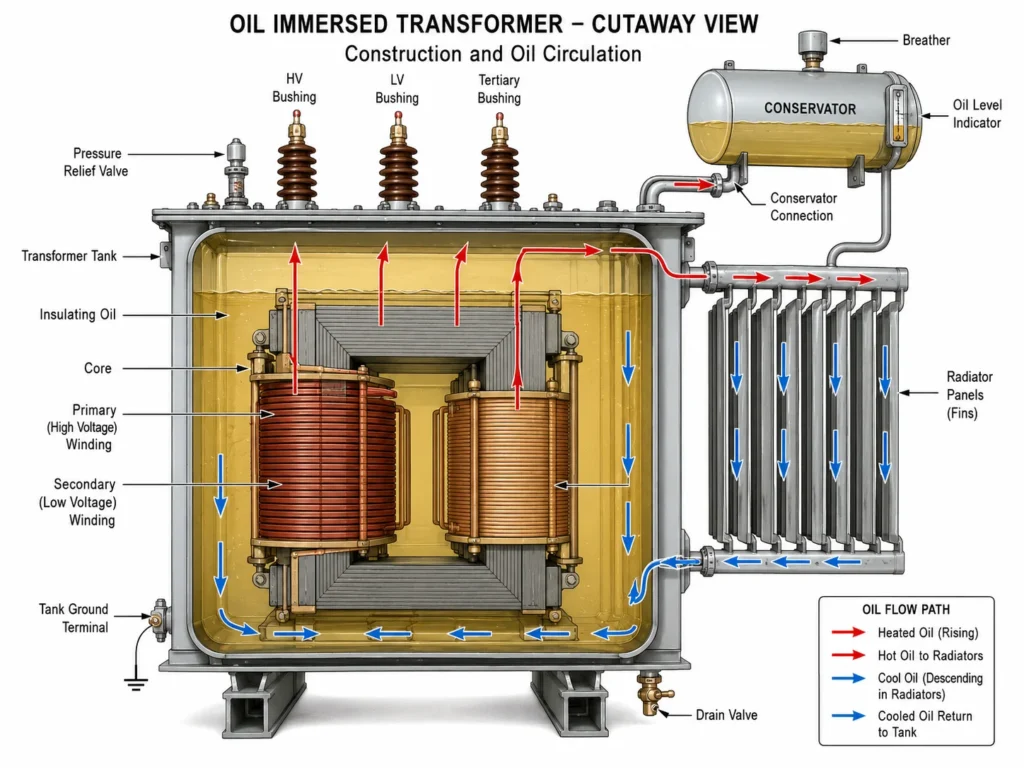
While energy transfers between windings, resistive losses in the conductors (copper loss) and magnetic losses in the core (iron loss) generate heat. If that heat is not removed, the winding insulation degrades and eventually fails. This is where the oil comes in. The oil absorbs the heat and circulates — naturally through convection in smaller units, or with the help of pumps in larger ones — toward the tank walls and radiator fins, where it dissipates into the surrounding air. Cooled oil then returns to the bottom of the tank, and the cycle repeats.
This continuous oil cooling loop is what allows an oil immersed transformer to run at high load for years or decades without overheating. A well-cooled transformer can even handle temporary overloads without damage, which is important during grid disturbances, plant startups, or seasonal peak demand.
The Three Jobs of Insulating Oil
Transformer oil is not just a coolant. It is a multifunctional material that determines how long the transformer lasts and how reliably it operates. When the oil degrades, all three of its functions weaken at the same time.
Electrical Insulation
Oil provides high dielectric strength between the primary winding, the secondary winding, and the grounded steel tank. This prevents flashover and partial discharge even at high voltage stress. Mineral oil typically offers a breakdown voltage of 30 kV or higher per 2.5 mm gap when in good condition, far exceeding what air can provide in the same space.
Heat Dissipation
Oil has roughly 10 times the thermal conductivity of still air, which means it pulls heat out of the windings and core much more effectively. As it warms, its density drops and it rises naturally, creating a convection current that carries heat to the radiators without any moving parts in the most common cooling designs.
Protection from Moisture and Oxidation
By submerging the core and windings, the oil isolates them from atmospheric oxygen and humidity — the two main drivers of insulation aging. Paper insulation that is kept dry and oxygen-free inside oil can last 25 to 40 years or longer. When moisture enters the oil through a failed breather or a leaking gasket, insulation life shortens dramatically.
Key Components of an Oil Immersed Transformer
A transformer is built from a small set of functional groups. Knowing what each component does helps you read a datasheet and understand maintenance reports instead of treating the unit as a sealed box.
Component
Function
Why It Matters
Laminated core
Carries the magnetic flux between windings
Core material and loss grade determine no-load loss, which you pay for every hour the transformer is energized
Windings (copper or aluminum)
Carry current and transfer energy between primary and secondary circuits
Conductor material and cross-section affect load loss, efficiency, and short-circuit withstand capability
Insulating oil
Cools, insulates, and protects the active parts
Oil type and condition determine dielectric strength, cooling performance, and maintenance cost over the life of the unit
Main tank
Houses the core, windings, and oil; provides mechanical protection
Tank design affects sealing integrity, outdoor rating, and oil leak risk
Conservator
External expansion tank that allows oil volume to change with temperature
Present on free-breathing units; reduces oil contact with ambient air
Breather (silica gel)
Dries the air that enters the conservator as oil contracts
Saturated silica gel allows moisture into the oil — a common and preventable cause of insulation failure
Radiators or cooling fins
Release heat from the oil to the surrounding air
Surface area and fan staging determine the cooling class and overload margin
Buchholz relay
Detects gas accumulation and oil surge caused by internal faults
A critical protection device; should be confirmed present and tested on any unit you specify
Tap changer
Adjusts the turns ratio to regulate output voltage
Off-circuit (de-energized) versus on-load tap changer affects price and the voltage regulation you can achieve in operation
Bushings
Bring high-voltage conductors through the grounded steel tank
Bushing rating and creepage distance must match the site pollution level and system voltage
Temperature gauges and oil level indicator
Show top-oil temperature and oil volume
The simplest checks that warn of overloading, low oil, or cooling problems before they cause damage
Cooling Methods ONAN, ONAF, OFAF, and OFWF
The cooling class describes how oil and air (or water) move through the transformer. It directly limits how much power the unit can safely handle.
Cooling Class
How It Works
Typical Use
ONAN (Oil Natural Air Natural)
Oil circulates by natural convection; air cools the radiators naturally
Small to medium distribution transformers — simplest design, lowest maintenance
ONAF (Oil Natural Air Forced)
Oil still circulates naturally, but fans force air over the radiators
Medium to large units; fans engage at a set temperature to add overload capacity
OFAF (Oil Forced Air Forced)
Oil pumps circulate the oil and fans move the air
Large power transformers where forced circulation raises cooling efficiency
OFWF (Oil Forced Water Forced)
Oil pumps plus a water heat exchanger replace air cooling
Large plants, underground substations, or sites where water cooling is available
The practical rule: more forced cooling buys more capacity in the same physical size, but it adds fans, pumps, controls, and maintenance points. Match the cooling class to the real load profile, not to a peak that may never occur.
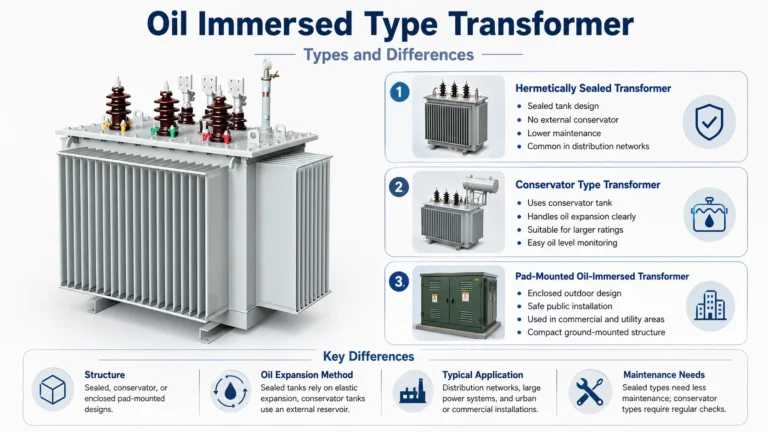
Common Types of Oil Immersed Transformers
Oil immersed transformers can be grouped by construction style and by application. Understanding both dimensions helps when you compare specifications or discuss requirements with a supplier.
By Construction
Type
Design
Best For
Conservator type
Uses an external expansion tank (conservator) with a breather to manage oil volume changes. The tank is not fully sealed; air enters and exits the conservator as the oil expands and contracts.
Larger power transformers; units where oil volume change is significant and regular oil sampling is expected
Hermetically sealed type
Tank is fully welded shut with no conservator. Oil expansion is absorbed by the tank walls or by an internal gas cushion. No air enters the tank during normal operation.
Small to medium distribution transformers; locations where minimizing maintenance visits is a priority
By Application
Distribution transformers — Step medium voltage (commonly 10 kV or 35 kV) down to 400 V for residential, commercial, and light industrial loads. These are the most common type.
Power transformers — Larger units installed in substations that transfer energy between transmission and distribution voltage levels. Ratings typically start in the MVA range.
Step-up transformers — Raise generator output voltage to transmission level for grid connection. Common in power plants, wind farms, and solar installations.
Special-purpose transformers — Built for specific industrial duties such as furnace transformers, rectifier transformers, and traction transformers for railway power supply.
For lighter loads or sites that need single-phase distribution, an oil type single phase transformer may be a more practical choice than a three-phase unit since it simplifies pole-mounted and rural distribution.
Why Oil Immersed Transformers Are Widely Used
Oil immersed transformers dominate the global market for medium- and high-voltage applications for good reason. The combination of physical properties and decades of field experience creates a compelling case in most outdoor and industrial settings.
Benefit
What It Means in Practice
Superior cooling
Oil removes heat far more effectively than air, allowing continuous operation at higher loads and withstanding temporary overloads during peak demand or fault conditions
High dielectric strength
Oil provides robust insulation between high-voltage parts, reducing the risk of partial discharge and electrical breakdown — particularly important in humid or polluted environments
Wide capacity and voltage range
Available from a few hundred kVA to several hundred MVA, covering distribution, transmission, and industrial power needs in a single technology family
Lower upfront cost
For the same kVA rating, an oil immersed unit is typically less expensive to purchase than a dry type transformer
Long service life
With proper maintenance, distribution units commonly operate for 25 to 40 years and power transformers can exceed that. The oil environment protects the paper insulation from its main enemies: heat, oxygen, and moisture
Excellent outdoor performance
Designed for outdoor installation in a wide range of climates, from desert heat to coastal humidity, when paired with appropriate coatings and enclosures
You will find oil immersed transformers wherever medium or high voltage must be converted and the site can accommodate an oil-filled design. The strongest cases are:
Utility substations — Stepping transmission voltage down for distribution to cities, towns, and industrial zones. These are often the largest units and are designed for 30 years or more of continuous outdoor service.
Industrial plants — Feeding heavy loads such as motors, arc furnaces, rolling mills, compressors, and process equipment in steel, cement, mining, and petrochemical facilities where load profiles are demanding and downtime is expensive.
Renewable energy projects — Step-up transformers at wind farms and solar parks that connect generation to the medium-voltage collection grid or directly to the transmission network. Units must handle variable output and harsh outdoor conditions.
Infrastructure and commercial complexes — Large hospitals, data centers, airports, and university campuses that need a dedicated on-site main transformer for reliable bulk power supply.
For medium-voltage distribution specifically, the 10kV oil immersed transformer selection guide explains how to match voltage ratio, loss class, and installation environment when you are ready to specify a unit.
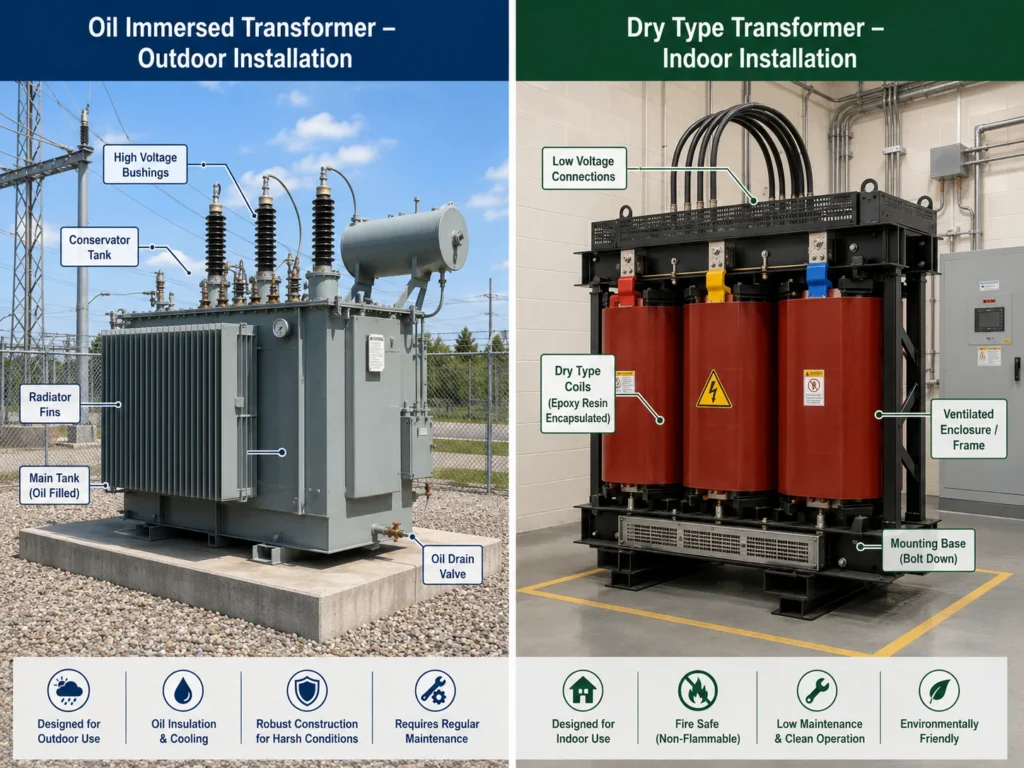
Oil Immersed vs Dry Type Transformer
The comparison between oil immersed and dry type transformers is the one that most often determines which technology a project selects. The core trade-off is cooling performance and cost versus fire safety and placement flexibility.
Factor
Oil Immersed Transformer
Dry Type Transformer
Cooling and insulation medium
Insulating oil
Air and solid insulation (epoxy resin or varnish)
Capacity and voltage range
Wide — from 30 kVA to hundreds of MVA, up to very high voltage
Typically up to around 2500 kVA and 35 kV; best for small to medium ratings
Typical installation
Outdoor substations, dedicated electrical rooms
Indoor, close to occupied spaces
Fire safety
Oil is combustible; fire protection measures and containment required
Oil-free, lower fire load — preferred where building codes are strict
Purchase cost at comparable rating
Usually lower
Usually higher (often 20-30% more)
Maintenance
Requires periodic oil sampling, testing, and occasional filtration or regeneration
Minimal oil-related maintenance; mainly cleaning and inspection
Overload capability
Generally higher and more tolerant of short-term peaks
More restricted, especially for continuous overload
Choose oil immersed when the project is substation-based, outdoor, capacity-sensitive, or driven by total cost of ownership over many years. Choose dry type when the unit sits inside an occupied building or where fire regulations dominate. For the full point-by-point comparison, see the article on the 9 key differences between dry type and oil immersed transformers.
Basic Maintenance and Service Life
A well-maintained oil immersed transformer commonly operates for 25 to 40 years, and many large power transformers have exceeded 50 years in service. The life limit is almost always the paper insulation around the windings. Paper aging is driven by heat, moisture, and oxygen — all of which the oil condition reflects.
The two most important diagnostic tests are:
Dissolved Gas Analysis (DGA) — Measures gases dissolved in the oil that are produced by thermal and electrical faults. DGA can detect arcing, overheating, and partial discharge long before they cause a failure. For critical units, it is typically performed at least annually.
Breakdown Voltage (BDV) test — Measures the oil’s dielectric strength. A dropping BDV value indicates moisture, particles, or aging byproducts in the oil. Usually checked every 6 to 12 months.
Routine checks include monitoring the top-oil temperature (keep it below approximately 85C to avoid accelerated insulation aging), inspecting the breather silica gel and replacing it before it becomes saturated, checking oil level in the conservator, and confirming that protective devices such as the Buchholz relay are functional.
An oil immersed transformer is the most widely deployed power conversion technology in the world for good reason: it combines high capacity, strong cooling, long service life, and competitive upfront cost in a single proven package. If your project involves outdoor installation, medium or high voltage, and a need for reliable continuous operation, an oil-filled design is likely the right starting point.
Once you understand what an oil immersed transformer is and how it works, the next step is matching the right type and specification to your actual requirements. For a deeper technical walkthrough covering working principles, construction types, cooling classes, and a complete selection framework, read the oil immersed transformer working principle, types, and selection guide. If you have a specific project in mind and would like to discuss requirements, contact the Hairui Electric team for a technical consultation and tailored proposal.
FAQ
What is the difference between an oil immersed transformer and a dry type transformer?
The main difference is the cooling and insulation medium: oil immersed transformers use insulating oil, while dry type transformers use air and solid insulation materials. Oil units offer better cooling, higher capacity range, and lower cost for the same rating. Dry type units eliminate oil-related fire risk and are preferred for indoor installations in occupied buildings.
What type of oil is used in an oil immersed transformer?
Most oil immersed transformers use highly refined mineral oil. For projects with stricter fire safety or environmental requirements, natural ester oils (vegetable-based) or synthetic ester oils are available. Ester fluids have higher flash points and better biodegradability, making them suitable for environmentally sensitive or indoor sites.
How long does an oil immersed transformer last?
With proper sizing, installation, and routine maintenance, a distribution transformer typically operates for 25 to 35 years and a power transformer for 30 to 40 years or more. The limiting factor is the paper insulation, which ages faster when the oil runs hot, wet, or contaminated.
Can an oil immersed transformer be installed indoors?
Yes, but only in a dedicated, fire-rated electrical room with proper ventilation, oil containment, and the protection devices required by local electrical codes. For most occupied indoor spaces, a dry type transformer is the safer choice. If indoor oil installation is unavoidable, consider ester-filled units for added fire safety.
What does ONAN mean on a transformer nameplate?
ONAN stands for Oil Natural Air Natural. It means the oil circulates by natural convection (no pumps) and the air cools the radiators naturally (no fans). This is the simplest and lowest-maintenance cooling method, common in small to medium distribution transformers. ONAF adds forced-air fans, and OFAF adds both oil pumps and fans for larger units.
How often should transformer oil be tested?
Breakdown voltage (BDV) testing is typically done every 6 to 12 months, and Dissolved Gas Analysis (DGA) at least annually for larger or critical units. Test more frequently after a fault event, after a period of heavy overload, or when the unit is approaching the end of its expected service life.
If you are evaluating oil immersed transformers for a substation, industrial plant, or renewable energy project, the variety of available types can make selection feel complicated. The distinctions are not only about kVA and voltage. They extend to cooling class, tank construction, phase configuration, insulating fluid chemistry, winding material, and the specific duty the transformer […]
An oil immersed transformer is the workhorse of medium- and high-voltage power distribution — the unit you find in substations, industrial plants, and renewable energy projects where cooling capacity, overload margin, and long service life matter more than a compact footprint. Most specification mistakes do not start with the brand or the price. They start […]
This guide explains how to choose a 10kV oil immersed transformer, compare it with dry type units, evaluate losses, and assess manufacturers for substation and industrial projects.