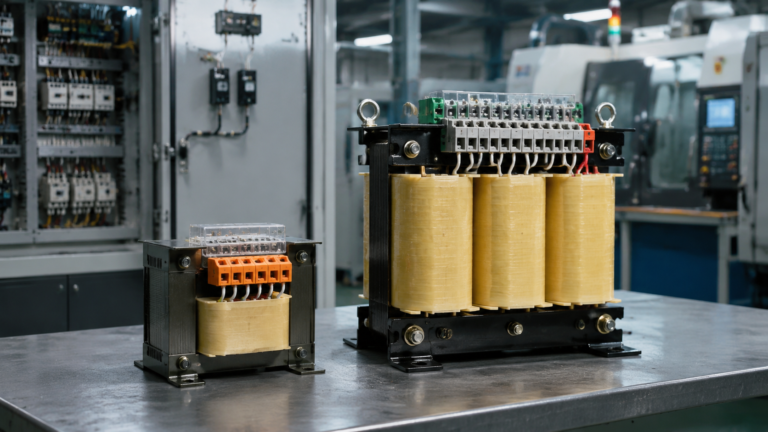
JBK3 Machine Control Transformer Guide: How to Choose
Published: Author: Lisa
Choosing the right control transformer can make the difference between a stable CNC panel and one that trips under load. The JBK3 machine control transformer is one of the most common choices for machine-tool power supplies, automation panels, and industrial control circuits in the 50 VA to 2,500 VA range. This guide walks procurement and engineering teams through the selection logic, price drivers, and OEM/ODM options so you can order a JBK3 unit that fits the application without over-specifying.
What Is a JBK3 Machine Control Transformer?
A JBK3 machine control transformer is a dry-type isolating transformer built to step down higher line voltages to the lower control voltages used by relays, contactors, PLCs, and indicator lamps. It is widely used in CNC machines, industrial automation systems, machine tools, and distribution panels where reliable low-voltage control power is essential.
The JBK3 series follows the JB/T 5555 / GB 5226 machine-tool control-transformer standard. Typical ratings run from 50 VA up to 2,500 VA, with primary options such as AC 220 V or 380 V (440 V available on request) and secondary outputs from 6 V to 220 V. Insulation classes are usually B or F, and cooling is natural air convection, so no additional fan is required for normal duty.
Unlike a general power transformer that is sized for continuous full-load efficiency, a control transformer is selected for its ability to deliver high inrush current during contactor or relay energization. That is why VA rating, voltage ratio, and winding construction matter more than raw kVA efficiency. If you are new to the series, our comparison of the JBK3 control transformer versus a general-purpose unit explains the design differences in more detail.
How to Choose the Right JBK3 Control Transformer
Selection comes down to four practical decisions. Get them right and the transformer will run cool, hold voltage during inrush, and fit the panel without rework.
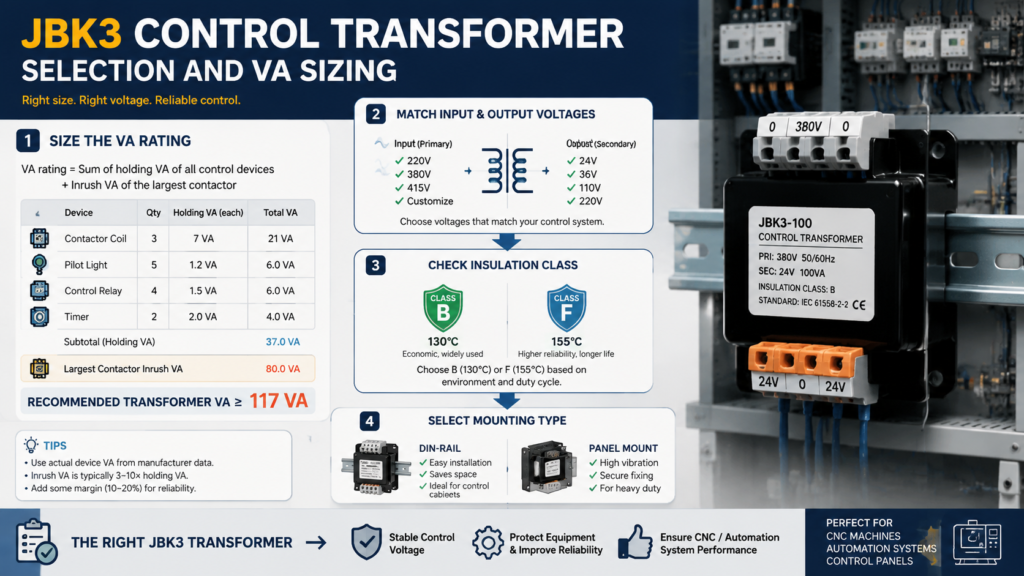
Step 1 – Size the VA Rating
Add the holding VA of every device on the control circuit: contactor coils, relay coils, timers, indicators, and PLC power supplies. Then add the inrush VA of the largest contactor that will energize at the same time. A common rule of thumb is to choose a transformer rated at least 1.5 times the continuous load, or higher if multiple contactors pull in simultaneously.
For example, a small CNC panel with four 10 VA contactors and a handful of indicators might only need a 100 VA unit. A larger machine center with multiple motor starters and a PLC rack may need 400 VA or more. If you are unsure, size up rather than run the transformer near its thermal limit.
Step 2 – Match Input and Output Voltages
Confirm the available supply voltage at the installation site. In China and many Southeast Asian plants, 380 V three-phase is common, but the control transformer primary may be wired across one phase and neutral for 220 V. Secondary voltage must match the coil ratings of the control devices—typically 110 V, 24 V, or 220 V depending on the machine design.
Many JBK3 units offer multiple primary taps or dual-voltage primaries. If your plant voltage can vary, specify a unit with tap settings so the secondary voltage stays within the ±5 % tolerance most control devices expect.
Step 3 – Check Insulation Class and Duty Cycle
Class B insulation is rated for 130 °C and is sufficient for most enclosed panels with adequate ventilation. Class F insulation, rated for 155 °C, is the better choice for hot climates, compact cabinets, or continuous-duty applications. JBK3 transformers are typically built to Class B or Class F with copper or aluminum windings.
Copper windings handle overload and inrush better and are preferred for high-reliability applications. Aluminum windings reduce material cost and weight but require slightly larger conductors. Discuss the expected duty cycle with your supplier so they can recommend the right conductor and insulation combination.
Step 4 – Pick the Mounting and Enclosure
JBK3 transformers are usually IP20 open-frame units designed for mounting inside a control cabinet. The two most common styles are DIN-rail mount and panel/back-plate mount. DIN-rail mounting is faster for assembly and service; panel mounting is more rigid for heavy units above 1,000 VA.
Measure the available depth as well as width and height. Some transformers are taller than they look in photos, and cable bends need clearance. If the unit will sit in a dusty or wash-down area, ask whether an enclosed version or additional terminal cover is available.
JBK3 Model Specifications at a Glance
The table below summarizes the typical JBK3 range. Always confirm the exact datasheet with your supplier before ordering, because terminal layout and dimensions can vary by manufacturer.
If you are buying JBK3 transformers under an OEM or ODM program, the base design can usually be adjusted without a full custom redesign. Common modifications include special secondary voltages, dual-primary taps, custom terminal blocks, integrated fuses, branded nameplates, and non-standard mounting footprints.
Before you request a quote, have these details ready:
Target VA rating and expected inrush current
Primary and secondary voltage combinations
Required insulation class and ambient temperature
Mounting method and maximum enclosure dimensions
Quantity forecast and preferred delivery schedule
Any required certificates or test reports
A clear spec sheet shortens sample lead time and reduces the risk of a mismatch during first-article inspection. Most suppliers can produce samples within one to two weeks for standard modifications and four to six weeks for more complex ODM work.
What Drives Control Transformer Price?
Control transformer price is driven by material content, rating, and order volume more than by brand. Copper windings cost more than aluminum but offer better overload performance. Higher VA ratings need more copper and steel, so price rises roughly with size. Custom voltages, special terminal blocks, or branded labeling add engineering and tooling charges that are usually amortized over the order quantity.
Volume is the other major lever. A single-unit replacement order will carry the highest per-piece price. A 100-piece wholesale order typically unlocks a meaningful discount, and scheduled release orders for 500 pieces or more often qualify for the best pricing and production slots. When you ask for a wholesale control transformer quote, include the annual forecast rather than just the first shipment. Suppliers can often propose a tiered price ladder that rewards predictable demand.
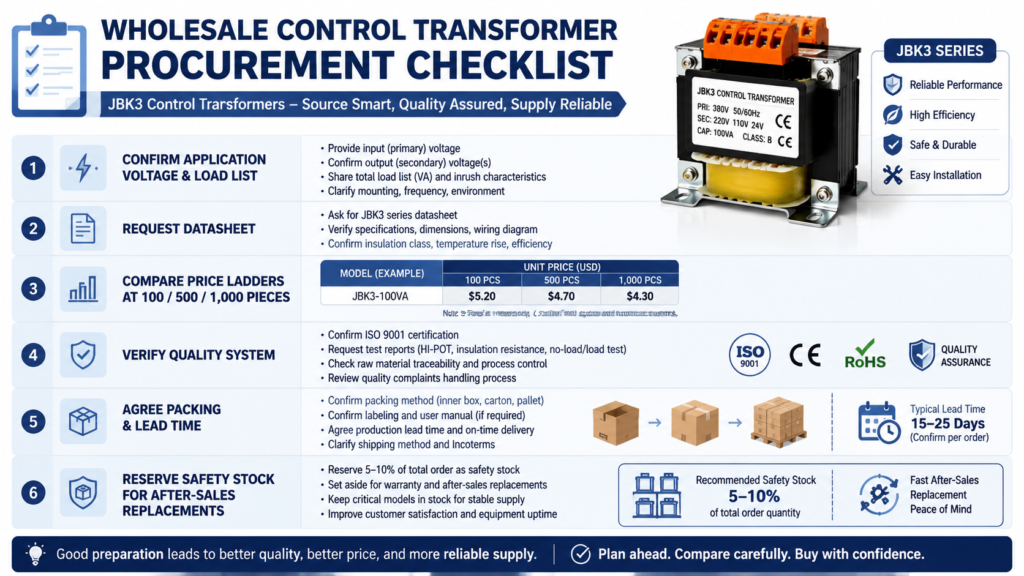
Wholesale Control Transformer Procurement Checklist
Use this checklist to keep the sourcing process on track, especially when evaluating multiple suppliers for a recurring production need.
Confirm the application voltage, load list, and inrush current.
Request a datasheet with VA rating, voltage ratios, insulation class, and dimensions.
Ask for sample photos or a first-article sample before mass production.
Verify the supplier’s quality system and any required test reports.
Compare price ladders at 100, 500, and 1,000-piece quantities.
Agree on packing, labeling, incoterm, and lead time in writing.
Reserve a small safety stock for after-sales replacements.
Common Selection Mistakes to Avoid
Even experienced buyers can overlook details that cause problems after installation. Watch for these common issues:
Undersizing the VA rating: Calculating only steady-state load and ignoring contactor inrush leads to voltage sag and unreliable coil pull-in.
Wrong voltage ratio: Ordering a 380/220 V unit for a site that actually supplies 220 V line-to-line will give an incorrect secondary voltage.
Ignoring ambient temperature: A Class B transformer in a 50 °C cabinet may run past its thermal limit; upgrade to Class F or increase ventilation.
Specifying aluminum without checking duty: Aluminum works for many applications, but high inrush or continuous overload favors copper.
Skipping the sample step: Terminal layouts and mounting dimensions vary; a sample prevents a production-line surprise.
Conclusion
A well-chosen JBK3 machine control transformer keeps control circuits stable, contactors reliable, and panels compact. Focus on VA rating including inrush, the correct voltage ratio, insulation class for the environment, and a mounting style that fits the cabinet. When sourcing at volume, use the annual forecast to negotiate a better control transformer price and lock in consistent lead times. If you are still comparing models, our JBK3 buyers guide covers the full ordering workflow. If your project needs custom voltages or branding, an OEM/ODM program is usually the most cost-effective path once the specification is clear.
If you need help matching a JBK3 rating to your load list, contact our team with your device schedule and we will recommend the right VA size and winding configuration.
Frequently Asked Questions
What does JBK3 stand for?
JBK3 is a Chinese industry model designation for machine-tool control transformers built to JB/T 5555 and related standards. The “K” commonly refers to control, and the number indicates the series generation.
How do I calculate the right VA rating for a JBK3 transformer?
Add the continuous VA of all control devices, then add the inrush VA of the largest contactor that switches at the same time. Select a transformer rated at least 1.5 times the continuous load, or higher for simultaneous switching.
Can I get a JBK3 transformer with custom voltages?
Yes. Most manufacturers offer OEM/ODM options for non-standard primary or secondary voltages, dual-voltage primaries, tap changers, and custom terminal arrangements. Provide a clear spec sheet and quantity forecast for the fastest quote.
Is copper winding worth the extra cost?
Copper handles overload and inrush better and is more durable in high-temperature cabinets. Aluminum reduces cost and weight for standard-duty panels. The best choice depends on your duty cycle, ambient temperature, and reliability requirements.
What is the typical MOQ for wholesale JBK3 control transformers?
MOQs vary by supplier and customization level. Standard catalog units may start at 10 to 100 pieces, while fully customized ODM designs often require 500 pieces or more to cover tooling and engineering costs.
How long does OEM/ODM sample production take?
Simple modifications such as voltage taps or custom labels usually take one to two weeks. More complex ODM work with new tooling or special testing can take four to six weeks, depending on material availability.
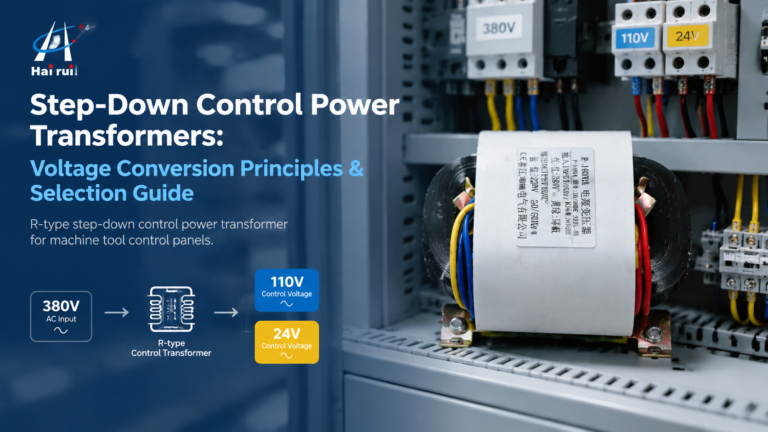
How step-down control power transformers convert 380V/480V line voltage to 110V or 24V control power: turns ratio, VA sizing with inrush, voltage-drop behaviour, wiring and selection.
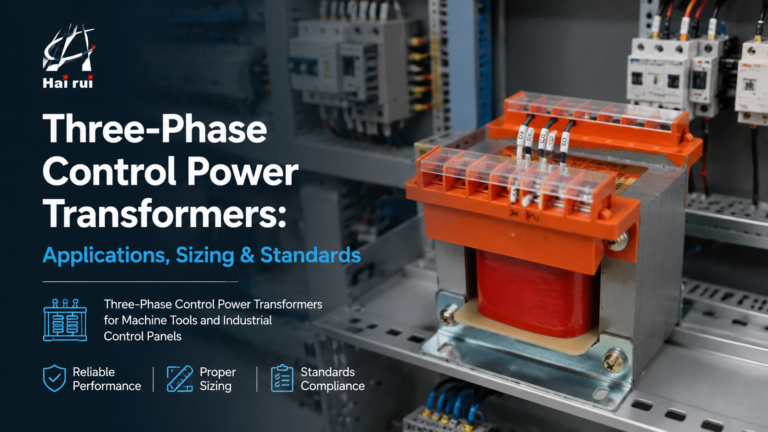
How three-phase control power transformers work, how to size them for machine tool and control-panel loads, and the delta/wye, standards and protection choices that matter in the field.