Single-Phase vs Three-Phase Control Power Transformers: Which Do You Need?
Published: Author: Lisa
Choosing between a single-phase and a three-phase control power transformer is a decision every panel builder and machine OEM faces at some point — and getting it wrong means either paying for capacity you never use or watching contactor coils drop out under load. The short answer for most machine-tool and control-panel applications is a single phase control power transformer: control circuits are inherently single-phase loads (coils, relays, PLCs, indicator lamps), and a compact single-phase unit delivers that 24V or 110V control bus more economically. Three-phase control transformers earn their place when you need a balanced three-phase control supply, higher VA in a single enclosure, or a neutral-forming secondary for mixed panel loads.
This guide compares both configurations on the factors that actually decide the spec — input availability, output requirements, VA sizing, regulation, mounting, and cost — with a decision path you can apply directly to your next panel or machine design.
What a Control Power Transformer Actually Does
A control power transformer steps a line voltage (typically 220V, 380V, 400V, or 480V) down to a stable low voltage that powers the control side of a machine — commonly 24V for PLCs and relay logic, 110V or 120V for contactor coils and pilot devices. Unlike general-purpose transformers, control transformers are rated for the short inrush currents of electromagnetic loads (contactors closing, solenoids energizing) and hold tighter voltage regulation under those bursts.
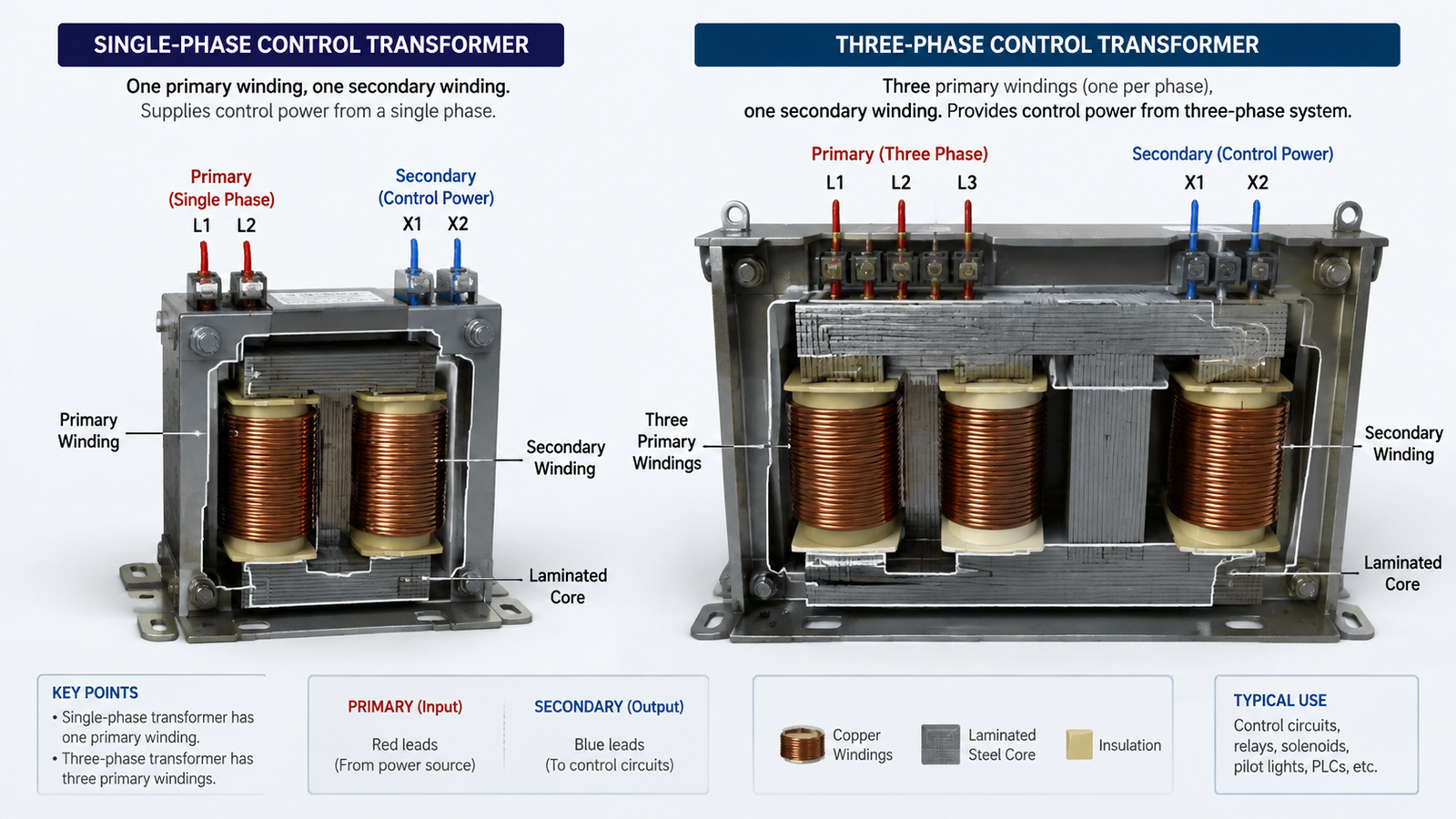
The phase question is separate from the voltage question. Phase describes how the input and output windings are arranged relative to the supply: a single-phase transformer has one primary winding fed from a single line (and neutral or another line), while a three-phase transformer has three primary windings arranged for a three-phase supply. What matters is matching the transformer to the supply you have and the load you feed — not picking “bigger” because it sounds safer.
Single-Phase Control Power Transformers: Where They Fit
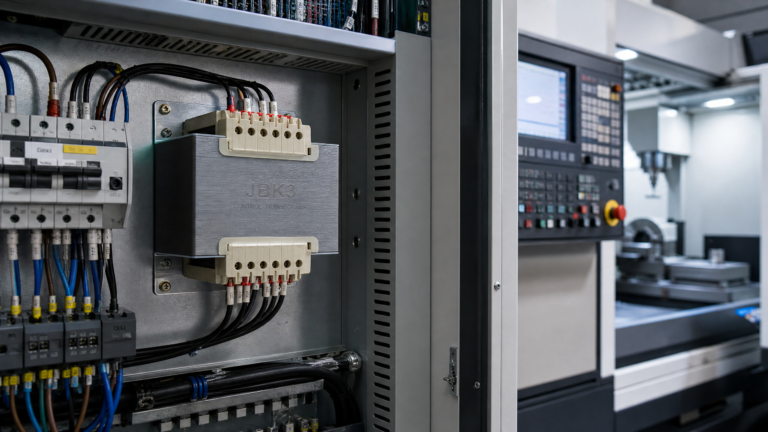
A single-phase control transformer is the default for machine tools, CNC cabinets, HVAC panels, and packaging lines. Almost every control component you will connect — a 24V DC power supply, contactor coils, thermal relay circuits, signal lamps, a small PLC — draws from a single-phase control bus. Because the load is single-phase, a single-phase transformer is the direct, lowest-loss way to feed it.
Input flexibility: available in 220V, 230V, 380V, 400V, and 480V primary ratings; on a three-phase plant supply, you simply connect across the appropriate lines (e.g., two phases for 380V, or phase-to-neutral for 220/230V).
Output options: one or more secondary taps such as 24V, 36V, 110V, or 220V, often with multiple taps on the same unit for flexibility.
Typical range: roughly 25VA to 2,500VA — enough for entire small-machine control systems.
Cost and footprint: smaller core and single winding set make single-phase units lighter and less expensive than a three-phase unit of equal VA.
For example, the BKJ5 machine tool control transformer series covers this exact space: single-phase input at 220/380V with selectable 24/110/220V output and ratings up to 2500VA — a practical fit for CNC and automation control panels. The BK series control transformer offers the same single-phase architecture across a 50–2500VA range with customizable secondary voltages for less demanding or retrofit applications, while the JBK3 series provides a compact base-mount option with multiple primary taps for OEM cabinets where panel space is tight.
Three-Phase Control Power Transformers: When They Make Sense
Three-phase control transformers are not “better” versions of single-phase units — they solve a different wiring problem. You genuinely need one when any of the following is true:
The load itself is three-phase. Some control schemes feed three-phase auxiliary circuits — coolant pumps with three-phase motors, three-phase servo supply pre-charge, or balanced heating elements in the cabinet.
You must create a neutral for mixed loads. In a plant with a 3-wire delta supply and no neutral, a three-phase transformer with a wye secondary can provide a system neutral so you can run standard single-phase 110/220V panel circuits safely.
Panel VA exceeds practical single-phase limits. Above roughly 3–5kVA of continuous control load, a three-phase unit shares the burden across windings, reducing per-winding current and often giving a smaller overall footprint than a bank of single-phase units.
Specification or code requires balanced loading. Utility or internal plant rules may penalize heavy single-phase loading on a three-phase service; a three-phase transformer balances the draw.
Configuration
Typical Input
Typical Output
Common VA Range
Best For
Single-phase control transformer
220/230/380/400/480V, one line (L–N or L–L)
24V, 36V, 110/120V, 220V
25VA – 2,500VA
Machine tools, CNC cabinets, HVAC panels, relay/PLC control buses
Three-phase control transformer
380/400/415/480V three-phase
3 × 110/220V or 3 × 24V with optional neutral
1kVA – 25kVA+
Large automation lines, three-phase auxiliaries, delta-supply neutral creation
If your control panel powers only coils, lamps, and PLCs — no three-phase auxiliary motors, no neutral-creation requirement — a three-phase transformer adds cost, weight, and mounting complexity without adding value. That is the most common selection mistake in the field.
How to Decide: A Practical Selection Path
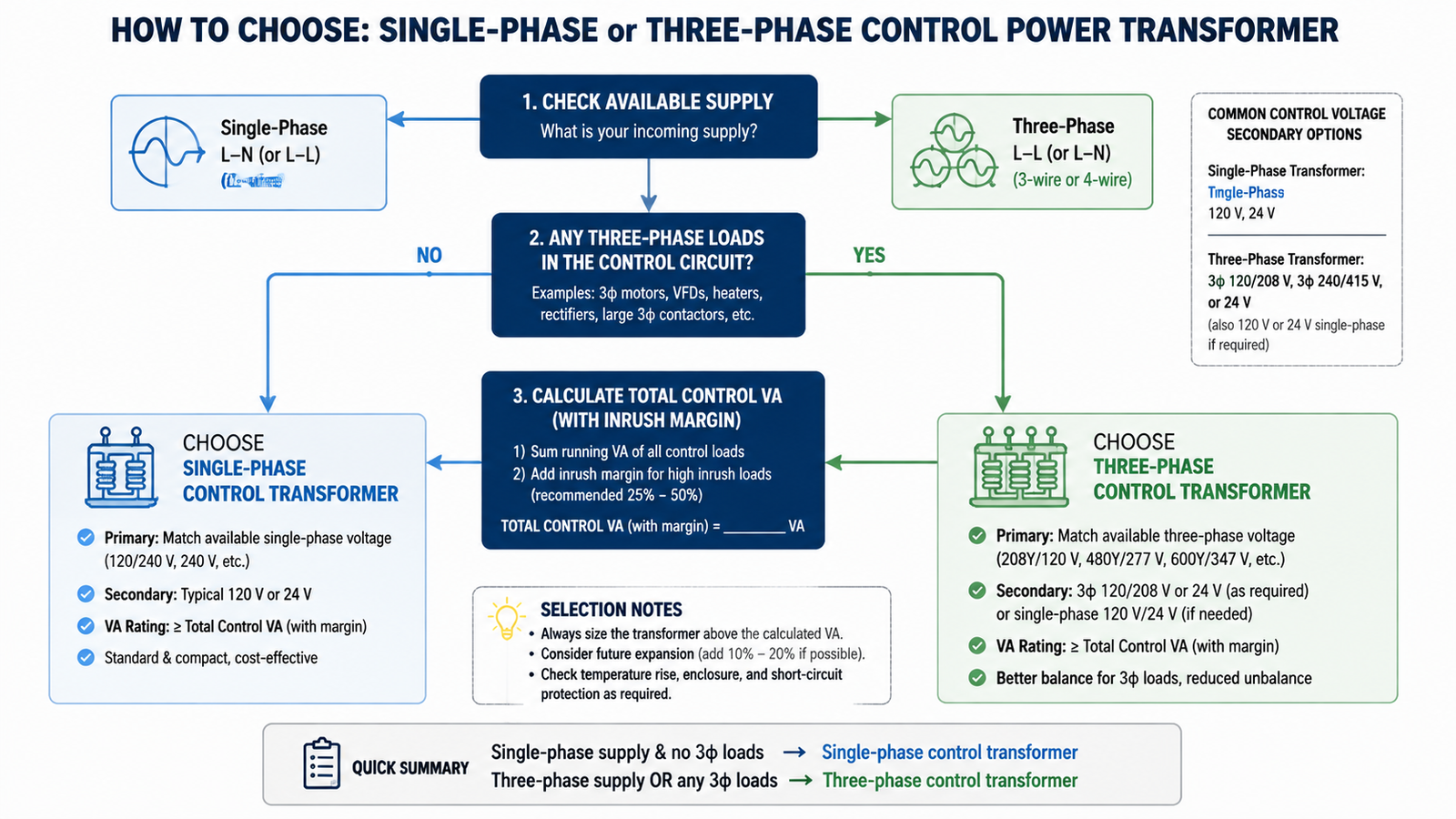
Work through these five questions in order and the right configuration becomes obvious.
What supply voltage is actually available at the panel? Confirm whether the feed is single-phase (L–N or L–L) or three-phase, and note the exact line voltage (e.g., 220V L–N, 380V L–L). A 380V-rated single-phase unit can be fed from two phases of a 380V three-phase system — this is standard practice on machine tools.
What voltage does the control circuit need? Sum the operating voltage of every load: most PLCs and relay logic use 24V DC via a power supply; most contactor coils are 110/120V or 220V AC. Match the secondary tap to the majority load.
Is any load three-phase? Motors, three-phase heaters, or three-phase servo auxiliaries push you toward a three-phase transformer or a separate three-phase feed. Pure single-phase control loads stay on a single-phase transformer.
What is the total VA with inrush margin? Add the steady-state VA of all loads, then apply a margin for contactor/relay inrush — commonly 150–200% for intermittent coil duty. Oversizing by one standard step (e.g., 500VA → 630VA) is cheaper than a field failure.
How much panel space and budget remain? Single-phase units mount on a DIN rail or base plate with small clearances; three-phase units need more ventilation and structural support. Choose the smallest configuration that satisfies steps 1–4.
Decision Point
Choose Single-Phase
Choose Three-Phase
Available supply at panel
Single-phase feed, or L–L connection on three-phase mains
Three-phase feed with balanced load requirement
Control circuit loads
Coils, relays, PLCs, lamps, DC supplies — all single-phase
Includes three-phase auxiliaries (motors, heaters, servo pre-charge)
Neutral availability
Neutral exists or L–L voltage matches primary rating
Must synthesize a neutral from a delta supply
Total control VA
25VA – 2,500VA typical machine/panel range
Above ~3–5kVA or large automation islands
Cost / space priorities
Lower cost, smaller footprint, DIN-rail capable
Accepts higher cost and larger footprint for balanced capacity
If your load profile is typical — 24V or 110V control circuits in a CNC machine, lathe, press, or conveyor panel — the answer will almost always be a single-phase control transformer sized with a healthy inrush margin. If you are specifying a large automation island or must synthesize a neutral from a delta supply, evaluate the three-phase option deliberately rather than defaulting to it.
VA Sizing, Regulation, and Mounting Considerations
Phase choice and VA sizing are linked. A single-phase transformer feeding a contactor-heavy circuit must hold output voltage when several coils energize at once; that is a function of regulation, not phase count. Look for regulation in the 5–10% range at full load for control duty, and confirm the unit can deliver its nameplate VA continuously plus the intermittent inrush.
For mounting, single-phase control transformers are offered in base-mount and DIN-rail formats, which simplifies panel layout. Three-phase units are generally base-mounted with larger terminals and heavier cabling, so plan knockouts and cable entry accordingly. Also check insulation class, ambient temperature rating, and whether the secondary should be grounded per your local code — grounding practice is identical regardless of phase configuration.
For the full sizing math — adding load VA, applying inrush factors, and matching regulation to the coil types in your panel — see the control transformer VA rating sizing guide. If your application is a CNC machine tool, the CNC machine tool control transformer guide walks through a worked example on a typical machining-center control cabinet.
Common Selection Mistakes
Choosing three-phase “for headroom.” Extra phase capacity does not improve single-phase regulation or inrush handling; it only adds cost and space. Size the correct configuration properly instead.
Ignoring the supply wiring. A 220V-rated single-phase unit connected across 380V phases will fail on first energization. Always verify L–N versus L–L voltage before ordering.
Forgetting inrush when adding up VA. Coil-only loads can draw 5–10× steady-state current at pick-up; under-sized transformers cause contactor chatter and premature failure.
Assuming a three-phase unit is needed because the machine is “industrial.” Machine-tool control circuits are overwhelmingly single-phase. Check the actual load list before defaulting to three-phase.
Conclusion
For the vast majority of control-panel and machine-tool applications, a single-phase control power transformer is the correct, economical choice — control circuits are single-phase loads, and single-phase units cover the 25VA–2500VA range where most machines operate. Move to a three-phase control transformer only when you have three-phase auxiliary loads, a delta supply that needs a synthesized neutral, or a panel VA that exceeds practical single-phase limits. Confirm the available supply voltage, match the secondary to your control bus, and size with inrush margin — that combination eliminates most field failures before they start.
Need a specification review for your panel? The HaiRui engineering team can help confirm phase configuration, VA sizing, and secondary voltages for your machine or cabinet design.
FAQ
Can I use a single-phase control transformer on a three-phase supply?
Yes. Connect the single-phase primary across the appropriate lines — for example, a 380V-rated primary across two phases of a 380V three-phase system, or a 220V-rated primary from phase to neutral where a neutral exists. Verify the actual line voltage before wiring.
Do CNC machines use single-phase or three-phase control transformers?
CNC machine control circuits are almost always single-phase (typically 24V or 110V control buses), so a single phase control power transformer is the standard solution even though the machine’s main supply is three-phase. Three-phase transformers appear only for three-phase auxiliary loads or special cabinet requirements.
When would I need a three-phase control transformer?
When your control scheme includes three-phase loads (small motors, heaters, servo auxiliaries), when you must create a system neutral from a three-wire delta supply, or when the total control VA is high enough that a three-phase unit is more compact and balanced than multiple single-phase units.
What is the difference between 24V and 110V control transformer secondaries?
24V is the standard for PLCs, sensors, and modern electronic control circuits (usually via a 24V DC power supply fed by the transformer). 110/120V is common for traditional contactor coils and pilot devices. Choose the secondary that matches the majority of your loads.
How do I size a single-phase control transformer?
Add the steady-state VA of all connected loads, then multiply by 1.5–2.0 to cover the inrush of electromagnetic devices such as contactors and solenoids. Select the next standard rating above the result and verify the unit’s regulation is suitable for control duty.
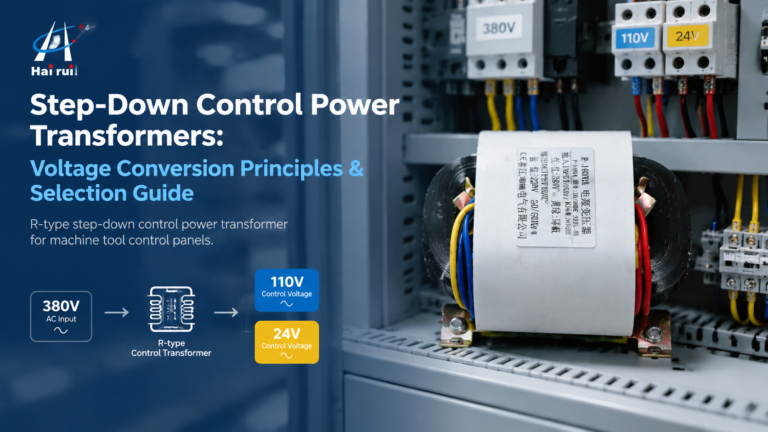
How step-down control power transformers convert 380V/480V line voltage to 110V or 24V control power: turns ratio, VA sizing with inrush, voltage-drop behaviour, wiring and selection.
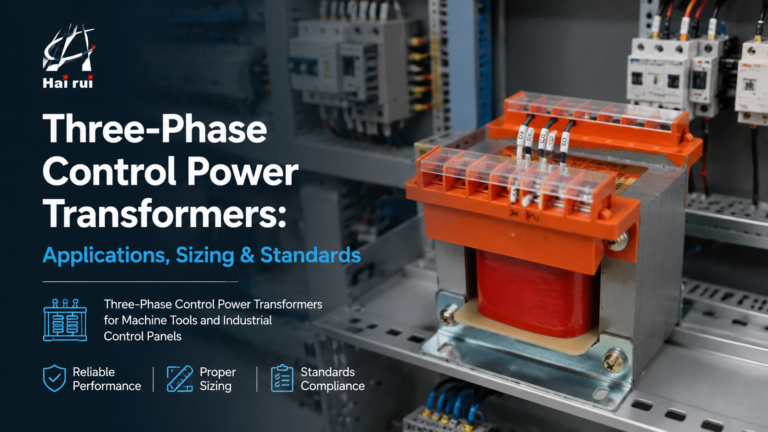
How three-phase control power transformers work, how to size them for machine tool and control-panel loads, and the delta/wye, standards and protection choices that matter in the field.
Practical B2B guide to evaluating machine tool transformer suppliers: certifications, manufacturing depth, product range, batch testing, red flags, and total cost of ownership comparison.