SF6 vs Oil Circuit Breakers: The Evolution of HV Interruption
Published: Author: Lisa
Comparing an SF6 vs oil circuit breaker is really a comparison between two eras of power engineering. For roughly sixty years, from the 1900s to the 1960s, oil was the only practical way to interrupt a high-voltage fault current. Today, almost every new substation at 72.5 kV and above is built around sulfur hexafluoride gas. If you are maintaining, retrofitting, or specifying equipment for a substation that still contains oil breakers, you need to understand what actually changed — not just that one technology replaced another.
This guide walks through how each type quenches an arc, how the two designs compare on ratings, footprint, maintenance, and safety, and how the industry moved from bulk oil to minimum oil to air blast and finally to SF6. It ends with a practical replacement checklist so you can decide, unit by unit, whether an existing oil breaker should be kept, refurbished, or replaced with a gas-insulated unit.
Oil Circuit Breakers: Bulk Oil and Minimum Oil Designs
Oil circuit breakers use refined mineral oil as both the insulating medium and the arc-quenching medium. They dominated transmission and distribution for decades because oil was cheap, available, and a far better insulator than air at the voltages utilities were beginning to use.
How an Oil Circuit Breaker Quenches an Arc
When the contacts part under load or fault current, an arc forms across the gap. In oil, that arc does something useful and something destructive at the same time. The heat — thousands of degrees at the arc root — decomposes the surrounding oil into hydrogen and hydrocarbon gases. A high-pressure gas bubble forms around the arc, and the interrupter is shaped to drive that bubble through the arc path.
Two mechanisms then work together. Hydrogen has very high thermal conductivity, so it strips heat out of the arc column, and the pressure forces the arc into a narrow channel or arc chute where it is elongated and cooled. When the alternating current passes through its natural zero crossing, the deionized gap recovers dielectric strength and the arc stays extinguished.
The destructive part is the residue. Every interruption burns oil and leaves behind carbon particles and sludge. The oil’s dielectric strength degrades progressively, which is why oil breakers need periodic oil testing, filtration, and eventually replacement. There is also a genuine fire and explosion risk: a bulk oil breaker contains hundreds or thousands of liters of flammable liquid sitting directly under a high-energy arc.
Bulk Oil (Dead Tank) vs Minimum Oil (Live Tank)
Oil breakers come in two families, and the distinction matters when you are planning a replacement.
Bulk oil (dead tank). The entire interrupter and the live parts sit inside a large grounded steel tank filled with oil. The oil provides both insulation to earth and arc quenching. These units are heavy, require substantial concrete foundations, and were built as single-tank or three-tank designs — typically single or three-tank at 69 kV and below, and three-tank above 115 kV.
Minimum oil (live tank). Oil is used only inside a small interrupter chamber; insulation to earth is provided by solid insulation and porcelain. This cut oil volume dramatically and made the units lighter and more compact, which is why the design spread quickly across Europe, China, and other markets from the 1940s onward, reaching 110 kV, 220 kV, and eventually 330 kV systems.
In both designs, the interrupting capability was pushed upward mainly by improving the interrupter chamber — cross-blast, axial-blast, and combined cross-axial blast arrangements — rather than by changing the medium itself. By the 1960s the physics of oil interruption was close to its practical limit.
How SF6 Circuit Breakers Interrupt the Same Fault Current
An SF6 breaker replaces the oil with a gas that has roughly three times the dielectric strength of air and an unusual chemical appetite for free electrons. The interruption mechanism is fundamentally different from oil’s.
Sulfur hexafluoride is strongly electronegative. As the arc burns in the gas-filled interrupter chamber, SF6 molecules capture the free electrons that carry the current and convert them into heavy negative ions. Heavy ions move slowly, so the arc’s conductivity collapses and the arc is starved of charge carriers. In a puffer interrupter, the opening stroke also compresses gas and blasts it through the arc; in self-blast designs, the arc’s own heat raises the chamber pressure and provides the blast energy.
The decisive advantage is reversibility. The arc temporarily dissociates SF6 into sulfur and fluorine, but as the gas cools, the molecules recombine back into SF6. There is no carbon sludge, no oil to filter, and no progressive degradation of the insulating medium. A properly sealed SF6 interrupter can sit for years, interrupt a fault, and be ready to interrupt the next one. If you want to go deeper into the gas properties behind this behaviour, the article on why SF6 gas is used in circuit breakers covers electronegativity, dielectric recovery, and thermal conductivity in detail.
SF6 breakers are also built in two mechanical forms — dead tank and live tank — and the choice between them affects footprint, CT integration, and seismic behaviour. That is covered in the overview of SF6 circuit breaker types.
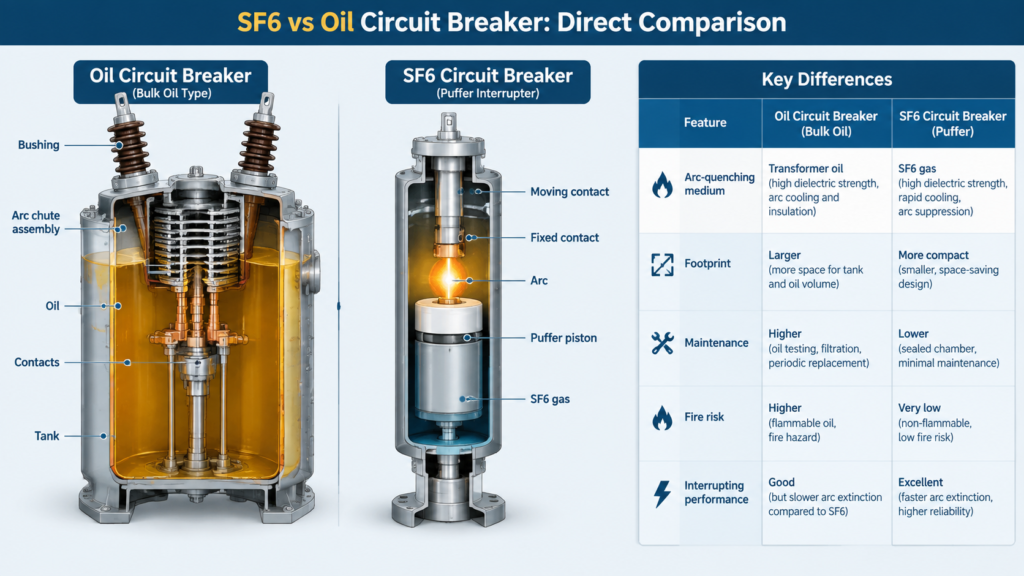
SF6 vs Oil Circuit Breaker: Direct Comparison
The table below summarises the differences that matter most in an SF6 vs oil circuit breaker evaluation, whether you are assessing an existing installation or specifying new equipment.
Parameter
Oil circuit breaker (bulk / minimum oil)
SF6 circuit breaker
Arc-quenching medium
Mineral oil; hydrogen gas bubble from oil decomposition
Pressurised SF6 gas; electron capture and recombination
Medium condition after interruption
Degraded; carbon particles and sludge accumulate
Self-restoring; gas returns to its original composition
Typical voltage range in service
Legacy units up to about 245 kV
36 kV to 800 kV and above
Footprint and weight
Very large; heavy steel tanks and substantial foundations
Compact; light sealed enclosures, indoor or outdoor
Routine maintenance
Oil testing, filtration, gasket and tank inspection
Gas density monitoring, moisture checks, mechanism service
Fire and explosion risk
High — large volume of flammable oil under an arc
Low — non-flammable gas
Environmental concern
Oil spill and disposal; oil containment required
High GWP gas; leak-tight sealing and recovery required
Interrupting performance
Limited by interrupter chamber design
Single interrupter covers very high fault currents
Notice that both technologies carry an environmental liability, but they are not equal in practice. Oil risk is a containment and disposal problem that can be managed with bunding and scheduled oil changes. SF6 risk is a leakage problem, and because one kilogram of SF6 is equivalent to roughly 23,500 kilograms of CO2, a slow leak that would be invisible with oil becomes a reportable emission. That is why modern SF6 equipment is specified with leak rates well below 0.5 percent per year and why gas recovery, not venting, is mandatory during maintenance.
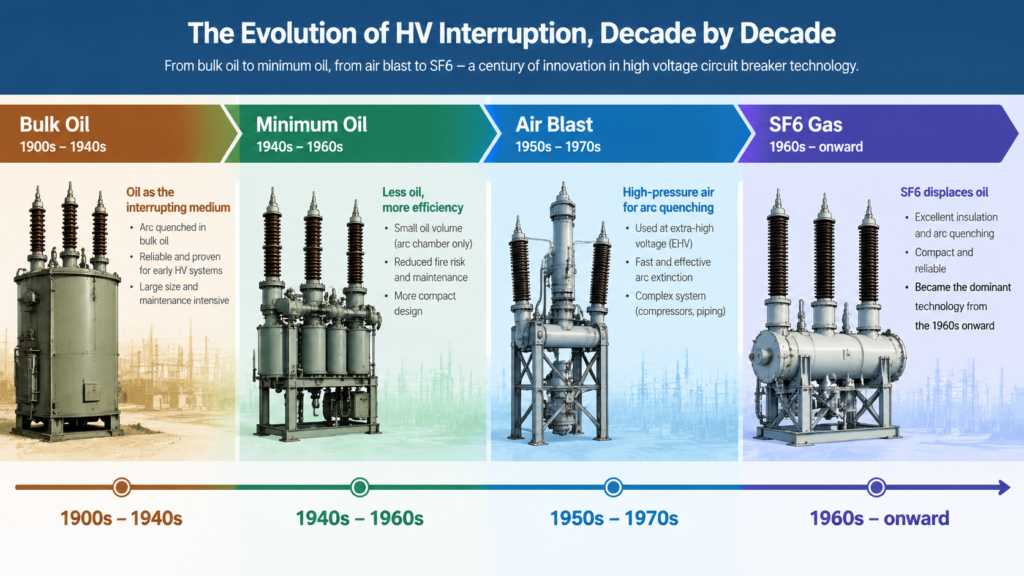
The Evolution of HV Interruption, Decade by Decade
Understanding the sequence helps explain why oil breakers are still found in older substations but are no longer specified for new ones.
Why Oil Dominated the First Half of the 20th Century
Early high-voltage networks needed a device that could both insulate and interrupt at voltages far above what air could handle. Oil solved both problems with one material and no moving gas system. As networks grew to 110 kV, 220 kV, and 330 kV, engineers kept improving interrupter chambers — cross-blast, axial-blast, and combined arrangements raised breaking currents from around 16 kA to 40 kA in the minimum oil generation. But the ceiling was real: more capability required more oil, more pressure, heavier tanks, and more maintenance.
The Air Blast Detour
Compressed air was the first serious alternative. Air blast breakers used a stored high-pressure air supply to blast the arc, and they performed well at the highest transmission voltages of the time, including extra-high-voltage levels. They were also, in the end, a dead end. The compressed air plant — compressors, receivers, dryers, piping — added an entire auxiliary system to maintain, the breakers were loud, and interrupting performance depended on keeping the air supply dry and pressurised. Air blast breakers are no longer manufactured, and the transmission positions they once held are now occupied by SF6 equipment.
Why SF6 Replaced Oil
SF6 arrived with a combination no earlier medium offered: very high dielectric strength, excellent arc-quenching ability, no residue, and no auxiliary gas plant. A single puffer interrupter could do the work of an interrupter chamber that previously needed a tank of oil or a compressor hall. Add the safety argument — no flammable liquid under an arc — and the maintenance argument, and the direction of travel became obvious. Utilities stopped ordering oil breakers for new installations and, as existing units reached the end of their service life, replaced them with SF6 units rather than refurbishing them again.
Period
Dominant interrupting medium
What drove the change
1900s – 1940s
Bulk oil (dead tank)
Oil insulates and interrupts; networks expand beyond air capability
1940s – 1960s
Minimum oil (live tank)
Cross-blast and axial-blast chambers cut oil volume and weight
1950s – 1970s
Air blast at EHV
High breaking capacity, but a costly auxiliary air system
1960s – 1990s
SF6 displaces oil
No residue, no fire risk, compact single-interrupter designs
1990s – present
SF6 as the HV standard; vacuum below 40.5 kV
Reliability, low maintenance, and now F-gas regulation
Where Oil Circuit Breakers Are Still Running Today
Oil breakers have not disappeared. They remain in service in several recognisable situations:
Aging transmission substations where the breaker is still within its mechanical and electrical life and spares are available.
Industrial plants with captive generation, particularly where the original switchgear was installed decades ago and outages are planned around production, not around asset renewal.
Distribution feeders at 10 kV to 35 kV, where minimum oil units were extremely common and are only now being displaced.
Regions where the installed base is large and replacement is paced by budget rather than by technology preference.
The practical question is rarely “is SF6 better?” — it usually is, on almost every technical axis. The real question is whether a specific oil breaker should be kept in service, refurbished, or replaced, and that depends on condition, criticality, fault level, and the cost of an outage.
Replacing an Oil Breaker: A Practical Checklist
A replacement is not a like-for-like swap. Oil breakers and SF6 breakers differ in mass, foundation loading, CT arrangement, and control interface, so the engineering scope extends well past the breaker itself.
Confirm the system parameters. Rated voltage, maximum system voltage, continuous current, and the actual fault level at the busbar today — not the value from the original drawing. Fault levels often rise over the life of a substation.
Match the breaking capacity with margin. The replacement must break the prospective fault current with the applicable safety margin, and it must handle the transient recovery voltage of the specific circuit.
Check the making capacity and short-time withstand. Closing onto a fault and carrying fault current for the protection clearing time are separate requirements from breaking it.
Review the foundation and structure. An SF6 breaker is far lighter than a bulk oil tank, but the interface points, seismic loading assumptions, and terminal heights all change.
Plan the CT and protection interface. Dead tank SF6 breakers can integrate current transformers in the tank bushings; live tank designs may need separate CTs.
Confirm the operating mechanism and control supply. Spring mechanisms are now standard at most voltages; if the existing installation used pneumatic or hydraulic auxiliaries, those systems can usually be retired.
Plan gas handling and monitoring. Specify density monitoring with alarm and lockout contacts, and confirm that recovery equipment and trained personnel are available before commissioning.
Decide the fate of the oil. Oil removal, testing, disposal or recycling, and tank decommissioning must be in the scope, along with any contaminated soil assessment.
The table below maps typical legacy oil installations to suitable replacement classes. Exact selection always depends on the fault study, but the pattern is consistent.
Voltage class is the starting point, not the answer — a 40.5 kV replacement and a 252 kV replacement sit at very different points on the cost and complexity curve. The guide to SF6 circuit breaker voltage classes explains how ratings, breaking capacity, and rated current scale across the range.
Maintenance and Lifecycle Cost Comparison
Oil breakers are not simply “high maintenance” and SF6 breakers “low maintenance” — they are maintained differently, and the cost profile shifts over the asset’s life.
Oil: recurring oil sampling and dielectric testing, filtration or replacement, gasket and seal renewal, tank inspection for corrosion and leaks, plus bunding and oil containment upkeep. Labour is the dominant cost, and much of the work is done on site.
SF6: periodic gas density verification, moisture and purity analysis, leak detection, and mechanism service — lubrication, spring charging checks, and contact wear monitoring. Gas handling requires trained technicians and recovery equipment, but the intervals are far longer.
Over a twenty-year horizon, the SF6 unit usually wins on total cost of ownership, largely because the number of intrusive maintenance events drops and because an unexpected oil problem can force an unplanned outage. The counterweight is the cost of gas handling and the regulatory overhead of F-gas reporting, which varies significantly by region. Where SF6-free alternatives are being considered for medium-voltage switchgear, the trade-offs are different again — the comparison of SF6 vs vacuum circuit breakers covers that decision in detail.
Common Mistakes When Comparing SF6 and Oil Breakers
Comparing nameplate voltages instead of fault levels. A replacement must be selected against today’s prospective fault current, which is frequently higher than when the original oil breaker was installed.
Assuming the retrofit is limited to the breaker. Foundations, CTs, control supplies, and cable terminations usually change as well.
Treating SF6 leakage as a minor issue. A leak that would be a housekeeping problem with oil becomes a compliance and reporting issue with SF6, and it degrades interrupting capability at the same time.
Ignoring cold-weather behaviour. SF6 pressure and dielectric strength fall as temperature drops, so low-temperature installations need density monitoring and sometimes tank heaters or a lower-rated gas pressure design.
Planning for oil disposal at the last minute. Decommissioning scope, disposal routes, and any soil assessment should be budgeted with the replacement, not after it.
Refurbishing beyond the economic crossover point. Once a bulk oil unit needs major interrupter work plus tank and oil system renewal, the case for replacement usually closes quickly.
Conclusion
Oil circuit breakers were the right answer for a century of grid expansion, and minimum oil designs in particular were a genuine engineering achievement. But the medium itself set the ceiling: every interruption degraded the oil, and every kilovolt of capability added weight, oil volume, and fire risk. SF6 removed those constraints by using a gas that recovers after every arc, which is why it replaced oil for high-voltage interruption and why air blast disappeared entirely.
If you are evaluating a specific unit, start from the fault study and the voltage class, then check foundation, CT, and control interfaces before you compare prices. That is where replacement projects go wrong.
For units in the 40.5 kV to 252 kV range, our outdoor SF6 circuit breaker range covers the standard replacement classes with ratings from 2000 A to 4000 A and breaking capacities matched to typical utility and industrial fault levels. You are welcome to send your system parameters and we will map them to a suitable configuration.
FAQ
Is an SF6 circuit breaker better than an oil circuit breaker?
Looking at the SF6 vs oil circuit breaker question on technical merit alone, SF6 wins for high-voltage applications on almost every measure. It interrupts higher fault currents in a smaller footprint, produces no carbon residue, carries no fire risk from flammable liquid, and needs far less routine maintenance. The trade-off is that SF6 is a potent greenhouse gas, so leak-tight construction, gas recovery, and emissions reporting become part of the operating cost.
Why did SF6 replace oil circuit breakers?
Three reasons drove the change. Oil interruption had reached its practical limit — more breaking capacity meant more oil, more pressure, and heavier tanks. SF6 offered much higher dielectric strength and arc-quenching ability with a self-restoring medium. And the fire and containment liability of large oil volumes became harder to justify as regulations tightened. Air blast was tried at extra-high voltage but lost out because of its compressor plant and auxiliary complexity.
What is the difference between bulk oil and minimum oil circuit breakers?
Bulk oil breakers immerse the interrupter and live parts in a large grounded steel tank of oil, which provides both insulation to earth and arc quenching. Minimum oil breakers use oil only inside a small interrupter chamber and rely on solid insulation and porcelain for insulation to earth. Minimum oil designs use far less oil and are lighter, which is why they became the dominant oil type from the 1940s onward.
Can an oil circuit breaker be replaced by an SF6 breaker directly?
The electrical function can be replaced, but not as a like-for-like physical swap. The replacement must be selected against the current fault level and transient recovery voltage, and the project usually includes foundation or structural changes, new or relocated current transformers, updated control and protection wiring, and gas handling provisions. Oil removal, disposal, and tank decommissioning are also part of the scope.
Do oil circuit breakers still have any advantages?
In a few situations, yes. Oil is inexpensive, widely available, and the technology is well understood by older maintenance teams. Units already in service with adequate spare parts and a low fault level may be economically reasonable to keep running, especially where an outage is expensive and the breaker is not safety-critical. Once a bulk oil unit needs major interrupter work plus tank and oil system renewal, replacement usually becomes the better option.
How often does an SF6 circuit breaker need maintenance compared with an oil breaker?
Oil breakers typically need oil sampling and testing on a regular cycle plus filtration or oil replacement when dielectric strength falls, alongside tank, seal, and containment inspections. SF6 breakers mainly need gas density verification, periodic moisture and purity analysis, leak checks, and mechanism service. The intervals are longer and the number of intrusive interventions is much lower, which is the main reason SF6 units usually show a lower total cost of ownership over a twenty-year horizon.
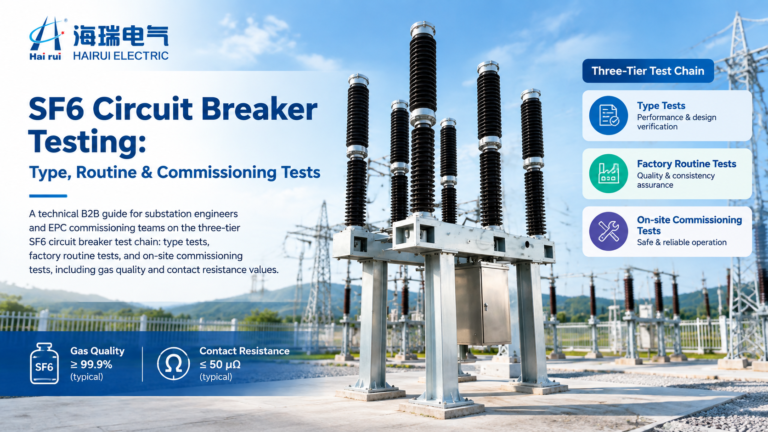
SF6 circuit breaker testing explained in three tiers: type tests, factory routine tests and on-site commissioning tests, with gas quality limits, contact resistance values and test report checks.
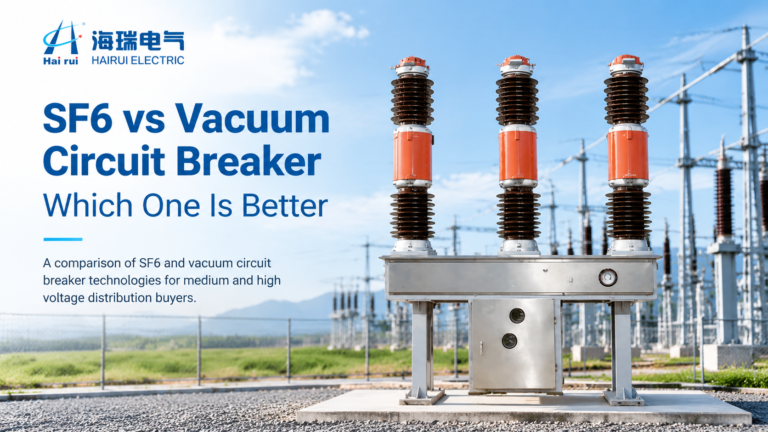
Vacuum or SF6? Compare arc quenching, voltage limits, switching behaviour, maintenance, F-gas rules and cost to pick the right circuit breaker for your network.
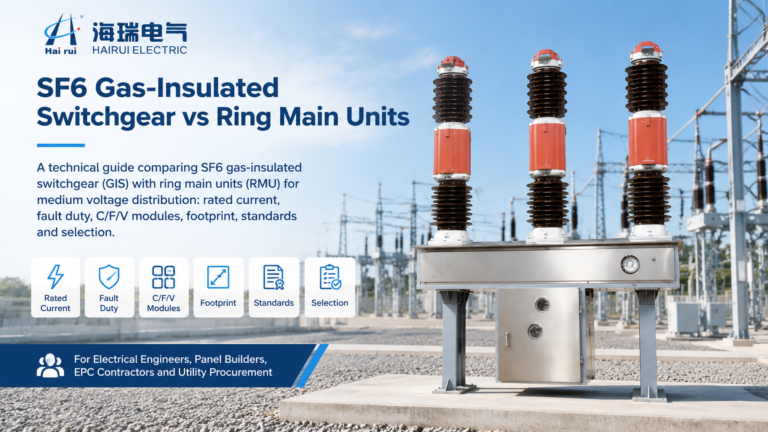
A practical comparison of SF6 gas-insulated switchgear (GIS) and ring main units (RMU) covering modules, ratings, fault duty, standards and how to choose.