SF6 Gas-Insulated Switchgear (GIS) vs Ring Main Units (RMU): Key Differences
A practical comparison of SF6 gas-insulated switchgear (GIS) and ring main units (RMU) covering modules, ratings, fault duty, standards and how to choose.
Read More
The SF6 vs vacuum circuit breaker debate comes up in almost every medium-voltage and high-voltage procurement meeting. The honest engineering answer is not that one technology is universally better — it is that each fits a different voltage class, switching duty, environment, and compliance exposure. Both interrupt fault currents reliably and both have been proven over decades. Vacuum dominates up to roughly 36–40.5 kV, SF6 circuit breakers become the practical choice from 72.5 kV upward, and the 40.5 kV class in between is genuinely contested.
This guide compares the two technologies the way a specification engineer would: arc-quenching physics first, then a head-to-head table, then the deciding factors — voltage class, switching behaviour, environmental regulation, and total cost of ownership. By the end you should be able to place any breaker position in your single-line diagram on one side of the fence with confidence.
If you want the verdict before the physics, here it is:
The rest of this article explains why that crossover exists and what to check before you commit either way.
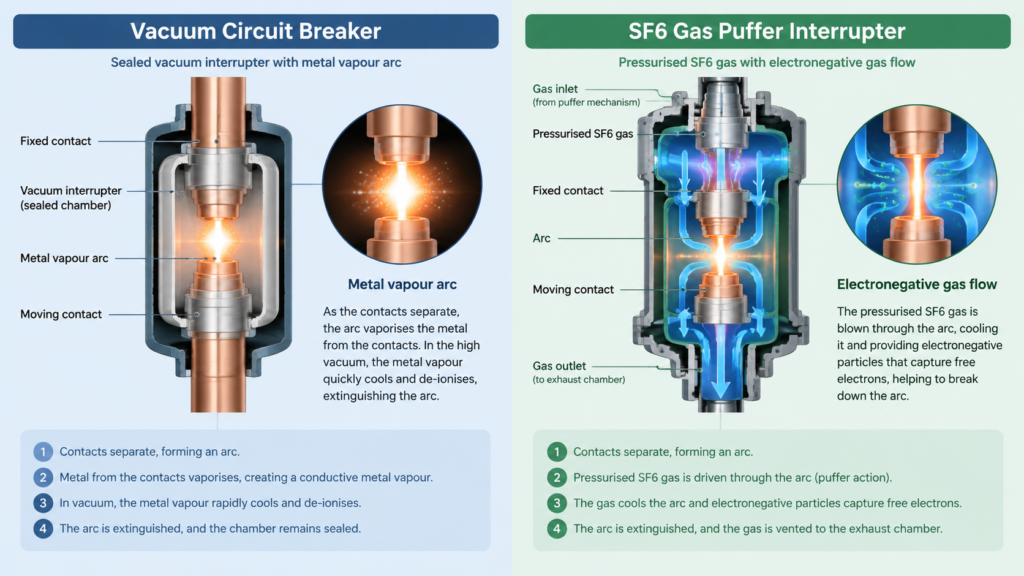
The entire comparison flows from one difference: the medium inside the interrupting chamber. Vacuum breakers interrupt in a near-perfect vacuum; SF6 breakers interrupt in pressurised sulfur hexafluoride gas. Everything else — maintenance, lifespan, footprint, environmental exposure — is a consequence of that choice.
A vacuum circuit breaker houses its fixed and moving contacts inside a hermetically sealed ceramic-and-metal bottle evacuated to a very high vacuum (below roughly 10-2 Pa). When the contacts part under load, the current does not simply stop — it continues burning as a metal vapour arc, sustained by material evaporated from the contact surfaces. Because there are almost no gas molecules to sustain the plasma, the vapour diffuses and condenses rapidly, and the arc extinguishes at the first or second current zero.
The practical strengths follow directly from this design. Dielectric strength across the open gap recovers extremely fast, which makes vacuum breakers excellent for frequent switching and auto-reclosing. The interrupter is sealed for life: no gas to monitor, no moisture to manage, no refill equipment. The weaknesses are equally structural. Contact erosion is not observable from outside, so the interrupter is treated as a replaceable component rather than a serviceable one. And the achievable withstand voltage of a single gap is physically limited — which is exactly why vacuum struggles above 40.5 kV.
An SF6 circuit breaker surrounds its contacts with sulfur hexafluoride at a controlled pressure, typically around 0.4–0.6 MPa in modern single-pressure designs. SF6 is strongly electronegative: its molecules capture free electrons, so the gas deionises quickly after each current zero and its dielectric strength is roughly 2.5 to 3 times that of air at the same pressure. During interruption, a puffer or self-blast mechanism drives gas through the arc column, cooling it and sweeping away hot ionised products. This is why SF6 can clear enormous fault energies in a single compact chamber — a property no other medium matches at transmission voltage.
If you want the deeper physics, our guide on why SF6 gas is used in circuit breakers covers the dielectric and thermal properties in detail, and the puffer and self-blast interrupter designs article explains how gas flow is generated mechanically.
The table below compresses the comparison into the parameters that actually appear in tender documents. Figures are typical manufacturer ranges; always verify against the specific nameplate.
| Parameter | Vacuum Circuit Breaker (VCB) | SF6 Circuit Breaker |
|---|---|---|
| Arc quenching medium | High vacuum in a sealed interrupter | SF6 gas at 0.4–0.6 MPa (single-pressure) |
| Practical voltage range | 3.6–40.5 kV (126 kV designs emerging in China) | 12 kV to 800 kV and above |
| Dielectric strength of medium | Very high across a short gap, but fixed by gap geometry | 2.5–3× air at equal pressure; scales with pressure and gap |
| Load-current operations (typical) | ~10,000–30,000 before interrupter replacement | ~5,000–10,000 before contact and gas service |
| Maintenance | Minimal — mechanism checks and contact resistance tests | Gas density monitoring, leak checks, moisture and purity analysis, gas recovery equipment |
| Switching overvoltage behaviour | Current chopping and possible re-ignitions; may need surge arresters | Low chopping level, soft recovery; benign for inductive loads |
| Footprint | Compact indoors; grows quickly with voltage | Compact at all voltages — the same gas insulates and quenches |
| Condition monitoring | Sealed interrupter; vacuum quality not field-measurable | Gas density monitor gives a continuous, inspectable health signal |
| Environmental exposure | Zero greenhouse gas | SF6: GWP ~23,500, atmospheric lifetime ~3,200 years |
| Failure mode | Interrupter replaced as a unit | Gas system serviceable; leaks detectable and repairable |
| Best fit | MV distribution, frequent operation, indoor panels | HV/EHV substations, compact outdoor stations, transformer feeders |
Voltage class is the single question that settles most selections, because the dielectric stress after current zero scales steeply with system voltage. Here is how the two technologies divide the map.
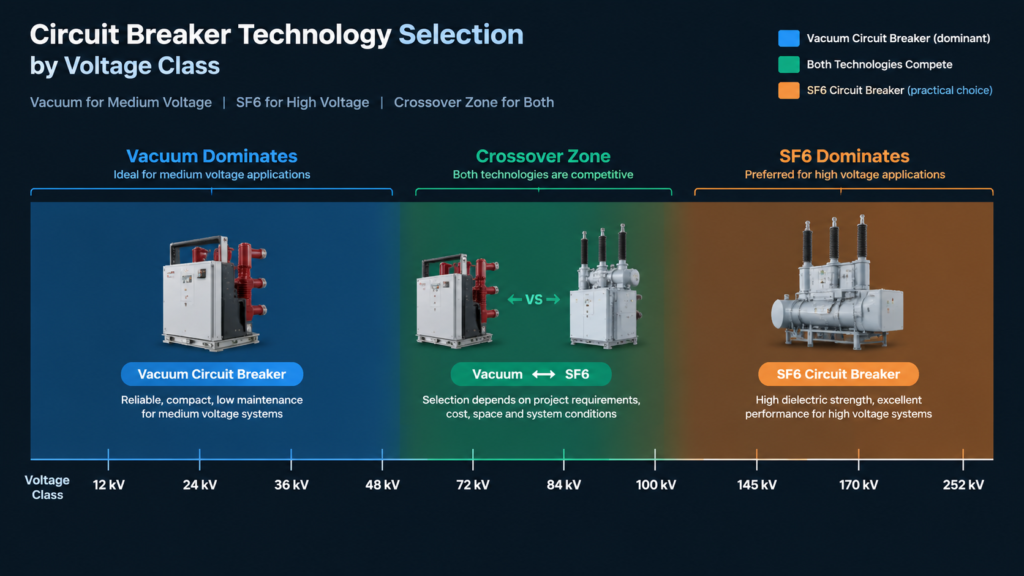
Below 24 kV, the vacuum interrupter operates comfortably inside its physical limits. Breakers are compact, the operating energy is low, and a sealed interrupter delivers decades of service with nothing more than mechanism maintenance. Utilities in China, Japan, Europe, and North America have standardised on vacuum for this range, and the supply chain reflects it — interrupters are commodity items with fierce price competition. Specifying SF6 here buys you nothing except gas-handling obligations and, since 2026, regulatory exposure in the EU.
At 36–40.5 kV the physics get interesting. A single vacuum interrupter is still workable, but contact gaps become long, X-ray emission and partial discharge margins tighten, and the interrupter becomes a premium component rather than a commodity. This is the only voltage class where the choice is genuinely open.
Indoor metal-clad panels at 40.5 kV still lean vacuum — panel geometry suits the interrupter, and buyers value the maintenance profile. Outdoor substation duty leans the other way. An outdoor medium-mounted design such as the 40.5 kV outdoor SF6 gas insulated circuit breaker uses the same gas to insulate the porcelain column and quench the arc, so there is no composite weatherhousing around a fragile interrupter and no external insulation coordination headaches. For transformer feeders in particular, SF6’s low chopping current and smooth recovery avoid the overvoltage protection that a vacuum breaker’s switching transients can demand.
Endurance is a legitimate vacuum counter-argument at this level — sealed interrupters excel where dozens of operations per day are normal. But note that modern SF6 designs are not fragile either: the LW8-40.5 series, for example, is rated for a 3,000-operation mechanical life, which comfortably covers a typical distribution substation’s duty cycle for decades.
Above 40.5 kV, the vacuum interrupter’s fixed dielectric ceiling becomes binding. To reach 72.5 kV or 126 kV, a vacuum breaker needs multiple interrupters in series — more mechanism synchronisation, more height, more cost, more things to fail. Some Chinese manufacturers have demonstrated 126 kV and even 252 kV vacuum designs, but they remain niche and expensive. SF6, by contrast, scales naturally: the gas withstands what the gap sees, and self-blast chambers clear the highest fault currents in a single break.
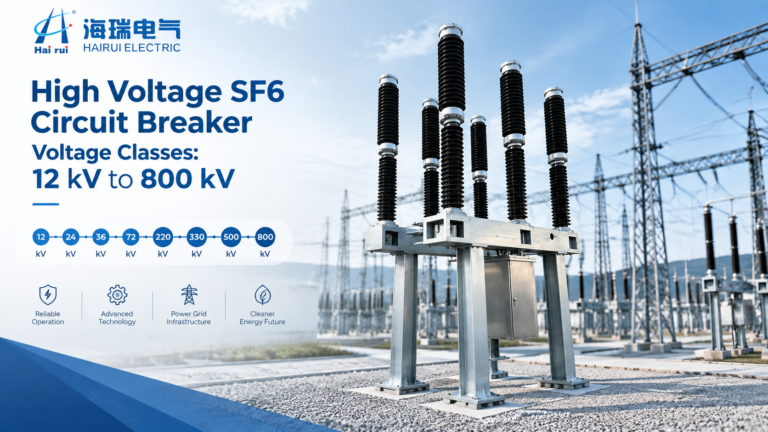
That is why every 72.5 kV, 126 kV, and 252 kV breaker you will find in a transmission substation today is overwhelmingly SF6 — for instance the LW9-72.5 outdoor SF6 breaker rated 4000 A with high breaking capacity, which would be physically impractical to build as a single-gap vacuum unit. Our SF6 circuit breaker voltage classes guide walks the full ladder from 12 kV to 800 kV and matches each class to typical ratings.
| System voltage | Typical winner | Why |
|---|---|---|
| 12 kV / 13.8 kV | Vacuum | Commodity interrupters, lowest cost, zero gas obligations |
| 24 kV | Vacuum | Same as 12 kV; EU F-gas ban on new SF6 gear applies from 2026 |
| 33 kV / 36 kV | Vacuum (indoor) / contested (outdoor) | Vacuum wins panel duty; outdoor stations weigh SF6’s insulation and switching behaviour |
| 40.5 kV | Contested | Indoor leans vacuum; outdoor transformer feeders lean SF6 |
| 72.5 kV | SF6 | Single-gap vacuum impractical; SF6 scales naturally |
| 126 kV / 145 kV | SF6 | Standard transmission practice worldwide |
| 252 kV and above | SF6 | Only mature technology at EHV; multi-break chambers with grading capacitors |
Voltage class decides the battle; switching duty decides the tie-breakers.
Vacuum’s known quirk is current chopping. Because the metal vapour arc extinguishes so decisively, a vacuum breaker can cut off the current slightly before its natural zero — chopping a few amperes in an inductive circuit converts the magnetic energy into a voltage spike. Switching idle transformers, motors, or reactor feeders with a VCB may therefore require surge arresters or RC snubbers. Vacuum breakers can also experience re-ignitions during capacitive switching (cable and capacitor bank de-energisation), which is why IEC 62271-100 classifies breakers as C1 or C2 for restrike probability — specify C2 where capacitive duty is frequent.
SF6’s recovery is gentler. The gas arc extinguishes at current zero without chopping aggressively, so switching overvoltages stay low without auxiliary protection — a real advantage on transformer and reactor feeders. The trade-off is that SF6’s dielectric recovery is slower than vacuum’s at medium voltage, which is one reason auto-reclose-intensive distribution duty historically favoured vacuum.
One more spec-sheet item buyers overlook: in vacuum, interrupter health is invisible. There is no gas density monitor to read, so condition assessment relies on timing tests, contact resistance, and dynamic resistance measurement. In SF6, the density monitor gives you a continuous, trendable health signal — and a slow leak announces itself years before it becomes a dielectric problem.
SF6 is the most potent greenhouse gas the electrical industry uses: a global warming potential around 23,500 times that of CO₂ and an atmospheric lifetime of roughly 3,200 years. The quantities per breaker are small and modern designs leak well under 0.5% per year, but regulators have stopped treating “small” as “negligible.”
The EU’s revised F-gas Regulation (EU) 2024/573 sets the pace: new medium-voltage switchgear up to 24 kV may no longer use SF6 from 1 January 2026, and the restriction extends to the 24–52 kV band from 1 January 2030. Similar pressure is building in other markets through procurement standards and ESG reporting. Three practical consequences for buyers:
Vacuum has no equivalent exposure. If your project carries ESG scoring, green financing conditions, or a public procurement climate clause, that asymmetry alone can decide a medium-voltage tender.
Pricing questions — “sf6 vs vcb price” is one of the most-searched variants of this topic — do not have a single answer, because the two technologies spend money in different places.
Capital cost. At 12–24 kV, vacuum breakers are usually the cheaper purchase: the interrupter supply chain is large and competitive, and there is no gas system to build. At 40.5 kV the gap narrows sharply, because the vacuum interrupter itself becomes a premium component while the SF6 design stays conventional. Above 72.5 kV there is often no vacuum offer to price against at all.
Life-cycle cost. Vacuum wins the maintenance ledger at MV: no gas checks, no refill kits, no recovery unit, no handling certification for technicians. SF6 ownership carries a specific cost stack — periodic gas quality analysis (moisture, purity, decomposition by-products), leak detection, a gas recovery and filling set, and trained personnel. Those line items are modest for a utility with an existing SF6 fleet and a workshop, and heavier for a first-time buyer building gas-handling capability from zero.
End of life. A vacuum interrupter is replaced and scrapped; its materials are unremarkable. An SF6 breaker must be decommissioned with certified gas recovery and documented destruction or recycling — a real cost, though a manageable one for operators who already run gas-handling procedures.
The defensible way to compare is to build a 20-year TCO table for your specific duty cycle: purchase price, planned maintenance intervals, gas-handling consumables, switching-related surge protection (if vacuum + inductive loads), and decommissioning. On most MV projects vacuum wins; on 40.5 kV-and-above outdoor substations the SF6 total is usually competitive despite the extra gas discipline, because the alternative is a multi-interrupter vacuum design that costs more to buy and to keep in adjustment.
One nuance that most “SF6 vs vacuum” articles miss: at medium voltage the two technologies increasingly coexist inside a single assembly. Modern GIS and ring main units frequently pair vacuum interrupters (which do the arc quenching) with SF6 or alternative gas insulation (which handles the dielectric between phases and to earth). Each medium is used where it is strongest.
So the sharper framing of the buyer’s question is not “SF6 or vacuum” but “which medium should quench, and which should insulate?” For a freestanding outdoor breaker at 40.5 kV and above, one gas doing both jobs keeps the design simple and sealed. For an indoor MV panel, a vacuum interrupter in air or solid insulation is simpler still. The products differ; the physics division of labour is consistent.
Before you shortlist suppliers, answer these five questions for each breaker position:
Neither technology is “better.” Vacuum is the rational default for medium-voltage distribution — cheaper to buy, nearly free to maintain, and immune to F-gas regulation. SF6 is the only mature answer at 72.5 kV and above, and a genuinely competitive option at 40.5 kV, where its combined insulation and arc-quenching role, gentle switching behaviour, and continuous gas monitoring earn it a place in outdoor substation specifications. Match the medium to the voltage class and the duty, and the SF6 vs vacuum circuit breaker question answers itself.
If your project sits in the 40.5 kV to 252 kV range — the territory where SF6 engineering decides the outcome — browse our SF6 circuit breaker guides or request a datasheet and quotation for the specific voltage class you are specifying.
For most medium-voltage applications up to 24 kV, vacuum is better: lower cost, minimal maintenance, and no greenhouse gas. From 72.5 kV upward, SF6 is better because a single vacuum interrupter cannot practically withstand the dielectric stress. At 33–40.5 kV the choice depends on the application — vacuum for indoor panels, SF6 often preferred for outdoor transformer feeders.
The withstand voltage of a vacuum gap is limited by contact geometry and vacuum quality, and it does not scale economically. Reaching 72.5 kV or higher requires stacking interrupters in series, which multiplies cost, height, and mechanical synchronisation requirements. SF6’s dielectric strength scales with gas pressure and gap length, so one chamber can handle transmission-class voltages.
In the EU, the revised F-gas Regulation (EU) 2024/573 bans SF6 in new medium-voltage switchgear up to 24 kV from 1 January 2026, and in the 24–52 kV range from 1 January 2030. Existing installations remain in service. Outside the EU, SF6 remains legal and standard at high voltage, though leak-rate and recovery requirements are tightening globally.
Not always. Vacuum breakers chop current slightly before zero, which can create switching overvoltages on highly inductive loads such as idle transformers, motors, and reactors. These positions should be checked against insulation coordination and fitted with surge arresters or RC snubbers where necessary. Resistive and capacitive feeders usually need nothing beyond normal practice.
Vacuum interrupters typically deliver more rated-current operations (commonly quoted in the tens of thousands) than SF6 chambers of equivalent voltage class (roughly 5,000–10,000) before service. Both technologies comfortably exceed 20–30 years of calendar service with proper maintenance. For SF6, mechanical life ratings such as 3,000 operations on the LW8-40.5 series cover decades of typical distribution duty.
At 12–24 kV, yes — vacuum is usually cheaper to buy and to own. At 40.5 kV the capital prices converge because premium vacuum interrupters offset the SF6 gas system. Above 72.5 kV, SF6 is typically the only practical offer. Over a 20-year life, SF6’s extra cost is mostly gas monitoring, quality analysis, and handling equipment rather than the breaker itself.