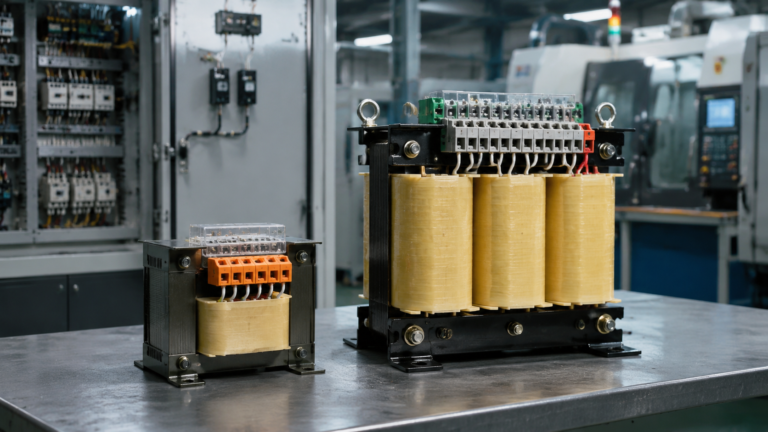
A machine tool isolation transformer is a control transformer whose primary job is not to step the voltage down, but to place a galvanic barrier between the incoming line voltage and the low-voltage control circuit of a CNC, lathe, grinder, or press. The reinforced insulation and the faraday shield between primary and secondary block voltage transients, common-mode noise, and ground-loop currents before they can reach the PLC, the servo enable circuits, the encoders, and the safety relays.
On a noisy shop floor, that isolation is the difference between a cabinet that runs for years and one that locks up every time a spindle drive, hydraulic pump, or stick welder is switched. This B2B guide explains how isolation transformers work in machine tools, where they earn their place over a plain step-down transformer, the standards that govern their design, how to size them, and how to choose a reliable control transformer manufacturer in China when you are sourcing a production build.
Quick Specifications: What a Machine Tool Isolation Transformer Delivers
Parameter
Typical Specification
Why It Matters for Machine Tools
Function
Galvanic isolation between line and control circuit
Protects PLCs, encoders, and sensors from common-mode noise and ground loops
Standard VA range
50 VA – 2500 VA
Covers bench drills through large 5-axis machining centers
Primary voltage
220 V / 380 V / 400 V / 440 V / 480 V / Custom
Matches incoming plant supply in EU, North America, and Asian markets
Secondary voltage
24 V / 110 V / 120 V / 220 V / Custom
Matches control circuit voltage of the machine tool
Dielectric withstand
4 kV AC between primary and secondary
Provides a high-impedance barrier that limits fault current to the control side
Common-mode noise rejection
20 dB – 40 dB with a grounded faraday shield
Keeps high-frequency transients off the encoder and analog signal lines
Typical efficiency
92 % – 96 % at full load
Low losses reduce cabinet heat and extend insulation life
Insulation class
Class F (155 °C) or Class H (180 °C)
15 – 25 year service life in a typical machine tool environment
Applicable standards
IEC 61558-1 / 61558-2-4, UL 5085-3, NEMA ST-1, CE, RoHS
Accepted by EU, North American, and Chinese OEMs without re-testing
What Makes an Isolation Transformer Different from a Plain Step-Down Transformer
Every control transformer has a primary and a secondary winding on a common core, and every step-down transformer provides some electrical isolation between them. The distinction is intentional design: an isolation transformer is built and specified for the isolation function first, while a general step-down control transformer is built and specified for voltage conversion first.
Three design choices separate the two in practice:
Reinforced insulation between windings. Isolation transformers use thicker inter-winding insulation, often combined with a faraday shield or electrostatic screen between the primary and secondary, so that high-frequency transients on the line side are attenuated before they can couple into the econdary.
Lower coupling capacitance. The physical separation and the grounded shield reduce the capacitive coupling between primary and secondary, which is what really allows common-mode noise to ride through a transformer. Isolation transformers minimize that coupling.
Tighter voltage regulation. Because the secondary is dedicated to low-current control loads and not to motors, the winding design can be optimized for stable output at 110 V, 120 V, or 24 V even when the line voltage sags under heavy load elsewhere on the plant.
You can read a more detailed side-by-side comparison in the dedicated guide on the difference between control transformers and isolation transformers. The buying rule is simple: if your machine tool control circuit has a PLC, an encoder, or any sensor that is sensitive to electrical noise, an isolation transformer is the right choice over a general step-down unit.
How an Isolation Transformer Is Wired into a Machine Tool Control Cabinet
The physical placement of the isolation transformer inside the cabinet is what determines whether it actually delivers the isolation it is rated for. The recommended layout is:
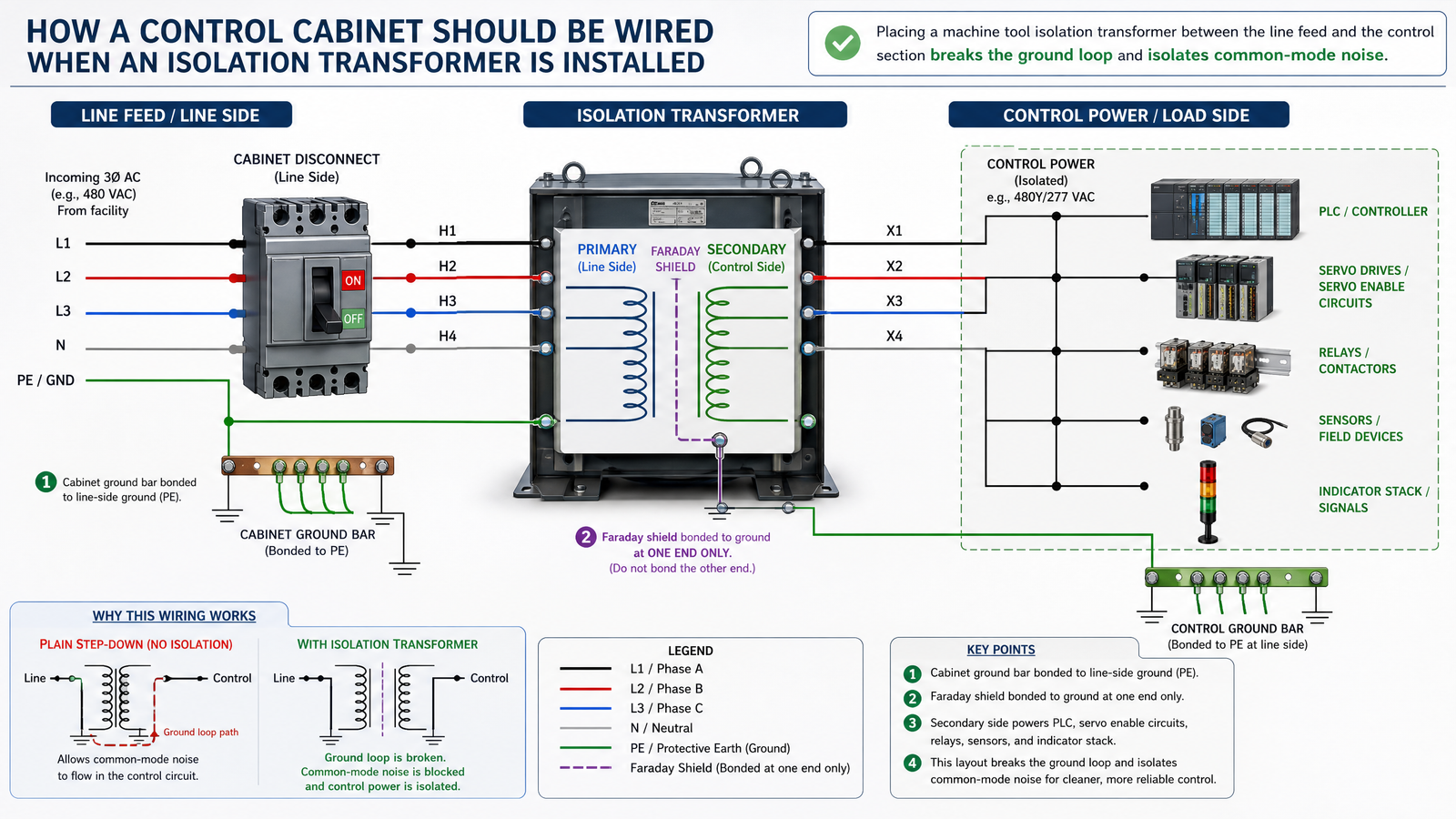
Feed the primary side of the isolation transformer directly from the cabinet disconnect or branch circuit protector. The cabinet ground bar bonds to the line-side ground at this point.
Bond the faraday shield of the transformer to the cabinet ground bar at one end only. Bonding at both ends creates a ground loop in the shield itself, which defeats the noise rejection the shield is supposed to provide.
Run the secondary output to a dedicated control bus that feeds the PLC, servo enable circuits, relays,contactors, solenoid valves, sensors, and indicator stack.
Keep primary wiring and secondary wiring in separate cable bundles. Never run low-voltage signal cables (encoder, load cell, thermocouple) in the same bundle as the primary feed.
Verify output voltage at the control bus under full cabinet load at commissioning, and again at six-month intervals. A drift of more than 5 % usually indicates a failing capacitor or a winding issue that should be addressed before it escalates.
The visual above shows this layout as a single-line diagram. When wired this way, the isolation transformer breaks the ground path between the line side and the control side, so each cabinet sees its own clean reference, and any common-mode noise injected by adjacent equipment stays on the line side.
Key Benefits of Using an Isolation Transformer in a Machine Tool
Installing an isolation transformer on a machine tool is a deliberate decision driven by reliability, safety, and compliance. The benefits that matter most for OEM builders and plant engineers are these:
1. Protects Sensitive Electronics from Voltage Transients
A machine tool shares its electrical environment with variable-frequency drives, contactors, and braking resistors. Every time a motor is switched, a counter-EMF spike rides back onto the line. Isolation transformers with a faraday shield attenuate those spikes by 20 dB to 40 dB on common-mode noise,which is enough to keep a PLC from locking up or an encoder from missing pulses.
2. Eliminates Ground Loops Between Multiple Cabinets
When a CNC and its auxiliary equipment are grounded at different points, a small potential difference appears between those grounds. That potential drives current through sensor cables, producing erratic analog readings and ruined digital signals. An isolation transformer breaks the ground path by removing the direct electrical connection between primary and secondary, so each cabinet sees its own clean reference.
3. Improves Operator and Equipment Safety
The reinforced insulation between primary and secondary provides a higher dielectric withstand voltage, often 4 kV AC or more, which protects service technicians from a line-to-control short during diagnostics. In machines with exposed 24 V control circuits, this barrier limits the worst-case fault current a human could encounter.
4. Stabilizes Voltage Under Sag and Swell Conditions
Industrial plants frequently see line voltage sag during large motor starts and swell when loads drop. Because isolation transformers for machine tools are sized for the control load only, not for the spindle, their tight regulation keeps the output within ±5 % even when the line swings more widely. The 85 / 90 / 95 % regulation rating guide explains how that number translates to real cabinet behavior.
5. Extends the Life of Contactors and Relays
A clean, stable 110 V or 120 V supply with low total harmonic distortion keeps relay coils from chattering and contact tips from welding prematurely. In a busy production cell, that can mean months of additional service life for every contactor in the control chain.
Where Machine Tool Isolation Transformers Are Used
Isolation transformers are not limited to one type of machine. They are the standard control supply wherever the cabinet mixes low-voltage electronics with line-voltage actuators:
CNC machining centers. Isolating the PLC, servo drive enable circuits, and tool-length probe from the spindle VFD.
Surface grinders and EDM machines. Filtering the high-frequency noise that comes from the spark generator on wire EDM units.
Packaging and filling lines. Protecting filling valves, scales, and vision cameras that share a long trunk with conveyor VFDs.
Woodworking and stone CNC routers. Keeping the dust-extraction VFD noise out of the spindle-encoder signal path.
Automated press and stamping cells. Isolating safety relays from the high inrush current drawn by the press clutch and brake circuits.
The R-type dry-type transformer in our control transformer family is designed specifically for these applications. Its waist-shaped, grain-oriented silicon-steel core produces low magnetic flux leakage and quiet operation, which is exactly what is needed when the transformer is mounted inside the same abinet as a PLC and a servo drive.
Standards That Govern Machine Tool Isolation Transformers
When you evaluate a supplier, look for compliance with the standards that actually apply to your application. The most common ones for machine tools are:
Standard
Scope
Why It Matters for Machine Tool OEMs
IEC 61558-1 / 61558-2-4
Safety of isolating transformers for general use
Benchmark for European OEMs exporting machinery into the EU
UL 5085-3
Class 2 / Class 3 control transformers used in industrial control panels
Required for control panels listed under UL 508A in North America
NEMA ST-1 / ANSI C57.12.01
Dry-type transformer ratings, sound levels, and temperature rise
Defines the 80 °C, 115 °C, and 150 °C rise classes for insulation systems
IEC 60076-11
Dry-type power transformer construction and testing
Used for larger floor-standing isolation units in heavy machine tools
CE / RoHS / REACH
EU conformity, hazardous substance, and chemical restrictions
Mandatory for any control transformer sold in the EU market
GB 19212.1 / GB 19212.5
Chinese national standard for isolating and control transformers
Required for machine tools shipped under CCC certification in China
A reputable Chinese control transformer manufacturer should be able to provide test reports for at least the IEC 61558 series and CE / RoHS on request. If the data sheets quote only vague terms like industrial grade” without standard numbers, that is a sign to ask deeper questions.
How to Size an Isolation Transformer for a Machine Tool
Sizing an isolation transformer follows the same rule as sizing any control transformer, with one extra consideration: an isolation transformer must carry the full continuous VA of every control device plus the inrush VA of the largest relay or contactor coil. The general procedure is:
List every control-circuit load and its sealed VA from the panel schematic.
Add the largest inrush VA from contactor or relay coils that close together during machine start-up.
Apply a safety factor of 1.25 to 1.5 to cover aging, ambient temperature, and supply voltage variation.
Round up to the next standard VA size (50, 100, 150, 250, 300, 500, 750, 1000, 1500, 2000, 2500).
The detailed math, including how to handle inrush, is covered in the control transformer VA rating and sizing guide. As a quick reference for typical machine tool cabinets, the table below is a useful starting point.
Machine Tool Application
Typical Control Load
Recommended Isolation Transformer VA
Small bench drill or grinder
Indicator lamps, holding contactor
50 – 100 VA
Standard milling machine or lathe
PLC, several relays, solenoid valves, indicator lamps
If your machine falls into the larger end of this range, a BK Series control transformer or a higher-power BKJ5 machine tool control transformer is often paired with the R-type isolation unit to cover both the isolation and the bulk step-down needs of the cabinet.
Common Installation Mistakes to Avoid
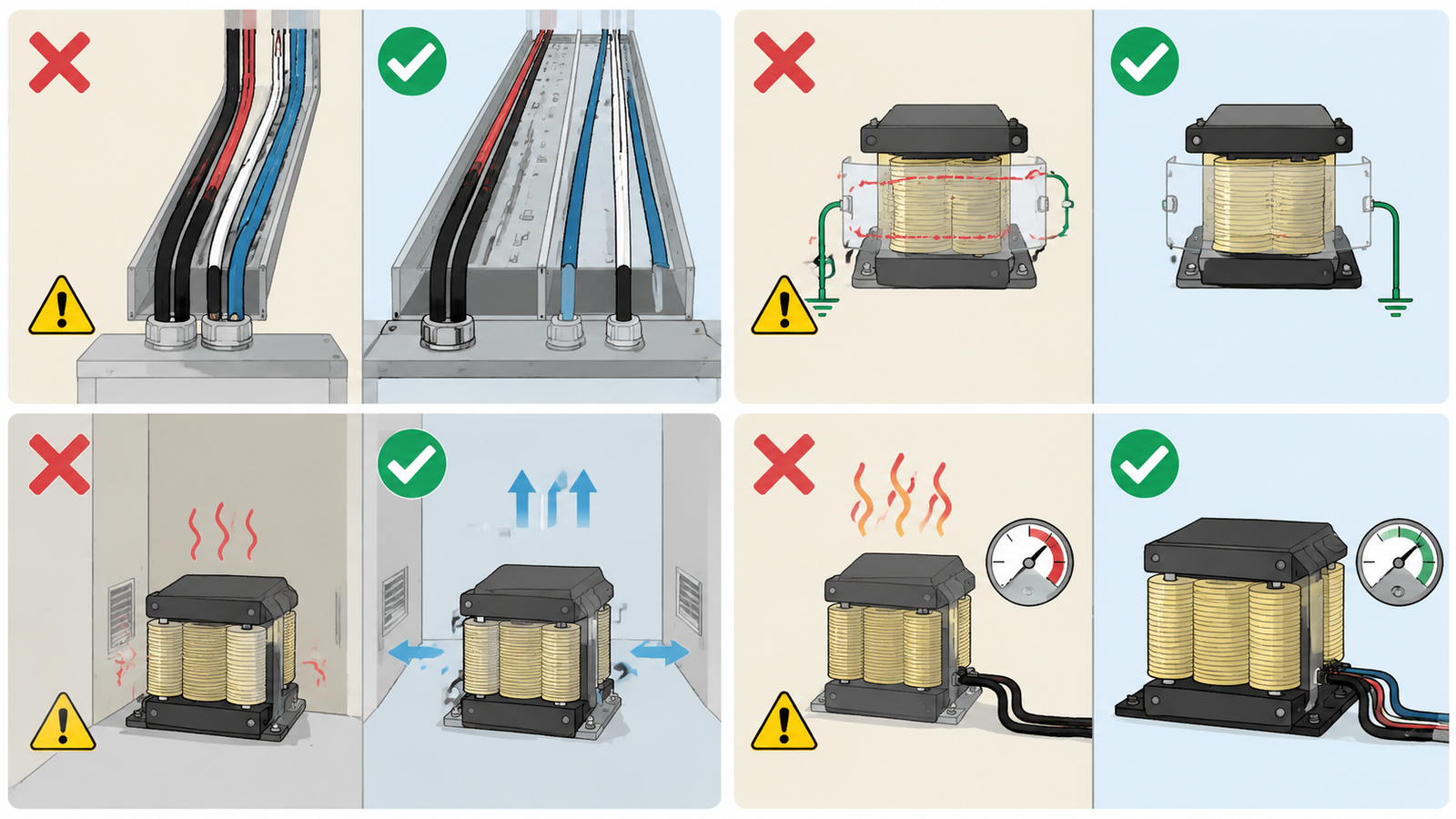
Even the best isolation transformer can fail early or fail to deliver its rated isolation if it is installed in the wrong way. The four mistakes below account for most of the field issues our service team has seen in the last decade.
Mistake 1: Bundling Primary and Secondary Wiring Together
Running the line-side feed and the control-side output in the same cable tray or conduit lets capacitive coupling bypass the isolation barrier. The line-side noise couples straight back onto the control wires, and the faraday shield has nothing left to reject. Always separate primary and secondary wiring, and keep at least 100 mm between the two bundles along their full run.
Mistake 2: Grounding the Faraday Shield at Both Ends
A faraday shield is designed to be bonded at one end only. Bonding it at both ends creates a closed loop that the shield itself was meant to break. Any small potential difference between the two ground points drives current through the shield, and that current radiates noise into the secondary winding. Single-point bonding is the rule.
Mistake 3: Mounting in a Dead-Air Corner With No Clearance
A control transformer relies on natural convection to shed heat. Squeezing it into a corner of the cabinet next to a VFD or a hydraulic manifold raises its ambient temperature by 10 °C to 15 °C, which shortens insulation life by roughly half. Keep at least 25 mm clearance on every side and 100 mm above the top of the body.
Mistake 4: Undersizing the VA to Save Cost
Buying a 500 VA isolation transformer for a 500 VA continuous load is not enough. The transformer needs to carry the inrush of the largest contactor at start-up without saturating, and it needs headroom for future added loads. Sizing at exactly the calculated load is the most common cause of premature failure. Round up to the next standard VA size and apply the 1.25 to 1.5 safety factor from the sizing procedure above.
Choosing a Chinese Control Transformer Manufacturer
Sourcing machine tool isolation transformers from a Chinese supplier can deliver strong value, but it pays to verify four things before placing a production order:
Standard compliance documents. Ask for the IEC 61558-2-4 test report, the CE declaration, and the RoHS test summary. These should be dated within the past 12 months.
Core and winding materials. Look for grain-oriented silicon steel and double vacuum-pressure impregnated (VPI) windings. These extend insulation life and reduce the audible noise that would otherwise be picked up by a microphone on the machine.
Continuous-duty rating. Confirm the transformer is rated for continuous duty, not just “instantaneous” or “inrush” duty. A continuous-duty rating is the difference between a transformer that lasts the life of the machine and one that fails during warranty.
Customization capability. For OEM builders, the supplier should offer custom primary and secondary voltages, custom fuse or breaker options, and custom terminal layouts. HAIRUI offers all three as standard services.
For buyers comparing comparable machines and supply scenarios, the JBK3 platform is a popular companion to the R-type isolation transformer in many Chinese-built machine tools. See the JBK3 machine tool control transformer product page for how the two are typically paired.
Conclusion
A machine tool isolation transformer is one of the more cost-effective reliability upgrades you can specify in a new machine tool build. A well-designed unit provides the galvanic isolation that protects PLCs, encoders, and sensors from the noisy industrial environment, the tight voltage regulation that keeps contactor coils cool, and the reinforced insulation barrier that protects both the equipment and the people who service it.
When you are ready to evaluate a specific model, browse the R-type transformer product page for the isolation-focused option in our control transformer family, or contact our engineering team with your panel schematic for a sizing recommendation. For buying teams building a complete control transformer cabinet, our control transformer product category brings together the full set of options, or use the request-a-quote form to send us your panel schematic and VA requirements.
Frequently Asked Questions
What is a machine tool isolation transformer and why is it needed?
It is a control transformer whose primary purpose is to provide galvanic isolation between the incoming line voltage and the machine tool control circuit. The isolation barrier blocks voltage transients, ground-loop currents, and common-mode noise that would otherwise ride into PLCs, relays, and sensors.
How is an isolation transformer different from a standard step-down control transformer?
A standard step-down control transformer focuses on voltage conversion; an isolation transformer adds reinforced insulation, a faraday shield, and reduced coupling capacitance between windings. The control transformer vs isolation transformer guide covers the full comparison.
What VA size of isolation transformer does a typical CNC machining center need?
A standard 3-axis vertical machining center with a PLC, servo enable circuits, tool changer, hydraulic package, and indicator stack usually lands in the 500 VA to 1000 VA range. Large 5-axis or twin-spindle cells often need 1000 VA to 2500 VA.
Does an isolation transformer replace a surge protector or line filter?
No. The isolation transformer handles common-mode noise and ground loops; a surge protector handles high-energy transients such as lightning and switching surges; and a line filter handles conducted EMI in specific frequency ranges. For the most demanding cabinet environments, all three are normally installed together.
What standards apply to machine tool isolation transformers?
IEC 61558-1 / 61558-2-4 for safety, UL 5085-3 for North American industrial control panels, NEMA ST-1 / ANSI C57.12.01 for ratings, and CE / RoHS for the EU market. Most reputable Chinese suppliers will quote compliance to at least the IEC 61558 series and CE on the data sheet.
How long does a quality isolation transformer typically last in a machine tool?
Properly sized and installed, a quality isolation transformer with a Class F or Class H insulation system provides 15 to 25 years of continuous service in a typical machine tool environment. Failures before that are almost always the result of undersizing, blocked ventilation, or repeated over-temperature events.
Can an isolation transformer be customized for a specific primary and secondary voltage?
Yes. Most control transformer manufacturers, including HAIRUI, build isolation transformers to order with custom primary voltages (for example 220 V, 380 V, 400 V, 440 V, 480 V), custom secondary voltages (24 V,110 V, 120 V, 220 V), and custom terminal or mounting layouts. Standard delivery is 15 to 20 days after order confirmation.
How step-down control power transformers convert 380V/480V line voltage to 110V or 24V control power: turns ratio, VA sizing with inrush, voltage-drop behaviour, wiring and selection.
How three-phase control power transformers work, how to size them for machine tool and control-panel loads, and the delta/wye, standards and protection choices that matter in the field.