Control Transformer Regulation What 85/90/95% Really Means
Published: Author: Hairui Electric
If you have ever opened a catalog or datasheet and seen “85% / 90% / 95% regulation” next to a Control Transformer, you are not alone in pausing. Engineers wonder whether it is a quality grade. Buyers wonder whether it affects price. Maintenance teams just want the contactor to stop chattering.
Here is the practical truth: those percentages are a selection promise about voltage dip during inrush, not marketing fluff. They exist because real-world control circuits slam transformers with short, high inrush VA when coils pull in—and that moment is exactly when undervoltage can cause nuisance dropouts.
In this article, we will decode what “85% / 90% / 95% regulation” means, how to choose the right column, and how to turn the concept into a clear RFQ that suppliers, wholesalers, and manufacturers can quote correctly (including customization options).
Regulation has two meanings—do not mix them up
In power engineering, “voltage regulation” traditionally describes how much a transformer’s secondary voltage changes from no-load to load due to internal impedance and losses. It is often expressed as a percentage change between no-load and full-load voltage.
But in industrial control power contexts, “85% / 90% / 95% regulation” is used differently: it is tied to control circuit inrush and selection charts. Many selection guides define it as the minimum secondary voltage (as a percentage of nameplate secondary voltage) that will be available during maximum inrush conditions, at rated input voltage.
If you keep that distinction in your head, everything else becomes much easier.
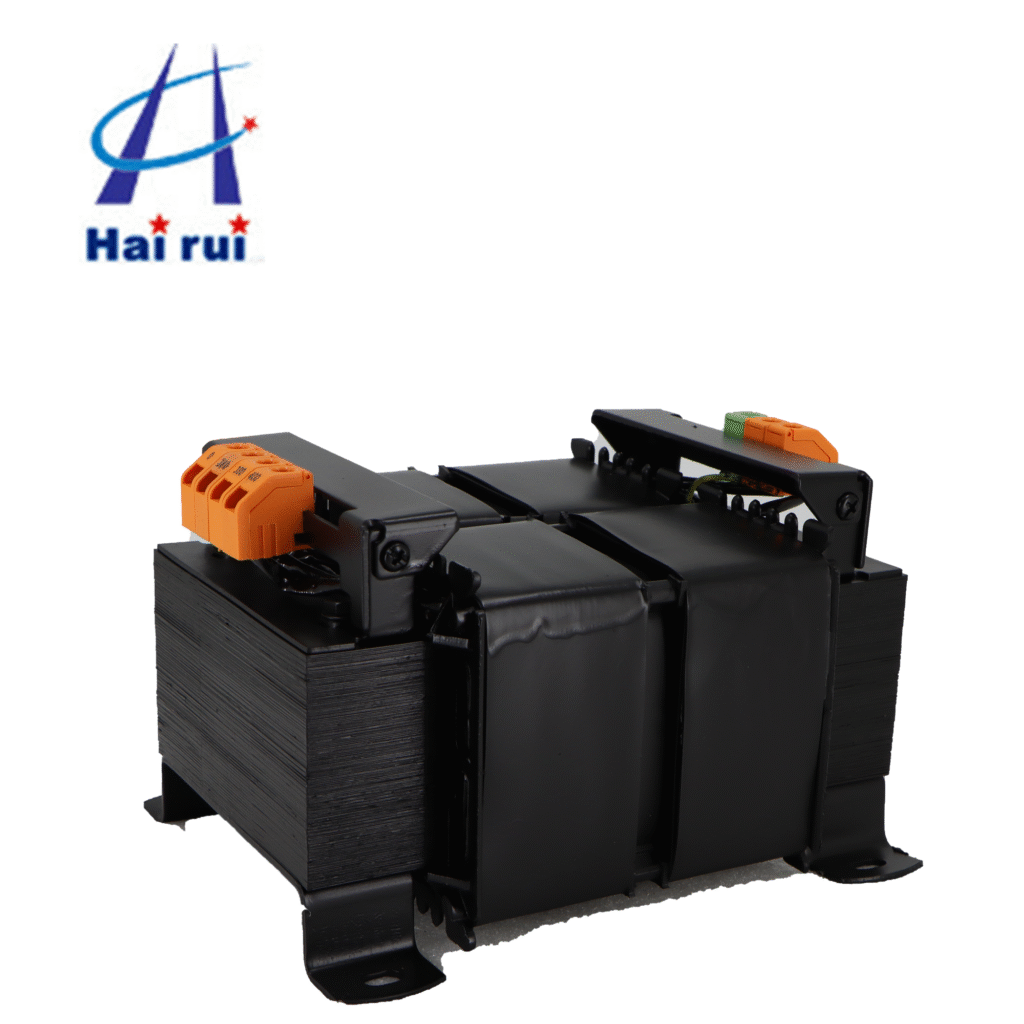
BKJ5 Machine Tool Control Transformerhttps
What “85% / 90% / 95% regulation” means in plain English
When a selection guide says “85% / 90% / 95% regulation,” it is effectively saying:
“If you size the transformer using the 90% column, then during the worst inrush event (at rated primary voltage), the secondary voltage should not dip below 90% of the nameplate secondary voltage—as long as your inrush VA does not exceed the chart’s limit.”
So if the nameplate secondary is 120 Vac:
85% means the secondary might dip to 102 Vac during inrush
90% means the dip floor is 108 Vac
95% means the dip floor is 114 Vac
And for common control voltages:
Nameplate secondary
85% floor
90% floor
95% floor
24 Vac
20.4 Vac
21.6 Vac
22.8 Vac
48 Vac
40.8 Vac
43.2 Vac
45.6 Vac
110 Vac
93.5 Vac
99.0 Vac
104.5 Vac
120 Vac
102.0 Vac
108.0 Vac
114.0 Vac
230 Vac
195.5 Vac
207.0 Vac
218.5 Vac
Why do catalogs care about inrush? Because electromagnetic devices can demand many times their steady-state VA for a brief period. Siemens notes inrush can be up to about ten times steady current and can last tens of milliseconds, and that voltage stability can drop as current spikes.
This is why two transformers with the same continuous VA rating can behave very differently in a control panel at the exact moment a contactor pulls in.
Why these numbers exist: the “85% operating” reality and the 90% default
Control circuits are full of coils: contactors, relays, solenoids. These devices have a practical operating window. If the coil voltage dips too far during pull-in, you may see:
failure to pick up (won’t pull in)
chatter (rapid open/close)
nuisance trips
overheating from repeated inrush attempts
Selection references often connect this to standards expectations. One widely used guideline notes that, to comply with NEMA requirements that magnetic devices operate successfully at 85% of rated voltage, the 90% column is most commonly used for selection. Siemens similarly describes that, per NEMA standards, secondary voltage would typically be around 85% of rated voltage during inrush conditions.
So why not always pick 95%? Because tighter performance generally implies more transformer capacity (VA), cost, and size, and many control devices will still operate reliably without that tighter dip limit—especially if the primary voltage is stable and wiring runs are short.
A practical way to think about it:
Column
What you are “buying”
Typical reason to pick it
85%
More tolerance for dip
Input voltage fluctuates widely; cost/space sensitive; less demanding coil mix
90%
Balanced default
Common industrial practice to support reliable pull-in while staying economical
95%
Tighter dip control
Sensitive loads, high reliability targets, long control wiring, or frequent cycling
If you want a one-sentence procurement summary: 90% is the “safe and standard” column for many industrial panels; 95% is an upgrade; 85% is a tolerance strategy when supply variation is your bigger problem.
How engineers size a control transformer using inrush and sealed VA
Most selection methods follow the same logic:
Determine sealed (steady-state) VA: what is continuously energized.
Determine inrush VA: what happens at the peak moment when the maximum set of coils energize together.
Convert those into a sizing requirement and choose a regulation column (85/90/95) based on voltage dip tolerance and line variation.
Select a transformer whose rating meets both the inrush requirement and the sealed VA requirement.
Some manufacturers also provide a combined inrush sizing equation. Eaton, for example, shows a method to calculate a CPT inrush VA using the square-sum of total inrush and total sealed VA.
Here is a simplified worked example (numbers chosen for clarity):
Item
Quantity
Sealed VA each
Inrush VA each
Included at peak inrush?
Contactor coil
2
20
200
Yes
Relay coil
3
6
60
Yes
Pilot lights
6
2
(no inrush)
Yes
PLC I/O load
1
15
(no inrush)
Yes
Now compute:
Total sealed VA = (2×20) + (3×6) + (6×2) + (1×15) = 40 + 18 + 12 + 15 = 85 VA
Total inrush VA = (2×200) + (3×60) + (pilot lights 12 VA at that moment) + (PLC 15 VA) = 400 + 180 + 12 + 15 = 607 VA
At this point, you would go to a selection chart and choose the 85/90/95 column that matches your voltage tolerance goal, then find the transformer VA rating whose inrush capacity is not less than 607 VA, and confirm its continuous VA rating is ≥ 85 VA. This “inrush must not be less than” logic is explicitly called out in multiple selection references.
A small but important reminder: sequence of operation matters. If not all coils energize simultaneously, your peak inrush may be lower than “sum of everything,” and you can avoid oversizing.
JBK3 Machine Tool Control Transformer
Choosing 85% vs 90% vs 95%: a decision framework that holds up in the field
Engineers often ask, “Which column should I use?” The best answer is not a slogan—it is a short risk assessment:
How stable is your primary voltage?
How severe is your inrush event?
How sensitive is your load to undervoltage during pull-in?
How long are your control wiring runs (extra drop)?
What is your reliability target (downtime cost)?
Many references explicitly tie column choice to input voltage fluctuation (for example, if the supply fluctuates as much as ±10%, select the 85% column). Eaton also notes 90% or 95% is often recommended, because exceeding inrush capability can deepen the secondary dip and lead to premature failures of coils and devices.
Use the table below as a practical mapping from scenario to selection posture:
Scenario
Typical risk
Recommended column mindset
Utility is stable; short control wiring; moderate coil inrush
Low dip risk
90% is usually a sensible default
Frequent cycling of contactors/solenoids; sensitive coil pickup
Inrush dip causes chatter
Bias toward 95% (or larger VA margin)
Supply varies widely (generator sets, weak feeders, long runs)
Primary voltage variation dominates
85% column may match real supply conditions
High downtime cost (process lines, critical interlocks)
“One dropout is too many”
95% plus conservative sizing
Retrofitting an older panel with unknown loads
Hidden inrush events
Start with 90%, validate inrush, then adjust
If your internal debate is “90% or 95%,” ask yourself one question: What is the cost of one nuisance dropout? If it costs more than the price delta, the decision is straightforward.
how to verify you really got the regulation performance you paid for
Because the 85/90/95 concept is about a transient dip, verifying it is not the same as measuring a steady 120 Vac with a handheld meter. Inrush events can be short (tens of milliseconds), and the minimum voltage may not show up on basic averaging meters. Siemens notes inrush duration can be on the order of milliseconds, which hints at why test method matters.
A practical acceptance test strategy is:
Apply rated primary voltage.
Trigger the worst-case inrush event (maximum simultaneous coil pickup).
Capture the minimum secondary voltage during that instant.
Compare to the promised floor (85/90/95 of nameplate), assuming you are within the inrush VA the selection chart allows.
Testing options:
What you want to observe
Recommended instrument
Notes
Minimum voltage during a short dip
Oscilloscope or power quality recorder
Best visibility into fast events
“Dip happened” but not exact waveform
True-RMS meter with MIN/MAX capture
May miss very fast dips depending on sampling
Load validation
Clamp meter + logging
Useful to confirm coil pickup current and sequence
Troubleshooting tip: if you see coil chatter, do not assume “bad transformer” first. Check:
primary voltage sag upstream
too many coils pulling in simultaneously
long, undersized secondary wiring causing additional drop
Remember: the selection column is only meaningful if the load’s inrush VA stays within the transformer’s inrush capacity for that column.
“85% / 90% / 95% regulation” is best understood as a performance floor during inrush, not a generic quality label. It tells you how much the secondary voltage is allowed to dip—when coils pull in and your control circuit is at its most vulnerable. Selection guides define these columns around the idea that, when properly sized, the Control Transformer will maintain at least that percentage of nameplate secondary voltage under worst-case inrush conditions.
For engineers, the workflow is straightforward: calculate sealed VA, calculate peak inrush VA, choose the regulation column based on supply variation and control sensitivity, then size from the chart and validate both inrush and continuous VA requirements.
For procurement, the win is clarity: turn “regulation” into a quote-able requirement. When you provide sealed/inrush VA plus the desired 85/90/95 target, suppliers, wholesalers, and manufacturers can respond with accurate pricing, lead times, and customization options—without guesswork.
FAQ
Does 90% regulation mean the transformer is “90% efficient”?
No. It refers to u003cstrongu003eminimum secondary voltage during inrushu003c/strongu003e, not efficiency.
Is 95% always better?
It is tighter (less dip), but may require higher VA rating, higher cost, and more space.
Why is 90% used so often in industry?
Many selection references use 90% as a common choice to support reliable magnetic device operation aligned with NEMA expectations around 85% operability.
Can I size only by sealed VA?
Risky. In control circuits, u003cstrongu003einrush VAu003c/strongu003e often drives sizing.
What should I send to suppliers for a quote?
Primary/secondary voltages, frequency, sealed VA, peak inrush VA, and desired 85/90/95 dip target.
How do I verify the regulation dip?
Use a method that captures transient minimum voltage (scope/recorder), not only steady RMS readings.
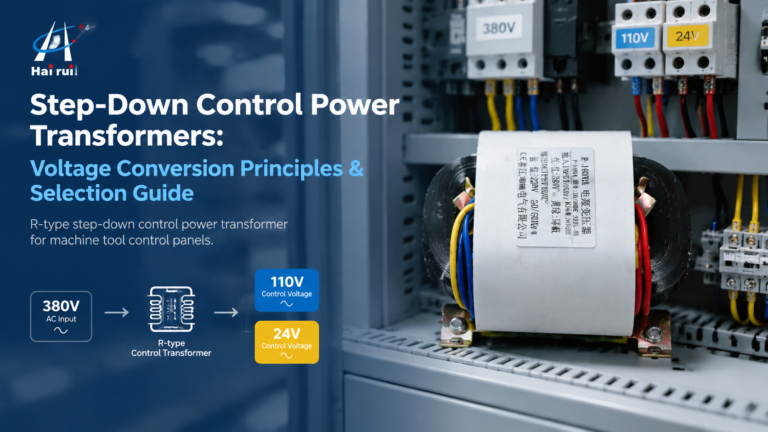
How step-down control power transformers convert 380V/480V line voltage to 110V or 24V control power: turns ratio, VA sizing with inrush, voltage-drop behaviour, wiring and selection.
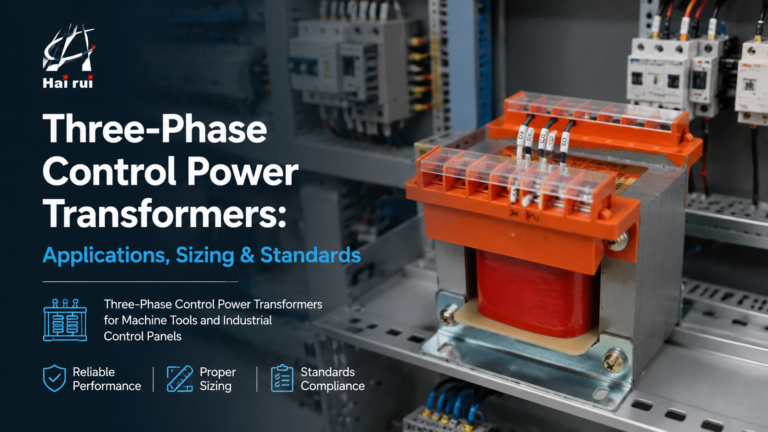
How three-phase control power transformers work, how to size them for machine tool and control-panel loads, and the delta/wye, standards and protection choices that matter in the field.