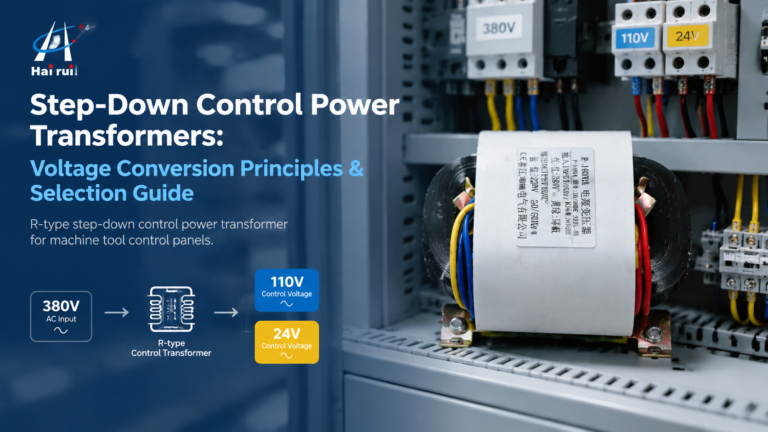
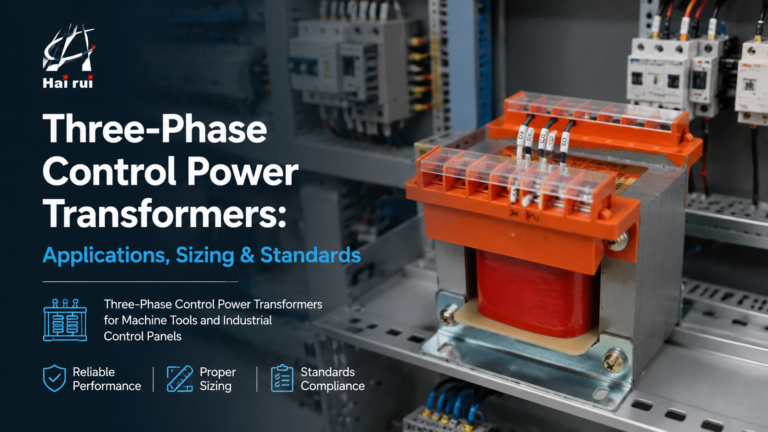
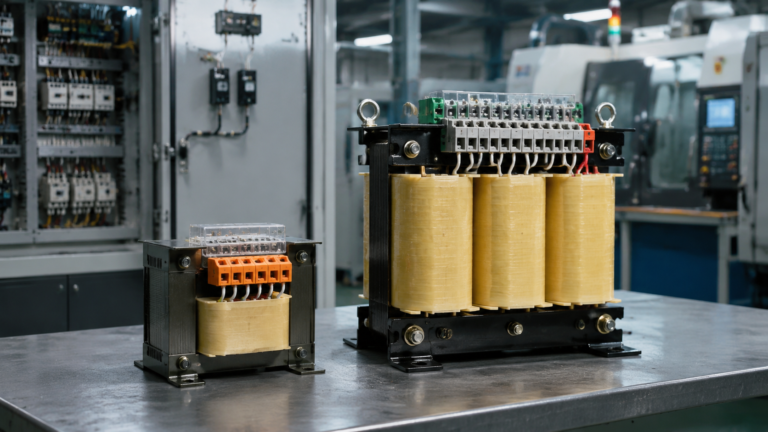
Why Supplier Reliability Matters for Machine Tool Transformers
When a machine tool transformer supplier delivers a unit that fails mid-production, the cost is never just the replacement part. You lose spindle uptime, miss delivery windows, and spend engineering hours diagnosing a fault that traces back to undersized copper windings or poor insulation. For OEM builders and panel shops running CNC lines, a single transformer failure can cascade into thousands of dollars in downstream delay.
Finding a dependable control transformer factory is therefore not a procurement formality — it is a engineering decision that directly affects machine reliability, warranty exposure, and long-term operating cost. This guide breaks down the criteria that matter in 2026, from certifications and manufacturing depth to red flags and total-cost analysis, so you can evaluate suppliers with a structured framework rather than a gut feeling.
![Flowchart showing the key steps for evaluating a machine tool transformer supplier: certifications, manufacturing capability, product range, batch testing, and total cost comparison]()
Essential Certifications and Quality Standards
A reliable supplier should hold internationally recognized certifications that prove their transformers meet safety and performance benchmarks. The certifications below are non-negotiable for most export and OEM markets:
| Certification | What It Verifies | Why It Matters |
|---|
| ISO 9001:2015 | Quality management system | Ensures repeatable production processes and documented quality control |
| CE / IEC 61558 | Electrical safety and insulation coordination | Required for European market access; validates creepage and clearance distances |
| RoHS / REACH | Restriction of hazardous substances | Compliance for environmental and material safety in insulation and potting |
| UL / cUL (optional) | North American safety listing | Needed if machines ship to US or Canadian end-users |
Beyond the certificates themselves, ask whether the supplier can provide batch test reports — not just a one-time lab sample. A factory that tests every production run for dielectric strength, no-load loss, and temperature rise is fundamentally different from one that ships untested inventory. Request a sample test certificate with your inquiry, and verify that the report number corresponds to the actual production batch.
Manufacturing Capability and Customization
Machine tool applications rarely use off-the-shelf transformer specs. A CNC machining center may need a custom primary voltage (e.g., 400V or 440V input), a specific secondary tap arrangement (24V for control circuits, 110V for indicator lamps), or a mounting footprint that fits an existing cabinet layout. Your supplier must handle these variations without a six-week engineering review cycle.
When evaluating a control transformer factory, ask these questions early:
- What is the typical lead time for a custom winding specification (e.g., non-standard primary voltage or dual secondary)?
- Can you produce DIN-rail mounted variants as well as base-mount units?
- Do you offer OEM branding, custom labels, and packaging?
- What is the minimum order quantity (MOQ) for a custom specification versus a standard model?
- Can you provide 3D CAD models and electrical schematics before production?
A supplier that can answer these questions with specific numbers — not vague assurances — has real manufacturing depth. For example, the JBK3 machine tool control transformer line supports multiple primary voltages (380V, 400V, 440V) and secondary tap configurations, which is exactly the flexibility OEM buyers need.
Product Range and Technical Expertise
Supplier reliability is also a function of product breadth. A factory that makes only one transformer type may be a low-cost source, but they cannot support you when your next machine design calls for a different VA rating, a step-down configuration, or an isolation-rated unit. Look for a supplier whose catalog spans the common machine tool transformer families:
- JBK3 series — compact DIN-rail and base-mount control transformers, 40VA to 630VA, ideal for CNC control circuits and contactor coils
- BK series — traditional shell-type step-down transformers, widely used in legacy machine tools and retrofit projects (BK series product page)
- JBK5 / BKJ5 series — upgraded high-efficiency designs with improved voltage regulation and lower temperature rise (BKJ5 series product page)
- R-type transformers — toroidal core designs with low stray flux and quiet operation, suitable for sensitive electronic controls
A supplier with this range can serve as a single source across your product line, reducing qualification overhead and ensuring consistent lead times. They should also be able to advise on VA sizing, inrush current margins, and voltage regulation — the three technical parameters that most often determine whether a control transformer survives real-world duty cycles.
Supplier Evaluation Checklist
Use the following checklist as a structured framework when comparing candidates. Score each item 1–5 and weight the total toward your highest-priority criteria.
| Evaluation Dimension | What to Verify | Weight |
|---|
| Certifications | ISO 9001, CE/IEC 61558, RoHS — request current certificates with scope | High |
| Manufacturing depth | Custom winding capability, lead time for non-standard specs, OEM/ODM support | High |
| Product range | Covers BK, JBK3, JBK5, R-type — single-source potential | Medium |
| Batch testing | Every-run dielectric, no-load loss, temperature rise tests with traceable reports | High |
| Export experience | Documented shipping track record to your target region, Incoterms flexibility | Medium |
| Technical support | Can advise on VA sizing, inrush margins, insulation class, mounting standards | High |
| Communication | Response time under 24 hours, English-language technical documentation | Medium |
![Comparison matrix table for scoring transformer suppliers across seven evaluation dimensions with weighted priorities]()
No supplier will score perfectly on every dimension. The value of this framework is that it makes trade-offs explicit — you can see where you are accepting risk and where a candidate clearly exceeds expectations.
Red Flags to Watch For
Some warning signs are easy to spot once you know what to look for. Treat any of the following as a reason to dig deeper before placing a production order:
- No batch test reports available. If a supplier can only show a single lab certificate from two years ago, their production quality is unverified.
- Unrealistically low pricing. A transformer priced 30–40% below market usually means thinner copper, lower-grade silicon steel, or skipped testing. The savings evaporate on the first field failure.
- Reluctance to provide samples. A reliable factory should offer 1–2 sample units (often free or at cost) for qualification testing. Refusal signals either a trading company without manufacturing control or a factory unsure of its own quality.
- Vague lead times. “About 2–3 weeks” without a production schedule is a sign of poor capacity planning. Look for specific commitment dates.
- No technical staff on the call. If every conversation goes through a salesperson who cannot discuss inrush current or insulation class, the factory lacks engineering depth.
Comparing Quotes and Total Cost of Ownership
Price-per-unit is the wrong metric for machine tool transformers. A 500VA unit that costs 15% less but has a 95% voltage regulation (instead of 90%) will sag under inrush and trip your control circuit breakers. The real comparison is total cost of ownership (TCO), which includes:
- Unit price (including tooling and setup amortization)
- Freight and customs (check Incoterms — DAP vs. FOB can shift $200+ per shipment on small orders)
- Qualification cost (your engineering time to test and approve the first batch)
- Expected field failure rate and warranty cost
- Reorder lead time (affects your safety stock and working capital)
A supplier with slightly higher unit pricing but shorter reorder lead times, better test documentation, and stronger technical support often wins on TCO — especially when you are running 50–200 machines per year through the same transformer specification.
If you are still in the specification stage, the JBK3 machine control transformer guide covers VA sizing math and inrush margins in detail. For step-down application scenarios, the step-down transformer selection guide walks through voltage conversion principles and duty-cycle considerations.
Conclusion
Choosing a reliable machine tool transformer supplier in 2026 comes down to three things: verifiable quality (certifications and batch testing), manufacturing depth (customization and product range), and engineering support (someone who can size a transformer correctly). Use the evaluation checklist above, watch for the red flags, and compare on total cost — not just unit price. The right supplier is a long-term partner who keeps your machines running, not just a vendor who ships the cheapest winding.
FAQ
What certifications should a machine tool transformer supplier have?
At minimum, ISO 9001:2015 for quality management and CE/IEC 61558 for electrical safety. RoHS compliance is essential for European and many OEM markets. If shipping to North America, UL or cUL listing is also expected.
How do I verify a control transformer factory’s quality?
Request batch test reports — not a single lab certificate — covering dielectric strength, no-load loss, and temperature rise. Ask for sample units for your own qualification testing. A factory that tests every production run and provides traceable reports is fundamentally more reliable than one that relies on a one-time sample.
What is a typical lead time for custom machine tool transformers?
For a standard-spec unit, 7–15 days is reasonable. For a custom winding (non-standard primary voltage, dual secondary, or special mounting), expect 15–25 days depending on complexity. Suppliers that cannot give a specific date are a red flag for capacity planning.
What is the minimum order quantity for custom control transformers?
Most factories set a MOQ of 10–50 units for custom specifications, with lower MOQs (5–10) for standard models. Some suppliers offer 1–2 free samples for qualification after reviewing your requirements and approving your buyer credentials.
Should I choose the cheapest transformer supplier?
No. Transformers with 30–40% below-market pricing typically use thinner copper, lower-grade silicon steel, or skip production testing. The savings disappear on the first field failure. Compare on total cost of ownership — including quality, lead time, and support — not just unit price.