What Is a Control Power Transformer? A Practical Guide
Published: Author: Lisa
A control power transformer (CPT) is an industrial transformer designed to supply stable, isolated AC voltage to a machine’s control circuit. It commonly steps a higher line voltage down to 120 V, 48 V, or 24 V for contactor coils, relays, solenoids, indicator lamps, and other control devices. Unlike a general-purpose transformer, a CPT is built to keep its secondary voltage from dropping excessively during the brief inrush current created when electromagnetic devices energize.
This guide explains how a CPT works, where it is used, how it differs from related transformer types, and how to select one using both steady-state and inrush VA. If you are planning a machine or control-panel project, you can also browse Hairui Electric’s Home page for an overview of its electrical equipment solutions.
What Does a Control Power Transformer Do?
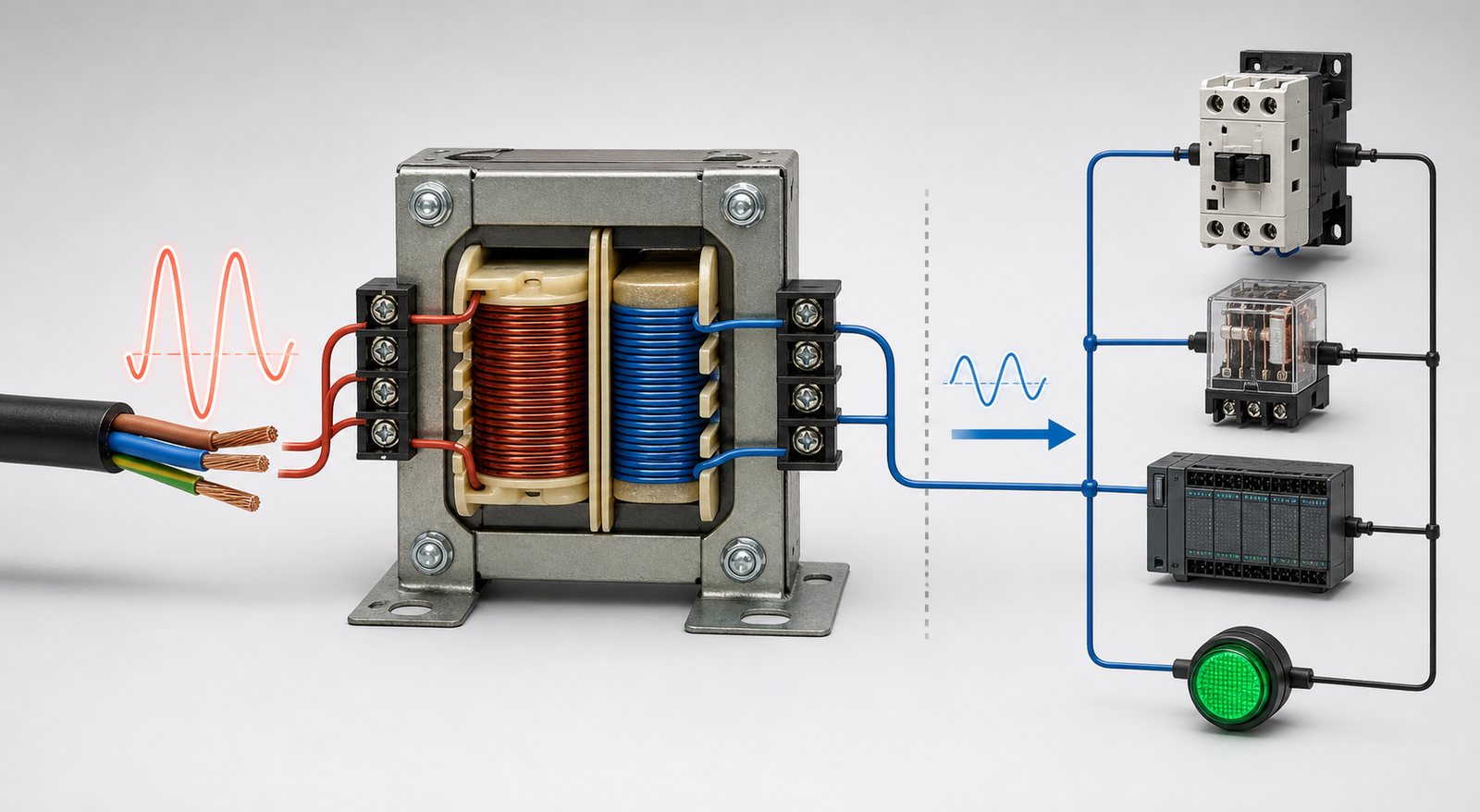
A control circuit does not normally need the same voltage or power level as the motor, heater, or other main load it commands. The CPT creates a separate secondary supply for that control circuit. Its two essential jobs are voltage conversion and galvanic isolation.
Voltage conversion: The primary winding receives the available AC line voltage, while the secondary winding delivers the voltage required by the control devices.
Electrical isolation: Separate primary and secondary windings provide a physical isolation barrier between the line supply and the control circuit.
Voltage stability during inrush: The transformer is designed to support brief, high-current demands without an unacceptable secondary-voltage dip.
Flexible control voltage: Multiple taps may support more than one input or output voltage, depending on the model.
Isolation does not automatically make a circuit touch-safe. Correct grounding, overcurrent protection, enclosure selection, and compliance with the applicable electrical code remain essential.
How Does a Control Power Transformer Work?
Like other AC transformers, a CPT operates by electromagnetic induction. Alternating current in the primary winding creates a changing magnetic flux in the laminated steel core. That flux induces an AC voltage in the secondary winding. The turns ratio determines the approximate voltage ratio:
Secondary voltage / primary voltage ≈ secondary turns / primary turns
When a contactor or solenoid first energizes, its coil can draw several times its normal sealed current. During this short interval, the CPT must supply the required inrush VA while maintaining enough secondary voltage for the device to pull in reliably. Once the magnetic device closes, the demand falls to its lower sealed or holding VA.
Control Power Transformer vs. Other Transformer Types
Several transformer categories may change voltage or provide isolation, but they are optimized for different loads. The following comparison helps prevent a common specification mistake.
Transformer type
Primary purpose
Typical load
Key design priority
Control power transformer
Supply an industrial control circuit
Contactors, relays, solenoids, lamps
Voltage regulation during short inrush events
General-purpose transformer
Serve continuous electrical loads
Lighting and general equipment
Continuous rated output
Isolation transformer
Separate a load from the source
Noise-sensitive or service equipment
Galvanic isolation, often at a 1:1 ratio
Autotransformer
Change voltage efficiently with one shared winding
Voltage conversion where isolation is unnecessary
Compact size and efficiency
A CPT is normally an isolation transformer, but not every isolation transformer is designed for contactor inrush. Likewise, an autotransformer may change voltage but does not provide the same primary-to-secondary galvanic isolation.
Where Are Control Power Transformers Used?
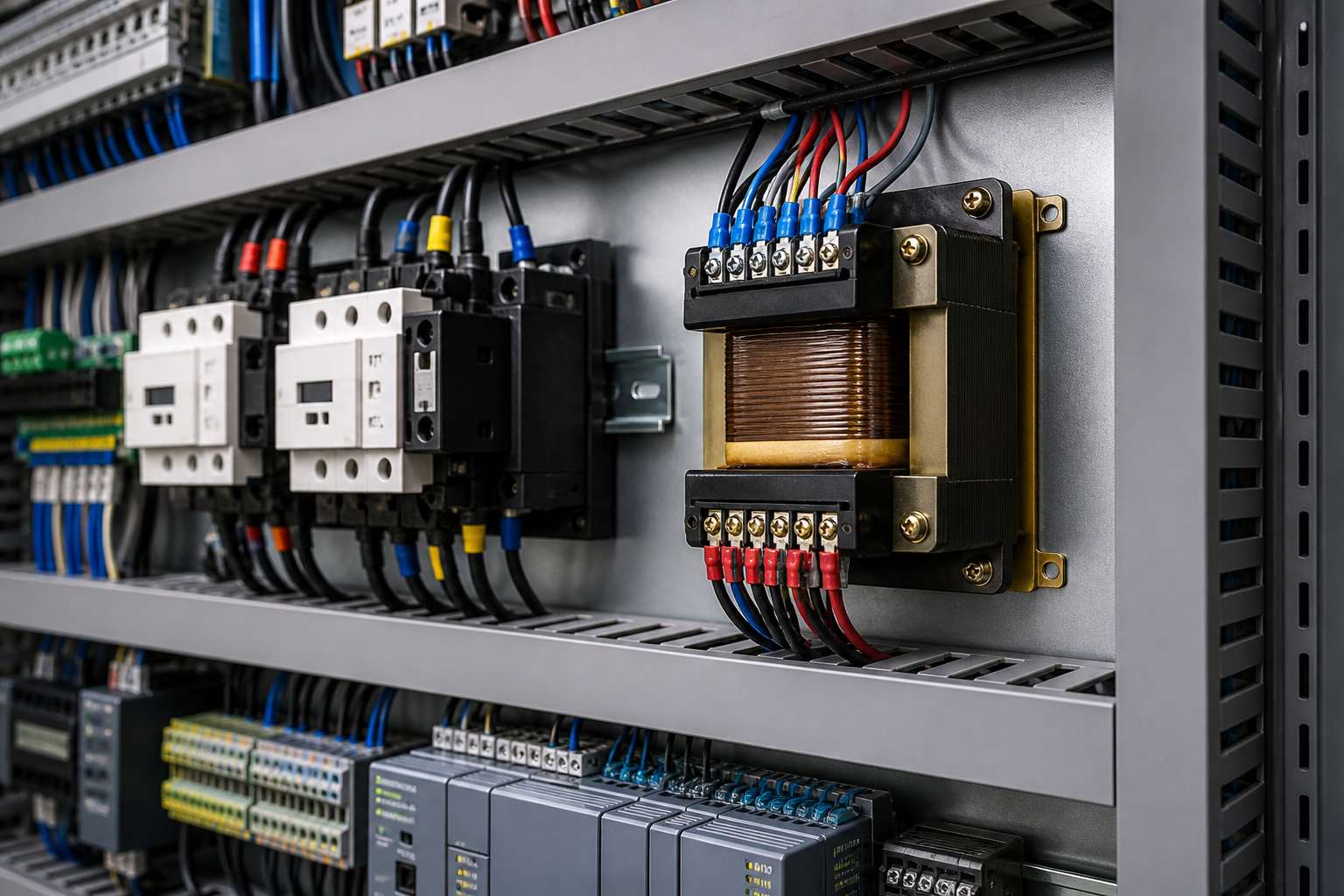
CPTs are common wherever a higher-voltage power circuit and a lower-voltage AC control circuit share the same machine or panel.
Motor control centers: supplying motor starters, contactor coils, pilot lights, and interlocks.
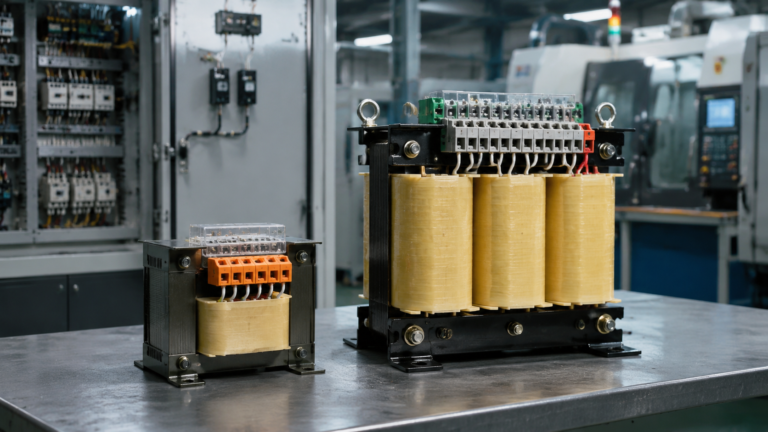
CNC machines and machine tools: powering relays, electromagnetic devices, and control circuits that must operate consistently.
Industrial automation panels: serving AC control loads and, when paired with a rectifier or power supply, supporting downstream DC control devices.
HVAC and pumping systems: operating contactors, valves, thermostatic controls, and signaling devices.
Conveyors, packaging lines, and process equipment: supplying coordinated control and safety circuits.
Do not size a CPT from operating watts alone. Electromagnetic loads are specified in volt-amperes (VA), and their momentary inrush demand can determine the required transformer size. Use the manufacturer’s selection table whenever one is available.
Confirm the primary voltage and frequency. Match the available line supply and verify whether primary taps are required.
Confirm the secondary voltage. Use the rated voltage required by every connected control device.
Add the sealed VA. Total the steady-state VA of all devices that can remain energized simultaneously.
Calculate simultaneous inrush VA. Identify the devices that may energize together. Add their inrush VA, then include the sealed VA of loads already energized.
Check allowable voltage regulation. Ensure the chosen CPT can deliver that inrush without dropping below the minimum pickup voltage of the connected coils.
Account for real operating conditions. Consider ambient temperature, enclosure ventilation, duty cycle, altitude, available space, and future additions.
For example, suppose a control circuit has two relays totaling 20 VA sealed, one contactor drawing 25 VA sealed and 180 VA inrush, and a 10 VA indicator load. The continuous load is 55 VA. If the contactor starts while the other loads are already on, the momentary requirement is approximately 210 VA: 180 VA contactor inrush plus 20 VA relay load plus 10 VA indicators. Final selection should use the transformer’s regulation or inrush-capacity table rather than simply choosing the next rating above 55 VA.
Key Specifications to Check Before Buying
Specification
Why it matters
Primary voltage and taps
Must match the actual supply and intended wiring connection.
Secondary voltage
Must match coil, relay, lamp, and other control-load ratings.
Continuous VA rating
Must cover the maximum simultaneous sealed load.
Inrush capability and regulation
Determines whether electromagnetic devices will pull in reliably.
Frequency
A transformer must be approved for the system frequency.
Insulation class and temperature rise
Affects thermal performance and service conditions.
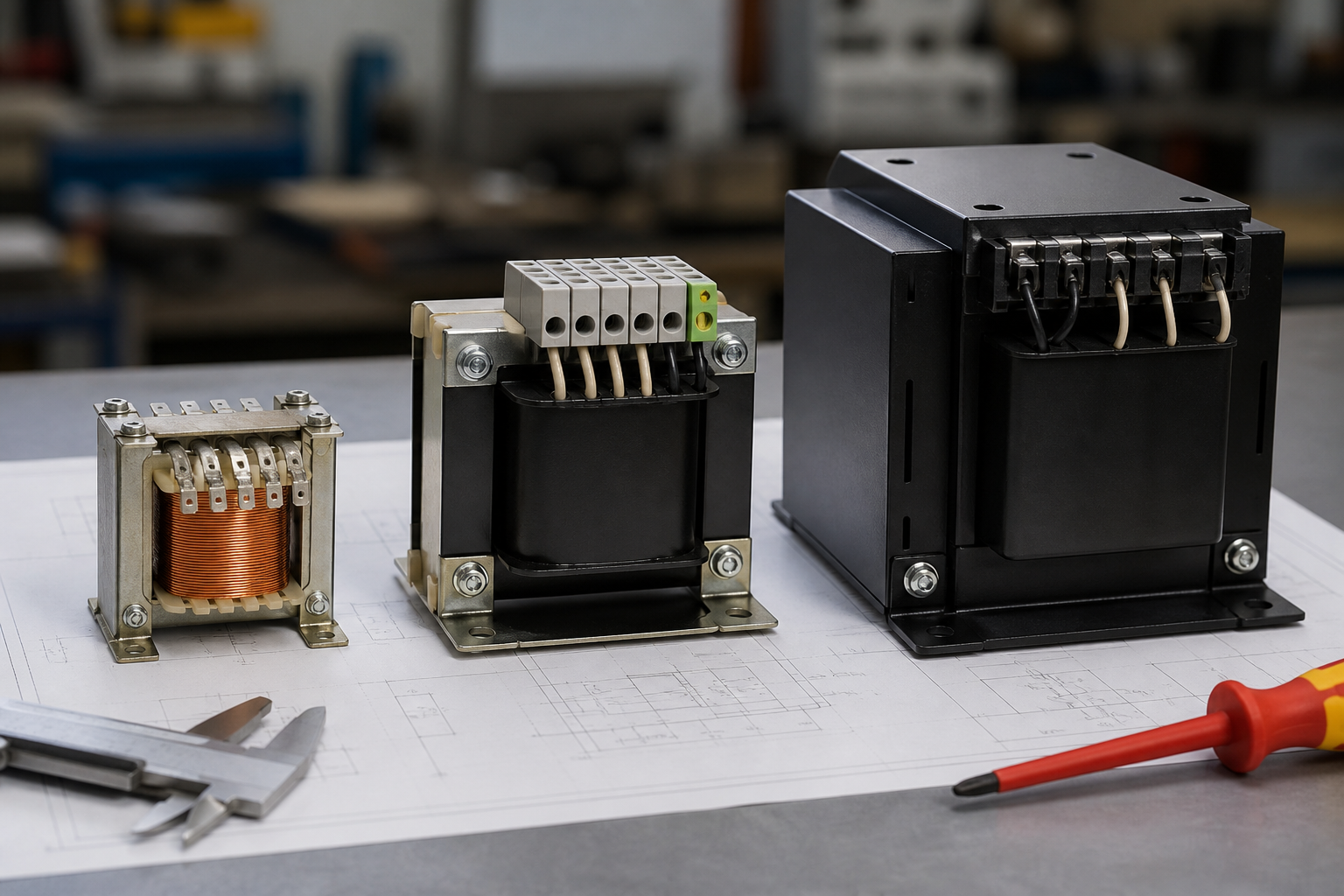
Open or enclosed construction
Must suit the panel, environment, access, and contamination risk.
Standards and test documentation
Supports project approval and market-specific compliance.
Mechanical dimensions, terminal arrangement, mounting method, and documentation can be as important as electrical ratings for an OEM panel. Hairui Electric’s Catalog provides a broader product reference, while the About Us page explains the company’s manufacturing background.
Installation and Protection Essentials
Installation should be completed by qualified personnel using the transformer manufacturer’s instructions and the electrical rules that apply at the installation site. Before energizing:
verify primary and secondary terminal connections against the nameplate;
provide primary and secondary overcurrent protection where required;
ground or bond the secondary circuit as required by the system design and applicable code;
maintain ventilation and specified clearances;
protect open units from accidental contact, conductive dust, moisture, and debris;
check terminal torque and insulation condition during planned maintenance.
Never assume that a lower secondary voltage eliminates all risk. The primary remains connected to line voltage, stored mechanical energy may be present in controlled equipment, and incorrect secondary grounding can create hazardous fault conditions.
Frequently Asked Questions
Is a control power transformer always a step-down transformer?
It is usually used to step line voltage down to a lower control voltage, but the defining characteristics are its control-circuit purpose, isolation, and short-duration inrush performance. Always confirm the actual primary and secondary ratings.
Can a control transformer power a PLC?
It can supply a PLC that accepts the transformer’s AC secondary voltage. Many PLC systems require DC power, in which case the CPT may feed a suitable AC-to-DC power supply rather than the PLC directly.
Why is inrush VA higher than sealed VA?
Before a contactor or solenoid armature closes, its magnetic circuit has a larger air gap and the coil draws substantially more current. After the armature closes, impedance rises and current falls to the sealed value.
What happens if a CPT is undersized?
Secondary voltage may sag during pickup, causing contactors to chatter, relays to drop out, controls to reset, coils to overheat, or a machine to operate unreliably. Persistent overload can also cause excessive transformer temperature.
Does a control power transformer convert AC to DC?
No. A conventional CPT changes AC voltage and provides isolation. Producing DC requires a rectifier or an AC-to-DC power supply connected after the transformer.
How do I choose between open and enclosed construction?
An open transformer is typically installed inside a suitable protected panel. An enclosed unit adds physical and environmental protection. The correct choice depends on location, ingress risk, access, ventilation, and applicable enclosure requirements.
Final Takeaway
A control power transformer supplies stable, isolated AC power to the devices that operate an industrial control system. The correct unit must match voltage and frequency, carry the simultaneous sealed load, and support the much higher momentary inrush demand without excessive voltage drop. For help matching a transformer to your input voltage, output voltage, continuous VA, inrush VA, mounting, and environment, share those details through the Contact Us page.
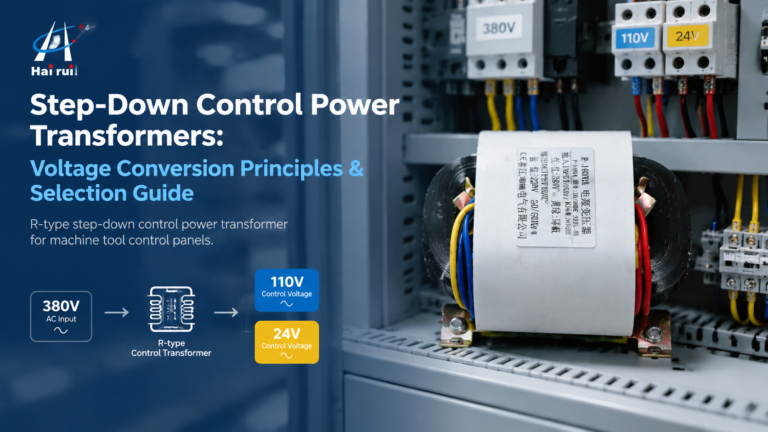
How step-down control power transformers convert 380V/480V line voltage to 110V or 24V control power: turns ratio, VA sizing with inrush, voltage-drop behaviour, wiring and selection.
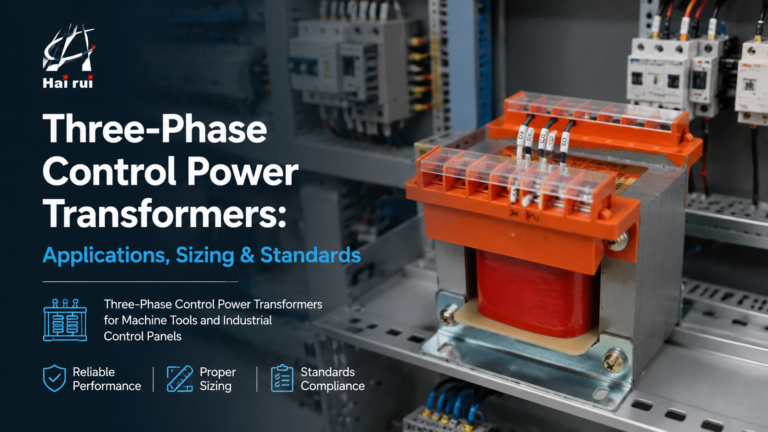
How three-phase control power transformers work, how to size them for machine tool and control-panel loads, and the delta/wye, standards and protection choices that matter in the field.