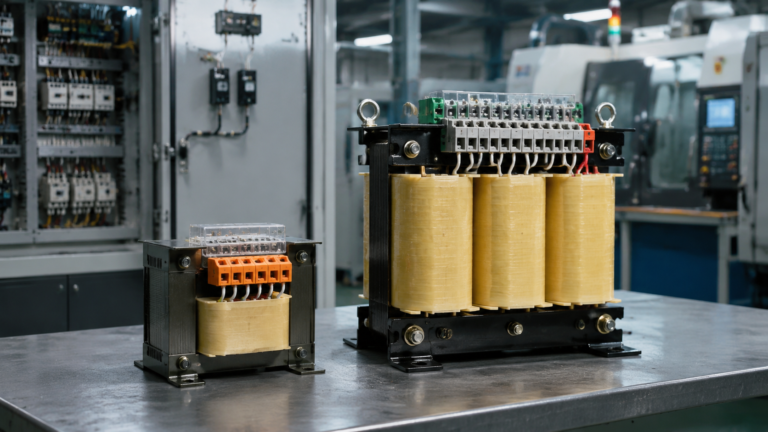
BKJ5 Machine Tool Control Transformer for Industrial Buyers
Published: Author: Hairui Electric
When a CNC line stops because of a “small” control transformer, nobody in the plant thinks it’s small anymore. As a buyer or engineer, you want the BKJ5 machine tool control transformer to be the quiet hero in your control cabinet: stable, safe, and so reliable that you forget it exists.
In this article, I’ll walk you through what the BKJ5 machine tool control transformer is, how it differs from older series such as JBK3/JBK5, where it fits best in machine tools and automation panels, and what B2B details you should check before sending out RFQs or POs. We’ll keep it practical, with tables, examples, and a bit of humor—because yes, even control transformers deserve an interesting article.
What Is a BKJ5 Machine Tool Control Transformer?
The BKJ5 machine tool control transformer is a dry‑type control transformer designed for AC 50/60 Hz circuits, typically used as control power, signal power, and work‑light power in machine tools and general industrial equipment. It’s part of the broader “machine tool control transformer” family, optimized for panel space, wiring safety, and reliability under frequent switching and short‑time overloads.
Compared with older machine tool control transformer series, the BKJ5 type usually features more compact dimensions, improved terminals, and better insulation systems, making it easier to integrate into modern CNC machines, PLC panels, and OEM control cabinets.
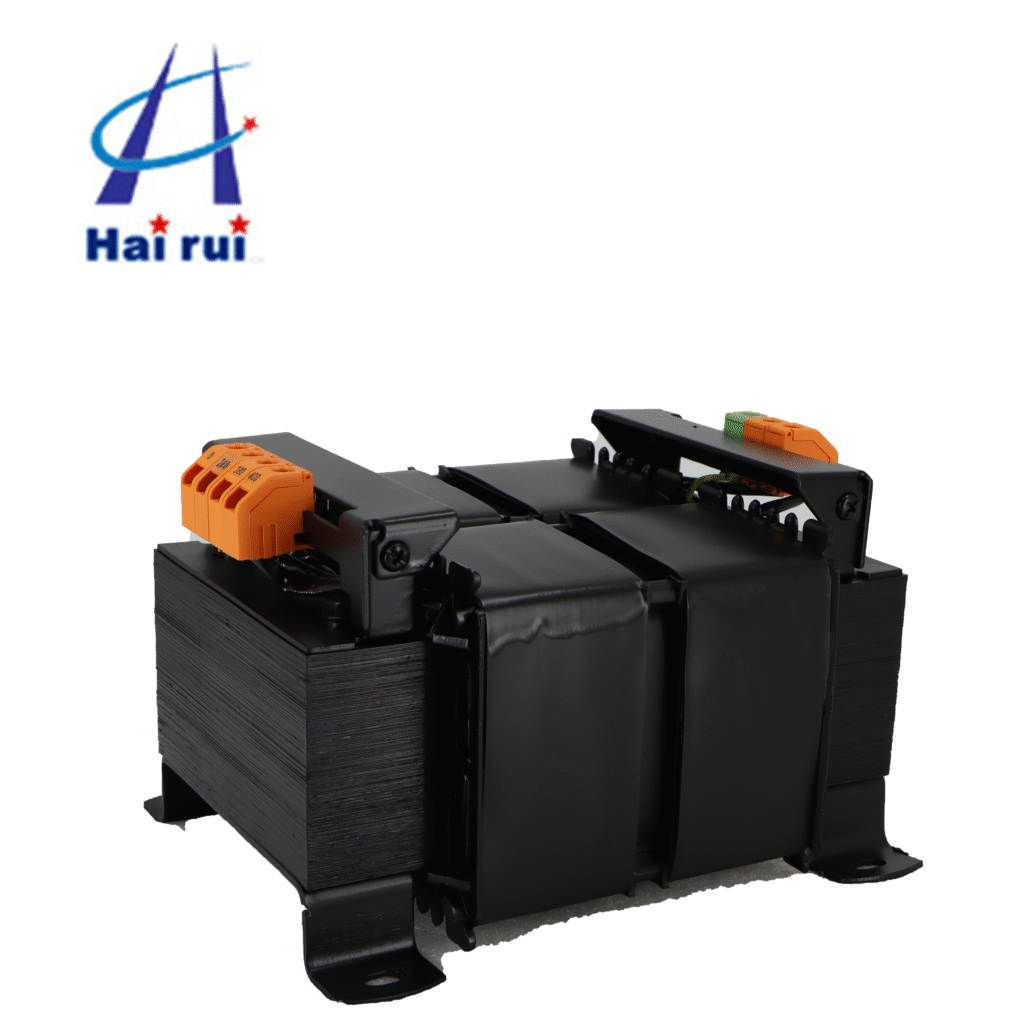
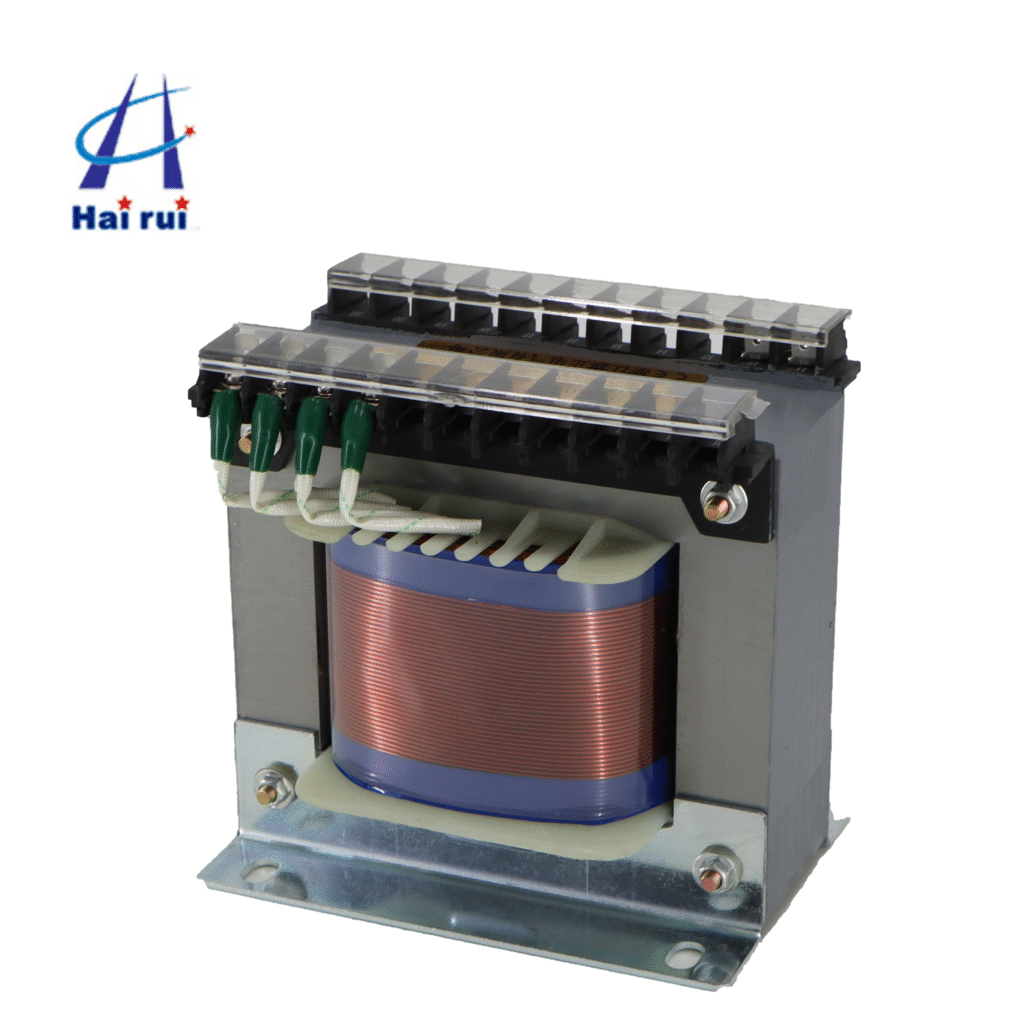
BKJ5 Machine Tool Control Transformer
Typical BKJ5 application scenarios
Scenario
How the BKJ5 transformer is used
Why BKJ5 is a good fit
CNC machine control
Steps down 380/400/415 V or 480/600 V mains to 110/220/24 V for relays, PLC I/O, and contactor coils.
Stable control voltage, good short‑time rating, easy terminal wiring for multi‑core cables.
Machine tool work lights
Provides low‑voltage 24 V or 36 V AC for operator lamps and inspection lights.
Enhanced safety for operators, isolation from mains, suitable for continuous duty.
Signal and indicator circuits
Feeds signal lamps, buzzers, and meters on the operator panel.
Low noise, small footprint, simple mounting in compact panels.
General mechanical equipment
Acts as control power and auxiliary power source in packaging, textile, and process machinery.
Wide applicability, flexible input/output voltage combinations, compliance with international standards.
Key Technical Features of BKJ5 Machine Tool Control Transformers
From a procurement or design point of view, you don’t just buy “a transformer”; you buy specific ratings, terminals, insulation, and mounting styles that match your project. The BKJ5 machine tool control transformer series is engineered to make that job easier for both engineers and purchasing.
Many BK‑family and JBK‑family machine tool control transformers share some typical parameters: AC 50–60 Hz, input up to around 500–1000 V depending on series, and output voltages up to 220 V for control power and lower for signal circuits.
Typical BKJ5‑style parameters and features
Parameter / feature
Typical BKJ5 / BK‑family characteristic
Why it matters to B2B buyers
Frequency
50/60 Hz AC, suitable for global grids.
One platform can serve EU, Asia, and many export markets with minimal changes.
Input voltage range
Commonly up to 500–600 V, sometimes up to 1000 V depending on design.
Compatible with 380/400/415 V, 440/460/480 V and 600 V industrial systems.
Lets you power control circuits, lamps, and signals from one compact unit.
Rated capacity (VA)
Typical range 40–2500 VA in machine tool control series.
Easy to match small panels and large machines with the same product family.
Construction
Dry‑type, layered windings on laminated silicon‑steel core; often vertical stack structure.
Robust, low loss, simple to mount and cool in normal control cabinets.
Terminals
Cold‑pressed / improved terminal blocks fixed firmly to the coil former in newer series.
Higher wiring strength, lower risk of loose connections during transport and vibration.
Protection and safety
Designed to meet EN/IEC and local GB/JB standards (e.g., IEC 61558 family).
Easier compliance for OEM exports and panel builders facing inspections.
Operating environment
Typically up to 40–55 °C ambient and 2000 m altitude in similar control transformer series.
Suitable for most factory floors, with margin for warm control rooms.
In plain language: the BKJ5 machine tool control transformer is designed to live inside hot, noisy control cabinets, deal with frequent on‑off switching, and keep your control voltage stable even when the mains voltage or load conditions are not perfect.
BKJ5 vs JBK3 / JBK5: What’s the Difference for Your Project?
If you’ve been buying machine tool control transformers for years, you’ve probably seen model names such as BK, JBK3, and JBK5 on drawings or BOMs. BKJ5 fits into this family but targets more optimized structure and better standardization for modern equipment.
From a B2B perspective, the main question is simple: “Can I replace the older series with BKJ5 without headaches in design, certification, or maintenance?” In many cases, yes—manufacturers design these transformers to be interchangeable with previous models and even similar foreign products.
Comparative view: BKJ5 vs older machine tool control transformers
Aspect
BKJ5 / newer BK‑family
Older BK / JBK3 / JBK5 series
Design origin
Developed based on domestic JBK3, integrating advanced terminal and structure concepts from German‑style designs.
Earlier domestic designs, less optimized terminal structure.
Terminals
Cold terminal blocks, better mechanical strength, fixed directly to skeleton or frame.
Conventional screw terminals, sometimes less robust under vibration.
Mounting accuracy
More accurate mounting dimensions and base structures, often with bottom one‑time molding.
Acceptable but sometimes less precise for mass‑produced cabinets.
Grounding reliability
Enhanced by high‑quality anti‑corrosion alloys and improved structure.
Grounding performance may rely more on external installation quality.
Standard compliance
Designed to comply with IEC and GB standards for control transformers, with many series supporting CE.
Many also comply, but documentation and export focus can be weaker on older series.
Interchangeability
Often compatible with foreign machine tool control transformers in rating and size.
May require extra adaptation when replacing imported parts.
If your existing machines use JBK3 or JBK5, a BKJ5 machine tool control transformer can usually be specified as a next‑generation drop‑in, with improved mechanics and terminals while keeping familiar VA ratings and voltages. When you prepare RFQs, it’s a good idea to mention “BKJ5 or equivalent machine tool control transformer” so manufacturers can propose the best match for your panel space and standards.
How to Select the Right BKJ5 Machine Tool Control Transformer
Now to the practical part: how do we choose a BKJ5 machine tool control transformer model that keeps your project safe, compliant, and cost‑effective? This is where engineers and procurement need to cooperate—otherwise you end up with a transformer that either overheats or is oversized and overpriced.
Selection for machine tool control transformers generally considers VA rating, input/output voltages, duty, ambient conditions, and mounting space.
Selection checklist for BKJ5 machine tool control transformer
Step
What to check
Practical tip for buyers and engineers
1. Define input voltage
Confirm the plant mains (e.g., 380/400/415 V, 440/460/480 V, 600 V) and frequency (50/60 Hz).
Check panel specs and local grid code; avoid assuming “it’s always 380 V”.
2. Define output voltages
List all required control, signal, and lighting voltages (e.g., 220 V control, 24 V lamps).
Decide whether one multi‑winding transformer can feed all or you need separate units.
3. Calculate total VA
Sum up coil VA for contactors, relays, PLC I/O, lamps, HMI, plus start‑up inrush margin.
Add 20–30% safety margin for future expansion and overloads.
4. Duty and overload
Consider whether the control circuit sees frequent inrush (contactors) or continuous lamps.
Machine tool control transformers usually allow short‑time overload; check data sheet.
5. Ambient and cooling
Check cabinet temperature and ventilation; de‑rate in hot environments.
For >40 °C ambient or dense wiring, select the next larger VA size.
6. Standards and approvals
Confirm IEC/EN/GB compliance and CE or other marks needed for export.
Include required standards in your RFQ, especially for EU/overseas markets.
7. Mechanical constraints
Verify dimensions, mounting hole spacing, and terminal direction.
Ask for dimension drawings or 3D files to avoid surprises during panel assembly.
8. Supplier capability
Review manufacturer’s experience, lead times, and customization options.
Stable suppliers reduce project risk more than saving a few cents per VA.
Here’s a simple example: If your CNC machine is powered from 400 V, and you need 230 V for control relays (total 200 VA) plus 24 V for lamps (50 VA), you would choose a BKJ5‑type transformer with at least 250–300 VA, 400 V input, 230 V control output, and 24 V auxiliary winding. Then you check that its dimensions and terminals fit your cabinet and that the supplier meets your standard and delivery requirements.
Typical Specifications and Buying Notes for B2B Customers
Let’s look at the “front page” information that usually appears on a machine tool control transformer data sheet. You don’t have to memorize every line, but knowing what to look at helps you compare quotes from different manufacturers quickly.
Machine tool control transformers in the BK/BKJ/JBK family generally list rated capacity, rated input/output voltages, insulation class, temperature rise, and basic dielectric performance.
Typical spec data points to review
Data point
What it usually looks like
What it tells you
Model
e.g., BKJ5‑160, BKJ5‑250, BKJ5‑630
Family + VA rating, sometimes with design sequence number.
Rated capacity
40–2500 VA range in machine tool control transformer series.
Determines how much load the transformer can safely feed.
Rated input voltage
Up to 500–600 V in many designs, sometimes higher for special types.
Must match your mains or be configured via taps.
Rated output voltage
220 V, 110 V, 48 V, 36 V, 24 V, 12 V, often with separate control and signal windings.
Must match load nameplates; check tolerance under load.
Output voltage regulation
Typically specified as a percentage drop between no‑load and full‑load.
Critical for devices sensitive to low voltage (e.g., PLCs, contactors).
Ambient temperature
Max 40–55 °C in many control transformer series.
Use de‑rating curves if the cabinet is hotter.
Insulation class
Often Class B or F for dry‑type control transformers.
Higher class = better temperature endurance.
Standards
IEC/EN 61558, GB/T and JB/T standards for control transformers, CE for EU markets.
Necessary for compliance and inspections in export equipment.
When you request quotes for BKJ5 machine tool control transformers, it helps to send a concise spec sheet with these points plus quantity, delivery terms, and any customization requirements. That way, manufacturers and wholesalers can respond quickly with accurate prices and suitable alternative models if needed.
If you’ve read this far, you’re probably the kind of person who double‑checks transformer specs instead of just accepting whatever is on the old BOM. That’s exactly how you prevent breakdowns and protect your production schedule.
The BKJ5 machine tool control transformer sits at the heart of safe, reliable control voltage for CNC machines, conventional lathes, packaging lines, and many other types of industrial equipment. When you choose the right VA rating, voltages, and supplier, this small component quietly ensures that contactors pull in, relays click correctly, and your operators’ work lights stay on shift after shift.
If your team is planning new machine tool projects or upgrading existing panels, now is a good time to organize your control transformer requirements—input/output voltage, VA rating, standards, and quantity—and send them to a professional machine tool control transformer manufacturer for a detailed quotation and technical suggestion.
FAQ
What is a BKJ5 machine tool control transformer used for?
A BKJ5 machine tool control transformer is used to supply isolated, stable low‑voltage power to control circuits, signal devices, and work lights in machine tools and other industrial equipment. It helps protect sensitive control devices from fluctuations and disturbances on the main power line.
How is a BKJ5 different from a general control transformer?
While both are control transformers, a BKJ5‑type machine tool control transformer is specifically optimized for machine tools and similar mechanical equipment, with attention to compact mounting, robust terminals, and suitability for frequent switching and inrush conditions. General control transformers may not always offer the same mechanical design or multi‑winding flexibility for signal and lighting power in one unit
Can I replace a JBK3 transformer with a BKJ5 / BKJ5‑type product?
In many cases, yes. BKJ5‑type machine tool control transformers are derived from JBK3 designs and are often intended to be interchangeable with previous series and similar foreign models, as long as the VA rating, voltages, and dimensions match. Always confirm terminal layout and mounting dimensions with the supplier before bulk replacement in existing equipment.
What VA rating should I select for my BKJ5 transformer
You should calculate the sum of the load VA for all control and signaling devices and then add a safety margin, typically 20–30%, to handle inrush and future expansion. For heavy contactor loads or high inrush devices, choose a higher rating or consult the manufacturer for guidance on short‑time overload capability.
Are BKJ5 machine tool control transformers suitable for export equipment?
Yes, many BK/BKJ‑family machine tool control transformers are designed to comply with IEC/EN standards and support CE certification, making them suitable for export to Europe and other regions. When you plan export projects, mention your target market and required standards in the RFQ so the manufacturer can confirm the exact certification and marking.
Where can I buy BKJ5 machine tool control transformers?
BKJ5‑type machine tool control transformers are typically supplied by specialized transformer manufacturers, low‑voltage switchgear factories, and industrial electrical wholesalers. For OEM and panel‑builder projects, working directly with a factory allows better control over customization, branding, and long‑term pricing.
How should I specify BKJ5 machine tool control transformers in my RFQ?
In your RFQ, include model or required VA rating, input voltage and frequency, output voltages and their VA allocations, applicable standards, quantity, preferred delivery date, and any special mechanical requirements (mounting orientation, terminal mark, color coding). A clear RFQ helps suppliers respond faster and reduces engineering change orders later.
What about maintenance and reliability?
Dry‑type machine tool control transformers generally require minimal routine maintenance—mainly checking terminal tightness, signs of overheating, and cleanliness to ensure proper cooling. Choosing a reputable manufacturer with solid quality control and standard compliance reduces failure rates and unplanned downtime in the field.
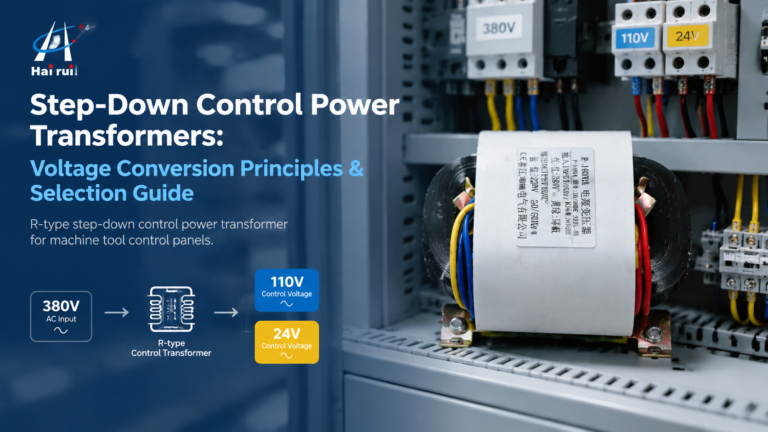
How step-down control power transformers convert 380V/480V line voltage to 110V or 24V control power: turns ratio, VA sizing with inrush, voltage-drop behaviour, wiring and selection.
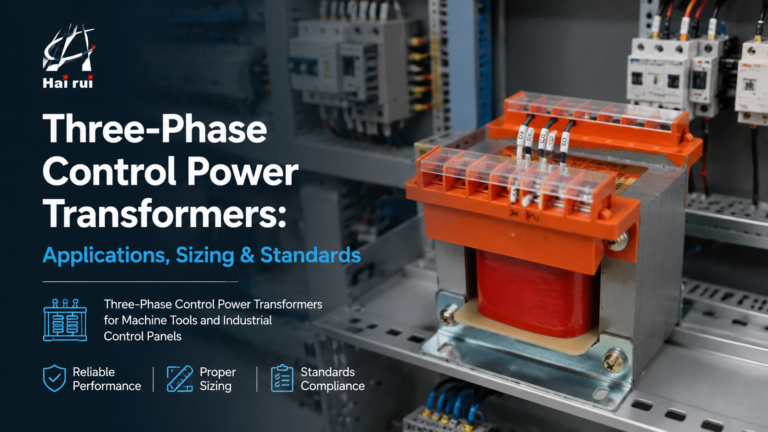
How three-phase control power transformers work, how to size them for machine tool and control-panel loads, and the delta/wye, standards and protection choices that matter in the field.