An IEC 62271-100 circuit breaker is not simply a breaker that “meets a standard.” It is a breaker whose every rating, every test duty and every certificate can be traced back to a numbered clause in a document that has been revised three times since it was first published. When a supplier sends you a quotation with the line “conforms to IEC 62271-100 and IEEE C37,” that sentence can mean anything from a fully witnessed type test programme at an independent laboratory to a self-declared internal form. The difference matters enormously, because it is the difference between a breaker that has been proven to clear 40 kA of fault current with a defined DC component and one that has only been proven to close and open in a workshop.
This guide explains what IEC 62271-100 and the IEEE C37 series actually regulate, how the three tiers of testing fit together, how to read a type test certificate without being misled by it, and where IEC and IEEE genuinely diverge. It is written for substation engineers, EPC procurement teams and QA staff who have to sign off on a breaker package and want to know whether the documents in front of them prove what they claim to prove.
The short answer: IEC 62271-100 defines the ratings and the test regime for AC high-voltage circuit breakers above 1 kV; IEEE C37.04, C37.06 and C37.09 do the same job for the North American market using a symmetrical-current basis and a different set of preferred ratings. A breaker built to one will usually satisfy the other’s physics but almost never its paperwork.
What IEC 62271-100 Actually Regulates
IEC 62271-100 is titled High-voltage switchgear and controlgear – Part 100: Alternating-current circuit-breakers. It sits inside the IEC 62271 family, which is structured so that a single common document holds the rules that apply to every piece of high-voltage switchgear, and the numbered parts hold the rules specific to one product family.
Where it sits in the IEC 62271 family
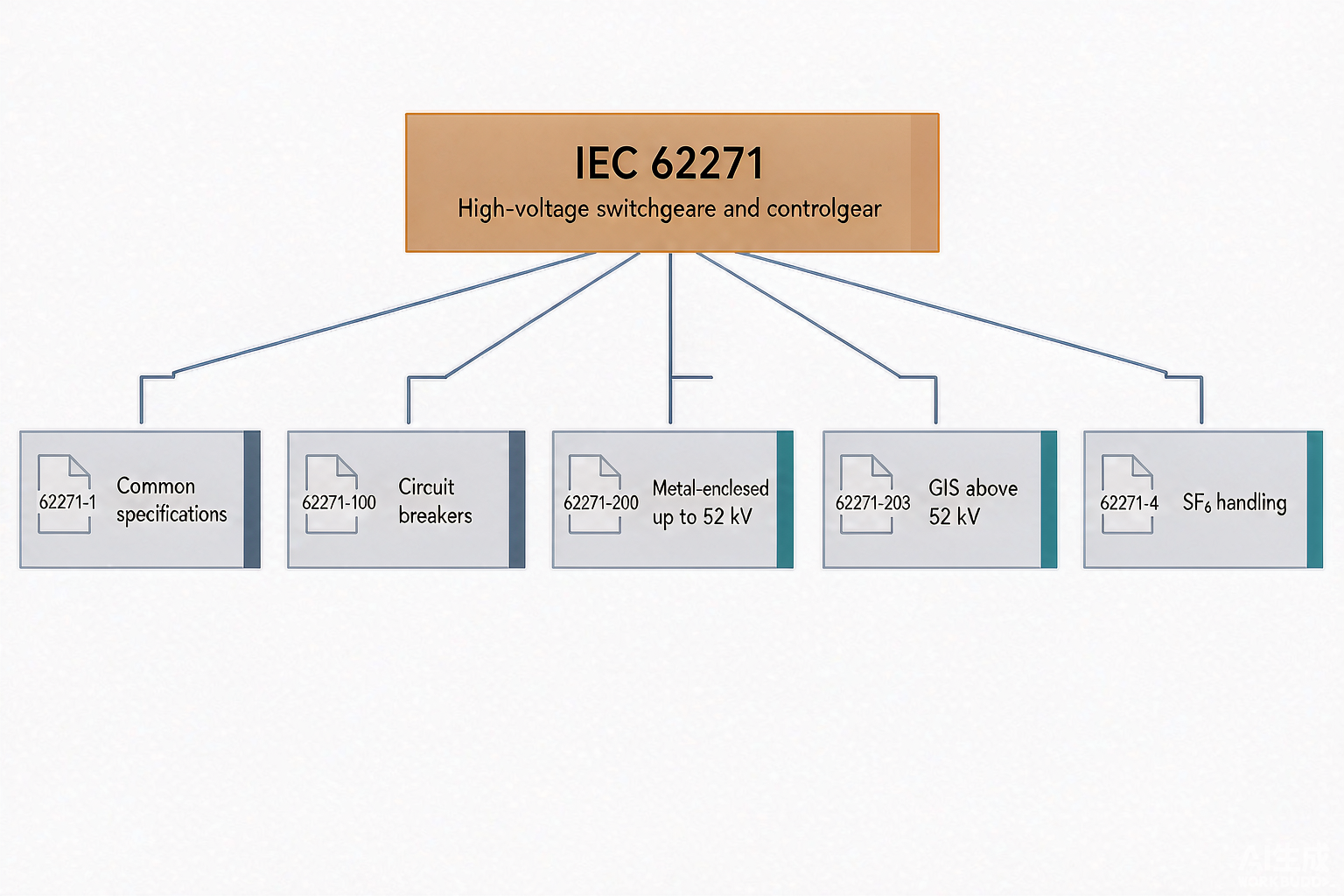
The document you will be quoted most often alongside 62271-100 is IEC 62271-1, Common specifications for alternating current switchgear and controlgear. Part 1 defines the shared vocabulary and the shared test methods — insulation levels, temperature rise, IP ratings, gas tightness, EMC — and Part 100 adds the circuit-breaker-specific requirements on top. If a test report cites “IEC 62271-1” only, it has not tested breaking capacity at all, because breaking capacity lives in Part 100.
Other parts that turn up in SF6 breaker packages include IEC 62271-200 for metal-enclosed switchgear up to 52 kV, IEC 62271-203 for gas-insulated metal-enclosed switchgear above 52 kV, and IEC 62271-4 for the handling of SF6 and its mixtures. Chinese manufacturers will frequently also cite GB/T 1984, the national standard that mirrors IEC 62271-100 clause for clause. That is a legitimate equivalence, not a substitute — but you should still confirm which edition of IEC 62271-100 the GB/T document was harmonised with.
The rated characteristics that must appear on the nameplate
Part 100 exists so that two engineers in two countries can describe the same breaker with the same numbers. The characteristics below are the ones you should find on any nameplate and in any quotation, and they are the ones a type test report must cover if the report is to be useful to you.
Rated characteristic
What it fixes
Typical value, 72.5 kV class
Rated voltage Ur
System voltage the insulation is designed for
72.5 kV
Rated insulation level
Power-frequency and lightning impulse withstand
140 kV rms / 325 kV peak
Rated normal current Ir
Continuous current at rated ambient
2000–4000 A
Rated short-circuit breaking current
Symmetrical fault current the breaker can clear
31.5–40 kA
Rated short-time withstand current
Current the closed breaker survives, for a stated duration
40 kA for 3 s
Rated peak withstand / making current
First-peak mechanical and contact-weld duty
2.5 × breaking current (50 Hz)
Rated operating sequence
Reclosing pattern the mechanism must survive
O – 0.3 s – CO – 3 min – CO
Rated gas pressure
Insulation and arc-quenching pressure at 20 °C
0.5–0.6 MPa
The last row is the one buyers overlook. A 40.5 kV breaker with a 0.5 MPa rated gas pressure and a 126 kV breaker at the same nominal pressure are not equivalent devices, because the pressure that matters is the density required to hold the rated insulation level at the coldest ambient the site will see. Part 100 and Part 1 both require the low-temperature performance to be verified, not assumed.
IEC 62271-100 sits inside a family of standards; the common rules live in IEC 62271-1 and the circuit-breaker requirements in Part 100.
Type Tests, Routine Tests and Site Tests Are Not Interchangeable
This is the single most common source of confusion in a breaker procurement package. Three different tiers of testing exist, they answer three different questions, and a supplier who offers you one of them in place of another is either confused or hoping you are.
Type tests — proving the design
Type tests are performed once on a representative sample of a design, and their result applies to every unit of that design that follows. They are the expensive tests: short-circuit making and breaking duties, insulation withstand, temperature rise, mechanical endurance, IP verification, EMC. They are normally witnessed by an independent laboratory and they cannot be repeated economically per unit, which is exactly why they are performed on a design and not on your breaker.
Routine tests — proving the unit
Routine tests are performed on every single breaker that leaves the factory, and their purpose is to catch manufacturing defects rather than design errors. Under Part 100 and Part 1 these typically include a power-frequency withstand test on the main circuit, a measurement of main circuit resistance, mechanical operating tests including the auxiliary and control circuits, and gas tightness checks. The document you receive is a routine test report bearing the serial number of your breaker.
Site acceptance — proving the installation
Site testing proves that the breaker survived transport, that it was assembled and gassed correctly, and that the wiring between the breaker and the protection scheme is right. Typical items are power-frequency withstand after installation, main circuit resistance, contact travel and timing, SF6 dew point and purity, leak rate check, and full functional testing of trip and close circuits from the protection relay. A clean factory report tells you nothing about whether the gas was filled from a contaminated cylinder on site.
Test tier
Question answered
Applied to
Document you should receive
Type test
Does the design work?
One representative sample
Type test report naming the exact type designation and ratings
Routine test
Does this unit work?
Every breaker
Per-unit routine test report with matching serial number
Site acceptance
Does the installation work?
The installed breaker
Commissioning test record signed by the site engineer
For a deeper walkthrough of what each individual test measures and what values should appear, see the companion article on SF6 circuit breaker testing, which covers type, routine and commissioning tests item by item.
How to Read an IEC 62271-100 Short-Circuit Test Report
The short-circuit breaking tests are where a type test report earns its value, and they are also where the most careful reading is required. Part 100 does not test breaking capacity at one current; it tests a set of duties across the range, because a breaker that clears 100% of its rated current can still fail at 30%.
Test duties T10 to T100a
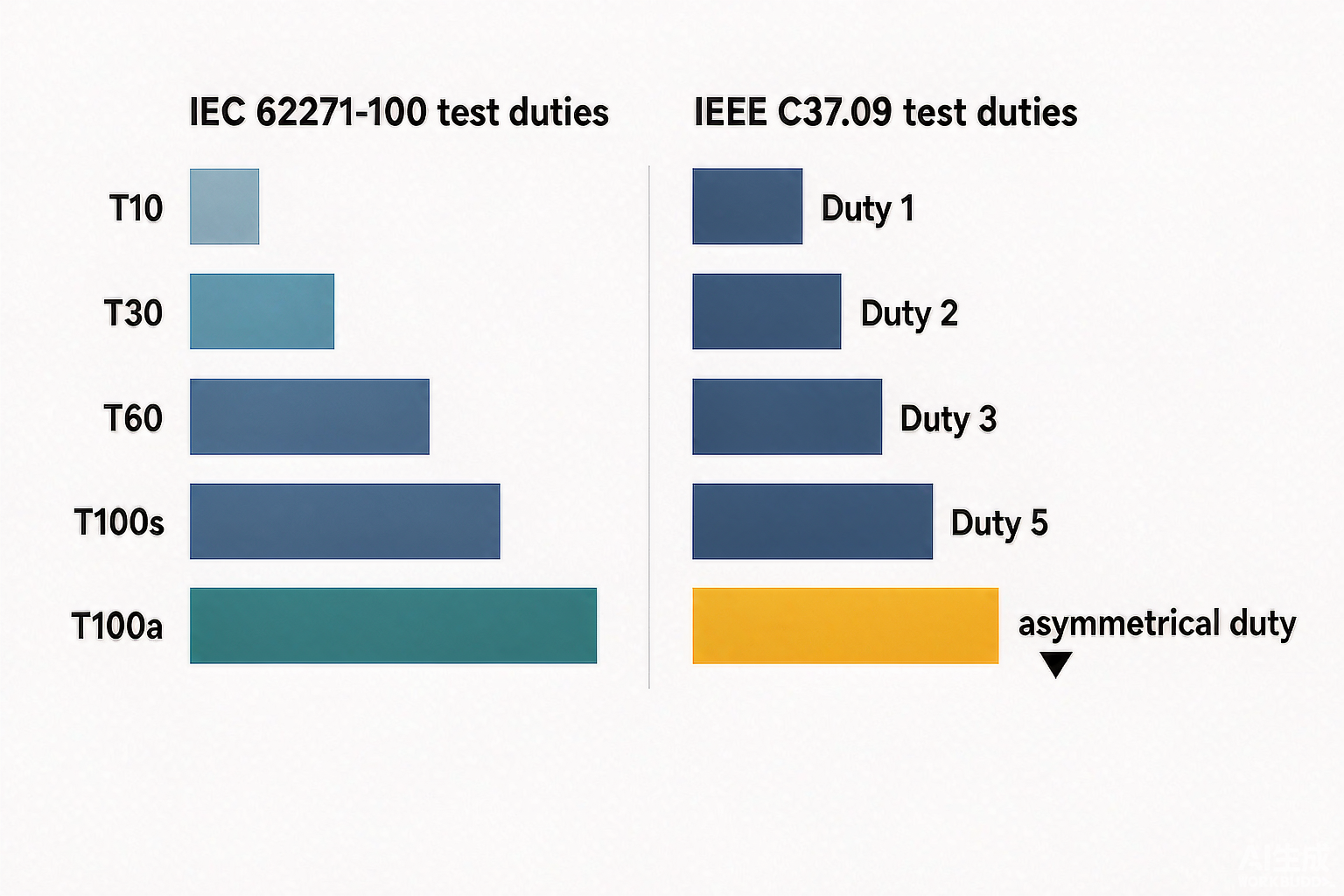
The sequence runs T10, T30, T60, T100s and T100a. The first three verify performance at 10%, 30% and 60% of rated short-circuit breaking current, where the arc energy per unit of current is disproportionately high and the recovery voltage stress is at its worst. T100s verifies the full rated symmetrical breaking current. T100a verifies 100% of rated current with the specified aperiodic (DC) component, which is the duty that separates a genuinely tested interrupter from a claimed one.
What you should check on the report is not merely that all five duties were passed, but that the breaker tested matches your specification on rated current and breaking capacity. A report covering a 31.5 kA unit does not qualify a 40 kA unit, even when the housing looks identical. A properly documented 72.5 kV breaker rated 4000 A with 40 kA breaking capacity will carry its own report for that specific rating combination.
Mechanical life class M1 versus M2
Part 100 introduced mechanical life classes so that buyers could stop arguing about endurance figures. Class M1 designates a breaker verified for 2,000 operating cycles; class M2 designates 10,000 cycles. The class is verified by a mechanical endurance test at ambient temperature plus verification at the high and low temperature extremes, and it is a property of the mechanism, not of the interrupter.
This is where the operating mechanism choice becomes a standards question rather than an engineering preference. A spring mechanism and a hydraulic mechanism can both achieve M2, but they get there differently and the test evidence is different. If your duty cycle is heavy — frequent switching on a capacitor bank, for example — insist on the endurance class explicitly rather than accepting “long mechanical life” as a description.
Electrical life class E1 versus E2
Electrical life is treated separately from mechanical life because the interrupter wears out faster than the mechanism. Class E1 covers a basic electrical life. Class E2 designates extended electrical life, demonstrated by a specified number of operating cycles at rated short-circuit breaking current. When you compare two suppliers quoting the same voltage and current class, the E class is often the real difference in the offer, and it is the one most frequently left out of the datasheet. Ask for it in writing.
The DC time constant trap
The aperiodic component of a fault current decays according to a time constant that depends on the network, and the standard duty is defined for a specific value. If your network has a longer time constant — as many transmission networks and generator-connected networks do — the breaker must be verified for a correspondingly harder duty. Suppliers sometimes quote a standard short-circuit rating while the actual network duty is harder. The fix is simple: state the required time constant in the technical specification and require the type test report to demonstrate it.
The interrupter design also influences how the duty is met. Puffer, self-blast and thermal expansion interrupters accumulate arc energy differently, which is why the same nominal rating can carry different electrical life classes. The comparison of SF6 circuit breaker types covers how each design manages that energy.
The IEEE C37 Series: Same Physics, Different Paperwork
If your project is in North America, or financed by an institution that specifies IEEE standards, IEC 62271-100 will not be accepted as the primary reference. The IEEE C37 series covers the same physical problem using a symmetrical-current basis, a different set of preferred ratings and a different vocabulary.
The four documents that matter
IEEE C37.04 sets out ratings and requirements for AC high-voltage circuit breakers above 1,000 V. IEEE C37.06 provides the preferred ratings and related required capabilities, which is where you find the actual tables of voltage classes and short-circuit currents used in North American practice. IEEE C37.09 is the test procedure — the counterpart to the testing clauses of IEC 62271-100. IEEE C37.010 is the application guide, and it is the document that tells an engineer whether a given preferred rating is adequate for a given system.
Around those four sit the specialised guides: C37.011 for transient recovery voltage, C37.012 for capacitance current switching, C37.013 for generator circuit breakers, C37.015 for shunt reactor switching, and C37.122 and C37.123 for gas-insulated substations. A generator breaker or a shunt reactor switching application quoted against C37.04 alone has been quoted against the wrong document.
Where IEC and IEEE genuinely diverge
The two families are not translations of each other, and pretending otherwise causes real specification errors. The table below summarises the differences that most often bite during a project.
Dimension
IEC 62271-100
IEEE C37 series
Voltage reference
Rated voltage Ur (e.g. 72.5 kV, 126 kV)
Rated maximum voltage with a voltage range factor K (e.g. 69 kV, 121 kV, 145 kV)
Current basis
Rated short-circuit breaking current, with defined DC component
Symmetrical current basis with related required capabilities, including a stated percentage DC component
Preferred ratings
Defined by IEC, harmonised nationally (e.g. GB/T 1984 in China)
Defined by C37.06, a closed list of preferred values
Endurance classes
Mechanical M1 / M2 and electrical E1 / E2 classes
Number of operations declared by the manufacturer
Continuous current at high ambient
Rated normal current at a stated ambient, with derating
K factor allowing rated continuous current to be multiplied at lower ambient
Test duty naming
T10, T30, T60, T100s, T100a
Numbered test duties with specified asymmetry percentages
Certification route
Type test report from an accredited or STL-member laboratory
Type test to C37.09, typically at a recognised high-power laboratory
IEC and IEEE both test a range of breaking duties, but name and sequence them differently.
The practical consequence is this: an IEC-qualified breaker is not automatically acceptable on an IEEE-specified project, and vice versa. The physics travel well — a well-built interrupter does not care which document names its duty — but the ratings, the preferred values and the test evidence do not. If you need both, specify both and expect to pay for a second test programme or for a documented cross-reference study by the manufacturer.
Voltage class naming is the first place the mismatch shows up. IEC classes at 40.5 kV, 72.5 kV, 126 kV and 252 kV map only approximately onto IEEE classes at 38 kV, 69 kV, 121 kV, 145 kV and 242 kV, and the insulation levels attached to them differ. The article on SF6 circuit breaker voltage classes sets out how the two ladders align in practice.
The Standards Behind the Gas and the Enclosure
A breaker package is never covered by one standard. The gas, the enclosure and the diagnostic measurements each have their own documents, and a complete compliance file should reference all of them.
The gas. IEC 60376 specifies technical-grade SF6 for use in electrical equipment — the purity, moisture and by-product limits for new gas. IEC 60480 covers the checking and treatment of SF6 recovered from equipment and the specification for its re-use. IEC 62271-4 covers the handling procedures, including recovery and reclaim equipment. A supplier who cannot name the standard their gas analysis is performed against is a supplier whose gas quality claim cannot be audited.
The enclosure. For metal-enclosed switchgear up to 52 kV the reference is IEC 62271-200; above 52 kV in gas-insulated construction it is IEC 62271-203. On the IEEE side, C37.122 and C37.123 cover gas-insulated substations. These matter because the enclosure determines the partial discharge environment, and partial discharge behaviour — measured under IEC 60270 — is often the earliest indicator that an insulation design is marginal.
The insulation level. The dielectric type tests are where the voltage class becomes concrete. A 252 kV breaker tested to 1050 kV lightning impulse withstand and a 252 kV breaker with a lower impulse rating are both “252 kV” on a quotation, and only the test report separates them.
Short-time withstand. The related test — the current the closed breaker must carry without damage for a stated duration — is frequently bundled into the same report and frequently the item where a cheaper offer is thin. A 126 kV breaker with 40.3 kA short-time withstand capability is stating something measurable about its busbar and contact design, not a marketing number.
How to Verify a Supplier’s Standards Claims
Standards compliance is a documentary claim, and documentary claims can be checked. Before you accept an IEC 62271-100 circuit breaker onto a project, run the following checklist and release the purchase order only when every line has an answer.
Ask for the report, not the certificate. A one-page “certificate of conformity” proves nothing about testing. Request the full type test report with the laboratory’s letterhead and report number.
Check the issuing laboratory. Independent high-power laboratories with recognised accreditation or STL membership — such as KEMA, CESI, IPH, XIHARI or CEPRI — carry more weight than an in-house test bay. Ask whether the test was witnessed.
Match the type designation exactly. The report must name the type designation on your quotation. A report for a related model is not evidence for your model.
Confirm the edition. IEC 62271-100 has been revised several times. A report against an older edition is not automatically invalid, but the gap should be understood and documented.
Check the ratings match your specification. Rated voltage, normal current, breaking capacity, short-time withstand and endurance class must all appear and must all match.
Require per-unit routine test reports. These must carry the serial number of each breaker delivered, and they must arrive with the shipment rather than on request afterwards.
Ask for the gas and enclosure documents. Gas analysis to IEC 60376 or 60480 and partial discharge measurement to IEC 60270 should be routine items, not extras.
The red flags are consistent: a report that covers a range of ratings rather than one combination, a certificate with no report number, a laboratory nobody in the industry recognises, a serial number on the routine report that does not match the nameplate, and a supplier who becomes vague the moment you ask about test duties rather than voltage class.
Conclusion
IEC 62271-100 and the IEEE C37 series do not compete; they describe the same engineering problem in two different languages. What matters to a buyer is not which family a breaker is certified to, but whether the certification actually covers the rating, the duty cycle and the network conditions you are buying for. That means reading the type test report rather than the certificate, matching the report to the exact type designation, insisting on per-unit routine test evidence, and treating the endurance classes and the DC time constant as specification items rather than supplier goodwill.
If you are assembling a technical specification and need the ratings and test evidence for a specific voltage class, the high-voltage SF6 circuit breaker range lists the rated voltage, current, breaking capacity and impulse withstand for each model, and our engineering team can supply the corresponding test documentation on request.
FAQ
Is IEC 62271-100 the same as IEEE C37.09?
No. They both specify how to test a high-voltage circuit breaker, but they use different rating bases, different preferred values and different test duty naming. IEC 62271-100 works from rated voltage and rated short-circuit breaking current with a defined DC component; IEEE C37.09 works from rated maximum voltage and a symmetrical current basis with related required capabilities. A breaker tested to one is not automatically accepted under the other.
Does an IEC 62271-100 type test certificate expire?
There is no fixed expiry date. A type test report remains valid for a design as long as the design is unchanged and the standard edition it was tested against is still accepted by the project specification. In practice, buyers should check the edition of IEC 62271-100 the report references and confirm that no design change has been made to the interrupter or mechanism since the test.
What is the difference between M1 and M2 mechanical life?
M1 designates a breaker verified for 2,000 operating cycles and M2 for 10,000 operating cycles, tested mechanically at ambient temperature and verified at the temperature extremes. The class belongs to the mechanism. A spring mechanism and a hydraulic mechanism can both reach M2, but the test evidence and the maintenance implications differ.
Which laboratory should issue an SF6 circuit breaker type test report?
Ideally an independent high-power laboratory with ISO/IEC 17025 accreditation or membership of the Short-circuit Testing Liaison. Names that carry weight in SF6 breaker procurement include KEMA, CESI, IPH, XIHARI and CEPRI. A test performed in a manufacturer’s own bay can still be useful evidence, but it should not be presented as equivalent to a witnessed third-party type test.
Does an IEC-compliant breaker automatically satisfy IEEE C37.06?
No. C37.06 is a closed list of preferred ratings, and a breaker designed to an IEC rating ladder will rarely match one of those preferred combinations exactly. Even where the physical capability is sufficient, the project will normally require a type test to C37.09 and ratings expressed on the IEEE basis before acceptance.
What is the Chinese equivalent of IEC 62271-100?
GB/T 1984, the Chinese national standard for high-voltage alternating-current circuit breakers, is harmonised with IEC 62271-100. Breakers manufactured in China for export are routinely tested to IEC 62271-100 directly, and buyers should ask which edition the test report references rather than assuming the GB/T and IEC editions are identical.
SF6 circuit breaker testing explained in three tiers: type tests, factory routine tests and on-site commissioning tests, with gas quality limits, contact resistance values and test report checks.
SF6 vs oil circuit breaker comparison: arc-quenching principles, bulk oil vs minimum oil, ratings, maintenance, fire risk, and a practical checklist for replacing legacy oil breakers with SF6 units.
Vacuum or SF6? Compare arc quenching, voltage limits, switching behaviour, maintenance, F-gas rules and cost to pick the right circuit breaker for your network.