SF6 vs Vacuum Circuit Breaker: Which One Is Better?
Vacuum or SF6? Compare arc quenching, voltage limits, switching behaviour, maintenance, F-gas rules and cost to pick the right circuit breaker for your network.
Read More
Choosing an outdoor SF6 circuit breaker over an indoor one is rarely about the interrupter. The arc-quenching chamber, the puffer or self-blast nozzle and the contact system are often identical. What changes is everything around them: the external insulation, the creepage distance, the enclosure rating, the phase spacing, the foundation and the maintenance routine.
That is why “indoor or outdoor?” is one of the first questions a substation designer has to settle, and why getting it wrong is expensive. Specify an outdoor unit for a room that cannot provide the clearances and you pay for space you cannot use. Specify an indoor unit for a coastal site and you will be cleaning polluted insulators and replacing corroded hardware for the next twenty years.
This guide breaks the decision into the variables that actually drive it: reference ambient conditions, pollution class, creepage, enclosure rating, gas sealing, altitude, wind loading and maintenance access. You will also get a comparison matrix, a creepage lookup table and a six-question framework you can run against a real project.
The distinction is not a single feature. It is a specification package defined by two different sets of reference conditions in IEC 62271-1, and the manufacturer then has to prove the breaker works inside whichever set you specify.
An indoor breaker is specified against a controlled reference ambient, typically −5 °C to +40 °C, with no wind, no direct precipitation, no solar radiation and a modest pollution level. The room itself does the work: walls block UV, the roof keeps rain off the bushings, and ventilation limits the temperature rise.
An outdoor breaker is specified against a much wider envelope: commonly −25 °C to +40 °C as standard, with −40 °C available on request, plus wind loading on the columns, rain, ice, UV degradation of external insulation, and pollution deposited on the creepage surfaces. Every one of those conditions has to be handled by the equipment, because there is no building to absorb it.
Because the interrupter is not the variable. A 40.5 kV puffer chamber does not care whether it sits in a metal-clad cubicle or on top of a porcelain column. What changes is the bushing, the external insulation length, the tank or column arrangement, the cabinet sealing and the clearances around live parts.
This is worth internalising before you read a single quotation: when two suppliers quote very different prices for what looks like the same breaker, they are usually quoting two different specification packages, not two different qualities of interrupter.
The table below is the working comparison. It maps the ten design aspects that change between the two arrangements.
| Design aspect | Indoor SF6 breaker | Outdoor SF6 breaker |
|---|---|---|
| External insulation | Gas-insulated or solid insulation inside a metal-clad enclosure | Porcelain or composite columns and bushings exposed to weather |
| Creepage requirement | Lower — no rain, no pollution deposit on live surfaces | Higher, sized to the site pollution class per IEC 60815 |
| Phase-to-phase clearance | Set by the enclosure, typically compact | Set by air clearance in open air — the largest single driver of footprint |
| Enclosure / protection | Metal-clad cubicle, IP4X-class for personnel protection | Live parts open to air; mechanism cabinet at IP54 or IP55 |
| Gas sealing duty | Moderate — temperature swing is small | Severe — daily and seasonal cycling stresses every gasket and seal |
| Reference ambient | Typically −5 °C to +40 °C | Typically −25 °C to +40 °C, with −40 °C option |
| Low-temperature risk | Low — rooms rarely drop below SF6 liquefaction range | Real — gas pressure must be checked against the local winter minimum |
| Civil works | Building, flooring, cable trench, ventilation, fire separation | Foundation plinth or gantry, earthing grid, access road |
| Maintenance access | Walk-up access, but confined space rules apply | Field access with mobile plant; insulator cleaning becomes routine |
| Fault-gas venting | Critical — decomposition products are denser than air and collect in trenches | Self-venting to atmosphere, subject to local emission rules |
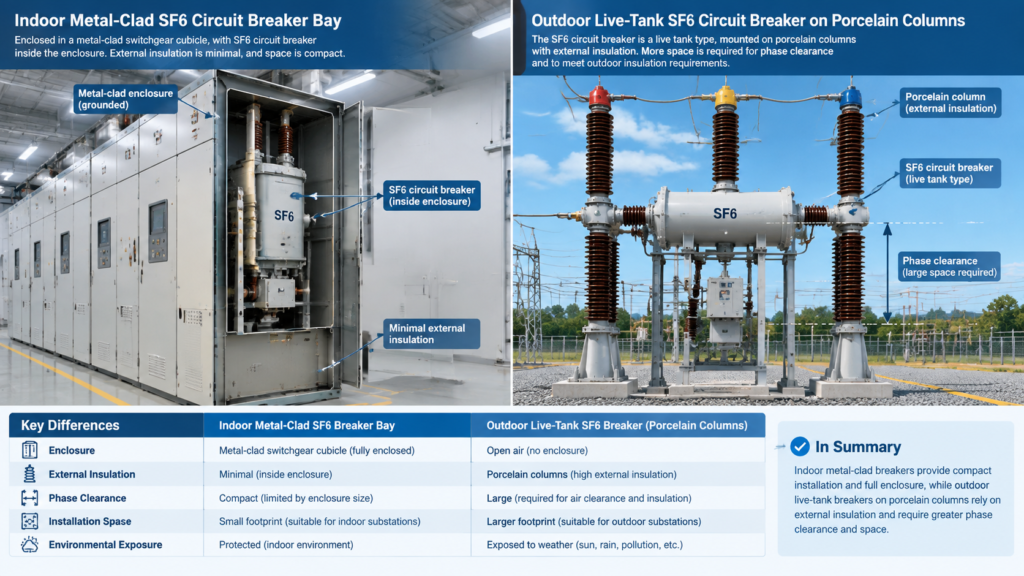
Two rows in that table deserve a closer look, because they are the ones that cause late-stage redesigns.
IEC 62271-1 caps the relative leak rate of a sealed pressure system at 0.5 % per year. Hitting that number in a temperature-controlled switch room is a different engineering problem from hitting it on a rooftop in a desert, where the tank and its gaskets may cycle through a 60 °C swing every single day. Outdoor units compensate with thicker flange sections, metal-to-metal sealing where possible, and more conservative O-ring compression. This is one reason an outdoor breaker of the same rating weighs noticeably more.
Outdoors, decomposition products from an internal arc disperse. Indoors, the same by-products — including SOF2, SO2F2 and HF — are heavier than air and settle into cable trenches, basements and low-level cable ducts. Indoor installations therefore need forced ventilation with low-level extraction and fixed gas detection, not just a pressure-relief flap on the cubicle. Designers who treat the indoor option as “the same breaker in a box” usually miss this item.
Procurement conversations rarely present a clean binary. In practice you will be offered one of three physical arrangements, and two of them sit on the boundary between indoor and outdoor.
This is the classic outdoor form. Each pole has its own interrupter head sitting on top of a porcelain or composite column, with the current path running through the column. Because the live parts are exposed to air, phase spacing and phase-to-earth clearance must be provided in open air, which is what makes the footprint large. It also means creepage distance has to be designed for the site, which is why two “72.5 kV breakers” can have visibly different column heights for different customers.
A good example of the long-creepage end of this family is the LW9-72.5 porcelain column SF6 breaker at 4000 A, which uses column-type external insulation to carry both the mechanical load of the interrupter head and the full creepage requirement.
In a dead-tank design the interrupter sits inside an earthed metal tank, so the external surface is at ground potential. Phase spacing is set by the tank and bushing arrangement rather than by open-air clearance, so the unit is far more compact. Current transformers can be mounted around the bushings or inside the tank, which removes a separate CT assembly from the layout. The trade-off between live-tank and dead-tank construction is covered in more detail in our guide to SF6 circuit breaker types.
That compactness is exactly why dead-tank and metal-clad designs are the usual answer when a project needs indoor-class footprint but outdoor-class weather resistance — a very common requirement in urban substations and coastal industrial plants.
At distribution level, especially from 12 kV to 40.5 kV, breakers are frequently mounted directly on a pole or packaged in a small weatherproof enclosure at the top of a feeder. These units are outdoor by definition, but they are not column breakers — they are compact sealed assemblies with an integral enclosure, and they are judged on enclosure rating and tamper resistance rather than on column creepage. The LW8-40.5 outdoor SF6 breaker with 0.5 MPa rated gas pressure is representative of the compact 40.5 kV end of this range, where a higher sealed gas pressure is used to keep the tank and the clearances small.
If you only take one technical rule from this article, take this one: for outdoor breakers, the site pollution class sets the minimum specific creepage distance, and that number can force a taller, wider and more expensive breaker than the voltage class alone would suggest.
IEC 60815 classifies sites by pollution severity and gives a minimum specific creepage distance expressed in millimetres per kilovolt of the highest system voltage for the equipment (Um). The levels used in most international specifications are:
| Pollution level | Typical site description | Minimum specific creepage |
|---|---|---|
| Light | Rural areas, low industrial activity, no coastal influence | ≈ 22 mm/kV |
| Medium | Areas with industry but no dense smoke, moderate traffic | ≈ 27.5 mm/kV |
| Heavy | Industrial zones, dense traffic corridors, coastal strips 1–3 km inland | ≈ 35 mm/kV |
| Very heavy | Desert with salt storms, shoreline exposure, heavy conductive dust | ≈ 43 mm/kV |
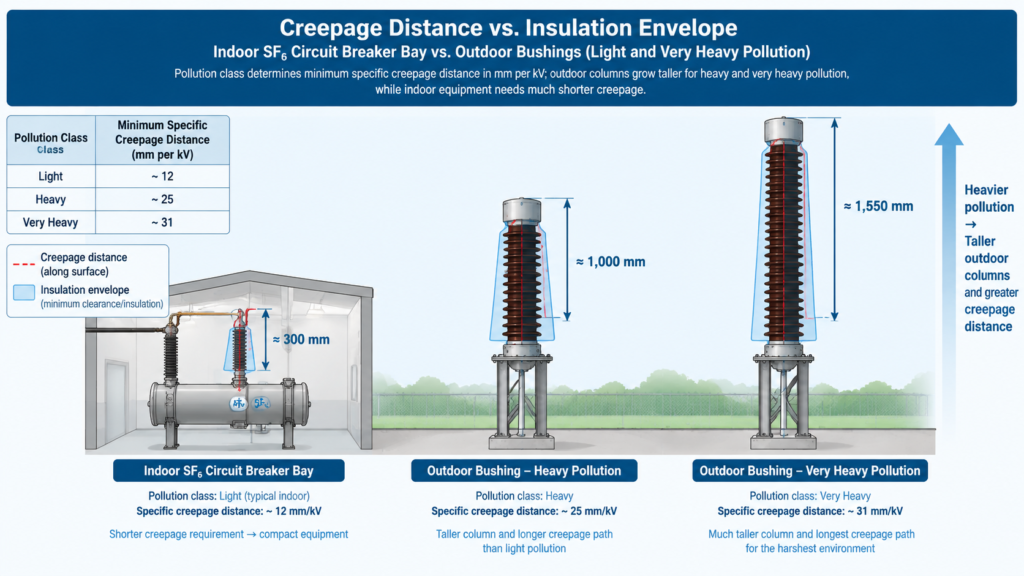
Read the table with a real number. A 72.5 kV breaker specified for a light-pollution inland site needs roughly 1 600 mm of creepage per pole. Move the same project to a shoreline site with very heavy pollution and the requirement jumps to roughly 3 100 mm — nearly double. That extra insulation length shows up as taller columns, larger phase spacing and a heavier foundation.
Two practical consequences follow.
Beyond pollution, four site conditions routinely force the decision regardless of what the layout drawing suggests.
An outdoor breaker is the first thing a travelling lightning surge meets when it arrives at the substation from an overhead line. An indoor bay, by contrast, normally sits behind a length of cable, a cable sealing end or a surge arrester arrangement that already attenuates the incoming wave.
The practical result is that outdoor breakers are usually specified with a higher lightning impulse withstand voltage for the same rated voltage, and with a higher power-frequency withstand to match. Insulation coordination therefore does not just decide the arrester rating — it feeds directly back into column height and phase spacing. A 72.5 kV outdoor unit specified with a 350 kV lightning impulse withstand level, such as the LW9-72.5 outdoor SF6 circuit breaker with 350 kV lightning impulse withstand, has a visibly longer insulation envelope than a unit of the same class specified for a lower impulse level. If you are comparing candidates across several voltage classes, our breakdown of SF6 circuit breaker voltage classes shows how the withstand levels scale with each step up the ladder.
SF6 is a gas only above its saturation curve. As temperature falls, the gas condenses and the density — which is what actually provides dielectric strength and arc-quenching capability — drops with it. The pressure at which liquefaction begins is a property of the fill pressure.
A breaker charged to 0.5 MPa will start to liquefy in the region of −30 °C. Raise the fill pressure to about 0.6 MPa and the threshold moves up to roughly −25 °C. For an indoor installation this almost never matters. For an outdoor installation in a cold climate it is a first-order design constraint, and it is normally solved by one of three routes:
Whichever route is chosen, the low-temperature limit must be written into the specification as a test condition, not left as an assumption. This is also why outdoor mechanism cabinets are specified with anti-condensation heaters and thermostat control — the same cabinet that manages stored energy in a spring operating mechanism also has to keep its own internals above the dew point.
Above 1 000 m, air density falls and the external insulation of an outdoor breaker loses dielectric strength. IEC 62271-1 applies a correction factor to the required withstand voltages, and it is not trivial: at 2 000 m the correction factor is approximately 1.13, meaning the breaker must be able to withstand about 13 % more voltage than the same unit at sea level.
The consequence is that a high-altitude site may need the next voltage class up, or a special high-altitude variant of the same class. Indoor installations are affected too, but the effect is easier to manage because the enclosure geometry is fixed and the manufacturer can simply prove a higher withstand level.
An outdoor column breaker is a tall, top-heavy structure. Wind loading on the columns and bushings must be calculated for the site, and in seismically active regions the unit has to be qualified for the relevant seismic level — commonly IEEE 693 or the equivalent IEC mechanical test regime. Neither applies to a metal-clad indoor bay, which is another point in the indoor column.
Flood level is the counter-argument. An outdoor breaker mounted on a plinth above the design flood level is easier to protect than an indoor switch room with cable trenches below grade. Sites that flood regularly often choose outdoor equipment for exactly this reason.
Run these six questions against the project. If four or more answers land in the same column, that column is your answer, and any remaining disagreement is a detail to be engineered rather than a reason to reopen the concept.
| Question | Points toward indoor | Points toward outdoor |
|---|---|---|
| 1. What does land or building space cost here? | Land is expensive or unavailable — compact bay wins | Land is cheap and available — footprint is not a constraint |
| 2. What is the site pollution class? | Medium or below, or the room is filtered and pressurised | Heavy or very heavy; long-creepage columns are unavoidable |
| 3. What is the winter design minimum? | Below about −30 °C, where liquefaction risk is real | Moderate climate, or heaters and a low fill pressure are acceptable |
| 4. What is the site altitude? | Above 1 000 m, where derating is easier to handle inside | At or near sea level, no derating needed |
| 5. Who maintains it, and how often? | Skilled staff on site; confined-space procedures already in place | Remote site; field access with mobile plant is easier than a building |
| 6. How will SF6 gas be handled at end of life? | Central recovery equipment and a gas log already exist | Gas work is contracted out; open access to the tank simplifies it |
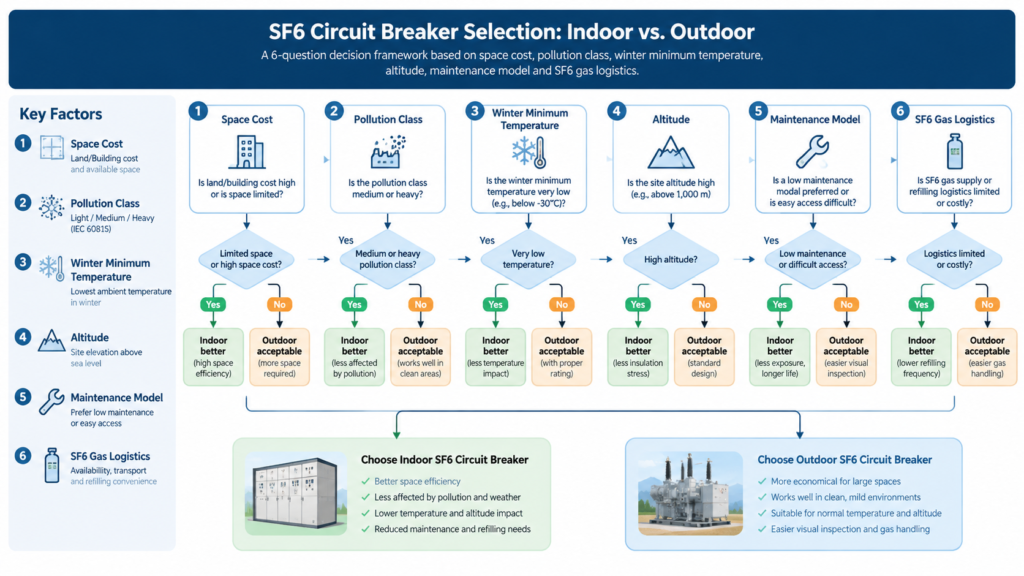
One hybrid answer deserves a mention because it resolves most of the tension. Where a project needs indoor-level compactness but the site is polluted or exposed, the usual solution is an outdoor-rated dead-tank or enclosed breaker installed on an open plinth, or an indoor metal-clad bay inside a prefabricated, climate-controlled enclosure. Both give you the compact current path without asking porcelain to survive a shoreline for twenty years. A representative mid-range option for this kind of layout is the LW36-126 outdoor SF6 breaker with 40 kA breaking capacity, which is commonly deployed in both open-air and enclosed substation configurations at 126 kV.
The indoor-versus-outdoor decision is really a decision about which environment you are asking the equipment to survive. Indoor means the building absorbs weather, pollution and temperature swing, and you pay for the building. Outdoor means the breaker absorbs all of it, and you pay in insulation length, phase spacing and sealing quality.
Work the six questions in order — space cost, pollution class, winter minimum, altitude, maintenance model, gas logistics — and the answer usually becomes obvious before the layout is finalised. Then confirm three numbers in the quotation: the specific creepage distance in mm/kV, the low-temperature limit at the rated fill pressure, and the altitude correction factor applied to the withstand voltages. Those three figures separate a specification that will work from one that merely looks correct on paper.
If you are comparing specific configurations for a project, you can review the full range of high voltage SF6 circuit breakers by voltage class and arrangement, or send the site conditions and we will match a breaker to them.
Yes, and it is common practice. An outdoor-rated breaker installed inside a building brings its weather protection with it, so the only new requirements are ventilation, fault-gas extraction at low level, fire separation and adequate phase clearance to walls and neighbouring equipment. The reverse is not true: an indoor-only breaker installed outdoors will not have the creepage, sealing or enclosure rating for rain, pollution and UV.
It depends on the site pollution class under IEC 60815. Typical minimum specific creepage values are about 22 mm/kV for light pollution, 27.5 mm/kV for medium, 35 mm/kV for heavy and 43 mm/kV for very heavy pollution, referenced to the highest system voltage. Multiply by the system voltage to get the required total creepage, then confirm the actual bushing value from the manufacturer’s drawing.
For two reasons. First, SF6 liquefies at low temperature, so heaters keep the tank and mechanism cabinet above the liquefaction range at the rated fill pressure. Second, heaters prevent condensation inside the mechanism cabinet, which would otherwise corrode linkages and short control wiring. Both functions are normally controlled by a thermostat, and both need to be fed from a reliable station DC supply.
The breaker itself often is, because it needs less external insulation and a lighter structure. The installation frequently is not. An indoor bay requires a building, flooring, cable trenches, ventilation, low-level gas extraction and fire separation. Compare total installed cost, including civil works and the ventilation system, rather than equipment price alone.
Above 1 000 m the reduced air density lowers the dielectric strength of the external insulation, so IEC 62271-1 requires a correction factor to be applied to the specified withstand voltages. At 2 000 m the factor is approximately 1.13, meaning the breaker must withstand roughly 13 % more voltage. In practice this means selecting a higher insulation level or a special high-altitude variant of the same voltage class.
For a coastal site within a few kilometres of the shoreline, pollution class is usually heavy or very heavy, which drives outdoor creepage requirements up sharply. Two options work well: a live-tank outdoor breaker with long-creepage porcelain or composite columns sized for the site, or a dead-tank or enclosed design that keeps most of the insulation inside an earthed tank and out of the salt-laden air. Both should be specified with a stainless-steel or hot-dip galvanised mechanism cabinet and hardware.