Transformers are the silent backbone of modern industrial electrical systems, doing their work quietly and reliably. Yet, when purchasing or designing systems across different regions, one question often sparks debate: Can I use the same control transformers for 50 Hz and 60 Hz power supplies?
If you’re a procurement engineer, a sourcing manager, or an OEM manufacturer selling globally, this question is not just academic — it can directly impact your control panel performance, cost, and even safety compliance. Let’s unpack this step by step.
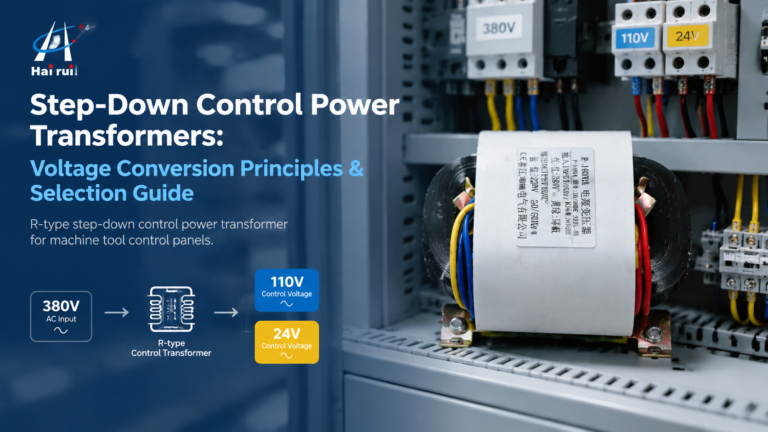
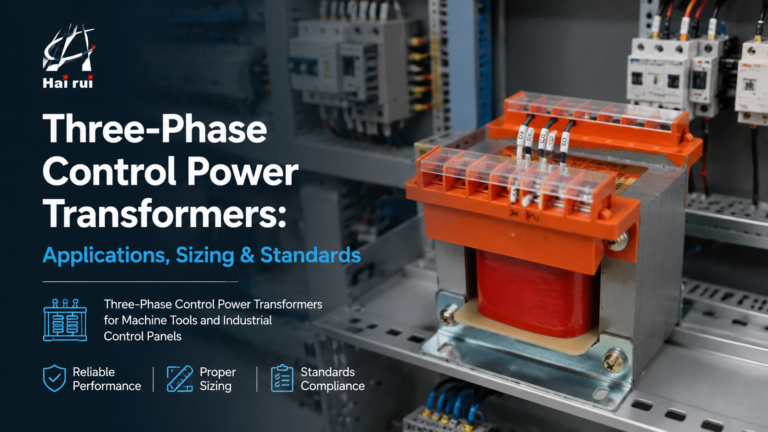
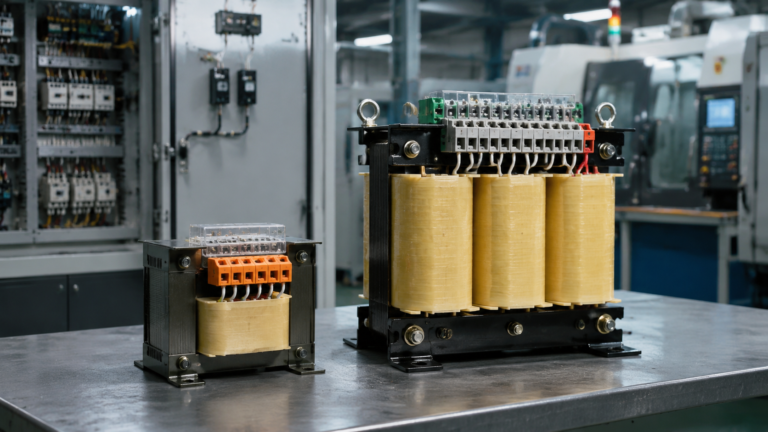
Control transformers BKJ5 Machine Tool are designed to provide stable voltage for control circuits in automation systems, machinery, and lighting applications. They help maintain consistent output voltage even when input voltage fluctuates under load changes — a critical factor for reliable operation.
Common applications include:
- CNC machines and industrial automation controls
- HVAC systems and motor starters
- Factory equipment with PLC-driven panels
- Power distribution systems in industrial settings
But before you source your next transformer batch, it’s crucial to understand the difference between 50 Hz and 60 Hz power frequencies and how they affect transformer design.
50 Hz vs 60 Hz: What’s the Difference?
Power frequency varies depending on the country.
- 50 Hz is standard in most of Asia, Europe, and Africa.
- 60 Hz dominates in North America and parts of South America.
This difference may look small, but it influences how transformers are wound, cooled, and rated.
| Frequency | Common Regions | Magnetic Flux Density | Efficiency Impact | Typical Applications |
|---|
| 50 Hz | EU, Asia, Africa | Higher flux for same voltage | Slightly less efficient | Heavy industrial equipment |
| 60 Hz | US, Canada, Japan (some areas) | Lower flux at same voltage | Higher efficiency, smaller core | Automation controls, HVAC |
The short answer is sometimes, but it depends on how the transformer is designed.
1. The Core Material and Size
A transformer designed for 60 Hz operation can overheat if used at 50 Hz without de-rating the voltage. This happens because at a lower frequency, magnetic flux density in the core increases. To prevent saturation, either:
- The rated voltage must be reduced, or
- The core must be designed larger to handle 50 Hz conditions.
Modern universal control transformers are built with this consideration in mind and can operate efficiently on both 50 Hz and 60 Hz. Always look for “50/60 Hz” printed on the nameplate — that’s your compatibility guarantee.
2. Voltage and Power Ratings
If a 60 Hz-only transformer is operated at 50 Hz, maintaining the same voltage could cause excessive magnetizing current. To adapt:
- Reduce the input voltage by about 17% when switching from 60 Hz to 50 Hz.
- Alternatively, choose a transformer explicitly rated for dual-frequency operation.
Let’s break it down:
| Parameter | Effect When Switching from 60 Hz to 50 Hz |
|---|
| Voltage regulation | Slightly less stable |
| Efficiency | Decreases due to higher losses |
| Core temperature | Increases |
| Output voltage under load | Slightly drops |
| Audible noise | May increase slightly |
Therefore, while a dual-rated transformer can handle both, single-frequency transformers should only be used within their rated parameters unless de-rated appropriately.
Engineers and procurement teams need to consider multiple factors before finalizing a control transformer supplier for international projects.
Here’s what to focus on:
- Frequency Rating: Prioritize transformers labeled 50/60 Hz to support global operations.
- Voltage Compatibility: Match primary and secondary voltages with regional power supplies (e.g., 230V/400V vs. 120V/208V).
- Power Rating (VA): Select adequate capacity for your load plus a margin for inrush currents.
- Build Quality and Insulation Class: High-quality materials reduce losses and improve durability.
- Certifications: Check for CE, UL, or ISO compliance depending on your market.
- Customization Options: Some suppliers can tailor winding, mounting, and terminal configurations for different voltage and frequency requirements.
When sourcing for industrial or global projects, choosing reliable control transformer manufacturers and wholesalers is just as important as selecting the right specifications.
Top-tier suppliers and OEM manufacturers often provide:
- Custom design services for dual-frequency transformers (50 Hz/60 Hz)
- Bulk order discounts for distributors and wholesalers
- Flexible pricing for long-term B2B customers
- Branding or packaging customization for OEM use
Many global control transformer suppliers in China, India, and Europe now develop advanced 50/60 Hz models designed for export markets. If your operations span multiple regions, working directly with a manufacturer offering customization and testing for both frequencies ensures consistent performance and compliance.
Common Scenarios and Best Practices
Scenario 1:
Your company exports control panels designed in the U.S. (60 Hz) to Europe (50 Hz).
Best Practice: Select transformers rated for “50/60 Hz operation” and verify CE marking.
Scenario 2:
You’re a wholesaler sourcing for both North American and Asian clients.
Best Practice: Stock dual-frequency universal control transformers to simplify logistics and reduce model diversity.
Scenario 3:
A client reports overheating when running a 60 Hz transformer on 50 Hz.
Best Practice: Recommend operating at a lower input voltage or replacing with a dual-rated unit.
Pricing and Cost Considerations
The price of control transformers designed for 50/60 Hz typically depends on:
| Factor | Impact on Price |
|---|
| Core material quality (silicon steel, amorphous core) | Higher quality = higher price |
| Power capacity (VA rating) | Directly proportional |
| Customization and certification | Adds cost but increases export flexibility |
| Order volume and B2B terms | Bulk orders significantly reduce unit cost |
If you’re a B2B buyer, wholesaler, or distributor, it’s always worth requesting a custom quotation based on frequency, primary/secondary voltage, and application. Many suppliers offer free technical consultation and sample testing before full production.
You can reach out to control transformer manufacturers or authorized distributors to get an exact quotation — especially if your project requires custom winding or dual-frequency optimization.
Not always.
Although universal 50/60 Hz control transformers work well for many applications, dedicated designs remain more efficient for fixed-frequency usage. For example:
- A 60 Hz-only transformer can be smaller and lighter, suited for North American usage.
- A 50 Hz-only model has a more robust core for sustained industrial environments in Europe or China.
Still, if you’re exporting across regions or managing multinational facilities, a universal unit saves time, simplifies inventory, and ensures compatibility.
Choosing the right BK Series control transformer for 50 Hz and 60 Hz applications is more than a technical decision — it’s a strategic one for global-ready manufacturing and B2B sourcing efficiency. With growing international trade and cross-border projects, selecting dual-frequency-rated transformers ensures compatibility, reliability, and compliance in every region your equipment serves.
Whether you represent an industrial OEM, wholesaler, or engineering contractor, partnering with an experienced transformer manufacturer who understands your regional frequency needs will save time, reduce costs, and enhance long-term performance.
Ready to source high-quality 50/60 Hz control transformers? Send us your specifications today to get a customized quote and technical consultation for your project.
FAQ
u003cstrongu003eWhat happens if I use a 60 Hz transformer at 50 Hz?u003c/strongu003e
The core may saturate, leading to overheating and reduced efficiency. Voltage should be reduced by approximately 17%, or you should use a 50/60 Hz-rated transformer.
u003cstrongu003eAre 50/60 Hz control transformers more expensive?u003c/strongu003e
Slightly, but the flexibility and global compatibility often offset the cost difference, especially for industrial suppliers and OEM manufacturers.
u003cstrongu003eCan I request customization for dual-frequency use?u003c/strongu003e
Yes. Leading manufacturers offer u003cstrongu003ecustomized windingu003c/strongu003e, u003cstrongu003emounting stylesu003c/strongu003e, and u003cstrongu003einsulation materialsu003c/strongu003e for optimized performance at both frequencies.
u003cstrongu003eWho are the best suppliers for 50/60 Hz control transformers?u003c/strongu003e
Look for certified suppliers in China, Germany, or the U.S. who specialize in u003cstrongu003eindustrial control transformersu003c/strongu003e and can provide CE/UL-compliant models.
u003cstrongu003eHow can I order or get technical support?u003c/strongu003e
Contact your preferred manufacturer or distributor directly to get expert advice, sample testing, and official quotations.