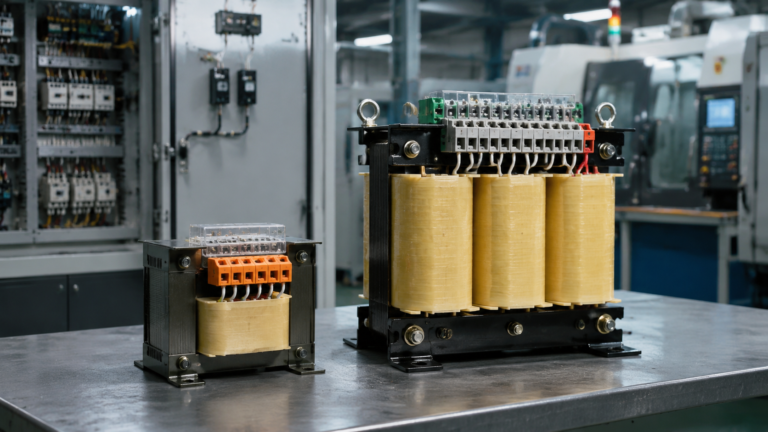
Step-Down Transformers for Machine Tools: Working Principles & Selection
Published: Author: Lisa
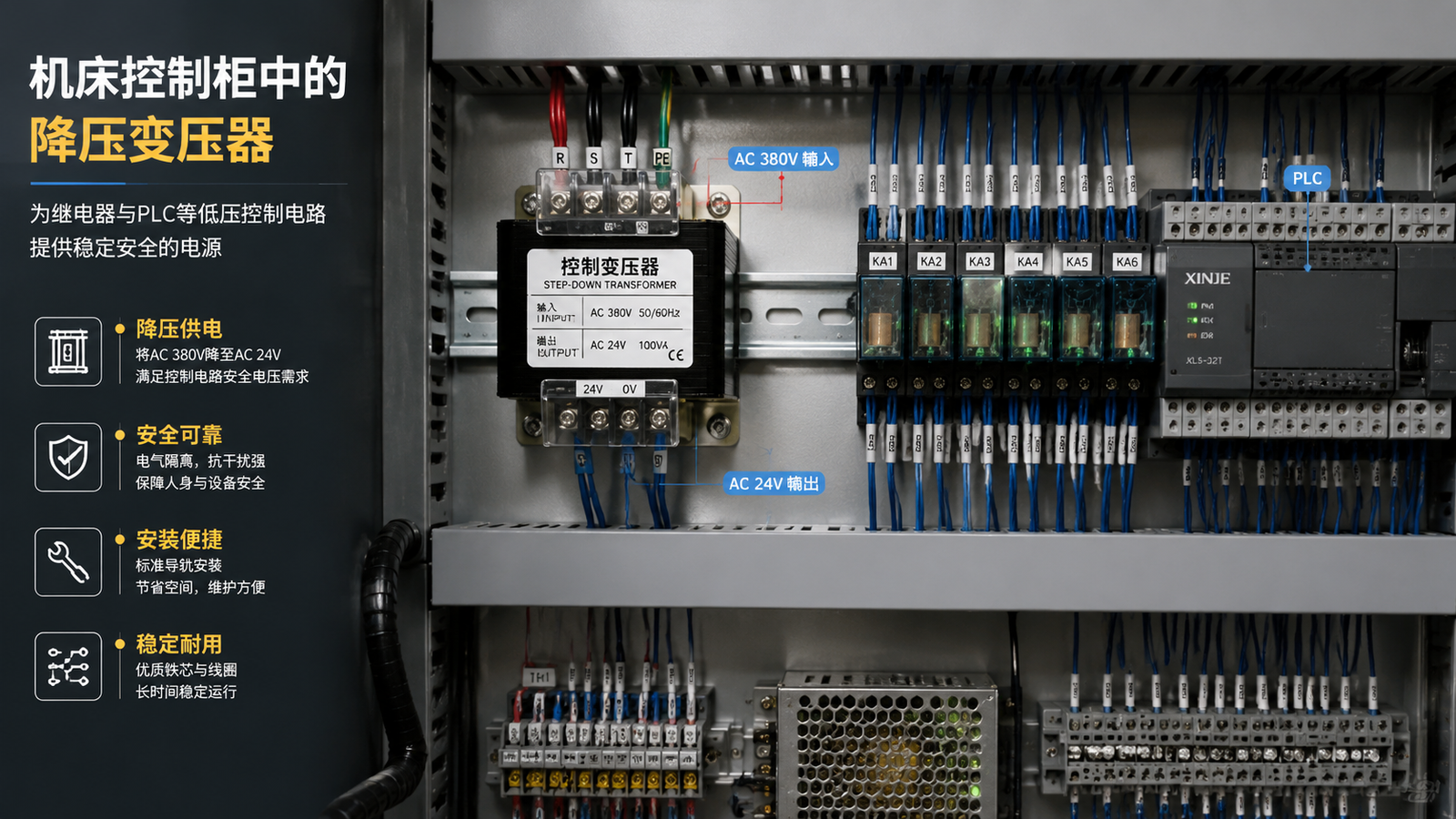
A machine tool step-down transformer
is the quiet workhorse behind every reliable control cabinet on a shop floor. It takes the incoming line voltage—often
220 V or 380 V AC—and converts it to a lower, safer control voltage that powers contactors, relays, PLCs, indicator lamps,
and solenoids. Without it, the control circuit of a CNC lathe, milling machine, or automated press would share the same
voltage as the main spindle drive, creating safety risks, noise issues, and premature component failure.
This guide explains how step-down transformers work in machine tools, how to size one correctly, and what to look for
when sourcing a custom control transformer for your equipment.
How a Step-Down Transformer Works in a Machine Tool
A step-down transformer is a static electromagnetic device. It transfers energy from its primary winding to its
secondary winding through a laminated silicon-steel core. Because the secondary winding has fewer turns than the primary,
the output voltage is lower than the input voltage while the frequency stays unchanged.
The relationship is simple:
Vprimary / Vsecondary = Nprimary / Nsecondary
For example, a transformer with 380 V on the primary and 110 V on the secondary has a turns ratio of roughly 3.45:1.
When the secondary voltage drops, the available current rises proportionally, so the control circuit still receives the
volt-amperes it needs to pull in contactors and energize relay coils.
Most machine-tool control transformers also provide galvanic isolation. The primary and secondary windings
are electrically separated, so transients and ground noise on the line side do not propagate directly into the low-voltage
control side. This isolation protects PLCs, sensors, and sensitive limit switches from voltage spikes caused by nearby
motor drives or welding equipment.
Common Machine Tool Applications
Step-down transformers are used wherever a machine needs a dedicated control supply. Typical applications include:
CNC machining centers – isolated 110 V or 220 V control supplies for spindle drives, servo amplifiers, and limit switches.
Lathes and milling machines – power for contactors, motor starters, coolant-pump relays, and emergency-stop circuits.
Injection molding and stamping presses – reliable low-voltage supplies for sequencing valves, safety interlocks, and operator panels.
Automated production lines – centralized control power distributed to multiple machine sections from one transformer.
In each case, the transformer must handle both the continuous sealed VA of the energized control circuit and
the momentary inrush VA when contactors and solenoids first pull in. A transformer that is sized only for
continuous load will sag during inrush and may drop out its own contactors.
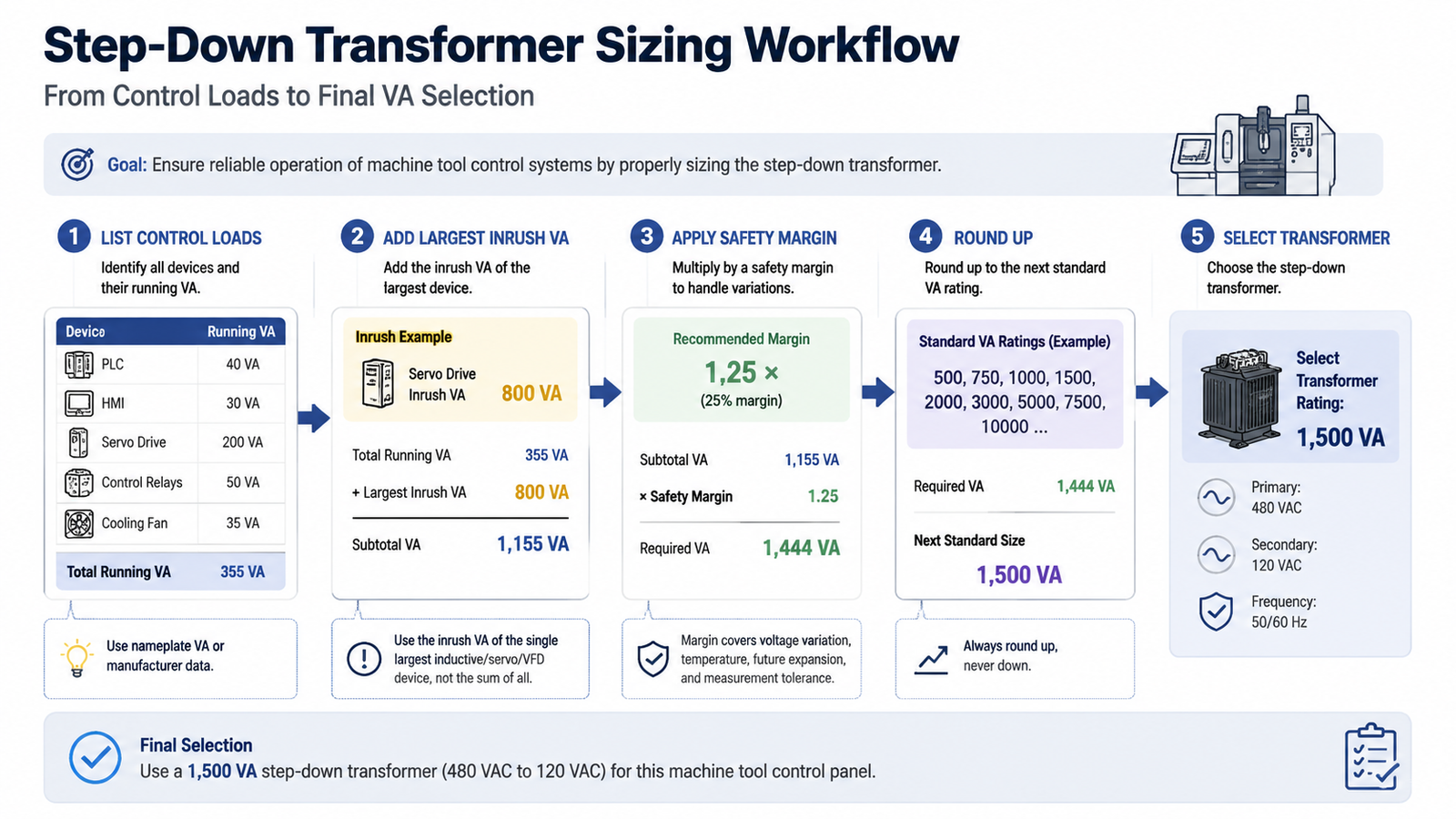
Sizing is the most common mistake when buying a control transformer. The transformer must be large enough to deliver the
inrush current of all switching devices without excessive voltage drop. Follow this process:
List every control load. Add the sealed VA of every contactor coil, relay, indicator lamp, PLC power
supply, and solenoid that will be energized at the same time.
Add the largest inrush VA. When one contactor pulls in, it can draw 3–10 times its sealed current for
a fraction of a second. Add the highest single inrush value to your total sealed VA.
Apply a safety margin. Multiply the result by 1.25–1.5 to account for measurement uncertainty, future
additions, and elevated ambient temperatures inside the cabinet.
Worked example: A CNC lathe panel has four 20 VA contactors, a 30 VA PLC supply, and four 2 VA indicator
lamps. The sealed total is 118 VA. The largest contactor inrush is 180 VA. The minimum transformer size is 118 + 180 =
298 VA. With a 1.25 margin, the design target becomes 373 VA, so a 400 VA transformer is the practical choice.
Most machine-tool transformers mount on a chassis bracket or on a DIN rail inside the control cabinet. DIN-rail mounting
is popular because it allows quick installation and easy replacement. Panel mounting is preferred when the transformer is
heavy or when vibration from the machine must be isolated from the rail. CNC machine tool installations
often combine both: a main transformer on a bracket and smaller auxiliary transformers on DIN rail.
Basic wiring rules apply regardless of mounting style:
Connect the line supply to the primary terminals, usually marked H1, H2, and sometimes H3, H4 for dual-voltage models.
Connect the control load to the secondary terminals, usually marked X1, X2.
Bond the transformer enclosure to the panel ground bus.
Install fuses or circuit breakers on both primary and secondary sides according to the nameplate current.
Verify the output voltage with no load before connecting sensitive electronics.
When to Choose a Custom Control Transformer
Off-the-shelf transformers cover many common ratings, but machine-tool builders often need a custom control transformer. Consider customization when:
The machine is exported to regions with different line voltages and requires multi-tap primaries.
The cabinet has tight height or depth limits and needs a special mounting bracket.
The control circuit needs multiple secondary voltages, such as 110 V for contactors and 24 V for PLCs.
The environment is hot, humid, or dusty and demands a higher insulation class or IP-rated enclosure.
The buyer wants private labeling, special terminal markings, or a customer-specific wiring diagram.
A custom transformer supplier should review your single-line diagram, duty cycle, ambient temperature, and target
certifications before quoting. This avoids the common problem of ordering a transformer that fits electrically but fails
mechanically or thermally in the final installation.
BK Series Example: A Practical Machine Tool Option
The BK series control transformer is a practical example of a
machine-tool step-down unit. It covers the 50–2500 VA range, accepts 220 V or 380 V primary input, and offers secondary
voltages customizable within 6–220 V AC. Both panel and DIN-rail mounting are available, which gives panel builders
flexibility in crowded enclosures.
Feature
BK series specification
Power range
50–2500 VA
Primary voltage
AC 220 V or 380 V
Secondary voltage
AC 6–220 V, customizable
Frequency
50/60 Hz
Mounting
Panel or DIN rail
Typical use
Machine tools, control panels, automation equipment
Use this checklist before finalizing your purchase:
Confirm primary voltage and frequency at the installation site.
Confirm secondary voltage required by the control circuit.
Calculate total sealed VA plus largest inrush VA.
Add 25–50% margin depending on duty cycle and ambient temperature.
Choose mounting style that fits the cabinet layout.
Verify insulation class and temperature rise for the operating environment.
Check whether CE, IEC, or RoHS compliance is required for the destination market.
Request a wiring diagram and terminal marking plan from the supplier.
Conclusion
A well-selected machine tool step-down transformer keeps control
circuits stable, protects sensitive electronics, and reduces nuisance tripping on the shop floor. The key is to size for
inrush, not just continuous load, and to specify voltage, mounting, and insulation requirements clearly. If your project
needs a non-standard voltage, special dimensions, or private labeling, a custom control transformer is the right path.
Share your load list, control voltage, and cabinet dimensions with our team, and we will recommend a transformer rating
and configuration that fits your machine.
Frequently Asked Questions
What is the difference between a step-down transformer and a control transformer?
A control transformer is a type of step-down transformer designed specifically for industrial control circuits. It is
built to handle high inrush currents from contactors and relays while maintaining stable secondary voltage.
Can I use a step-down transformer for both 220 V and 380 V input?
Only if the transformer has dual primary taps or is rated for both voltages. Always check the nameplate before wiring;
connecting 380 V to a 220 V primary will damage the unit.
How much VA margin should I add for a machine-tool control panel?
Add at least 25% above the sum of sealed VA plus the largest inrush VA. For continuous-duty or high-temperature cabinets,
50% margin is safer.
Why does my control transformer overheat?
Common causes include undersizing, poor ventilation, overloaded secondary, incorrect tap setting, or a shorted control
device drawing excess current.
What information do I need to request a custom control transformer?
Provide primary and secondary voltages, VA rating, frequency, mounting method, terminal requirements, insulation class,
quantity, and target market certifications.
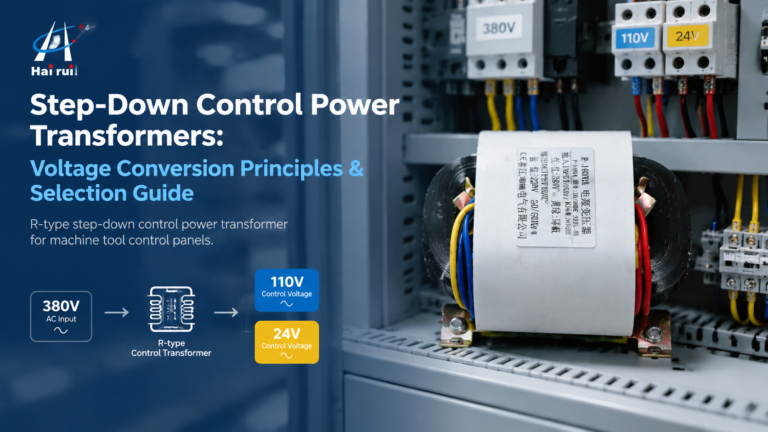
How step-down control power transformers convert 380V/480V line voltage to 110V or 24V control power: turns ratio, VA sizing with inrush, voltage-drop behaviour, wiring and selection.
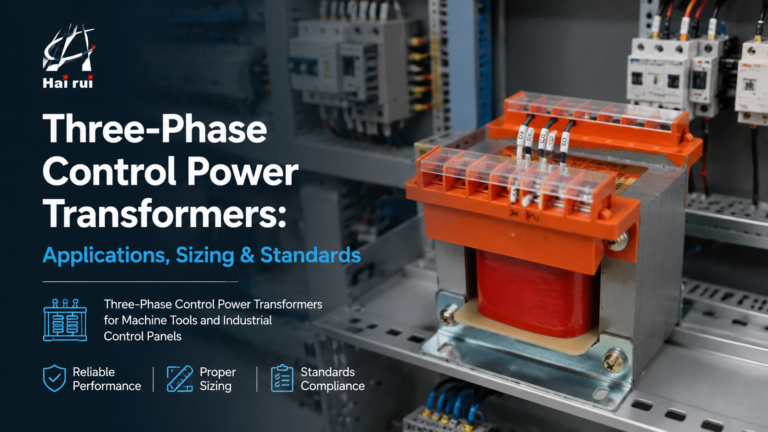
How three-phase control power transformers work, how to size them for machine tool and control-panel loads, and the delta/wye, standards and protection choices that matter in the field.