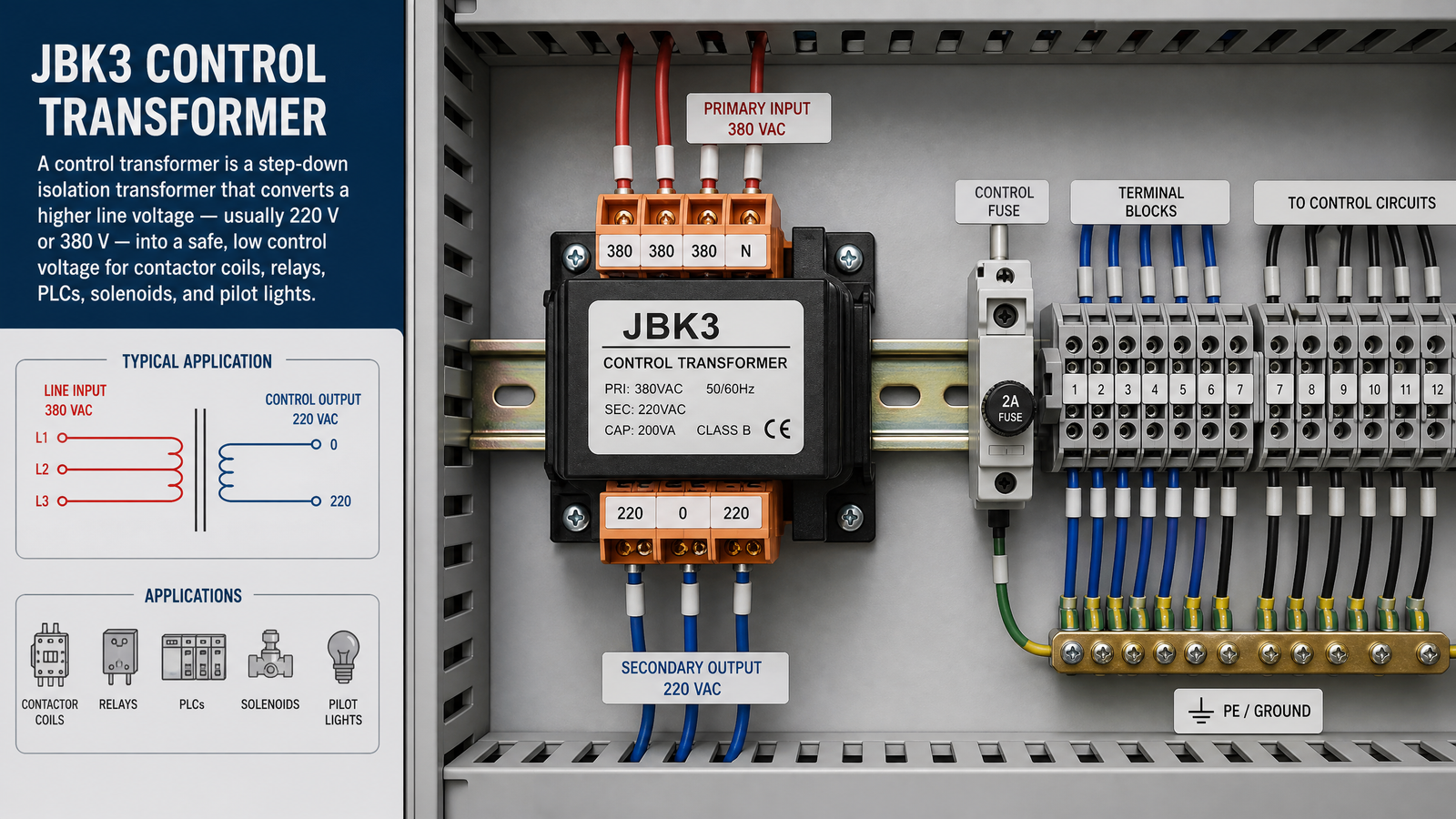
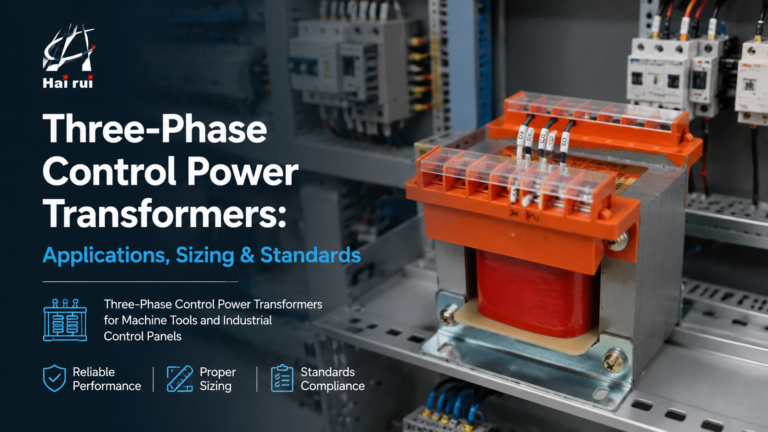
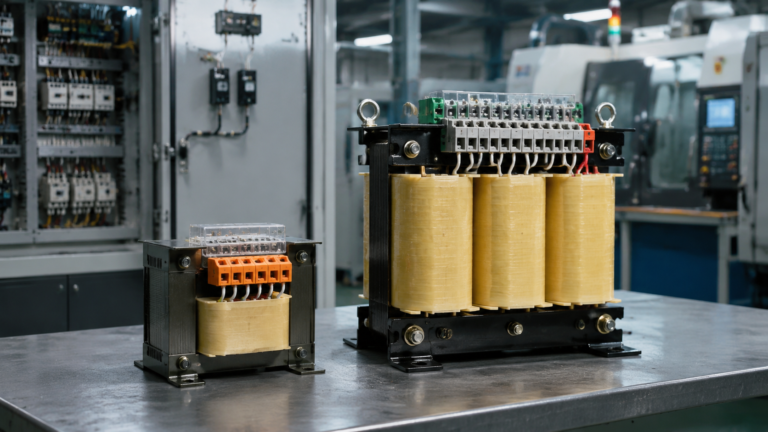
A control transformer is a step-down isolation transformer that converts a higher line voltage — usually 220 V or 380 V — into a safe, low control voltage for contactor coils, relays, PLCs, solenoids, and pilot lights. Understanding the main types of control transformer is the first step to specifying the correct unit for a CNC machine, packaging line, or electrical cabinet. In this guide you will learn how each type works, see the leading machine-tool series compared side by side, and get a simple selection method plus the mistakes to avoid.
Hairui Electric manufactures the four control-transformer series most commonly requested by panel builders and automation buyers, where each product page lists its rated capacity, input and output voltages, and mounting dimensions.
What Is a Control Transformer?
A control transformer — also called a control power transformer, or CPT — is a dry-type transformer purpose-built for control circuits rather than for bulk power delivery. Unlike a distribution transformer that feeds many loads, a control transformer powers the low-voltage devices that actually drive a machine: the coil of a contactor, the indicator lamp on a panel, or the input of a small PLC.
Its defining job is isolation and voltage reduction in one package. By stepping 220 V or 380 V down to a safe 6 V–220 V control level, it keeps operators away from line potential and protects sensitive electronics from spikes. Because control circuits are typically low-current, a control transformer is sized in volt-amperes (VA) rather than kilovolt-amperes — the JBK3 series, for example, spans 50 VA to 2500 VA.
How a Control Transformer Works
A control transformer follows the same electromagnetic principle as any transformer. An alternating current in the primary winding creates a changing magnetic field in the laminated silicon-steel core. That field induces a proportional voltage in the secondary winding. The turns ratio between the two windings sets the output voltage: fewer turns on the secondary means a lower, safer control voltage.
The practical steps look like this: the primary is wired to the machine’s incoming supply, the secondary is wired to the control devices, and the transformer is sized so its steady VA plus the inrush of contactor coils stays within its rating. When the load draws its normal control current, the transformer runs cool and the output stays steady even as the line voltage fluctuates.
The Main Types of Control Transformer
Hairui Electric’s control-transformer lineup breaks into four types that share a common purpose but differ in construction, mounting, and best-fit application. The three machine-tool series — BK, JBK3, and BKJ5 — dominate industrial panels, while the R-type serves low-noise electronics and instrumentation.
BK Series Control Transformer
The BK Series Control Transformer is a general-purpose workhorse for industrial automation and CNC power systems. Built with cold-rolled silicon steel and enamelled copper windings, it delivers low loss and high efficiency across a 50 VA–2500 VA range, accepting AC 220 V / 380 V input and providing 6 V–220 V output at 50/60 Hz. It mounts on a panel or DIN rail and is widely used for relays, indicators, solenoids, and work lamps in metalworking and packaging machinery.
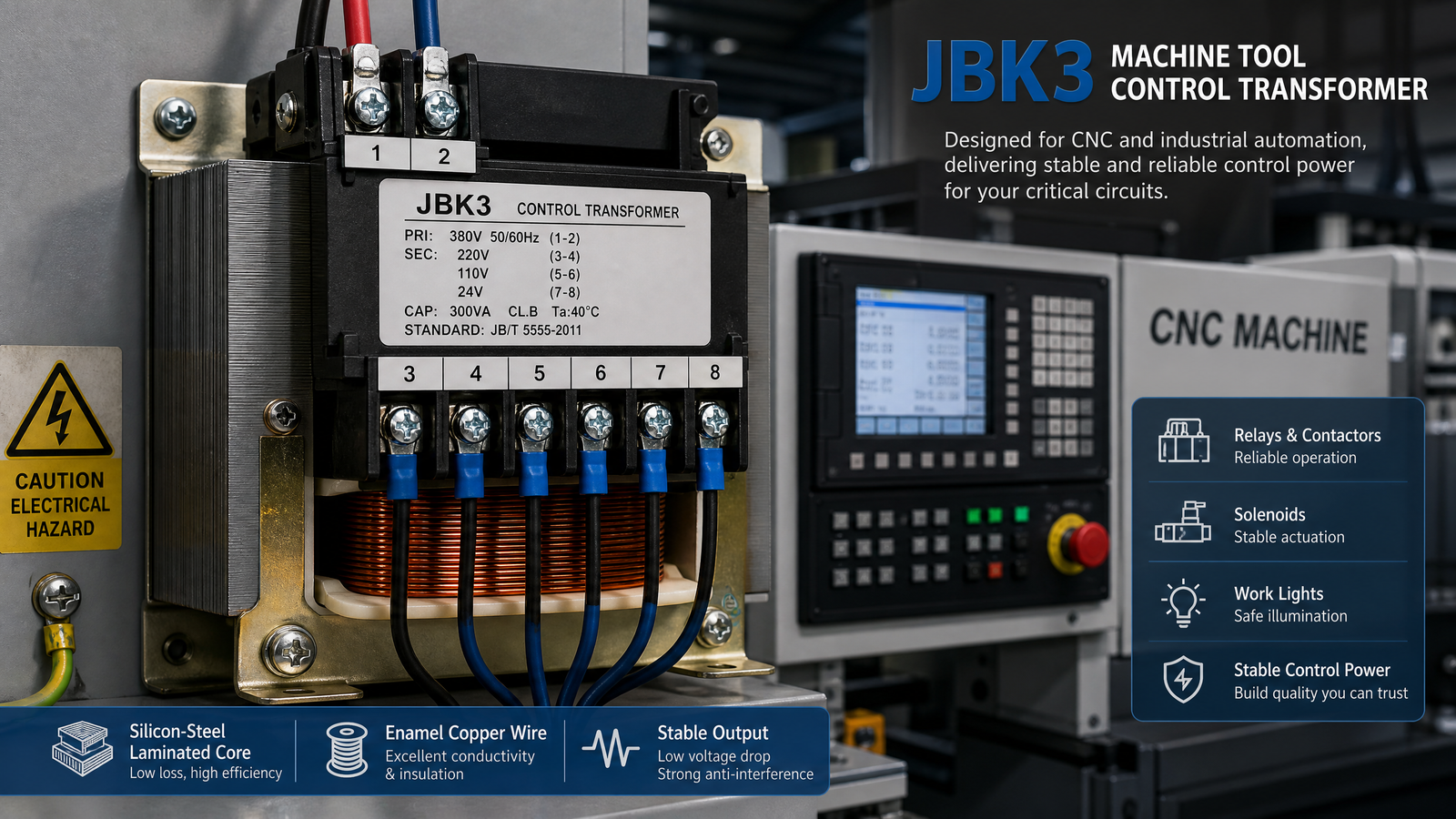
JBK3 Machine Tool Control Transformer
The JBK3 Machine Tool Control Transformer is the featured choice for CNC and industrial automation. It uses a silicon-steel laminated core with enamel copper wire and meets IEC and GB standards, with insulation classes B and F and an IP20 enclosure. Rated from 50 VA to 2500 VA, it accepts AC 220 V / 380 V and outputs 6 V–220 V, supporting DIN-rail or panel mounting. It provides stable control power for relays, contactors, solenoids, and work lights in metal processing, packaging, and textile lines.
BKJ5 Machine Tool Control Transformer
The BKJ5 Machine Tool Control Transformer is designed for industrial equipment that needs reliable single-phase control below 1000 V. It offers a standard 2500 VA capacity with customized options, AC 220 V / 380 V input, and 24 V / 110 V / 220 V output at 50/60 Hz. Its screw-terminal connections and vertical or horizontal mounting make it convenient in tight panel spaces, and it protects control circuits from voltage fluctuation and interference on packaging and textile equipment.
R-Type Transformer
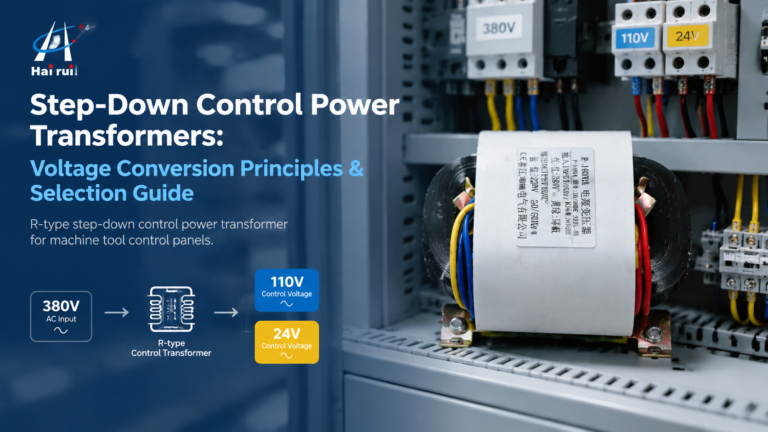
The R-type transformer is the quiet specialist of the group. Its core is a continuous grain-oriented cold-rolled silicon-steel strip wound into a circular cross-section, so it runs with low magnetic-flux leakage, low no-load current, and high efficiency. The coils sit on a flame-retardant PBT bobbin, which suits it to medical equipment, display devices, audio, and office equipment rather than heavy machine-tool loads.
Control Transformer Types Compared
The table below summarizes the four types at a glance. Use it to shortlist the right series before checking exact dimensions and VA ratings in the catalog.
Series
Rated capacity
Input / output voltage
Mounting
Best for
BK
50 VA–2500 VA
220/380 V in, 6–220 V out
Panel or DIN rail
General automation, relays, lamps
JBK3
50 VA–2500 VA
220/380 V in, 6–220 V out
DIN rail or panel
CNC and machine-tool control
BKJ5
2500 VA (custom)
220/380 V in, 24/110/220 V out
Vertical / horizontal
Single-phase control below 1000 V
R-type
Custom
220/380 V in, custom out
Panel
Low-noise electronics, medical, audio
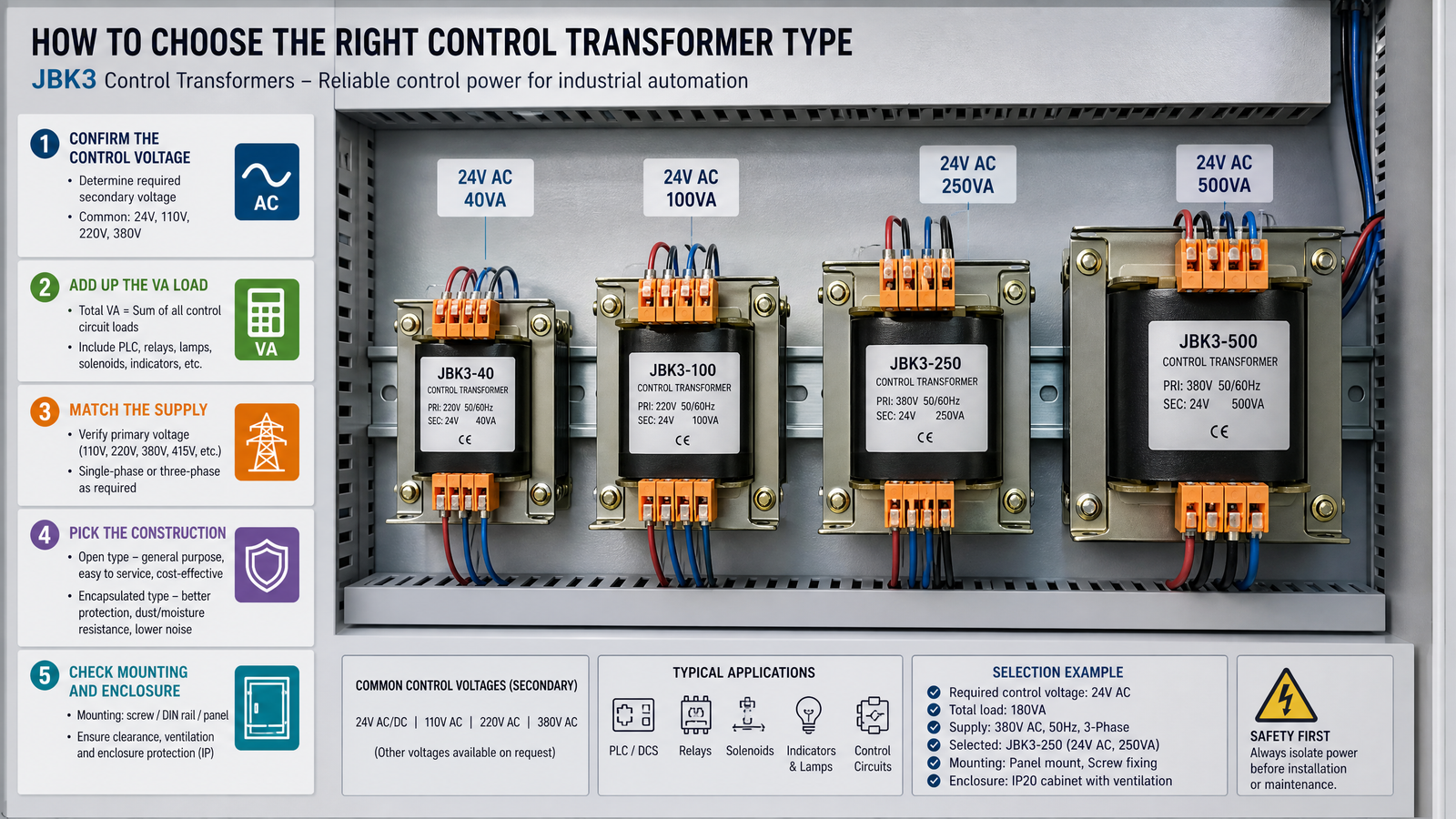
How to Choose the Right Type
Confirm the control voltage. Check what your contactors, relays, and PLC require — commonly 24 V, 110 V, or 220 V.
Add up the VA load. Sum the steady VA of every control device and add headroom for contactor-coil inrush.
Match the supply. Verify the incoming line is 220 V or 380 V so the primary wiring is correct.
Pick the construction. Choose a machine-tool series such as the JBK3 for CNC work, or the R-type when low noise matters.
Check mounting and enclosure. Confirm DIN-rail or panel fit and an IP20-rated enclosure for the cabinet.
Common Mistakes to Avoid
Sizing by watts instead of VA, which under-rates inductive control loads.
Ignoring contactor-coil inrush, the leading cause of a sagging control voltage.
Choosing an R-type for heavy machine-tool duty it was never meant to carry.
Overlooking the isolation requirement and wiring control devices straight to line.
Skipping the mounting check so the unit does not fit the panel footprint.
Hairui Electric has supplied industrial power solutions for years, with strict quality control on voltage stability, insulation, and durability — details you can review on our about us page.
Conclusion
Choosing among the types of control transformer comes down to the load, the control voltage, and the environment. For CNC and machine-tool panels, the JBK3 series offers the strongest all-round fit; the BK covers general automation, the BKJ5 handles single-phase control below 1000 V, and the R-type is the pick when silence and low loss matter most. Start from the comparison table, confirm your VA total, and you will land on the right unit the first time.
Frequently Asked Questions
What are the most common types of control transformer?
The most common are the BK, JBK3, and BKJ5 machine-tool series for industrial control circuits, plus the R-type transformer for low-noise electronic and instrumentation loads.
What is the difference between BK and JBK3?
Both span 50 VA–2500 VA with 220/380 V input, but the JBK3 is built specifically around CNC and machine-tool control systems, while the BK is a more general automation transformer.
What input and output voltages do control transformers use?
Hairui Electric’s machine-tool series accept AC 220 V / 380 V input and output 6 V–220 V (or 24 V / 110 V / 220 V for the BKJ5) at 50/60 Hz.
How do I size a control transformer?
Add the steady VA of all control devices, add margin for contactor-coil inrush, then choose a series whose rating covers that total without running hot.
Can control transformers be customized?
Yes, voltage, capacity, and mounting options are customizable through OEM/ODM support. For a tailored quote, reach our team through the contact us page.
How step-down control power transformers convert 380V/480V line voltage to 110V or 24V control power: turns ratio, VA sizing with inrush, voltage-drop behaviour, wiring and selection.
How three-phase control power transformers work, how to size them for machine tool and control-panel loads, and the delta/wye, standards and protection choices that matter in the field.