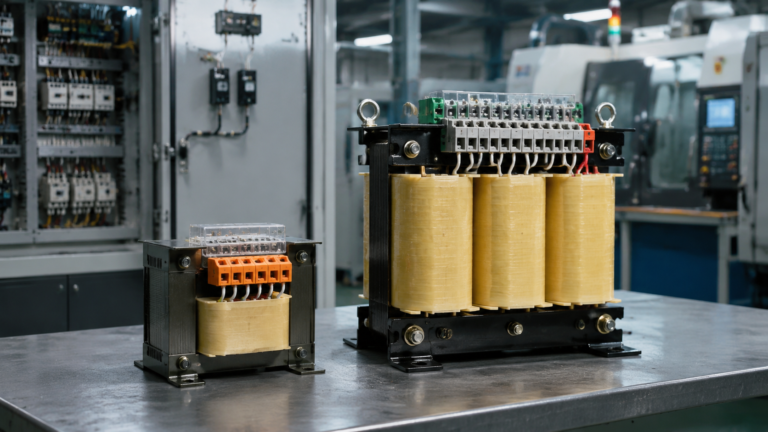
Control Transformers and Isolation Transformers Difference
Published: Author: Hairui Electric
Ever wondered why a control panel or industrial machine often contains more than one type of transformer? If you’ve encountered both Control Transformers and isolation transformers on schematics and weren’t sure how they differ, this article will make it clear.
Both play vital roles in electrical systems—but they’re not designed for the same purpose. Understanding their differences helps improve performance, safety, and cost efficiency in your setup.
What Are Control Transformers?
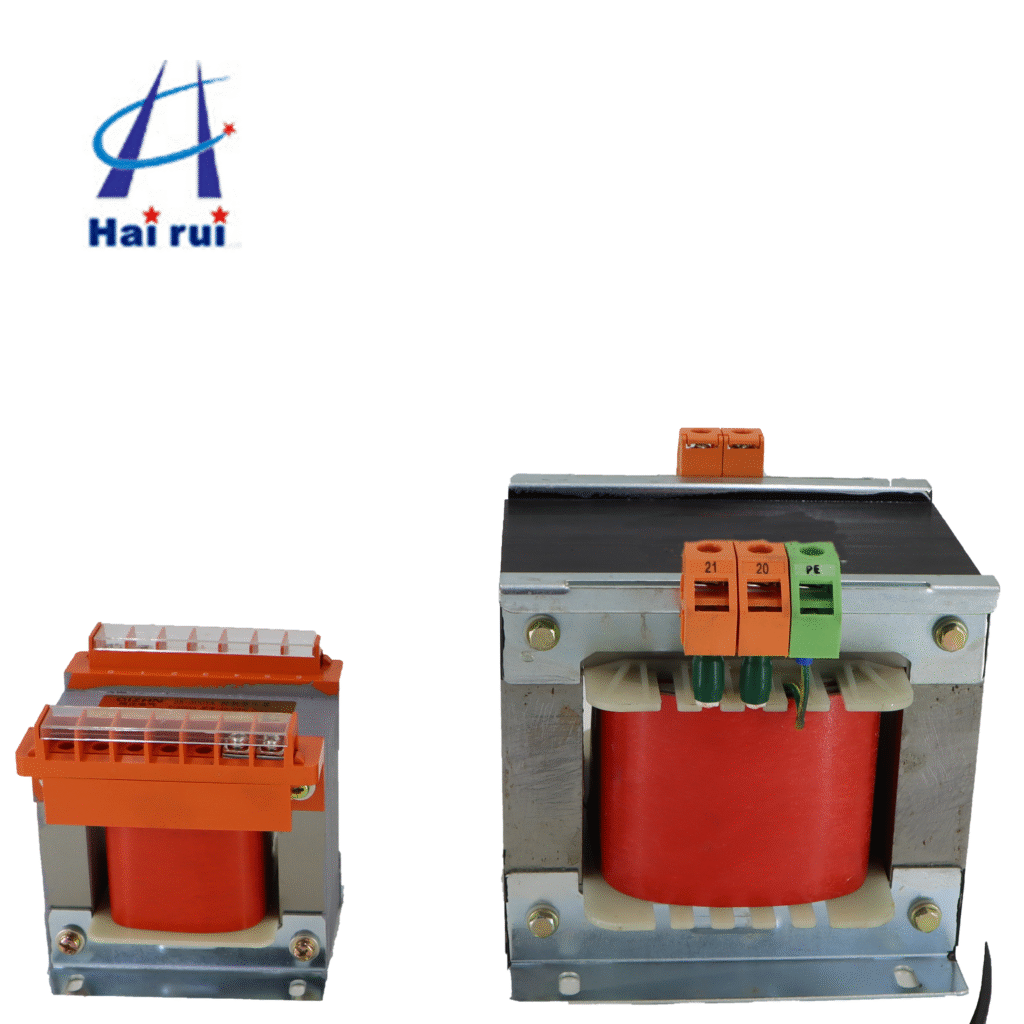
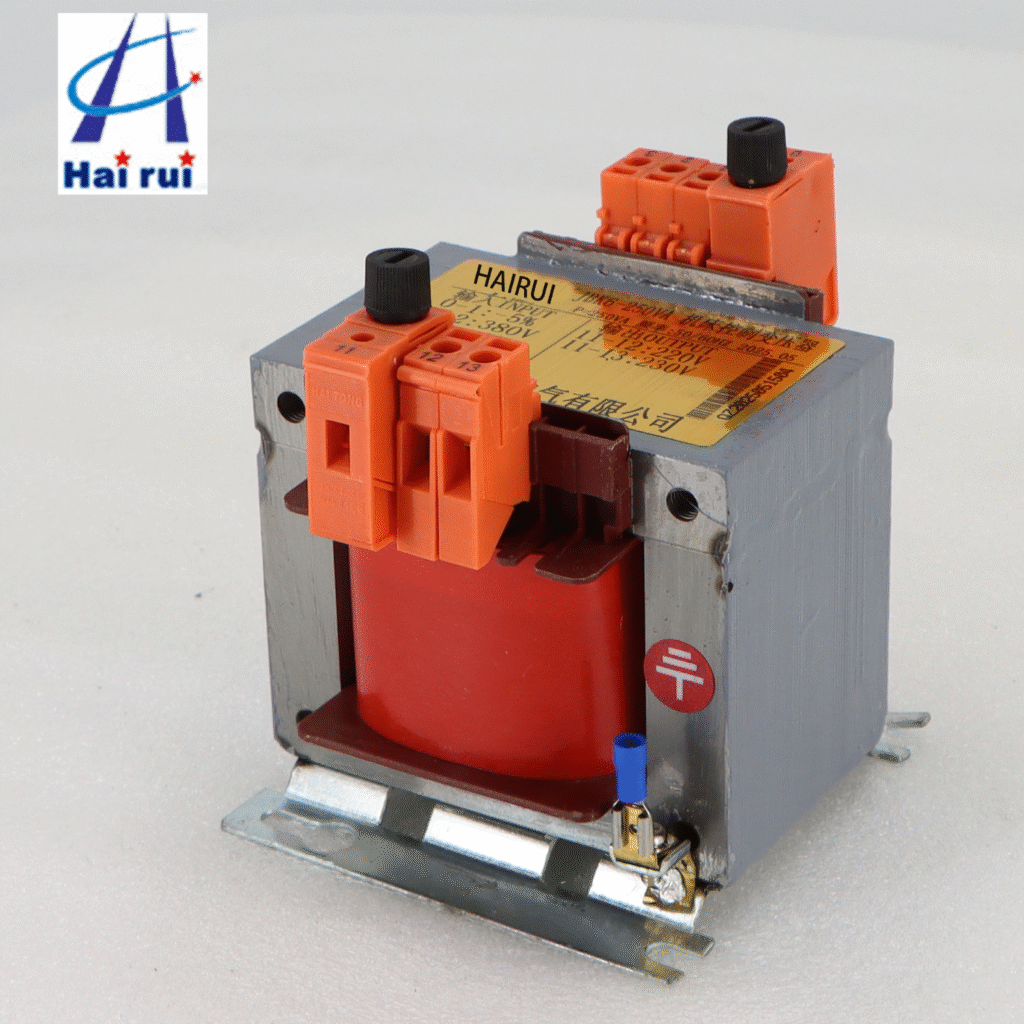
A BK Series Control Transformercontrol transformer (or machine tool transformer) is a type of step-down transformer used to provide stable voltage to control circuits. Typically, it converts higher line voltages (like 480 V or 240 V) down to lower control voltages (commonly 120 V, 48 V, or 24 V AC).
These transformers are designed to handle short-time inrush currents generated by devices like contactors, relays, and solenoids. In other words, they can momentarily supply high current without letting the voltage drop too much—a key need in automation and motor control panels.
Specification
Typical Range
Input Voltage
208V, 240V, 480V
Output Voltage
24V, 48V, 120V
Frequency
50/60 Hz
Power Rating
25 VA to 3 kVA
Core Type
Laminated silicon steel
Applications
CNC machines, PLC circuits, motor starters
One handy reference when reading industrial schematics is the control transformer symbol, often represented as a standard two-coil or laminated-core symbol. You can view a visual example from this control transformer electrical symbol guide.
BK Series Control Transformer
Isolation Transformer Purpose and Construction
An isolation transformer, in contrast, is built primarily to electrically isolate two circuits—without necessarily changing voltage. It protects human operators and delicate components by separating the secondary circuit from harmful ground loops or transient surges.
Feature
Isolation Transformer
Voltage Ratio
Usually 1:1 (same input and output voltage)
Key Function
Electrical isolation for safety
Primary Use
Medical, IT, and testing equipment
Shielding
Often includes electrostatic shields
Efficiency Focus
Low noise, high insulation resistance
Unlike control transformers, isolation models are not optimized for high inrush currents. Their main job is to provide safety, noise suppression, and system protection.
Key Differences Between Control Transformers and Isolation Transformers
Aspect
Control Transformer
Isolation Transformer
Purpose
Power control circuits reliably
Electrically isolate systems for safety
Voltage Ratio
Step-up or step-down
Usually 1:1
Load Type
Highly variable (relays, solenoids)
Sensitive electronic equipment
Regulation
Excellent during short inrush current
Stable continuous current
Application Examples
Motor control centers, automation systems
Test labs, data centers, medical equipment
Design Priority
Withstand high transient currents
Provide galvanic isolation and noise protection
Control transformers are specifically designed for situations where devices need quick bursts of power. Isolation transformers, however, are employed primarily for protection and system integrity.
Typical Industrial Applications
Control Transformers:
Industrial control panels
Machine tool circuits
HVAC control systems
Conveyor automation systems
Isolation Transformers:
Laboratory test benches
PLC I/O signal protection
Medical diagnostic machines
Data center power conditioning
These different application areas highlight why selecting the correct transformer for your project matters. A control transformer ensures your machine runs smoothly, while an isolation transformer protects sensitive devices from unwanted interference or potential harm.
Affordable price, huge discount!
Upgrade your power system today with reliable controltransformer! Contact us now for control transformer custom solutions and expert support.
Picking a control transformer isn’t just about voltage. Consider the following:
Voltage requirements – Ensure your primary and secondary match your control circuit.
Inrush VA vs. steady-state VA – Select based on the highest possible inrush load.
Frequency – Confirm compatibility with your region’s power supply (50 Hz or 60 Hz).
Ambient conditions – Look at enclosure rating (NEMA/IP) if installed outdoors or near dust/oil.
Certifications – UL, CE, or ISO approvals can simplify compliance checks for OEM exports.
To simplify specification, many manufacturers provide control transformer VA sizing charts online, making it easy to find the exact capacity you need.
Practical Example In a Motor Control Cabinet
In a standard motor control center (MCC), a control transformer provides 120 V AC to operate contactor coils, pilot lamps, and timers. When the main switch energizes, the transformer ensures adequate voltage to initiate the machine without flicker or relay chatter.
An isolation transformer, if added, typically protects communication modules or PLC analog inputs from grounding issues or transient spikes that travel through shared lines.
Together, they create a balanced design—one providing operational stability, the other ensuring safety and electrical cleanliness.
Benefits of Using Control Transformers in Industrial Systems
Improved system reliability: Stable control voltage = fewer nuisance trips.
Enhanced safety: Separation of control circuit from power circuit reduces operator risk.
Longer equipment lifespan: Proper power supply prevents overheating in coils and relays.
If your application involves mechanical relays or heavy-duty contactors that draw large inrush currents, choosing a dedicated control transformer instead of a general isolation unit will deliver better performance.
Maintenance and Troubleshooting Tips
Control transformers are robust, but regular inspection helps extend service life:
Check tightening of terminal connections.
Inspect for discoloration or odor (sign of overheating).
Measure secondary voltage under load to confirm output stability.
Keep ventilation openings clean and dry.
In case of irregular voltage or excessive vibration, verify both the primary voltage balance and core mounting. Transformers in dusty or high-vibration areas benefit from periodic visual checks and dust cleaning.
The difference between control transformers and isolation transformers lies in their purpose. Control transformers deliver steady voltage to control circuits during transient conditions, while isolation transformers provide electrical separation and noise protection.
For engineers, procurement teams, and OEM designers, selecting the right transformer means safer systems, better performance, and fewer downtime incidents.
If your project involves control panels or industrial automation, exploring custom or UL-listed control transformer options could significantly enhance reliability.
Need help finding the right control transformer or understanding specific wiring diagrams? Reach out to your supplier or submit an inquiry today for expert technical support.
FAQ
u003cstrongu003eCan an isolation transformer be used as a control transformer?u003c/strongu003e
Technically yes, but it’s not recommended. Isolation transformers aren’t designed to handle short bursts of high inrush current, so control circuit performance may degrade.
u003cstrongu003eWhat is the standard control voltage in industrial machines?u003c/strongu003e
Common levels include 24 V AC, 48 V AC, and 120 V AC, depending on regional safety standards and control device ratings.
u003cstrongu003eWhat is the control transformer electrical symbol?u003c/strongu003e
It’s depicted as two inductively coupled coils with a core, similar to a basic transformer symbol. See an example here.
u003cstrongu003eDoes a control transformer provide isolation too?u003c/strongu003e
Yes, but isolation is secondary—it’s mainly designed for magnetizing current stability and control circuit voltage regulation.
u003cstrongu003eHow can I calculate required VA size?u003c/strongu003e
Sum the total VA of all devices on the secondary circuit, then multiply by 1.25 to account for start-up inrush.
u003cstrongu003eAre control transformers available with dual primaries?u003c/strongu003e
Yes. Dual-primary models allow 240 V or 480 V input connectivity, offering flexibility for global installations.
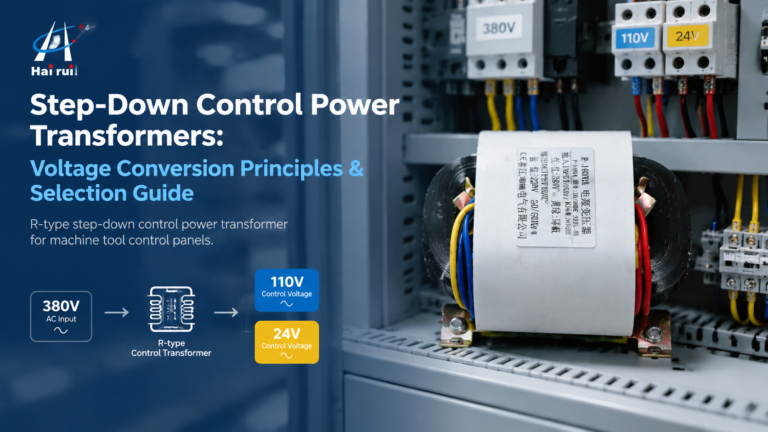
How step-down control power transformers convert 380V/480V line voltage to 110V or 24V control power: turns ratio, VA sizing with inrush, voltage-drop behaviour, wiring and selection.
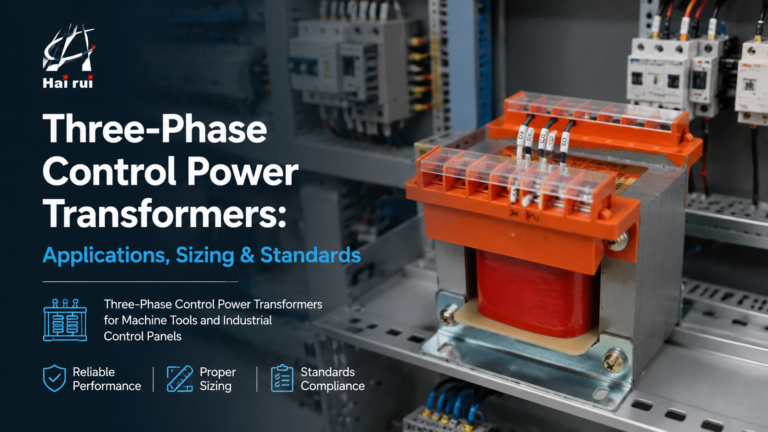
How three-phase control power transformers work, how to size them for machine tool and control-panel loads, and the delta/wye, standards and protection choices that matter in the field.