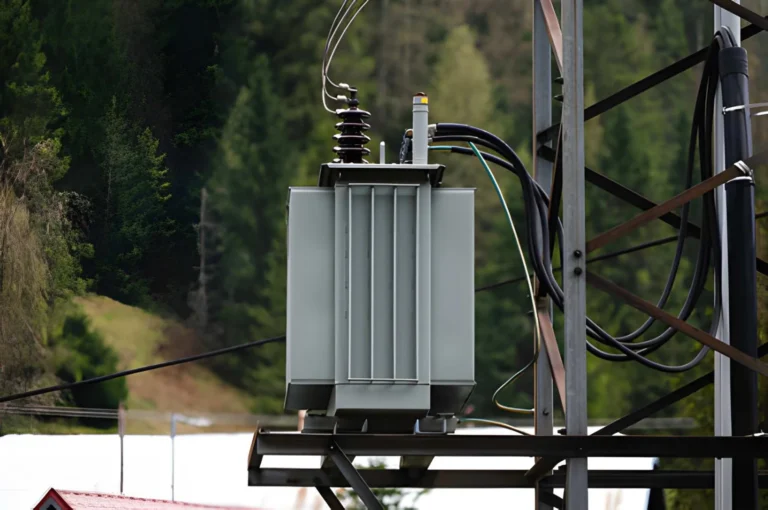
A 10kV oil immersed transformer is usually considered when a project needs medium-voltage distribution, outdoor installation, or a transformer that can handle higher-capacity duty with oil-based cooling and insulation. Choosing the wrong transformer type can affect installation limits, maintenance planning, fire-safety measures, and long-term operating loss. This guide helps you decide where a 10kV oil immersed transformer fits, when dry type is the better choice, and what a buyer should confirm before sending an RFQ.
Why 10kV Oil Immersed Transformer It Matters
An oil immersed transformer uses insulating oil around the core and windings, and that oil serves both as an insulation medium and as part of the cooling path. In practice, that matters because thermal behavior is not just a design detail; it affects loading, ageing, and service life under real ambient conditions.
For substation and distribution projects, buyers should not stop at the product name. A better question is whether the transformer matches the system voltage, expected load pattern, installation environment, loss target, and the rest of the distribution equipment in the same project.
Two loss terms matter early in the buying process. No-load loss is mainly core loss and exists even when the transformer is energized without supplying load, while load loss rises with current during operation. That is why a low loss oil immersed transformer may justify a higher purchase price when the transformer runs for long hours or when energy cost is a serious part of lifecycle cost.
Industrial plants with continuous or variable production loads.
Commercial distribution projects where medium-voltage intake must be stepped down for downstream equipment.
Utility-side or infrastructure upgrades where the transformer must match switchgear, protection, and site conditions.
The selection logic is simple: if the project is medium-voltage, load density is meaningful, and installation conditions favor an oil-filled design, the conversation usually moves from “what is it” to “which configuration and loss class should we buy.”
Where It Fits
The strongest application case for a 10kV oil immersed transformer is substation distribution. Oil-filled units are often preferred in larger applications and higher-voltage duties, while dry-type units are more often chosen for smaller or medium-voltage indoor environments with stricter fire-location constraints.
In an industrial plant, the transformer is part of a system, not a standalone purchase. The buyer may need to coordinate the transformer with medium-voltage switchgear, low-voltage panels, cable routing, space limits, and maintenance access. That is also why B2B buyers, distributors, and EPC teams should evaluate the transformer together with the upstream and downstream distribution architecture instead of buying only on rated kVA.
In commercial or public-facing buildings, the installation environment becomes a stronger filter. Dry-type transformers are often chosen where fire and indoor placement concerns dominate, while oil immersed transformers are more often used where outdoor installation, capacity range, and cooling advantages matter more.
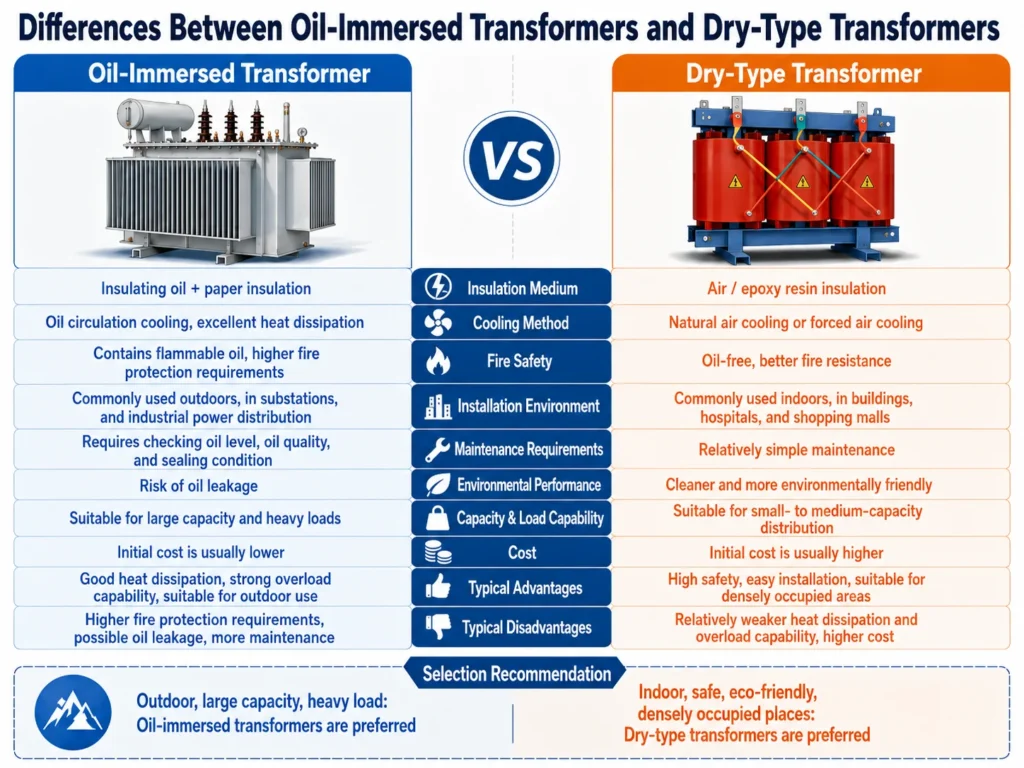
Oil Immersed Transformer vs Dry Type Transformer
The most searched comparison around this topic is not technical theory. It is a practical decision: should this project use an oil immersed transformer or a dry type transformer?
Factor
Oil Immersed Transformer
Dry Type Transformer
What the buyer should ask
Cooling and insulation
Uses oil for insulation and heat dissipation.
Uses air and solid insulation rather than oil.
Is heat removal a limiting factor in this installation?
Typical placement
Often better suited to outdoor or dedicated electrical areas.
Often preferred in indoor locations with stronger fire-related constraints.
Will the transformer be placed inside an occupied building or outside in a substation yard?
Capacity and voltage range
Commonly used across a wider capacity and higher-voltage range.
More often associated with medium and smaller distribution duties.
Is the project likely to grow in load or require more demanding duty?
Maintenance
Requires attention to oil condition and related maintenance items.
Generally seen as lower in routine oil-related maintenance because there is no insulating oil to monitor.
Does the site have maintenance capability for periodic checks?
Purchase economics
Often lower in initial cost at the same rating.
Often higher in initial cost for comparable rating.
Is the project driven more by installation constraints or by equipment cost?
Selection Logic
Choose oil immersed when the project is substation-based, outdoor, capacity-sensitive, or focused on thermal margin and total cost of operation over time. Choose dry type when the installation is indoors, closer to occupied space, or subject to stricter fire-location requirements.
That does not mean oil immersed is always better. It means the buyer should align the transformer type with the real site conditions instead of comparing only price or only nameplate capacity. In many failed purchasing decisions, the problem is not the transformer itself; it is the mismatch between transformer type and project environment.
What to Check
A serious RFQ for a 10kV oil immersed transformer should confirm more than rating and price. It should cover electrical fit, loss expectations, loading behavior, environmental limits, and supplier capability.
Critical Parameters
Parameter
Why it matters
What to confirm before purchase
Rated capacity
It determines whether the transformer can support present and expected load without constant overload pressure.
Actual load profile, future expansion, and whether peak load is occasional or continuous.
Voltage ratio
It must match the medium-voltage input and the required low-voltage or downstream distribution level.
Primary voltage, secondary voltage, frequency, and tap requirements.
No-load loss
It exists whenever the transformer is energized and is mainly associated with core loss.
Whether the project values lower standby loss across long operating hours.
Load loss
It increases with current and affects efficiency under real operating load.
Typical loading range, not just full-load rating.
Loading conditions
Thermal ageing and acceptable loading are affected by ambient temperature and duty conditions.
Site temperature, altitude, ventilation, and expected overload events.
Standard and testing
Oil-immersed transformer loading guidance is covered in IEC 60076-7 for mineral-oil-immersed units.
Which standard applies, what routine tests are included, and what documentation will be supplied.
low loss oil immersed transformer Selection
A low loss oil immersed transformer is not automatically the right choice for every project. It becomes more attractive when the unit stays energized for long hours, runs across many years, or serves a buyer that cares about operating cost rather than only purchase price.
That is why the right comparison is not “standard vs low loss” in isolation. The real comparison is upfront cost versus expected operating hours, electricity price, project life, and the buyer’s energy-efficiency target.
Supplier Evaluation
For B2B sourcing, the buyer should assess whether the company is a true manufacturer or factory, a trading supplier, or an exporter coordinating production through another plant. That affects drawing control, lead time stability, test transparency, customization depth, and after-sales support.
For a distributor, wholesaler, or bulk purchase team, the checklist is broader:
Can the supplier support OEM or ODM requirements?
Can the factory handle custom voltage ratio, loss target, and enclosure details?
Can the exporter provide packing, documentation, and shipment support for overseas delivery from China?
Can the manufacturer support repeat orders, white label or private label programs, and stable quality across batches?
Does the quoted price clearly state what is included: tests, accessories, packaging, and delivery terms?
If your project also needs matching distribution equipment, reviewing a manufacturer’s oil immersed transformer range can help you compare configuration options before price discussions begin.
Common Buying Mistakes
The first mistake is comparing only purchase price. A lower quote can become more expensive when losses, maintenance, documentation gaps, or project mismatch are included.
The second mistake is ignoring installation conditions. A transformer that looks correct on paper may be the wrong choice if the site is indoor, space-limited, maintenance-poor, or subject to strict fire-location rules.
The third mistake is treating supplier labels as the same thing. A manufacturer, supplier, factory, distributor, and trader can all sell the product, but they do not always control engineering, testing, or customization in the same way.
Before asking for a final quotation, confirm five points: voltage ratio, rated capacity, loss target, site environment, and whether the transformer must match switchgear or other distribution equipment in the same project. That small step usually saves more time than negotiating price too early.
Before sending an RFQ, it helps to confirm the required voltage ratio, capacity, loss target, installation environment, and whether the transformer needs to match switchgear in the same distribution system.”
FAQ
What is a hairui electric 10kV oil immersed transformer used for?
It is mainly used in medium-voltage distribution projects where 10kV power must be stepped down for downstream use. Common examples include substations, industrial plants, and commercial distribution systems connected to medium-voltage intake.
How do you choose between an oil immersed transformer and a dry type transformer?
Start with the installation environment. Oil immersed transformers use oil for cooling and insulation, while dry-type units rely on air and solid insulation, so the choice often depends on whether the project is outdoor and capacity-driven or indoor and fire-location sensitive.
What parameters should buyers confirm before ordering?
Confirm rated capacity, primary and secondary voltage, frequency, loss target, loading pattern, installation environment, and required standard or tests. If the project is cost-sensitive over many years, no-load and load loss deserve more attention than buyers often give them.
Is a low loss oil immersed transformer worth the extra cost?
Often yes, but only when the transformer will stay energized for long periods or operate for many years. Since no-load loss exists whenever the unit is energized, a low-loss design can improve lifecycle economics in the right duty profile.
Can a 10kV oil immersed transformer be used in substation projects?
Yes. Oil-immersed transformers are widely associated with distribution and substation duty, especially where outdoor placement, broader capacity range, and thermal performance are important.
How do you evaluate a 10kV oil immersed transformer manufacturer in China?
Check whether the supplier is the actual factory, what standards and routine tests are provided, whether export support is mature, and how customization is handled. For repeat procurement, also verify consistency across batches, documentation quality, and whether OEM or ODM requirements can be controlled without delaying lead time.
If you are evaluating oil immersed transformers for a substation, industrial plant, or renewable energy project, the variety of available types can make selection feel complicated. The distinctions are not only about kVA and voltage. They extend to cooling class, tank construction, phase configuration, insulating fluid chemistry, winding material, and the specific duty the transformer […]
An oil immersed transformer is the workhorse of medium- and high-voltage power distribution — the unit you find in substations, industrial plants, and renewable energy projects where cooling capacity, overload margin, and long service life matter more than a compact footprint. Most specification mistakes do not start with the brand or the price. They start […]
At its simplest, an oil immersed transformer (also called an oil filled transformer or oil type transformer) is a static electrical device that transfers energy between circuits through electromagnetic induction, with its active parts fully submerged in insulating oil.