Common Mistakes When Replacing Industrial Control Transformers
Published: Author: Hairui Electric
Replacing an industrial control transformer might sound straightforward—but even experienced engineers and procurement teams can make small mistakes that lead to big consequences. Whether you’re maintaining a production line, upgrading control panels, or troubleshooting frequent voltage drops, understanding what not to do is as important as knowing what to do.
In this post, we’ll dive deep into the most common mistakes made when replacing control transformers, how to avoid them, and what to consider when selecting the right model for your industrial application. If you’re responsible for maintaining reliable equipment performance or sourcing electrical components for your company, this guide is for you.
Why Industrial Control Transformers Matter
Industrial control transformers (ICTs) provide stable, reduced voltage to control devices such as contactors, solenoids, and relays. Unlike general-purpose transformers, ICTs are designed to handle high inrush currents while maintaining consistent secondary voltage under load changes—a critical factor for factory automation, CNC machines, and process control systems.
A transformer failure doesn’t just stop a machine—it can disrupt an entire production line. That’s why proper replacement, sizing, and installation are essential to keep your equipment safe and efficient.
Parameter
Description
Typical Range
Primary Voltage
Input voltage from the supply line
230V / 460V / 600V
Secondary Voltage
Output voltage for control circuits
24V / 48V / 120V
Power Rating
VA capacity that indicates load capability
50VA – 5000VA
Frequency
Operation frequency
50Hz / 60Hz
Protection
Enclosure or IP rating
IP20 – IP65
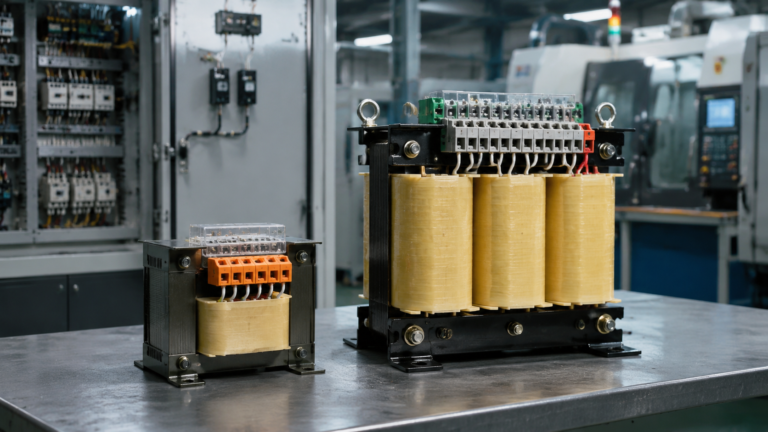
JBK3 Machine Tool Control Transformer
Mistake 1: Selecting the Wrong Transformer Rating
One of the most frequent errors during replacement is choosing a transformer with an incorrect power rating (VA value). Underrating can cause overheating, voltage drops, or tripping during startup. Overrating, on the other hand, increases cost and footprint unnecessarily.
When selecting a replacement:
Calculate the total inrush current and steady-state current of connected loads.
Add a safety margin (typically 25–50%) above your calculated VA.
Check manufacturer datasheets for Industrial Control Transformer Regulation (ICTR) performance curves.
Example: If your control circuit uses solenoids and contactors with a total steady-state draw of 300VA, choose a transformer rated around 400–500VA to ensure optimal performance.
A good rule of thumb: Match the transformer to your actual operational load, not just nameplate data.
Mistake 2: Ignoring Input Voltage and Frequency Compatibility
It’s easy to overlook voltage and frequency differences, especially for imported machinery or when sourcing transformers globally. Connecting a transformer rated for 480V/60Hz to a 400V/50Hz network can lead to:
Lower secondary output voltage
Excessive heating
Shortened device lifespan
Before installing a replacement, always verify:
Check Item
Why It Matters
Primary voltage match
Prevent low or high secondary voltage
Frequency match (50Hz vs 60Hz)
Ensures correct magnetic flux levels
Multi-tap primary configuration
Allows flexibility for multiple input voltages
When in doubt—consult your supplier or send us your equipment voltage details for a specification match recommendation.
Mistake 3: Poor Wiring and Grounding Practices
Even a perfectly rated control power transformer can fail due to poor wiring practices. Common missteps include loose terminals, reversed polarity, or neglected grounding.
Always ensure:
The primary winding is connected to the correct input voltage tap.
The secondary wiring is rated for the expected current.
A proper ground connection is established to prevent dangerous voltage leaks.
Pro tip: Use properly crimped ring terminals and label all connections before energizing. This step reduces downtime during future maintenance.
Mistake 4: Overlooking Ambient Conditions
Heat and humidity drastically affect transformer efficiency and longevity. Installing an industrial control transformer inside a non-ventilated electrical cabinet or near heat-producing equipment can cause insulation breakdown.
Factors to check before installation:
Environmental Factor
Recommended Action
High temperature (>40°C)
Use larger VA rating or forced ventilation
Vibration risk
Confirm mechanical mounting stability
Dust or moisture
Select transformers with higher IP protection (IP54 or IP65)
Chemical exposure
Opt for epoxy-filled or encapsulated designs
Always match the enclosure class to your environment. For example, transformers in outdoor control boxes should have an IP65 or NEMA 4 rating.
Mistake 5: Replacing Without Checking Load Condition
A transformer failure sometimes points to underlying circuit issues rather than age or wear. Before swapping out the old unit, measure the circuit’s current draw and check for shorts, coil failures, or abnormal inrush levels. Replacing the transformer without addressing root causes may lead to repeat failures.
Use tools like:
Clamp meters for current checks
Insulation resistance testers
Thermal imaging cameras to identify overheated components
If your plant operates 24/7, consider predictive maintenance monitoring—a growing trend in industrial power management.
Mistake 6: Using Non-Industrial-Grade Transformers
Not all transformers are designed for industrial duty. General-purpose or residential-grade transformers may fail prematurely in demanding control panel environments due to vibration, surge exposure, or continuous cycling.
Industrial models usually feature:
Reinforced insulation systems
High short-circuit withstand ratings
Robust voltage regulation design
When sourcing replacement parts, always look for UL 5085-2 or CE certified industrial control transformers. These certifications ensure compliance with performance and safety standards in factory automation and process industries.
Mistake 7: Forgetting to Verify Short-Circuit Protection
Every transformer installation should include secondary circuit protection, typically fuses or circuit breakers. Missing or incorrect protection leads to severe damage during overload events.
Best practices:
Fuse both primary and secondary sides for overcurrent protection.
Follow NEC Article 450 or IEC equivalents.
Use time-delay fuses for high inrush applications.
If you’re unsure which fuse rating to use, your control transformer supplier (that’s us!) can provide tailored protection recommendations based on load characteristics.
How to Choose the Right Industrial Control Transformer
Below is a quick decision table to simplify your next purchase:
Criteria
Key Considerations
Example Selection
Voltage requirement
Match your system (e.g. 480V to 120V)
480V/120V ICT
Load current (VA)
Total steady + inrush current
350VA + 25% margin = 440VA
Environment
Indoor, outdoor, high temp
IP54 rated encapsulated transformer
Certifications
UL, CE, RoHS
UL5085-2 certified
Mounting type
Panel mount / DIN rail
Panel-mounted
Noise level
Noise-sensitive or standard
Low-noise type for control rooms
Need a replacement urgently? Contact our sales team for fast quotes and stock availability on industrial control transformers for your voltage system.
Replacing an industrial control transformer is more than a swap—it’s a calibration of your control system’s reliability. Avoiding mistakes in voltage selection, wiring, and environmental fit will help you reduce maintenance costs and extend equipment life.
When in doubt, partner with a reputable manufacturer or distributor that provides technical support, genuine industrial-grade components, and fast delivery. Remember, the right control transformer keeps your operations running smoothly—and prevents unexpected shutdowns that cost far more than the part itself.
Looking for expert advice or a quote? Contact our engineering team today to find the ideal industrial control transformer for your next project.
FAQ
u003cstrongu003eWhat is the difference between a control transformer and a power transformer?u003c/strongu003e
A control transformer is designed to manage fluctuating inrush currents and stabilize output voltage for control circuits, while a power transformer handles continuous high voltage transfer for distribution.
u003cstrongu003eHow long does an industrial control transformer last?u003c/strongu003e
Typically 10–20 years, depending on operating temperature, load conditions, and maintenance practices.
u003cstrongu003eCan I use a 60Hz transformer on a 50Hz system?u003c/strongu003e
Yes, but you must u003cstrongu003ederate the VA capacityu003c/strongu003e to avoid overheating and voltage sag.
u003cstrongu003eWhat size control transformer do I need?u003c/strongu003e
Add up all loads on the secondary circuit, consider inrush current, then multiply by 1.25–1.5 to determine the appropriate VA rating.
u003cstrongu003eHow do I order an industrial control transformer?u003c/strongu003e
You can send your required primary/secondary voltage, VA, and enclosure type to our sales team—our engineers will match a model that fits your application precisely.
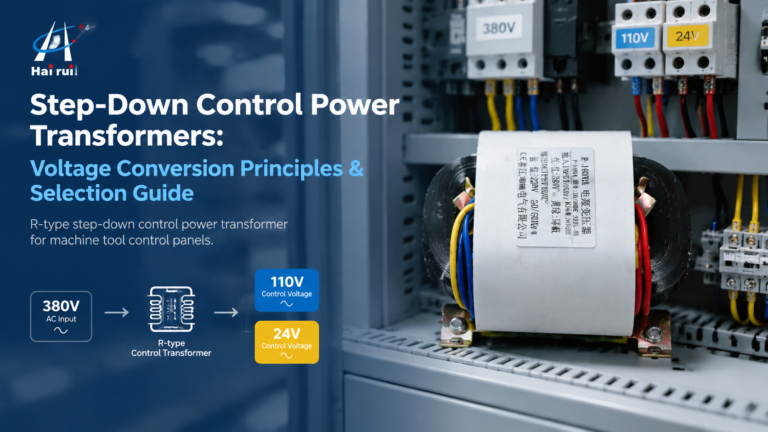
How step-down control power transformers convert 380V/480V line voltage to 110V or 24V control power: turns ratio, VA sizing with inrush, voltage-drop behaviour, wiring and selection.
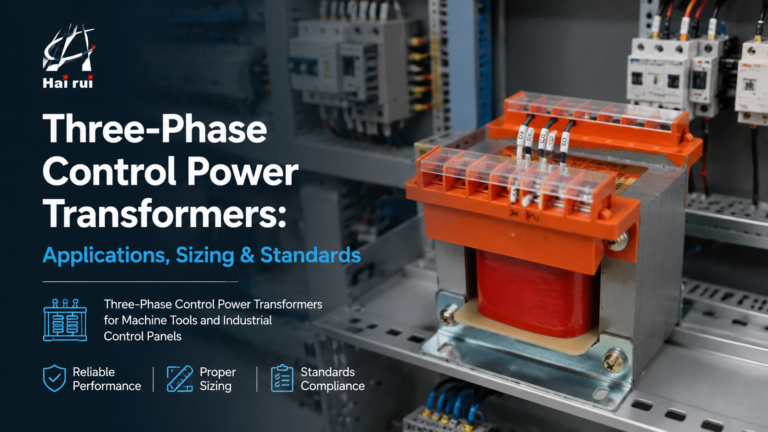
How three-phase control power transformers work, how to size them for machine tool and control-panel loads, and the delta/wye, standards and protection choices that matter in the field.