Oil Immersed Transformer How to Select, Connect & Buy Right
Published: Author: Lisa
Let me be straightforward with you — if you’ve ever stood in front of a procurement spec sheet wondering “which oil immersed transformer do I actually need?”, you’re not alone. Whether you’re equipping a new substation, upgrading an industrial facility, or sourcing equipment for a utility grid project, picking the wrong transformer is an expensive mistake nobody wants to make twice.
I’ve spent years in the electrical equipment industry, and if there’s one product that comes up in nearly every B2B power conversation, it’s the oil immersed power transformer. It’s reliable, cost-effective at high capacities, and — when properly selected — practically runs itself for decades. So let’s cut through the noise and talk real specs, real selection logic, and real connection know-how.
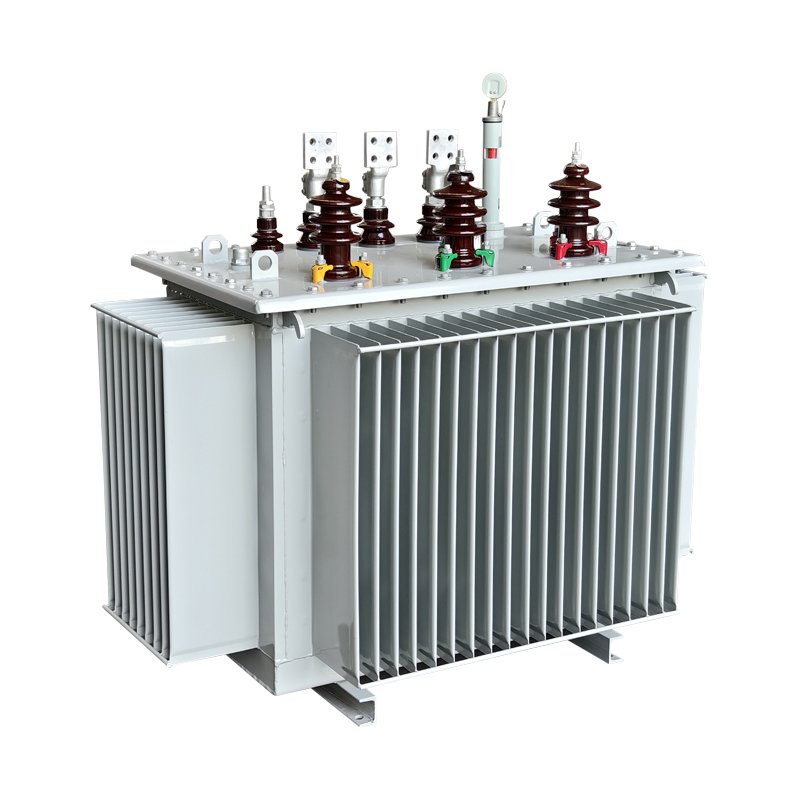
Oil-immersed Transformer Equipment
What Is Oil Immersed Transformer?
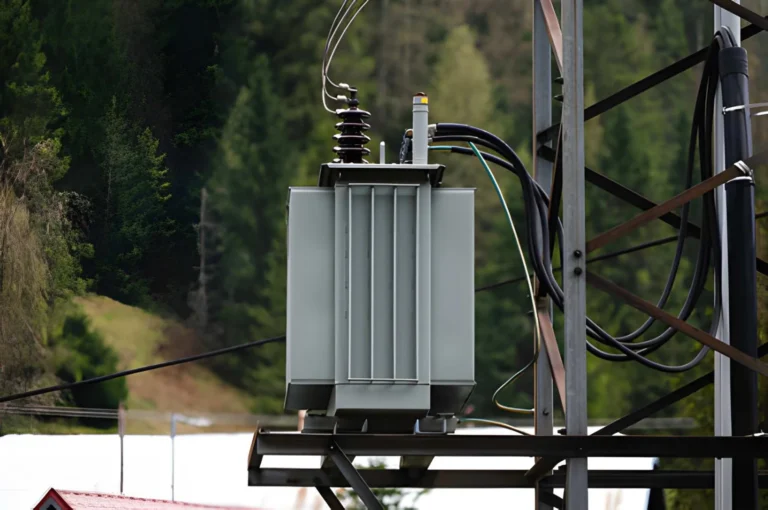
An oil immersed transformer is a type of power transformer where the core and windings are fully submerged in insulating mineral oil. That oil does two critical jobs simultaneously: it insulates the internal components from electrical faults and dissipates heat generated during operation.
More than 80% of power transformers currently operating on the grid use natural oil circulation cooling — and that’s no coincidence. The physics are elegant: hot oil rises, cooler oil sinks, and heat is carried away through external radiators or cooling fins without any pump or fan required on smaller units.
Feature
Oil Immersed Transformer
Dry-Type Transformer
Insulation Medium
Mineral oil
Air / Cast resin
Voltage Range
Up to 550 kV
Typically below 35 kV
Capacity Range
Up to 800 MVA
Small to medium load
Cooling Method
ONAN / ONAF / OFAF
AN / AF
Best Use Case
Outdoor substations, heavy industry
Indoor, confined spaces
Initial Cost
Lower at large capacity
Higher upfront
Maintenance
Regular oil inspection needed
Minimal
For large-scale industrial power distribution, utility substations, mining operations, and outdoor grid infrastructure, the oil immersed distribution transformer is almost always the preferred choice — both for performance and total cost of ownership.
Why Procurement Teams Keep Coming Back to Oil Immersed Units
Here’s the thing: I’ve seen buyers get dazzled by dry type transformers because they sound “cleaner.” And sure, for indoor commercial buildings, that might make sense. But for serious industrial procurement, oil immersed transformers win on three fronts:
First, thermal efficiency. Oil has a far superior heat capacity compared to air. That’s why oil-cooled units handle heavy continuous loads and high inrush current events — think motor starts, arc furnaces, welding equipment — with far more composure.
Second, voltage flexibility. Need to step down 110 kV to 10 kV for a steel mill? No dry-type unit is doing that for you. Oil immersed high voltage transformers comfortably operate well into the transmission voltage range.
Third, price-to-performance ratio. For capacities above 1,000 kVA, oil immersed units consistently offer lower capital expenditure. That matters when you’re ordering ten units for a substation project.
Procurement Factor
Oil Immersed Advantage
Large capacity ≥ 1,000 kVA
Lower unit price vs. dry-type
Outdoor installation
IP-rated tanks withstand weather
High ambient temperature zones
Superior oil cooling handles heat
Long operational lifespan
25–35 years with proper maintenance
Grid integration compliance
IEC / ANSI standards readily met
If you’re evaluating oil immersed transformer price per kVA or comparing vendors on efficiency ratings, keep reading — I’m about to get specific.
How to Select the Right Oil Immersed Transformer
This is where most buyers either nail it or live to regret it. Selection is not just about grabbing the closest kVA rating. Let me walk you through the core decision framework I actually use.
Step 1: Calculate your actual load — then add margin.
Never size a transformer to match your peak load exactly. Select a capacity rating that is 10–20% higher than your maximum estimated load demand to prevent overheating and derating over time. If your factory draws 800 kVA at peak, you’re looking at a 1,000 kVA oil immersed transformer minimum.
Step 2: Define your voltage requirements precisely.
Primary voltage (the supply side) and secondary voltage (the load side) must match your grid and equipment specs exactly. Common configurations include 11kV/0.4kV for distribution, 33kV/11kV for sub-transmission, and higher for industrial substations. The oil immersed transformer 33kV class is one of our most frequently specified models for medium-voltage industrial projects.
Step 3: Choose the right cooling class.
ONAN (Oil Natural, Air Natural): Passive cooling, no fans or pumps. Ideal for most standard installations.
ONAF (Oil Natural, Air Forced): Fans added to radiators for extra capacity.
OFAF (Oil Forced, Air Forced): Pump + fans for maximum heat removal on large power transformers.
Step 4: Confirm your installation environment.
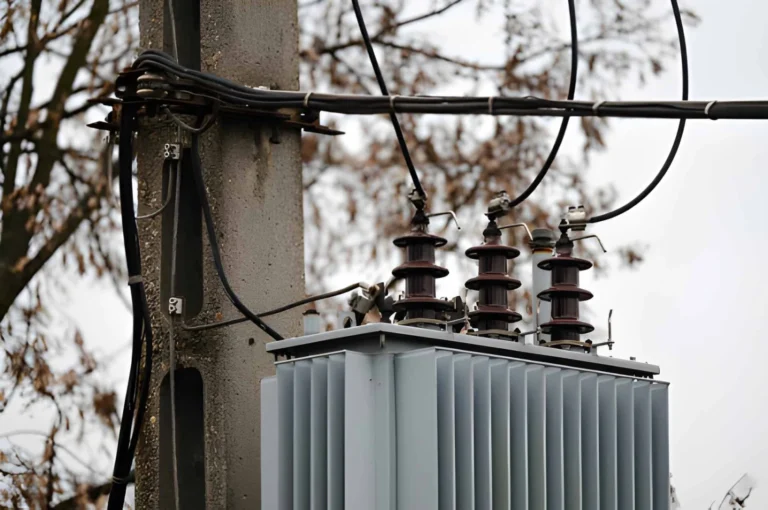
Outdoor pole-mounted transformers need different IP ratings and sealing specs than indoor substation units. Corrosive coastal environments, high altitude sites, or extreme cold all affect your specification requirements.
Step 5: Check applicable standards.
Always verify compliance with IEC 60076 (the international standard for power transformers) or local equivalent. This is non-negotiable for grid-connected equipment.
Application
Recommended Capacity
Voltage Class
Cooling Type
Commercial complex
315–630 kVA
11kV/0.4kV
ONAN
Light industrial facility
630–1,250 kVA
11kV/0.4kV
ONAN/ONAF
Heavy industry / steel
2,000–10,000 kVA
33kV/11kV
ONAF/OFAF
Utility substation
10,000 kVA–100 MVA
110kV+
OFAF
Renewable energy (wind/solar)
1,000–5,000 kVA
Site-specific
ONAN/ONAF
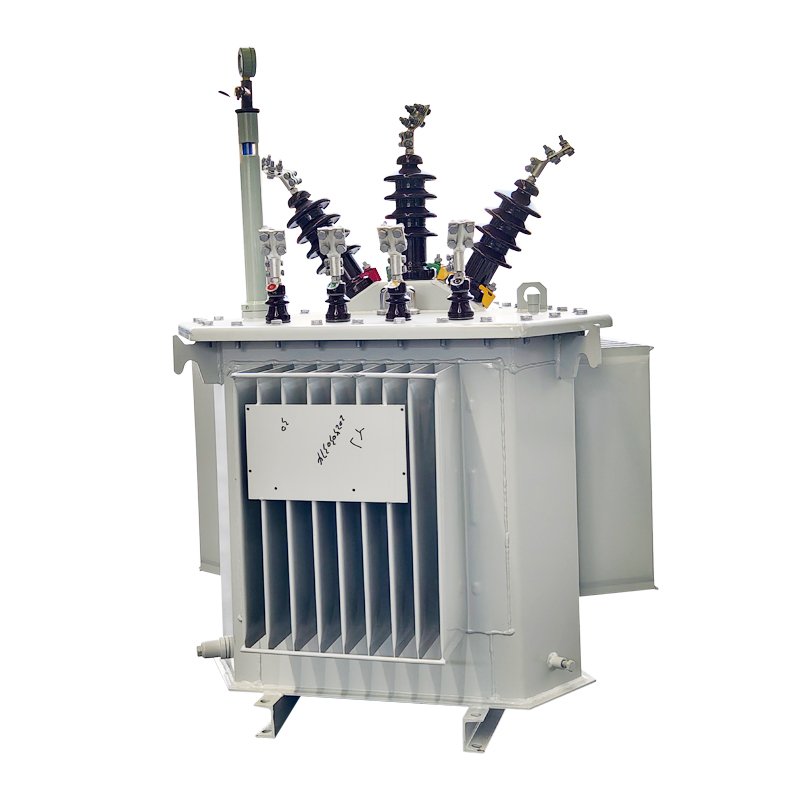
Oil-fired Delta Transformer
How to Connect an Oil Immersed Transformer Correctly
Let’s talk connection — because this is where field teams sometimes cut corners, and the consequences can be catastrophic. Here’s what a proper installation involves:
The primary HV terminals connect to your incoming supply through properly rated HV cables, surge arresters, and disconnecting switches. Never skip the Buchholz relay connection on the conservator — it’s your first early warning against internal faults and gas accumulation inside the tank.
On the secondary LV terminals, connect through a main LV circuit breaker with appropriate fault current rating. Earthing of the neutral point depends on your system: solid earthing, resistance earthing, or isolated neutral — match this to your local grid code.
Key connections checklist for oil immersed transformer installation:
Verify oil level in conservator tank before energizing
Perform insulation resistance testing (megger test) on HV and LV windings
Check tap changer position — ensure it matches the specified voltage ratio
Connect cooling radiator valves (open them — this sounds obvious but is frequently missed)
Earth the tank body to the substation ground grid
Commission protection relays: Buchholz, over-temperature, differential protection for large units
Conduct a no-load energization test before connecting load
If you’re unsure which protection configuration your unit requires, reach out to our technical team — we’ll specify the exact relay settings for your application.
Connection Point
Component Required
Why It Matters
HV Terminals
Surge arrester + HV cable terminations
Protects against lightning/switching surges
LV Terminals
Main LV breaker (ACB/MCB)
Fault isolation and load control
Neutral Point
Earthing electrode / NGR
System stability and fault safety
Tank Body
Ground cable to earth grid
Personnel safety and fault current path
Buchholz Relay
Gas/oil relay with alarm circuit
Early fault detection
Cooling System
Radiator valves open, fans wired
Prevents overheating under load
Which Model Should You Choose? Hairui Oil Immersed Transformer Lineup
At Hairui Electric, our oil immersed transformer equipment range is designed specifically to meet the demands of industrial purchasers, EPC contractors, and utility grid operators. Here’s a practical breakdown of what we offer and where each model shines.
Our S11 series oil immersed distribution transformer is the workhorse of the range — available from 30 kVA to 2,500 kVA, with primary voltages up to 35 kV. The S11 features amorphous alloy or silicon steel cores, ultra-low no-load losses, and complies fully with IEC 60076. It’s the unit most commonly specified for commercial substations, industrial parks, and rural distribution networks.
For projects demanding higher efficiency and reduced lifecycle operating costs, our S13 series delivers significantly lower load losses compared to S11 — making it the preferred choice when energy cost optimization is part of the procurement criteria. The S13 oil immersed transformer is becoming the go-to spec for ESG-conscious industrial buyers.
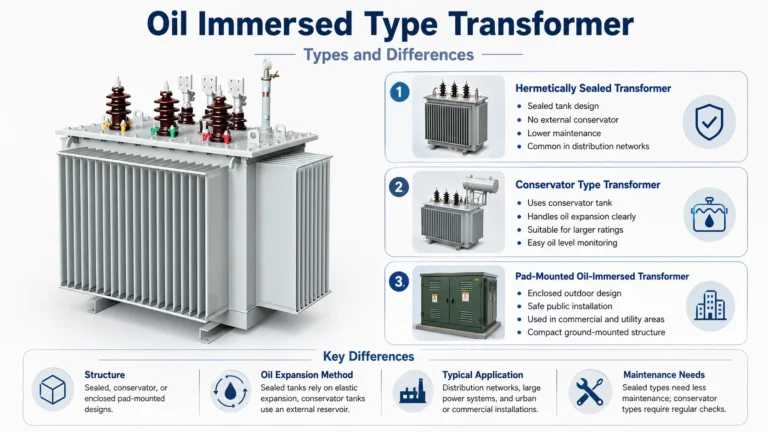
Need something built for extreme conditions? Our explosion-proof and hermetically sealed oil immersed transformer variants are designed for mining, petrochemical, and offshore installations where standard open-conservator designs aren’t appropriate.
Model
Capacity Range
Voltage Class
Core Loss Level
Best Application
S11 Series
30–2,500 kVA
Up to 35 kV
Standard
Distribution, commercial
S13 Series
100–2,500 kVA
Up to 35 kV
Low-loss
Energy-sensitive industrial
SZ11 (OLTC)
500–40,000 kVA
Up to 110 kV
Standard
Utility, grid-regulation
Hermetic Sealed
50–1,000 kVA
Up to 35 kV
Standard
Mining, hazardous zones
Ready to match the right model to your project? Send us your load data, site conditions, and voltage requirements — our engineering team can return a full specification recommendation within 24 hours.
CONTACT US!
Oil Immersed Transformer Efficiency The Numbers That Matter
Efficiency isn’t a marketing buzzword here — it directly affects your client’s electricity bill for the next 25 years. Oil immersed transformers typically achieve efficiency in the 94–96% range, which for large-capacity units running 24/7 means the difference between tens of thousands in annual savings versus losses.
The two loss components to compare between models:
No-load losses (iron losses): Occur continuously whenever the transformer is energized, regardless of load. S13 and amorphous-core variants dramatically reduce this figure.
Load losses (copper losses): Proportional to current squared. Proper capacity sizing (avoiding chronic overloading) keeps these in check.
When comparing oil immersed transformer efficiency ratings across manufacturers, always request the factory test report showing both no-load and full-load loss figures at rated voltage — not just the nameplate efficiency claim.
Loss Type
S11 Series (Typical)
S13 Series (Typical)
Impact
No-load loss
~1.0 kW per 100 kVA
~0.7 kW per 100 kVA
Always running cost
Load loss
~3.2 kW per 100 kVA
~2.5 kW per 100 kVA
Load-dependent
Overall efficiency
~94–95%
~96%+
Lifecycle energy savings
Oil immersed transformers have been the backbone of global power infrastructure for over a century — and for very good reason. They scale, they last, and when you select and install them correctly, they’re genuinely one of the most reliable pieces of electrical equipment you’ll ever procure. The key is in the details: right capacity, right cooling class, right voltage spec, right manufacturer.
If you’re evaluating oil immersed transformer suppliers for your next substation, industrial upgrade, or grid expansion project, Hairui Electric brings engineering depth, IEC-compliant manufacturing, and procurement-friendly lead times to every order. Don’t guess — get the spec right from day one.
FAQ
What is the lifespan of an oil immersed transformer?
With proper oil maintenance, routine insulation testing, and avoiding chronic overloading, a well-manufactured oil immersed transformer can reliably operate for 25 to 35 years. The oil itself should be tested annually and replaced or filtered as needed — this is the single most impactful maintenance action you can take.
How often should transformer oil be changed?
For most installations, transformer oil should be tested annually via dielectric strength testing and dissolved gas analysis (DGA). Full oil replacement is typically not needed until dielectric strength drops below 30 kV/2.5mm (per IEC 60156) or the DGA indicates fault gases. Many units go 10–15 years before needing a full oil change.
Can an oil immersed transformer be used indoors?
Yes, but with important caveats. Indoor installation requires an oil containment pit beneath the unit to capture any spill, adequate fire suppression, and proper ventilation. For indoor high-risk environments, a hermetically sealed oil immersed transformer without conservator is often a safer choice.
What is the difference between ONAN and ONAF cooling?
ONAN (Oil Natural, Air Natural) uses passive convection — no external power required. ONAF adds forced-air fans to the radiators, boosting capacity by roughly 25–33% without changing the tank size. Many modern units ship with fans fitted but switched off, only activating when oil temperature exceeds a set threshold — giving you ONAN efficiency at low load and ONAF headroom when needed
How do I read an oil immersed transformer nameplate?
The nameplate always includes: rated power (kVA/MVA), primary and secondary voltage, frequency (50/60 Hz), cooling class (ONAN/ONAF etc.), impedance voltage percentage, weight (total and oil weight separately), and applicable standard. The oil immersed transformer impedance voltage — typically 4–6% for distribution units — is critical for fault level calculations in your protection design.
What certifications should I require from the manufacturer?
At minimum: IEC 60076 type test reports, factory acceptance test (FAT) certificates, and ISO 9001 quality management certification. For export projects, additional certifications such as CE, KEMA, or local utility approval may be required depending on the destination country.
How do I compare oil immersed transformer quotes from different suppliers?
Don’t compare on price alone. Request itemized datasheets showing no-load loss, load loss, impedance voltage, and guaranteed efficiency. Factor in delivery lead time, warranty terms (typically 2 years), availability of spare parts, and the supplier’s track record on similar-scale projects.
If you are evaluating oil immersed transformers for a substation, industrial plant, or renewable energy project, the variety of available types can make selection feel complicated. The distinctions are not only about kVA and voltage. They extend to cooling class, tank construction, phase configuration, insulating fluid chemistry, winding material, and the specific duty the transformer […]
An oil immersed transformer is the workhorse of medium- and high-voltage power distribution — the unit you find in substations, industrial plants, and renewable energy projects where cooling capacity, overload margin, and long service life matter more than a compact footprint. Most specification mistakes do not start with the brand or the price. They start […]
At its simplest, an oil immersed transformer (also called an oil filled transformer or oil type transformer) is a static electrical device that transfers energy between circuits through electromagnetic induction, with its active parts fully submerged in insulating oil.