When you’re building or buying an industrial control panel, a “control transformer VA rating” looks like a small line item—until it becomes the root cause of nuisance trips, chattering contactors, dim pilot lights, or PLC inputs that behave “haunted.” If you’ve ever heard an engineer say, “The control circuit is fine… it just drops out when the coil pulls in,” you already know why VA rating matters.
This article explains what Control Transformer VA Rating means in practical terms, how it relates to sealed (holding) VA and inrush VA, and how to size it in a way that procurement teams can quote confidently and engineers can sign off quickly. I’ll also cover what to ask suppliers, wholesalers, and manufacturers, where prices typically move, and which customization options actually reduce risk instead of just increasing lead time.
What is a Control Transformer VA Rating?
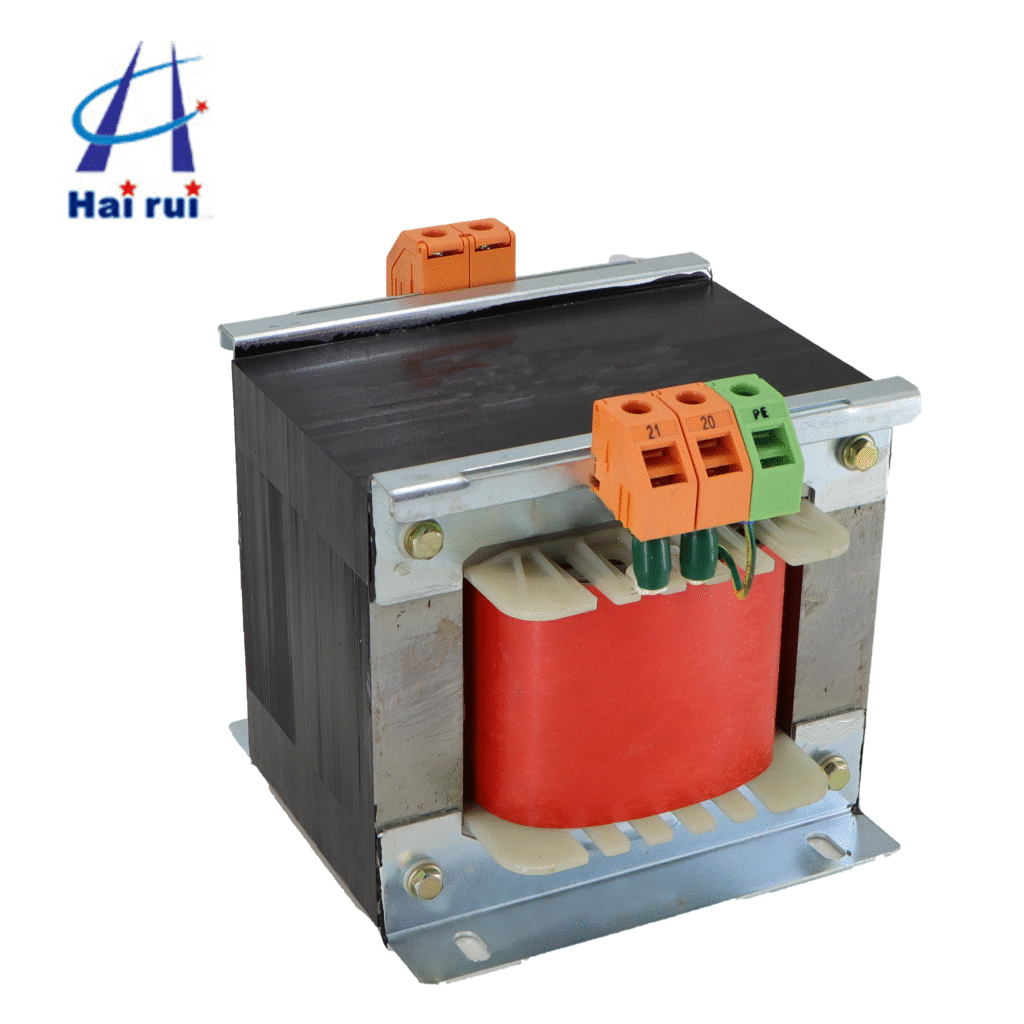
A BK Series Control Transformer control transformer’s VA rating tells you how much apparent power the transformer can deliver to the control circuit without overheating under its intended operating conditions. For a single-phase secondary, the basic relationship is:
VA = Volts × Amps
It’s called VA (volt-ampere), not watts, because many control loads—especially coils and solenoids—are not purely resistive. Their current and voltage are not perfectly in phase, so “watts” alone doesn’t capture how hard the transformer is actually working.
For control circuits, you’ll see two closely related ideas:
Nominal (continuous) VA: what the transformer can supply continuously.
Inrush VA capability: what it can support briefly when coils energize, while keeping the secondary voltage from sagging too far.
Many selection guides size control power transformers by ensuring the transformer can handle inrush VA while maintaining a minimum secondary voltage percentage such as 85%, 90%, or 95% under inrush conditions. Rockwell’s control circuit transformer literature describes this approach and uses the 85% / 90% / 95% secondary-voltage columns to select a nominal VA rating based on inrush demand.
Quick reference table: VA rating in control-panel language
Term you’ll see on datasheets
What it really means in a panel
Why buyers should care
VA (nominal/continuous)
Continuous capacity for steady loads (lights, PLC power draw, coil holding)
Underbuying risks heat, short life
Inrush VA
Short-duration “pull-in” demand for coils/solenoids
Why VA Rating is a High-Impact Spec in Real Control Circuits
In B2B projects, most VA-rating mistakes happen because the control circuit looks “small” compared to the motor power circuit. But the control side has two unique stressors:
Multiple loads switching at once (start command energizes coils + pilot lights + timers).
High inrush from electromagnetic coils (contactor pull-in can briefly demand far more VA than it needs to hold).
If the transformer can’t supply the inrush without a major voltage dip, downstream devices may not pull in cleanly. Some guides explicitly warn that secondary voltage must not fall too low during inrush; for example, one industry reference citing NEMA ST-1 notes the output should not fall below 85% of nominal during inrush.
Symptoms table: what “undersized VA” looks like
Symptom in the field
Common electrical cause
Typical fix
Contactor chatters or drops out on start
Secondary voltage dips during coil inrush
Increase VA rating or improve regulation
Pilot lights dim when a relay energizes
Transformer near limit; voltage sag
Separate loads or upsize transformer
PLC input glitches at coil pull-in
Transient drop/noise coupling
Up-size, add suppression, improve wiring
Transformer runs hot
Continuous VA exceeds nominal
Recalculate sealed VA; upsize
One practical detail procurement teams appreciate: a small VA increase can prevent expensive commissioning delays. The delta between a 50 VA and 75 VA transformer is often minor compared to a site visit or a production stoppage.
Sealed VA vs Inrush VA: The Part People Miss
For many BK Series Control Transformer selections, the “VA rating” printed on the nameplate is a continuous nominal VA. However, coils behave differently at energization versus steady-state:
Inrush (pull-in): brief, higher VA requirement when the magnetic circuit closes.
Sealed/holding: lower VA once the device is pulled in and held.
Eaton’s control power transformer application paper explains that some loads (relay coils, contactor coils) require a temporary spike in power at energization and then much less to hold. It also describes an approach where inrush VA is the critical rating used to size CPTs, and provides a sizing formula for inrush VA calculation in their method.
Meanwhile, EEPower provides a clear example showing why a transformer that meets continuous VA might still fail the inrush requirement; in their example, the correct selection is driven by the inrush VA capacity, not just the sealed VA.
Comparison table: sealed vs inrush in purchasing terms
Load type
Sealed VA behavior
Inrush VA behavior
Buying implication
Contactor / relay coil
Low after pull-in
High for a short time
Must size for inrush stability
Solenoid valve
Moderate holding
Often high pull-in
Consider simultaneous operations
Pilot lights
Constant
Same at start and run
Adds to both totals if switched together
PLC / control electronics
Constant
Usually constant
Drives continuous VA more than inrush
How to Size a Control Transformer VA Rating (Engineer-Approved, Buyer-Friendly)
A sizing workflow that works well for OEMs and panel shops is:
List all secondary loads (coils, relays, solenoids, indicators, electronics).
Identify which loads energize simultaneously at the worst case.
Calculate:
Total sealed VA for the steady-state simultaneous loads.
Total inrush VA for the simultaneous event (often dominated by the largest or combined coil pull-in).
Use the manufacturer’s selection chart (85/90/95% regulation columns) to ensure the transformer can supply the inrush VA while maintaining acceptable secondary voltage.
Rockwell’s method explicitly uses inrush VA columns and then confirms sealed VA does not exceed the nominal VA rating selected.
Add a practical margin for future devices and tolerances.
Table: the information your supplier will ask for (prepare it once, quote faster)
Data point
Example
Why it matters for VA selection
Primary voltage
480Vac / 60Hz
Correct primary winding
Secondary voltage
120Vac or 24Vac
Matches control devices
Load list (devices + qty)
3 contactors, 6 pilot lights
Sealed + inrush totals
Simultaneity
“All energize on start”
Worst-case inrush
Environment
High ambient, enclosure
Temperature derating
Standards
UL/CSA marking needs
Compliance + acceptance
If you can provide a simple load list, most manufacturers can recommend a transformer family and VA rating quickly. If you’re sourcing through wholesalers or multi-brand suppliers, bringing this table to the RFQ reduces back-and-forth.
Worked Example: Picking VA Rating for a Typical Motor Starter Control Circuit
Let’s use a simplified example similar to the industry examples that show why inrush matters. Suppose you have:
One motor starter coil (high inrush, lower holding)
One indicating light turned on at the same time
EEPower illustrates a case where the inrush VA requirement is the sum of the starter inrush VA plus the indicating light VA, and then checks operating VA versus sealed rating; the outcome is that a higher nominal VA transformer is selected because the smaller one cannot support the inrush.
Example load table (illustrative structure you can copy into an RFQ)
Device
Qty
Inrush VA (each)
Sealed VA (each)
Notes
Contactor / starter coil
1
(from device datasheet)
(from datasheet)
Dominates inrush
Pilot light
1
same as sealed
same as sealed
Adds to both totals
Timer relay
1
(if applicable)
(if applicable)
Often modest
PLC input / power module
1
typically constant
typically constant
Continuous load
How to use it: Ask your device vendors (or your panel engineer) for coil inrush and sealed VA values, then compute totals for the worst simultaneous event. Next, select a transformer whose inrush VA capacity meets the requirement at your desired regulation column (85/90/95%), and confirm sealed VA is below nominal continuous VA. Rockwell’s guide describes this “choose inrush, then verify sealed” sequence explicitly.
If you want a fast procurement-friendly shortcut: oversizing modestly is usually cheaper than troubleshooting—but it should still be anchored to a real load list, not guesswork.
Procurement Guidance: Comparing Suppliers, Manufacturers, and Customization Options
Once you know your target secondary voltage and VA rating, sourcing becomes a commercial decision: lead time, certifications, mounting format, and whether you need customization.
For certain starter families, OEM documentation may even suggest typical transformer capacities. Schneider Electric publishes a reference table for NEMA Type S starters showing standard transformer capacities like 50 VA, 100 VA, and 200 VA options depending on starter size/type. This kind of table is useful when procurement needs a “sanity check” before sending an RFQ.
Table: what to specify in your RFQ to reduce supplier ambiguity
Spec line
Recommended detail
Why it reduces risk
VA rating target
“Nominal VA ___; sized for inrush event ___”
Prevents undersized substitution
Primary/secondary
e.g., 480→120, 400→24
Avoids wrong winding
Frequency
50/60 Hz or 60 Hz
Core design / temperature rise
Mounting
Foot / panel / DIN bracket
Fit in enclosure
Approvals
UL/CSA/CE as required
Site acceptance
Terminations
Screw terminals / leads
Assembly time
Accessories
Fusing, covers, finger-safe
Safety + maintenance
Customization that actually helps (not just “nice to have”)
Customization request
When it’s worth it
Typical business benefit
Dual primary (e.g., 240/480)
Multi-market machines
Reduces SKU complexity
Multiple secondary taps
Voltage trim needs
Better commissioning flexibility
Specified regulation class
Sensitive coils/PLC
Fewer dropouts
Factory-fitted fusing
Standard panel build
Faster assembly, fewer errors
If you’re ready to quote, one efficient approach is: send your load table plus the RFQ spec table to your suppliers or manufacturers. A competent vendor can respond with compliant alternatives, options, and pricing tiers. If you want, you can also include your annual volume so wholesalers can quote better breakpoints.
A simple nudge that often speeds up sourcing: Send your control load list and primary/secondary voltages, and ask the supplier to recommend both the nominal VA and the inrush-supported selection basis. That signals you care about real performance, not just nameplate VA.
Cost and Pricing Drivers: Why VA Rating Changes the Quote
VA rating influences cost primarily through copper, core material, thermal design, and mechanical format. But VA is not the only price driver; certifications, enclosure accessories, and lead-time commitments often move the total more than the VA step itself.
Table: what tends to move prices up (and how to manage it)
Cost driver
Why it increases price
How buyers can optimize
Higher VA
More copper/iron, bigger frame
Standardize on a few VA sizes
Better regulation
Design for lower sag
Use where stability is critical
Approvals (UL/CSA)
Testing + traceability
Specify only what your project needs
Custom taps / special terminals
More engineering + setup
Bundle needs into one custom run
Short lead time
Expediting + capacity
Forecast demand; frame agreements
For B2B procurement, a strong strategy is to keep two qualified sources: a primary manufacturer and a secondary wholesaler channel for spot buys. That balance protects both price and schedule.
Common Mistakes and How to Avoid Them
Control transformers are simple devices, but the failure modes are repetitive. Here are the ones that cost the most time during commissioning.
Table: mistakes that cause field rework
Mistake
Why it happens
Prevent it by…
Using nominal VA only
Inrush not accounted for
Always check inrush capability
Ignoring simultaneous energization
Loads assumed sequential
Model “worst event” explicitly
Forgetting constant loads
PLC/pilot lights add up
Include in sealed VA totals
Choosing too strict/too loose regulation
No voltage-sag target
Align with sensitivity requirements
No margin for expansion
“Just enough” design
Add practical growth headroom
If you’ve inherited an existing panel design and you’re troubleshooting dropouts, one quick diagnostic is to measure secondary voltage at the exact moment coils energize. If it sags heavily, you’re looking at a VA/inrush/regulation issue, not “random noise.”
A control transformer VA rating is not just a catalog checkbox. It’s a reliability lever that determines whether coils pull in cleanly, whether voltage stays stable under inrush, and whether your control panel behaves predictably across real-world tolerances.
If you take only one idea from this guide, make it this: size for the event, not just the steady state. Build a simple load table, identify the worst simultaneous energization moment, and select a transformer that meets both inrush capability and continuous VA—using the manufacturer’s regulation-based charts where available.
FAQ
Is VA the same as watts?
Not exactly. VA is apparent power; watts are real power. In coil-heavy circuits, VA is the safer sizing metric.
Why do coils need high inrush VA?
Pull-in requires a temporary power spike; after sealing, holding power is lower.
What does “85% / 90% / 95% regulation” mean?
It’s a way to express how much the secondary voltage may dip during inrush; selection charts use these columns.
Can I just oversize the transformer?
Moderate oversizing is common, but it should still be based on a load list so you don’t create unnecessary cost or space issues.
Any quick reference for starter transformer sizing?
Some OEM tables provide typical capacities by starter size/type (e.g., Schneider’s reference table for certain NEMA starters).
When you’re sourcing electrical components for industrial systems, you’ll quickly realize that control transformers are not one-size-fits-all. They come in a wide range of types and configurations, each designed to suit different control circuits and operational environments. Whether you’re an engineer, a procurement specialist, or an industrial equipment wholesaler, understanding these variations can make a big difference in performance, reliability, […]
Micron control transformers sit quietly in your control panel, but they decide whether your machinery starts smoothly or fails at the worst possible moment. For OEMs, panel builders, and purchasing managers, choosing the right Micron control transformer is not just a technical decision, it is a reliability and cost decision across the whole life cycle […]
When you wire a 480V to 120V control transformer Wiring correctly, you get stable low‑voltage power for control circuits, PLC I/O, contactor coils, and panel auxiliaries—wired incorrectly, you get nuisance trips, overheated transformers, or even damaged equipment. This guide walks engineers, panel builders, and purchasing teams through how the wiring diagram works, typical 480V primary […]
We use cookies to enhance your browsing experience, serve personalised ads or content, and analyse our traffic. By clicking "Accept All", you consent to our use of cookies.